
See exactly how much room your account gives you
ExploreTrading discipline is the habit of following the same written process on every trade: the same entry criteria, the same risk per trade, the same stop, the same exit rules, whether you feel confident or nervous. It is not about having more willpower than other traders. Disciplined traders build systems that make the right action the easy one, then measure how often they actually follow them.
This guide is part of our trading psychology series. It covers why traders break rules, how to build discipline as a system, how to measure it, and what to do after a rule break.
Quick answer: Trading discipline is the consistent execution of a predefined trading process, including entry criteria, risk per trade, stop placement and exit rules, regardless of emotion or recent results. Discipline is built through written rules, checklists, routines, journal review and external limits, and is measured as the percentage of trades that followed the plan.
Highlights of this article
- Trading discipline means consistency of process, not heroic willpower in the moment
- Traders break rules because of loss aversion, FOMO, boredom, overconfidence after wins and fatigue
- Discipline works best as a system: written rules, a pre-trade checklist, a fixed routine, regular review and hard external limits
- You can measure discipline as a rule adherence rate: trades that followed the plan divided by total trades
- Breaking a rule calls for a fixed recovery protocol, not punishment or a bigger next trade
- Discipline is a professional skill that develops over months and years, not weeks
Funded accounts
Ready to get funded?
Trade up to $200,000 in firm capital with static drawdown, no consistency rule, and payouts within 24 hours. Pass the challenge and keep up to 90% of your profits.
Get funded from $40What does discipline mean in trading?
Discipline in trading means doing what your plan says, every time, even when your emotions argue for something else. A disciplined trader is not someone who never feels fear or greed. It is someone whose actions stay the same whether the last trade won or lost.
That shift changes what you work on. Willpower tends to fail when you are tired, bored or down on the day. Treating discipline as consistency of process means working on the process instead: clearer rules, fewer decisions under pressure, and limits you cannot override on impulse.
| Item | Detail |
|---|---|
| Definition | Consistent execution of a predefined trading plan, regardless of emotion or recent results |
| Rule of thumb | If a rule is not written down, it is not a rule, it is a mood |
| Worked example | 34 of 40 trades followed the plan: 34 / 40 = 85% rule adherence |
| When it matters | After a losing streak, after a big win, near a daily loss limit, during fast news moves |
| Main risk | Small exceptions grow into abandoned risk rules and a deep drawdown |
| Related terms | Trading plan, trading journal, risk management, loss aversion |
Gianluca Pizzituti, Velotrade's co-founder, has spent more than 25 years trading at London banks and building algorithmic strategies. In the video below he argues that trading is a profession: "If you only do it whenever you feel like it, you are treating it as a hobby." Discipline is what turns trading from a hobby into a practice.
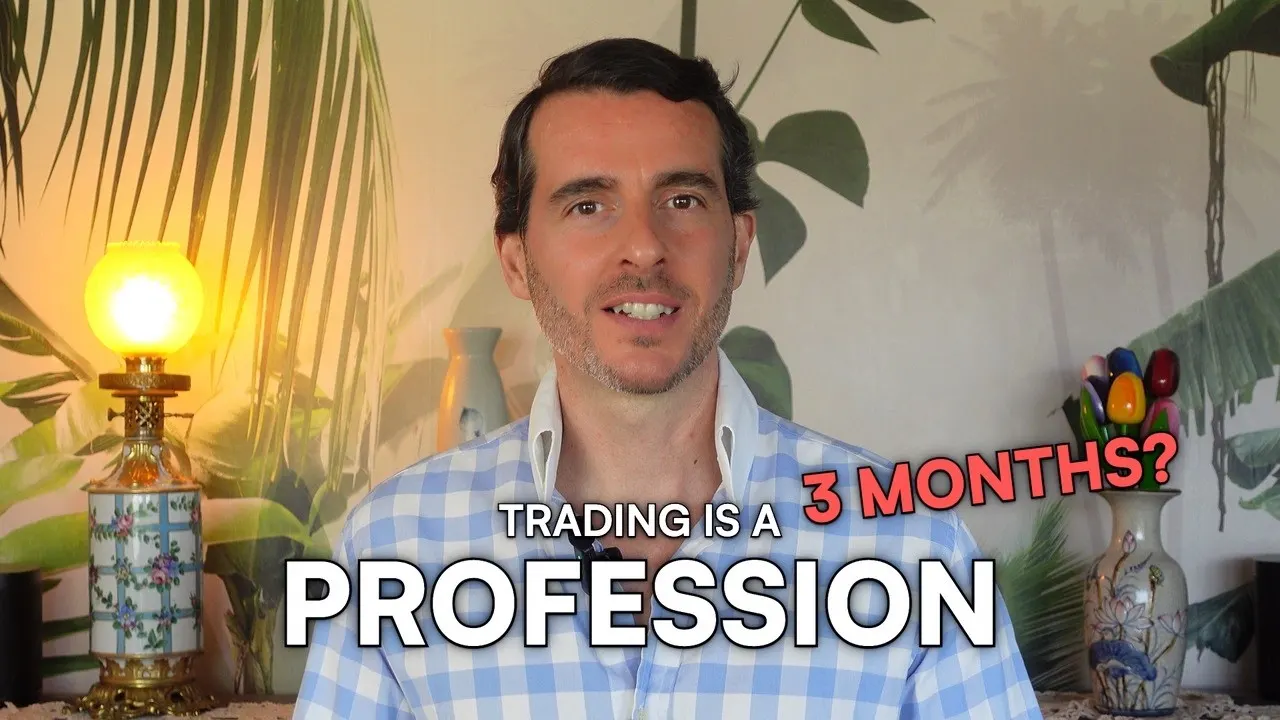 4:20
4:20Read the transcript
If trading is a profession, why do so many people expect to master it in three months?
After my last video about becoming a successful trader, I received several private messages. I am Gianluca Pizzituti, CEO of Velotrade. I've been trading for over 25 years, both institutionally and privately. So I want to expand on one point.
Trading can be a profession. You may do it for a living, or alongside another job. But if you call it a profession, you must approach it professionally, not casually. Not only when you feel like it.
Think about any serious profession. First, you research it. You understand what the work involves and decide whether it is genuinely what you want to pursue. Then you study. You learn the principles, the tools and the language of the profession.
After that, you begin applying what you've learned, slowly, through practice and experience. If you develop enough competence, you can operate consistently. Only then do you become capable of working in an environment that is supposed to be a profession.
Trading is no different. That environment does not need to be a bank or an office. You can create it at home.
How many hours will you commit every day or every week? How much capital can you responsibly allocate? Which markets will you study? Which tools and information sources do you need? When will you review your decisions and performance?
A profession receives a defined part of your time on a regular basis. If you only do it whenever you feel like it, you are treating it as a hobby.
Now, put all of that together. Do you genuinely believe you can go from zero to consistent professional success in three months? It is extremely unlikely. What about six months? That depends on your effort, background and objectives.
But even then, knowledge is not the same as developed skill. You can watch every trading video on YouTube. That does not mean you have built judgement. It doesn't mean you have experienced enough market conditions. And it does not mean you know how you will behave when real money is at stake.
Forget trading for a moment. Think about the profession you already know. How long did it take you to reach your current level? How many mistakes did you make? How many difficult situations did you need to experience before people could rely on your judgement?
It probably took years. So why would trading be the only profession you can master in three months? That is one of the most damaging misconceptions in retail trading.
The problem is not wanting to become successful quickly. Everybody wants that. The problem is believing a shortcut exists and building your expectations around it.
If you expect professional results without accepting the professional learning process, every setback will seem like failure. In reality, it is part of developing the skill.
And there is another important moment in that journey: the moment you realize paper trading is not the same as trading with real money. That deserves a separate video.
So before you call trading your profession, ask yourself whether your routine reflects that ambition. If you want professional results, you must treat trading like a profession long before it pays you like one.
Think about your current profession. How many years did it take you to become genuinely competent? Drop your answer in the comments or send me a message. See you in the next video.
Why do traders break their own rules?
Traders break their rules because the plan was written in a calm state, while decisions are made under pressure. Rules that feel obvious on Sunday feel negotiable after three losses on Tuesday. Behavioural finance research points to a few recurring drivers.
Loss aversion
Daniel Kahneman and Amos Tversky's prospect theory (1979) showed that losses feel stronger than equal gains; their 1992 work estimated the loss aversion coefficient at about 2.25. In trading, it shows up as moving a stop to avoid a loss. Shefrin and Statman (1985) called selling winners too early and holding losers too long the disposition effect. Our guide to loss aversion in trading covers this in depth.
FOMO and boredom
A move running without you creates pressure to enter late, outside your setup. Quiet markets bring boredom and marginal trades taken just to feel productive. Both lead to overtrading, one of the most common ways rules erode, and Barber and Odean (2000) found that the households that traded most earned the lowest net returns.
Overconfidence, fatigue and vague rules
After a good week, traders often raise size or loosen entry criteria, so the next normal losing streak hits a larger position. Other breaks are not emotional at all: the rule was vague ("enter on strength") or the trader was tired. Vague rules invite interpretation, and interpretation under pressure favours whatever feels good.
How do you build trading discipline as a system?
You build trading discipline by replacing in-the-moment decisions with written rules, checklists and limits. Here is a five-part system.
- Write your rules down. Your trading plan should state which markets you trade, which setups qualify, your risk per trade, where stops go, how you exit and when you stop for the day. Every rule should be specific enough that two people would read it the same way.
- Use a pre-trade checklist. Before each order, tick off a short list: Is this one of my setups? Is the stop at a level the plan defines? Is position size calculated from my risk per trade? Is the reward-to-risk at least my minimum? Am I under my daily loss cap? If any answer is no, there is no trade.
- Follow a fixed routine. Prepare at the same time each day, mark levels, check the calendar for scheduled news, then trade only within a set window. A routine reduces the number of decisions you make while emotional.
- Review on a schedule. Read your trading journal weekly. Look for rule breaks, not just profit and loss. One review a week beats a long post-mortem after a bad month.
- Add external limits. Use hard limits you cannot argue with: a maximum daily loss, a maximum number of trades, a platform stop on every position. External limits catch you on the days your internal ones fail.
The position size calculator turns account size, risk percentage and stop distance into a position size, so "a bit bigger" never enters the decision.
Why fixed risk per trade is the core rule
Risk per trade decides how long you survive a bad run. The chart below shows how many losing trades in a row it takes to lose 10% of an account at different risk levels.
At 1% risk per trade it takes 11 consecutive losses to lose 10% of the account; at 5% it takes only 3. Losing streaks of five or more are normal for most strategies, so a trader who quietly raises risk from 1% to 5% "just this once" has removed most of their margin for error. That is why a disciplined plan fixes risk per trade in advance and does not change it based on how the last trade felt. For more on choosing a level, see our guide to risk management in trading.
Payout proof
Fast, real payouts. Traceable on Arbitrum.
- Paid within 24 hours of approval
- Settled on Arbitrum in USDC or USDT
- Look up any transaction on Arbiscan


How do habits and environment support discipline?
Habits and environment make the disciplined choice the default, so you rely less on willpower.
- Reduce screen time. Watching small timeframes all day creates urges to act. Set alerts and step away; as Gianluca often says, not trading is also a trading decision.
- Place orders in advance. Limit orders with attached stops mean the decision is made calmly before the move. Gianluca prefers limit orders for this reason (see market order vs limit order).
- Keep the checklist visible. A printed card by the screen is harder to skip than a file.
- Set a hard stop time. Finish at the same time each day, win or lose.
How do you measure rule adherence?
You measure rule adherence by tagging every trade in your journal as "followed plan" or "broke a rule", then dividing rule-following trades by total trades. This number, your rule adherence rate, tracks discipline directly instead of inferring it from profit.
Worked example (hypothetical): over a month you take 40 trades. You tag 34 as fully following the plan and 6 as rule breaks (two moved stops, three entries outside your setups, one oversized position).
- Rule adherence rate: 34 / 40 = 0.85, or 85%
- Rule breaks: 6 / 40 = 15%
Then compare results. Suppose the 34 rule-following trades netted +4.2R and the 6 rule breaks netted -5.1R (R is the amount risked on one trade). The month was -0.9R overall, but the plan itself was positive: the problem was execution, not the strategy. Record the setup, planned risk, whether the stop moved, which rule broke and your state (tired, rushed, calm) so the pattern becomes visible.
A profitable trade is not the same as a good trade: a rule break that wins still counts as a break, because repeating it will eventually cost you. Aim to raise your adherence rate month by month.
What should you do after breaking a rule?
After breaking a rule, stop, record it, and follow a fixed recovery protocol instead of trying to win the money back. The urge to recover a loss quickly is how one mistake becomes revenge trading and a much larger drawdown.
- Stop trading for the session if the break involved size or a moved stop.
- Log it honestly: what you did, what triggered it, how you felt.
- Keep normal size on the next trade. Never size up to "make it back".
- Find the cause. A vague rule, fatigue, or a missing checklist step?
- Adjust the system. Tighten the rule, add a checklist item or add an external limit.
The chart below shows why stopping early matters. Losses and recoveries are not symmetric.
A 10% loss needs an 11.1% gain to get back to breakeven, but a 30% loss needs 42.9% and a 50% loss needs 100%. Every rule break that deepens a drawdown makes the climb back harder, so the cheapest moment to restore discipline is right after the first mistake.
If trading starts to feel compulsive or affects your wellbeing, consider speaking with a qualified professional.
How does discipline work in a prop firm challenge?
In a prop firm evaluation, the rules partly enforce discipline. Velotrade, a multi-asset prop trading firm offering simulated evaluations, sets two hard limits that act as an external discipline system:
- Daily loss limit: resets at 00:30 UTC and is set from the higher of balance or equity. It is 5% on CLASSIC 2-Step, 4% on CLASSIC 1-Step and 3% on PRO 1-Step.
- Static maximum drawdown: 10%, 7% and 3% respectively, fixed from the starting balance. See static maximum drawdown explained.
There is no time limit, only a minimum trading period per phase, so there is no deadline pressure to force trades. There is no cap on risk per trade either, so your own risk rule still matters. A disciplined approach is to set personal limits tighter than the firm's, for example stopping at half the daily loss limit. Our guide on why traders fail prop challenges shows how rule breaks, not strategies, cause most breaches. You can compare plans on the challenges page.
Can AI help with trading discipline?
AI can help with trading discipline by analysing your journal for patterns, such as which times or setups produce most rule breaks. It can also help test rules on historical data, as covered in our guide to backtesting trading strategies and our overview of AI trading strategies.
AI does not remove risk and cannot follow your plan if you override it. Respecting a stop, keeping size fixed and stopping for the day still need human judgement.
Discipline as a professional skill
Trading discipline is a skill developed over time, not a trait you either have or lack. In his video, Gianluca notes that "knowledge is not the same as developed skill": reading about discipline is easy, but behaving consistently through a losing streak only comes from practice and review.
Be realistic: broker disclosures and academic studies consistently find that most retail day traders lose money. Practising on a paper trading account or a simulated evaluation lets you build the routine before larger stakes are involved. As Gianluca puts it, "you must treat trading like a profession long before it pays you like one." For the broader path, see how to become a trader.
Sources
- Kahneman and Tversky, "Prospect Theory: An Analysis of Decision under Risk", Econometrica (1979): prospect theory: losses feel stronger than equal gains.
- Tversky and Kahneman, "Advances in prospect theory: Cumulative representation of uncertainty" (1992): loss aversion coefficient of about 2.25.
- Shefrin and Statman, "The Disposition to Sell Winners Too Early and Ride Losers Too Long" (1985): disposition effect: selling winners early, holding losers.
- Barber and Odean, "Trading Is Hazardous to Your Wealth", Journal of Finance (2000): households that trade most earn the lowest net returns.
Frequently Asked Questions
About the author

Gianluca Pizzituti
Chief Executive Officer
Formerly on the derivatives desk at Dresdner Kleinwort in London, then founded and ran a proprietary HFT firm in FX and equity indices out of Singapore.
View author page