
See exactly how much room your account gives you
ExploreRevenge trading is taking new trades to win back a loss, driven by frustration rather than by your strategy. The trades usually come faster, with bigger size and weaker setups than your plan allows, so a normal losing day turns into a damaging one. It is one of the most common and most expensive patterns in trading psychology, and it is fixable with rules you set before the session starts.
Quick answer: Revenge trading is the habit of placing impulsive trades immediately after a loss in order to win the money back. Revenge trades typically use larger position sizes and lower-quality setups than the trader's plan allows, which turns an ordinary losing streak into a large drawdown. Fixed daily loss limits and cool-down rules are the standard defence.
Highlights of this article
- Revenge trading follows a predictable sequence: loss, anger, the need to win it back, bigger size, then worse setups
- Doubling size after each loss turns four losing trades from a 3% dip into a 15% drawdown on a 10,000 USD account
- The deeper the drawdown, the larger the gain needed to recover: a 15% loss needs a 17.6% gain to get back to even
- A written stop system (maximum losses per day, a cool-down timer, size reset rules and a walk-away rule) breaks the cycle
- In a prop evaluation, the daily loss limit works as a circuit breaker that stops a revenge spiral before it reaches the whole account
Funded accounts
Ready to get funded?
Trade up to $200,000 in firm capital with static drawdown, no consistency rule, and payouts within 24 hours. Pass the challenge and keep up to 90% of your profits.
Get funded from $40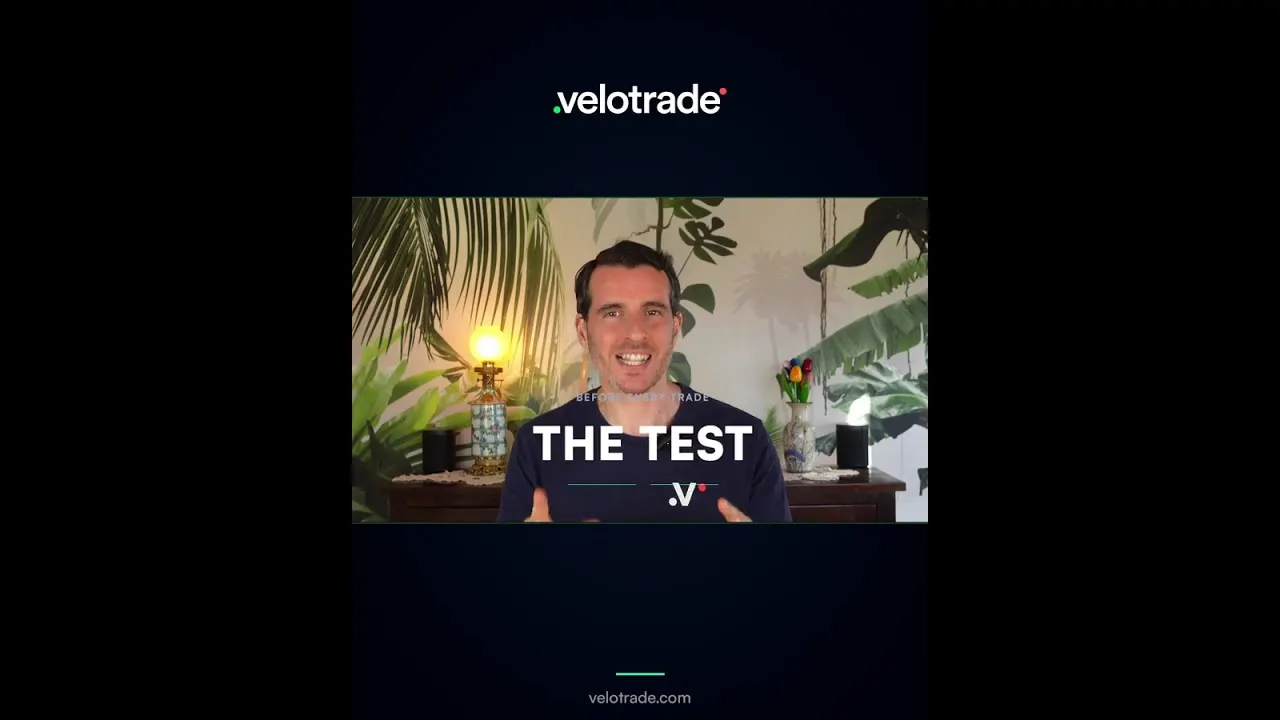 2:24
2:24Read the transcript
The trade that made you money might be the one that ruins you. Stay with me on this.
I am Gianluca Pizzituti, CEO of Velotrade. I've been trading for over 25 years, and I want to talk about the most dangerous winning trade.
Picture this. Your strategy is clear. Every rule you follow is screaming the same thing: do not enter. There is no signal. There is no setup. Nothing lines up.
And you enter anyway. Call it a feeling, call it boredom, call it whatever you like. And then it works. The trade runs in your favor and you make money. Feels great, doesn't it?
It shouldn't. Because that win just taught you the worst lesson of your entire career.
Here is what most traders never understand. A profitable trade and a good trade are two completely different things. When you make money on a trade you should never have taken, your brain does not file it under luck. It files it under skill.
You start believing you are smarter than your own system. You start thinking the rules are for everybody else. And that belief is poison.
Because the next time your gut speaks up, you listen. And the time after that. Until one day the market comes to collect. And when it collects, it takes back everything those reckless trades gave you, and then it takes more.
So here is the test I apply to every single trade. If someone sat me down and asked me why I entered, and I could not give a clear answer, something is fundamentally wrong.
And notice I said nothing about whether it won or lost. That part does not matter. If you cannot explain why you entered, it was a bad trade. Full stop.
Because a win you cannot explain is a win you cannot repeat. And trading is nothing but repetition. If you cannot do it again tomorrow for the same reason, you do not have a strategy. You have a coin flip that happened to land your way.
So the next time you break your own rules and get rewarded for it, do not celebrate. Worry. That is the market setting a trap, and you just walked straight into it.
Gianluca Pizzituti, Velotrade's co-founder, has spent more than 25 years trading at London banks and building algorithmic strategies. In this short video he explains why the most dangerous trade can be a winning one: "A profitable trade and a good trade are two completely different things." Revenge trading is the mirror image of that lesson, because the trader stops asking whether a trade is good and only asks whether it will get the money back.
Key facts about revenge trading
| Item | Detail |
|---|---|
| Definition | Impulsive trading after a loss, aimed at recovering that loss quickly rather than following a plan |
| Rule of thumb | After a set number of losses in a day (often 2 or 3), stop trading for the session |
| Worked example | Four losses at 1%, 2%, 4% and 8% of a 10,000 USD account cost 1,500 USD (minus 15%) |
| When it matters | Right after a large loss, a stop-out that reverses, or a streak of small losses |
| Main risk | Position size grows while setup quality falls, so drawdowns accelerate |
| Related terms | Loss aversion, tilt, overtrading, FOMO trading, martingale sizing |
What is revenge trading?
Revenge trading is trading to settle a score with the market after a loss, instead of trading because your strategy gives a signal. The market does not know about your last trade, so every revenge trade is a new bet placed with worse judgement. Taking the next valid setup at normal size after a loss is not revenge trading. The difference is the motive (getting even) and what it changes: more trades, larger size, looser entries, and stops that get moved or removed.
Why does revenge trading happen?
Revenge trading happens because losses hurt more than equal gains feel good, and the mind looks for the fastest way to end that pain. Daniel Kahneman and Amos Tversky described this in prospect theory (1979): people are loss averse, and in their 1992 paper they estimated that losses weigh about 2.25 times as heavily as gains of the same size. Our guide to loss aversion explains the research in detail.
Prospect theory also suggests that people take more risk when they are below their reference point, usually the balance at the start of the day. Being down feels like a state that must be fixed, so a bigger bet to get back to zero starts to look reasonable.
The emotional sequence
Most revenge trading follows the same five steps:
- Loss. A trade hits its stop, or worse, a stop is hit and price then moves in the original direction.
- Anger. The loss feels unfair or personal. Frustration replaces analysis.
- The need to win it back. The goal of the session quietly changes from "trade my plan well" to "get back to even today".
- Bigger size. To recover faster, the next trade is larger. Often it is double the last one.
- Worse setups. Wanting action now, the trader loosens entry criteria and trades mid-range, against the trend, or with no clear stop.
Each new loss restarts the sequence with more emotion and less capital, which makes it a spiral rather than a single mistake.
Why a lucky revenge trade is the worst outcome
Sometimes a revenge trade works, which reinforces the habit. As Pizzituti explains in the video, a win you could not justify in advance gets filed under skill rather than luck, until "the market comes to collect".
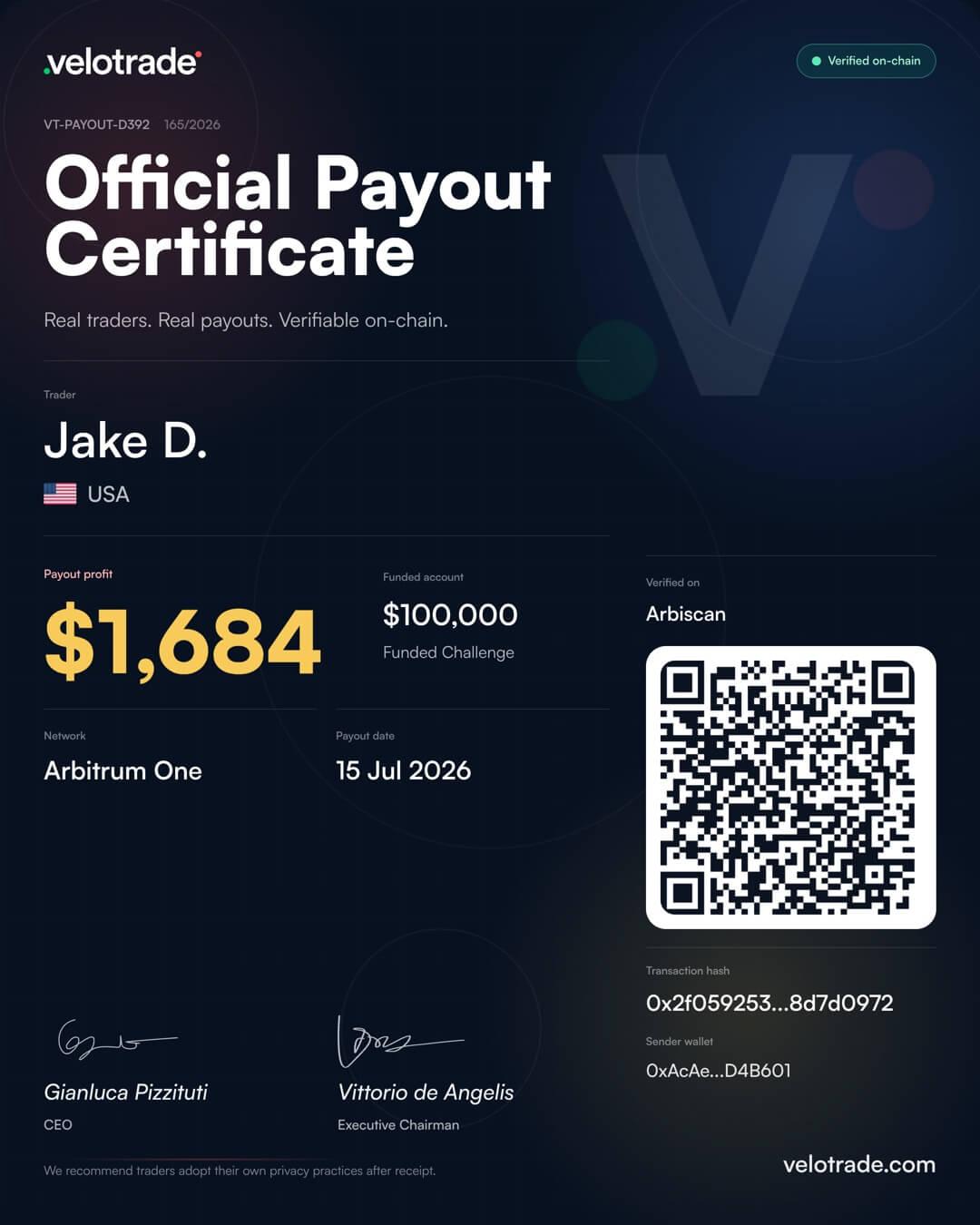
Payout proof
Fast, real payouts. Traceable on Arbitrum.
- Paid within 24 hours of approval
- Settled on Arbitrum in USDC or USDT
- Look up any transaction on Arbiscan

How much does revenge trading cost? The arithmetic
The chart below compares two traders who start the day with 10,000 USD and take the same four losing trades. The only difference is how they size and when they stop.
The disciplined trader risks 1% of the current balance per trade and stops after three losses:
- Trade 1: 1% of 10,000 = 100 USD loss, balance 9,900
- Trade 2: 1% of 9,900 = 99 USD loss, balance 9,801
- Trade 3: 1% of 9,801 = 98.01 USD loss, balance 9,702.99
- Stop rule triggers. No fourth trade. Total loss about 297 USD, or roughly 3%.
The revenge trader doubles the risk after every loss (1%, 2%, 4% and 8% of the 10,000 USD starting balance):
- Trade 1: 100 USD loss, balance 9,900
- Trade 2: 200 USD loss, balance 9,700
- Trade 3: 400 USD loss, balance 9,300
- Trade 4: 800 USD loss, balance 8,500
- Total loss: 100 + 200 + 400 + 800 = 1,500 USD, or 15%.
Same four signals, five times the damage. A fifth doubled trade would risk 16%, bringing the total to 31%. This is martingale sizing, and four or five losses in a row are normal for almost any strategy, as our guide to risk management in trading explains.
Why the hole gets harder to climb out of
The gain needed to get back to even grows faster than the loss itself.
Applied to the two traders:
- The disciplined trader at 9,703 needs about 297 / 9,703 = 3.1% to recover.
- The revenge trader at 8,500 needs 1,500 / 8,500 = 17.6% to recover.
Recovering 17.6% at sensible risk can take weeks, exactly the pressure that triggers the next revenge session.
What are the warning signs of revenge trading?
The clearest warning sign is placing a trade within minutes of a loss without being able to name the setup it came from. Other common signs:
- You increase position size after a loss, rather than keeping it fixed or reducing it.
- You move a stop-loss further away, or trade without one.
- You switch to a market or timeframe you do not normally trade because it is moving.
- You use market orders to get in immediately instead of waiting for your planned price.
- Your goal for the day becomes "just getting back to zero".
- You feel physical tension: a tight jaw, fast heartbeat, or an urge to click.
A useful test from Pizzituti's video: before every trade, ask whether you could clearly explain why you entered. If the honest answer is "to make back the last loss", it is revenge, not strategy.

How do you stop revenge trading?
You stop revenge trading by setting mechanical limits before the session, when you are calm, so they do not depend on willpower. A written stop system has four parts.
1. Set a maximum number of losses per day
Pick a number of losing trades after which you stop for the day, commonly two or three, and write it in your trading plan. When the count is reached, the session is over. Add a money cap too, for example a maximum daily loss of 2% of the account, well inside any external limit.
2. Use a cool-down timer after every loss
After any losing trade, wait a fixed time before placing another: 15 to 30 minutes is common, longer after a large loss. Use a real timer. During the cool-down, record the trade in your trading journal: the setup, the reason for entry, and what happened.
3. Follow size reset rules
Never increase size to recover a loss. Practical rules:
- Size every trade from a fixed risk per trade (for example 0.5% to 1%), calculated with a position size calculator.
- After two losses in a row, cut risk per trade in half for the rest of the day.
- Only return to normal size after a winning day, or after the next session starts.
Your exposure then shrinks during a losing streak instead of growing, the opposite of the revenge line in the chart.
4. Walk away
When any stop rule triggers, close the platform and leave the desk. Staying "just to watch" tends to restart the urge. Pizzituti often makes the point that not trading is also a trading decision.
Put it in writing
| Rule | Example setting | Purpose |
|---|---|---|
| Max losses per day | 3 losing trades | Ends the session before the spiral starts |
| Max daily loss | 2% of account | Caps the damage in money terms |
| Cool-down after a loss | 20 minutes | Breaks the loss, anger, re-entry loop |
| Size after 2 losses | Half normal risk | Exposure shrinks during a streak |
| Walk-away trigger | Any rule above hit | Removes the chance to re-engage |
If revenge trading starts to feel compulsive, or trading losses are affecting your sleep, finances or relationships, it is worth speaking to a professional, such as a counsellor or a gambling support service.
How does a daily loss limit act as a circuit breaker in a prop evaluation?
A daily loss limit is an external stop that ends the trading day for you, so a revenge spiral cannot run all the way to your maximum drawdown. Velotrade, a multi-asset prop trading firm offering simulated evaluations, sets a daily loss limit that resets at 00:30 UTC from the higher of balance or equity: 5% on CLASSIC 2-Step, 4% on CLASSIC 1-Step and 3% on PRO 1-Step. Separately, a static maximum drawdown (10%, 7% and 3% respectively) sets a fixed dollar floor for the life of the account. Breaching either limit ends the account.
On a 10,000 USD CLASSIC 2-Step account, the 5% daily limit is 500 USD, a floor of 9,500. The revenge trader breaks through it during the third trade (9,700 down to 9,300), while the disciplined trader finishes at about 9,703. On PRO 1-Step the 3% limit sets a 9,700 floor, so three 1% losses leave almost no room: one reason to keep a personal limit tighter than the official one.
Think of these rules as a discipline system you did not have to build yourself. There is no time limit on the evaluation, so there is no reason to force trades to recover a bad day. See why traders fail prop challenges for the common patterns.
How do you recover after a bad trading day?
You recover after a bad day by treating the next session as a normal day at normal or reduced size, not as a chance to win the loss back. A simple routine:
- Stop for the day as soon as a rule triggers.
- Review the next morning, not the same evening, marking which trades in your journal followed the plan.
- Separate process from outcome. A loss on a valid setup is a cost of trading. A trade you cannot explain is a mistake, whether it won or lost.
- Restart smaller. Trade the next session at half your usual risk and return to normal size after a day that follows the plan.
- Accept the drawdown. Do not try to recover it in one session.
Broker disclosures and academic studies consistently find that most retail day traders lose money, and FINRA's investor guide to day trading sets out those risks. Losing days are part of every trader's record. The aim is to keep them small enough that your edge, if you have one, has time to work.
Can AI help with revenge trading?
AI can help you spot revenge trading in your own data: analysis of a trading journal can flag trades placed soon after a loss and size increases after losing streaks. AI trading strategies and backtesting can also compare fixed sizing with sizing that grows after losses.
AI does not remove risk or emotion from the decision to click. You still set and follow the stop rules, and any pattern needs human judgement. Treat AI as a mirror, not a replacement for discipline.
Sources
- Kahneman and Tversky, "Prospect Theory: An Analysis of Decision under Risk", Econometrica (1979): prospect theory and loss aversion.
- Tversky and Kahneman, "Advances in prospect theory: Cumulative representation of uncertainty" (1992): loss aversion coefficient of about 2.25.
- FINRA, "Frequent Intraday Trading: Understanding the Basics": risks of frequent intraday trading.
Frequently Asked Questions
About the author

Gianluca Pizzituti
Chief Executive Officer
Formerly on the derivatives desk at Dresdner Kleinwort in London, then founded and ran a proprietary HFT firm in FX and equity indices out of Singapore.
View author page