Run your win rate against the rules before you start
ExploreIndustry estimates consistently put pass rates for prop trading challenges below 10%. The majority of traders who attempt evaluations do not reach the funded stage, and of those who do, a significant portion lose the funded account within the first few months.
These numbers are not a coincidence. Prop challenges are not designed to reward effort or raw intelligence. They are designed to identify traders who can operate within strict risk constraints under pressure, consistently, over time. Most retail traders are not prepared for that specific demand.
This guide breaks down the real reasons traders fail, what separates the minority who pass from those who don't, and how to approach evaluations in a way that gives you a structural advantage.
Highlights of this article
- Industry pass rates are below 10%. Most failures are behavioural, not strategic
- Rule breaches cause the majority of account terminations, not unprofitable trading
- Time pressure and profit targets trigger the same emotional responses that kill accounts
- Profitable traders regularly fail challenges because their strategy is structurally incompatible with prop rules
- There is a specific set of warning signs that appear before most account breaches
- Post-failure analysis is the single highest-ROI activity most traders skip
Prop Challenges Test Discipline, Not Just Profitability
The structure of a prop challenge appears simple: reach a profit target without breaching loss limits. In practice, this combination is unusually difficult because it demands two things simultaneously, generating returns and preserving capital, under time pressure.
On a personal account, these two demands are partially decoupled. A losing streak reduces your account but does not end it. You can recover slowly, or change strategy, or step back and regroup. On a prop challenge, the mechanisms that allow recovery are the same mechanisms that accelerate failure.
Before starting an evaluation, traders should understand what the challenge is actually testing:
- Rule comprehension: Do you know your exact numbers before every session?
- Loss tolerance without reaction: Can you absorb a loss without adjusting size or frequency?
- Inactivity discipline: Can you wait in cash when conditions don't meet your criteria?
- Recovery restraint: When drawdown room is reduced, does your behaviour change?
Most retail traders fail on at least one of these. The challenge reveals that quickly.
For an overview of how challenges fit into the broader model, see: What is crypto prop trading
Failure Reason 1: Revenge Trading After Losses
The most common account-ending pattern is revenge trading. A trader loses on the first trade of the session, then immediately enters a second trade to recover. The second trade also fails. They enter a third, larger trade. Within 45 minutes they have lost three times what they would have lost with a single bad trade.
Revenge trading is not a personality flaw. It is a normal human response to loss that becomes catastrophic in a rule-enforced environment. On a personal account, the consequences are gradual: you lose more than you should have, but the account persists. On a prop challenge, the daily loss limit triggers and the evaluation ends immediately.
The mechanics of why it gets worse:
When a trader is already down on the session, they are operating under stress. Under stress, risk tolerance increases, not decreases. The desire to recover the loss before the session ends overrides the pre-session plan. Position size increases. Entry criteria get relaxed. The trader is now taking trades they would never take in a calm state.
The fix: A hard rule: two consecutive losses in a session means no more trading that day. No exceptions. Not a guideline, not a preference. A rule. Write it into a pre-session checklist. The cost of sitting out the rest of the day is zero. The cost of breaking it is usually the account.
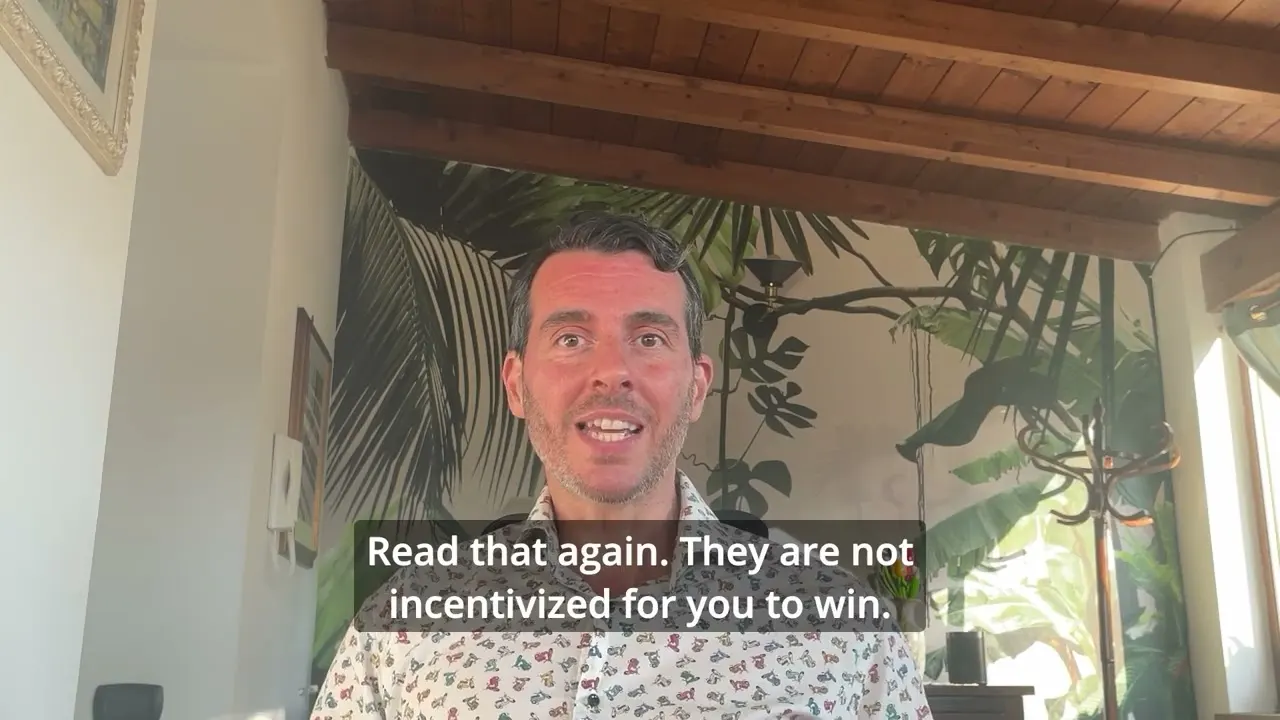
Revenge trading is one form of a wider problem: simply trading too much. Velotrade CEO Gianluca Pizzituti explains why exchanges and brokers profit from your volume rather than your results, and why fewer trades with a real thesis survive longer. More in our guide to trading psychology.
 3:00
3:00Read the transcript
Here is something nobody in this industry will ever tell you. You are trading too much, and it is quietly killing your account.
I am Gianluca Pizzituti, CEO of Velotrade. I've been trading for over 25 years, institutionally and privately. And what I'm about to say goes against almost everything you've been sold.
Open any feed and it is the same message on repeat. You can trade, you can become a trader, you can make money, you can build a career out of this. And look, all of that can be true. I'm not here to crush the dream. But there is a part of the story nobody mentions.
The whole machine is built to make you trade more. Not better. More.
Think about who is on the other side of all the noise. Every exchange, every broker, every platform wants one thing from you: volume. The more you trade, the more rebates they collect, the more fees they earn, the more VIP tiers and badges they dangle in front of you to keep you clicking.
Their business does not run on whether you are profitable. It runs on how often you press the button. Your activity is their revenue. Read that again. They are not incentivized for you to win. They are incentivized for you to trade.
And here is the quiet truth underneath it all. The more you trade, the more mistakes you make. It is simple math. Every extra trade is another chance to get it wrong.
And then there is the statistic almost nobody in this space wants to put on a billboard. Depending on the study you read, somewhere around 9 out of 10 day traders lose money over time. 9 out of 10. 90%.
So ask yourself an honest question. Why do you want to go against those odds? Why fight the statistics when the statistics are screaming at you? I am not saying this to discourage you. I am saying it because somebody finally should.
So here is my advice, and it is the opposite of what the industry feeds you. Trade less. Think carefully before you enter. Take a position with a real thesis and hold it.
Stop living on the five-minute chart, refreshing every candle, hunting for the next click. I have been there. I've done exactly that. And I can tell you with confidence that the vast majority of people are going to lose money. That is not me being harsh. That is the data nobody wants to repeat.
So be honest with me. How many trades did you take last week? Drop it in the comments. I read them.
Failure Reason 2: Misunderstanding Drawdown Rules
Most traders who breach drawdown limits did not intend to. They simply did not know where their floor was before entering the trade that ended the account.
Drawdown rules in prop challenges come in two main forms: static and trailing. Static drawdown is calculated from the initial balance and does not move. Trailing drawdown moves upward as the account reaches new equity highs.
The critical difference is what happens when you profit. With trailing drawdown, a winning trade reduces your future risk tolerance. Your floor moves up. If you make $2,000 on Monday, your drawdown floor has moved up by some amount depending on the model. On Tuesday, you have less absolute drawdown room than you started with on Monday, even though you are profitable.
Tick-by-tick vs EOD trailing:
Tick-by-tick trailing is the most restrictive model. Every time equity reaches a new intraday high, the floor moves immediately. If a trade runs $2,000 in your favour before pulling back $500 to close up $1,500, a tick-by-tick model has moved your floor up $2,000, not $1,500. You cannot give trades room to breathe.
EOD trailing only adjusts the floor at day close based on closing equity. Your intraday highs during a session do not move the floor until the session ends. This is meaningfully more trader-friendly in volatile markets where intraday whipsaws are common.
Velotrade uses static drawdown on all plans: the floor is fixed from the initial balance and never trails upward. Understanding this model and applying it to your specific challenge changes how you should manage every trade.
For a full breakdown of how drawdown models work in practice, see: Crypto prop firm rules and drawdowns explained
Failure Reason 3: Time Pressure Distorts Decision-Making
Many challenges include time limits, typically 30 to 60 days, to prevent traders from waiting indefinitely for perfect setups. These limits are intended to ensure traders demonstrate active, consistent strategy execution.
In practice, time limits introduce a form of deadline pressure that changes behaviour in predictable and damaging ways:
- Marginal setups get traded. As the deadline approaches and the profit target is not hit, traders lower their entry criteria. They take trades they would normally skip because the opportunity cost of waiting feels higher than the risk of entering.
- Frequency increases. Traders who normally take 3-4 trades per week start taking 2-3 per day trying to accelerate toward the target.
- Risk per trade increases. With 5 days left and 30% of the profit target remaining, traders increase position size to close the gap faster.
All of these responses increase drawdown risk precisely when drawdown room is most constrained. Challenges are most commonly failed in the final week, not the first.
The fix: Treat the profit target as a by-product of correct process, not a goal to optimise toward. If your strategy takes 6-8 weeks to reach the target, it will not reach it in 3 weeks by trading more aggressively. It will just breach faster.
Failure Reason 4: Oversizing During the Evaluation
Traders who want to pass quickly often trade larger than their risk framework supports. This is backwards logic. A larger position does not increase the probability of reaching the profit target. It increases the probability of breaching the drawdown limit before you get there. You can see how risk per trade shifts those odds with a challenge pass calculator.
The math is straightforward: on a $50,000 Velotrade CLASSIC 2-Step account, the daily loss limit starts at 5% ($2,500). If you risk 3% per trade ($1,500), two losing trades in one session breach the daily limit and end the challenge. Three losing trades across different sessions can consume most of your total drawdown room.
If you risk 1% per trade ($500), you need five losing trades in a single session to hit the daily limit. Across the full evaluation, you have ten total losing trades before hitting maximum drawdown. The difference in risk per trade, 1% vs 3%, changes the evaluation from a coin flip to a process that can survive normal variance. A position size calculator makes the right size explicit before you enter.
Position sizing is the single most controllable variable in funded account longevity. Traders who understand this pass challenges. Traders who do not lose evaluations they should have passed. Use the crypto prop challenge calculator to see exactly how many losing trades your account can absorb before hitting the daily limit.
Free calculator
What does passing actually pay you?
Plug in your account size and see your profit target, max drawdown, and first payout - before you commit to a challenge.
Use the free prop challenge calculatorFailure Reason 5: Strategy Incompatibility With Prop Rules
A strategy can be genuinely profitable over 12 months and still be structurally incompatible with a prop challenge. Profitability and challenge-compatibility are not the same thing. Knowing where your style sits among the main types of trading helps you check it against the rules before you start.

Strategies that commonly fail in prop environments:
| Strategy Type | Why It Struggles |
|---|---|
| High drawdown, high expectancy | Average drawdown exceeds daily loss limit before profit materialises |
| Martingale or scale-in recovery | Averaging into losses accelerates drawdown beyond any limit |
| News scalping without stops | Spike risk during releases can hit daily limit in a single candle |
| Low frequency, high conviction | Requires waiting; creates pressure to force trades near deadline |
| Highly correlated multi-position | Correlated losses hit daily limit simultaneously |
Strategies that adapt well:
- Low drawdown, rule-driven systems with defined stops on every trade
- Consistent position sizing with no averaging or scaling after losses
- Strategies with clear entry criteria that can be applied selectively
The question to ask before attempting a challenge is not "has this strategy made money?" but "what is the maximum drawdown this strategy has ever produced in a single day, and does that fit within the daily loss limit?"
Payout proof
Fast, real payouts. Traceable on Arbitrum.
- Paid within 24 hours of approval
- Settled on Arbitrum in USDC or USDT
- Look up any transaction on Arbiscan


Failure Reason 6: Ignoring the Psychological Pressure Differential
Personal account trading and prop challenge trading create different psychological environments, and many traders underestimate the gap.
On a personal account, losing money is real but gradual. You can tell yourself the account will recover. You can reduce risk, step back, or change strategy. The feedback loop is slow enough that emotional decisions have time to be corrected.
On a prop challenge, every session has explicit stakes: breach the daily limit or the overall drawdown and the evaluation is over. This pressure is present on every trade, every session. Traders who have not experienced this environment often discover that their emotional responses under this kind of pressure are significantly different from what they expected.
Common first-challenge experiences include:
- Taking smaller than normal position sizes out of fear, then missing the profit target
- Becoming hypervigilant about P&L during open trades and closing winning positions too early
- Inability to execute entries on good setups due to anxiety about the outcome
- Post-loss emotional states that carry into the next session
None of these are signs of a bad trader. They are signs of a trader who has not adapted to the specific psychological demands of a rule-constrained environment. That adaptation takes time and repetition.
Why Profitable Traders Still Fail Challenges
A substantial number of challenge failures come from traders who are demonstrably profitable on personal accounts. This is one of the most counterintuitive aspects of prop trading and the most important to understand.

The core reason: variance in the short term does not match long-term expectancy. A strategy with 65% win rate and 1.5:1 reward-to-risk can still produce three consecutive losing trades. On a personal account, three consecutive losses are an unremarkable event. On a prop challenge with 5% daily limits and a 30-day window, those three losses could end the evaluation.
A strategy that is profitable over 200 trades is not guaranteed to be profitable within the first 30 trades of a challenge. The shorter the evaluation window, the more variance dominates the outcome.
What this means practically:
- A strategy that requires 50+ trades to show its edge is not suitable for a short challenge window
- A strategy with individual losses that approach the daily loss limit is not challenge-compatible even if the long-run expectancy is positive
- The right question is not "what is my average monthly return?" but "what is my worst single-day loss in recent history?"
Structural Factors Beyond Trader Control
Not every failure is behavioural. Some evaluations fail due to external structural factors:
- Sudden market volatility: Crypto markets can move 8-12% in minutes during exchange outages, protocol announcements, or macro events. A well-placed stop can be triggered by a spike that immediately reverses, ending a session unnecessarily.
- Slippage and execution: Simulated environments have varying degrees of slippage. Strategies calibrated on personal accounts may experience different fill quality in evaluation environments.
- Session timing: Challenges with fixed calendar windows may overlap poorly with specific market conditions. A challenge running entirely through a low-volatility period makes reaching profit targets mechanically harder.
These factors are real and should be accounted for. They are also not the primary reason most evaluations fail. Structural factors explain a minority of failures. Behavioural factors explain the majority.
Warning Signs During an Evaluation
Traders approaching failure often show the same recognizable patterns in the days before breach:
- Increasing trade frequency without corresponding improvement in setup quality
- Taking marginal setups that would normally be filtered out
- Adjusting rules mid-challenge: moving stop losses, changing profit targets, switching timeframes
- Focusing on the profit target number rather than the process that produces it
- Trading outside their normal market conditions because they feel behind
If you notice any of these patterns in your own evaluation, the correct action is to reduce size immediately or stop trading for the day. The account surviving with less drawdown room is better than the account ending while you try to recover.
Post-Failure Analysis: The Highest-ROI Step Most Traders Skip
The majority of traders who fail a challenge pay the fee again and attempt the same evaluation with the same strategy and the same behaviour. This produces predictable results.
The highest-value activity after a failed challenge is a session-by-session review of what caused the breach:
- Which specific trade ended the evaluation? Was it the position sizing, the entry, or the emotional state at entry?
- Were there warning signs in the sessions before the breach? Increasing frequency? Marginal setups?
- Did the strategy itself breach the rules, or did execution deviate from the plan?
- What would need to change, in rules, in strategy, in behaviour, for the next attempt to produce a different outcome?
A trading journal kept during the attempt makes this review far easier, because the reasons behind each trade are already written down.
Without this analysis, additional attempts are expensive repetitions. With it, each failed challenge becomes structural data about what specifically needs to change.
How to Approach Prop Challenges Realistically
Before starting any evaluation, honest answers to these questions will tell you whether the timing is right:
- What is the worst single-day loss my strategy has produced in the last 90 days? Does it fit within the daily loss limit?
- Can I remain in cash for 5+ consecutive sessions when market conditions don't meet my criteria?
- Can I accept a breach without immediately retrying with increased position size?
- Have I reviewed the exact rules, not the summary, the actual rules, and can I explain them clearly?
If the answer to any of these is no, the challenge is likely a poor fit at this stage.
For guidance on choosing a firm that matches your trading style, see: How to evaluate a crypto prop firm. And for a checklist of warning signs before you pay any challenge fee, see top crypto prop firm red flags. To compare the leading crypto prop firms and find one whose rules suit your strategy, see best crypto prop firms 2026. If you are coming from a futures or forex background, see best FTMO alternative for crypto traders.
For a practical guide on passing once you know what to avoid, see how to pass a 2-step crypto prop challenge.
Ready to Take a Challenge With Fair Conditions?
Velotrade's prop trading challenges are built for traders who run real strategy logic: no consistency rule, news trading allowed, weekend hold allowed, and static drawdown on all plans (the floor is fixed from the initial balance and never moves against you).
See challenge options and account sizes →
If you would rather build that discipline before paying an entry fee, you can also earn a challenge account for free by playing Sprint Trading.
Frequently Asked Questions
About the author

Vittorio De Angelis
Executive Chairman
Former equity-derivatives trader at JP Morgan, Dresdner Kleinwort and Bank of America in London. Later Head of Brokerage at a global broker in Hong Kong.
View author page