Trade crypto with funded capital
ExploreNot all crypto prop firms operate the same way. Before paying any evaluation fee, traders should assess rule clarity, payout reliability, operational transparency, and whether the firm's structure is compatible with how they actually trade. Most negative experiences in crypto prop trading are not caused by bad trading. They are caused by misunderstanding firm rules, underestimating hidden constraints, or joining a firm that is not operationally stable.
This guide provides a practical due diligence checklist to evaluate a crypto prop firm before committing time or money. Work through each section before paying any evaluation fee.
Highlights of this article
- Rule clarity matters more than advertised profit splits
- Vague drawdown definitions and inconsistent documentation are major red flags
- Payout terms, processing times, and dispute history should be scrutinised independently
- Operational transparency separates credible firms from those that shift rules retroactively
- Platform quality and execution environment affect strategy performance regardless of rules
- Velotrade's structure is used throughout as a concrete reference for what good practice looks like
Funded accounts
Want a firm that passes all of these checks?
Trade up to $200,000 in firm capital with static drawdown, no consistency rule, and payouts within 24 hours.
See how Velotrade's challenges compareWhy Evaluating a Crypto Prop Firm Matters More Than You Think
Crypto prop trading combines trading risk with platform risk and counterparty risk. Even though traders typically do not deposit large trading balances, evaluation fees are non-refundable, and the cost accumulates across multiple attempts. Beyond fees, the less visible cost is time: weeks or months spent in an evaluation at a firm with opaque rules or inconsistent enforcement.
The firms operating in this space vary significantly. Some publish detailed, worked-out rules with specific numerical examples. Others describe rules in vague language that leaves critical questions unanswered until a dispute arises. The difference between these categories is knowable in advance, but only if you know what to look for.
Evaluating a firm carefully before joining is not due diligence for its own sake. It directly determines whether the time and money spent on an evaluation is likely to produce a fair result.
For a full overview of the prop trading model itself, start here: What is crypto prop trading
Criterion 1: Rule Clarity and Documentation
Rule clarity is the single most important evaluation factor. The majority of crypto funded trading account terminations happen because of rule breaches, not because strategies are unprofitable. Most rule breaches happen because traders did not fully understand the rules before they encountered the situation where they mattered.
A well-structured prop firm should document the following with specific numbers and worked examples:
Loss limits:
- The exact daily loss limit as a percentage and as a dollar figure for each account tier
- Whether the daily limit resets at UTC midnight, local midnight, or a different time
- Whether the daily limit is measured from the opening balance of the day or from the intraday equity high
Drawdown type:
- Whether the drawdown is static (fixed from initial balance) or trailing (moves as equity grows)
- If trailing, whether it adjusts tick-by-tick during the session or at end-of-day only
- The exact formula used to calculate the floor at any point in time
Termination conditions:
- What exactly happens when a limit is breached: immediate closure, warning, or grace period
- Whether limits apply to equity only or to balance including unrealised P&L
- Whether rule changes apply to active evaluations or only to new ones
Note: If you cannot explain a firm's drawdown rules clearly before paying, you should not expect clarity after joining. If the rules page raises questions, assume the answers are unfavourable until confirmed in writing.
For a deeper breakdown of how these rules work in practice, see: Crypto prop firm rules and drawdowns explained
Criterion 2: Payout Terms and Reliability
High profit splits are meaningless if payouts are inconsistent, delayed by fine print, or disputed without resolution. When evaluating a crypto prop firm, payout mechanics matter more than headline profit split percentages.

What to verify before joining:
- Payout schedule: Is withdrawal available on demand, weekly, bi-weekly, or monthly? Are minimum thresholds documented?
- Verification requirements: What identity verification is required? Is this completed at onboarding or only when you request a payout?
- Processing time: What is the documented timeframe from request to receipt? Is there a published SLA?
- Payout conditions: Are there any performance or compliance conditions that can delay or cancel a withdrawal request?
- Method: What payment methods are available? Crypto, bank transfer, or third-party processors? Are there fees?
For a detailed guide on what to confirm across each of these points before purchasing, see crypto prop firm payout speed: what traders need to check.
Independent verification:
Testimonials on a firm's own site are not a reliable signal. Look for independent trader experiences in communities, forums, and review platforms where the firm's brand team does not moderate content, and give the most weight to publicly verifiable withdrawals that anyone can confirm on-chain. A pattern of delayed payouts, disputed withdrawals, or unexpected condition changes is a meaningful warning signal regardless of how the firm responds to those complaints publicly.
One specific thing to look for: firms that change payout rules after traders have passed evaluations. If the rules that applied when you paid the fee change before you reach the funded stage, that is a significant operational risk.
Criterion 3: Drawdown Model Compatibility With Your Strategy
Different drawdown models create fundamentally different trading environments. Choosing a firm whose drawdown model is incompatible with your strategy is as problematic as choosing a firm with unfair rules.
Tick-by-tick trailing drawdown adjusts the floor in real time every time your equity reaches a new high. Every profitable trade that subsequently pulls back reduces your future risk tolerance. If you trade strategies with wide intraday swings, common in crypto markets, a tick-by-tick model will systematically compress your drawdown room even on profitable sessions.
EOD trailing drawdown adjusts the floor once per day at session close, based on your closing equity. Intraday equity peaks during the session do not move the floor. This allows you to manage open trades based on their merits without the floor tracking every tick. For crypto markets, where 5-8% intraday swings are routine, EOD trailing is materially more trader-friendly.
Practical scenario:
A BTC trade runs $3,000 in your favour before closing out at $1,500 profit.
- Tick-by-tick: your floor has moved up $3,000
- EOD: your floor moves up $1,500 at day close
On the same session and same trade, the tick-by-tick model has taken $1,500 more of your drawdown buffer than the EOD model. Across many sessions, this difference determines whether you can trade through normal market volatility.
Velotrade uses static drawdown on all plans. The floor is fixed from the initial balance and never trails upward regardless of profits made. Before joining any firm, confirm in writing whether their model is tick-by-tick, EOD trailing, or static, and get a worked example showing how the floor moves after a specific sequence of trades.
Payout proof
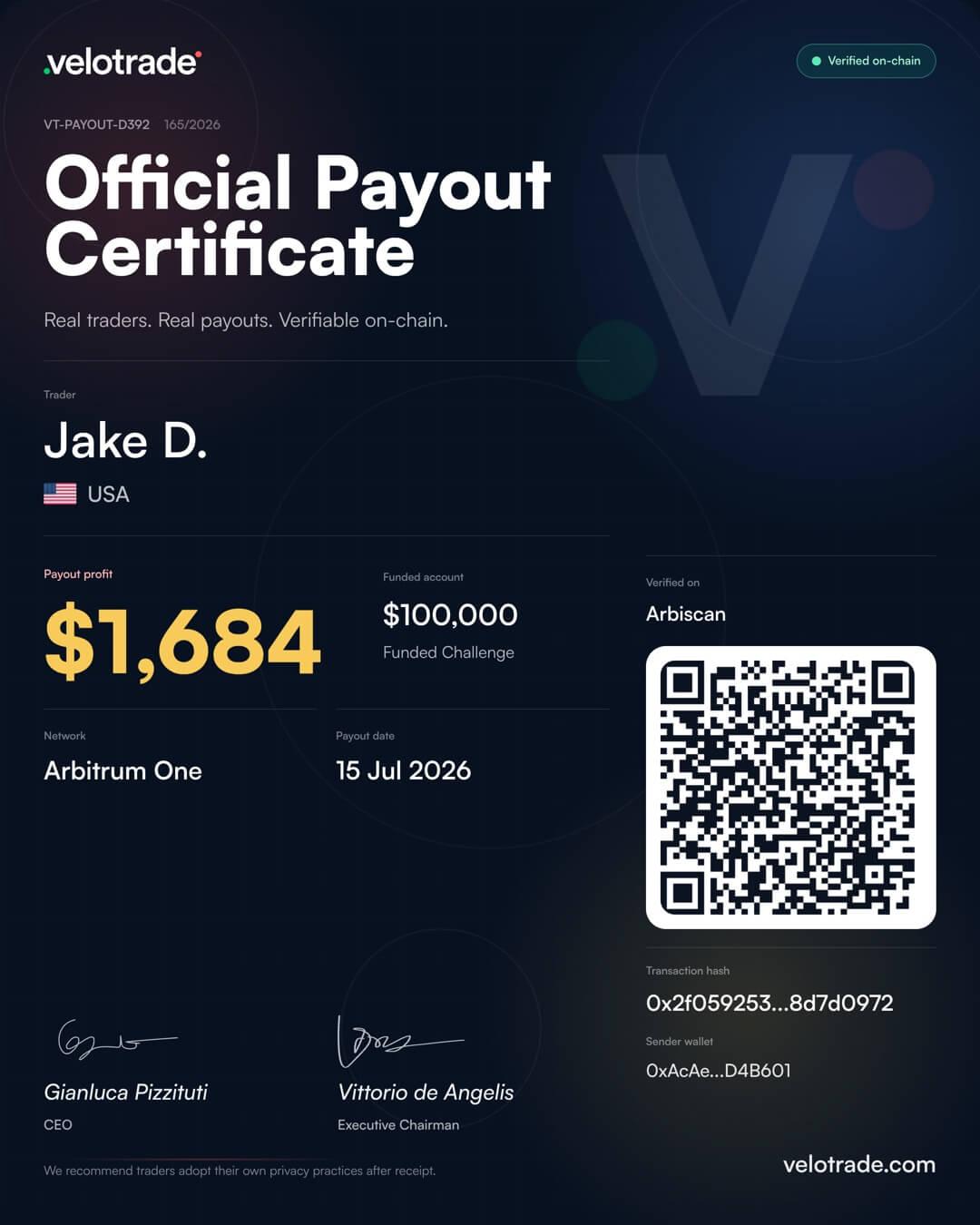
Fast, real payouts. Traceable on Arbitrum.
- Paid within 24 hours of approval
- Settled on Arbitrum in USDC or USDT
- Look up any transaction on Arbiscan

Criterion 4: Consistency Rules and Behavioural Restrictions
Consistency rules are among the most misunderstood and least disclosed restrictions in prop trading. They limit how much of your total evaluation profit can come from a single trading day. If you earn 40% of your profit target on one exceptional day, a strict consistency rule can disqualify that day's profit from counting toward the target.
Why this matters:
Crypto markets are volatile. Large single-day moves, in BTC, ETH, or altcoins, regularly create outsized opportunities. A trader who correctly positions into a major move can generate a significant return in a single session. If that return is then invalidated by a consistency rule, the trader must either re-earn it across more sessions or, depending on the rule, restart the evaluation.
Velotrade has no consistency rule at any stage. Your daily profit distribution is not evaluated. Only drawdown compliance matters.
Other behavioural restrictions to check:
- Are specific strategies explicitly prohibited? (martingale, grid trading, copy trading, EAs)
- Is news trading restricted or prohibited entirely?
- Can you hold positions over weekends?
- Are there restrictions on holding through scheduled economic releases?
Firms that prohibit news trading effectively prevent you from trading during some of the highest-probability setups in crypto markets. Firms that prohibit weekend holding force you to close positions before Sunday, potentially at poor prices, to comply with a rule that has no strategic logic.
Criterion 5: Platform Quality and Execution Environment

The platform you trade on during an evaluation determines whether your strategy can be executed as designed. Evaluate these factors before paying:
Available instruments:
- Which crypto assets are available? Spot, perpetuals, or both?
- Are the specific pairs you trade available with sufficient liquidity?
Execution quality:
- What is the typical spread on major pairs?
- Is slippage documented or available from historical data?
- Are market orders, limit orders, and stop orders all available?
Charting and tools:
- Does the platform support the chart types and indicators your strategy requires?
- Are mobile apps available if you trade across devices?
- Is there an API for algorithmic traders? Velotrade provides full API access on every account with no extra fee.
Stability:
- What is the platform's documented uptime history?
- Are there known outage windows around major market events?
Velotrade uses DXtrade. Before trading on any platform for an evaluation, paper trade or demo for at least one week to understand its specific execution characteristics.
Criterion 6: Operational Transparency and Company Background
Operational transparency is harder to assess than rule clarity, but it predicts long-term reliability more accurately.
Questions to answer before joining:
- Is the company registered and in which jurisdiction? Can this be independently verified?
- Who are the people behind the firm? Do they have documented backgrounds?
- How long has the firm been operating in its current form?
- Is there a physical presence or registered address?
- What happens to your funded account if the firm ceases operations?
Why this matters for crypto prop specifically:
The crypto prop space has seen firms close without warning, leaving funded traders with outstanding withdrawal requests unresolved. Unlike regulated financial entities, most crypto prop firms operate in jurisdictions with limited trader protection. The evaluation fee and the funded account balance both carry counterparty risk that is not visible in the marketing.
This does not mean avoiding newer firms, but it does mean that transparency about who operates the firm and how it is structured should factor into your decision alongside trading conditions. For a focused breakdown of the specific warning signs to watch for, see top crypto prop firm red flags. To compare all major firms on their key rules and trading conditions in one place, see the crypto prop firm directory.
Criterion 7: Support Quality and Dispute Resolution
The quality of support becomes critical in edge cases: a technical outage during a major trade, a drawdown calculation that does not match your records, a payout that is delayed beyond the stated processing time.
Before joining, assess:
- Is there a documented support channel with response time commitments?
- Is there a formal dispute process?
- How are borderline rule cases handled. Is there discretion or are all cases automatic?
- What is the escalation path if initial support cannot resolve the issue?
Test support before paying the evaluation fee. Send a question about a specific rule interpretation and assess the quality of the response. A firm that cannot answer specific rule questions clearly before you join is unlikely to handle disputes fairly after.
Red Flags Summary
The following patterns consistently indicate higher risk. One or two may be explainable in context. Multiple signals together should stop the evaluation process entirely.
| Red Flag | Why It Matters |
|---|---|
| Drawdown definitions differ across pages | Rules that contradict themselves cannot be enforced consistently |
| No worked examples for rule calculations | Ambiguity favours the firm in disputes |
| Consistency rules not disclosed upfront | Material restriction buried in fine print |
| Payout history unavailable or disputed | Core function of the business unreliable |
| Rules changed after evaluation payment | Retroactive rule changes are non-negotiable contracts |
| No documented company background | Counterparty risk not assessable |
| Support cannot answer specific rule questions | Enforcement will also be inconsistent |
| Heavy marketing focus with minimal rule detail | Acquisition-focused, not trader-focused |
Final Due Diligence Checklist
Before paying any evaluation fee, you should be able to answer yes to all of the following:
- I have read the full rules page, not the summary, and I understand every section
- I can state my exact daily loss limit in dollars for the account size I am purchasing
- I know whether the drawdown model is static, tick-by-tick trailing, or EOD trailing
- I know whether the firm has a consistency rule and if so, what the exact threshold is
- I have confirmed that my strategy type (news trading, weekend hold, etc.) is permitted
- I have verified the payout schedule, minimum withdrawal, and processing time in writing
- I have reviewed independent trader experiences from outside the firm's own channels
- I have tested the platform for at least one week before trading evaluation capital on it
If any of these are unclear, pause. The cost of pausing is zero. The cost of joining the wrong firm is real.
See How Velotrade Stacks Up
Velotrade publishes its full drawdown rules, daily loss limits, and termination conditions clearly, with worked examples. No consistency rule. News trading and weekend holding allowed. Static drawdown on all plans. HQ in Hong Kong with a team background in institutional finance.
For a full independent assessment of how Velotrade performs against each criterion in this guide, read our full Velotrade review. To see how Velotrade and other top firms compare side by side, see best crypto prop firms in 2026, or compare the exact rules of every firm in the prop firm rules database. If you are coming from a forex or futures background and want to understand how crypto prop firms differ from what you already know, see best prop firms for crypto traders. For standalone reviews of the major firms in this category, see FundedNext review 2026, DNA Funded review 2026, and FTMO review 2026. If you are newer to trading and want a firm-by-firm breakdown calibrated for beginners, see best crypto prop firms for beginners, and build the basics first with our learn to trade lessons. If you are still deciding whether a prop firm makes sense versus trading your own capital, see crypto prop firm vs trading your own account. Once you have evaluated your options, the next step is how to become a funded crypto trader. You can also review the full trading rules or compare challenge types and pricing directly.
Free calculator
Is prop trading worth it for you?
Enter your account size, expected monthly profit, and how many attempts to pass. See your break-even month and 12-month net in seconds.
Use the free ROI calculatorFrequently Asked Questions
About the author

Vittorio De Angelis
Executive Chairman
Former equity-derivatives trader at JP Morgan, Dresdner Kleinwort and Bank of America in London. Later Head of Brokerage at a global broker in Hong Kong.
Velotrade was founded in Hong Kong in 2016 by a team from JP Morgan, Dresdner Kleinwort and Bank of America, has paid out over $2.5 billion to its trade-finance clients, and has been featured in Bloomberg, the Financial Times, the Wall Street Journal and on Nasdaq. Its prop trading evaluations are simulated and educational.
View author page