New to funded trading?
ExploreFunded trading and leverage trading both allow traders to control positions significantly larger than their personal capital. That larger position is measured by its notional value, the full market value of the exposure rather than the capital posted. Beyond that surface similarity, the two models differ fundamentally across almost every dimension that matters: risk structure, autonomy, psychological pressure, cost profile, and long-term career trajectory.
Choosing between them is not a question of which is better. It is a question of which one you are better suited for, and that answer depends on your strategy, your temperament, and the resources you have available right now.
This guide examines both models in depth and gives you a framework for making an honest assessment.
Highlights of this article
- Funded trading limits personal financial exposure but introduces strict rule enforcement
- Leverage trading offers full autonomy but full personal financial risk
- The cost structure of each model is fundamentally different and often misunderstood
- Rule constraints change trader behaviour more than capital size does
- Neither model is universally better. Suitability depends on strategy, temperament, and capital
- Most professional traders eventually settle into one model; very few operate well in both simultaneously
What Is Leverage Trading?
Leverage trading means trading your own account using borrowed funds provided by a broker or exchange. You deposit collateral, a margin requirement, and the exchange multiplies your effective position size based on the leverage you select.
In leverage trading:
- You own the capital and the account
- You control all position sizing and risk decisions
- You keep 100% of profits
- You absorb 100% of losses
- Your positions are liquidated automatically if losses exceed your margin
Leverage is available on crypto exchanges from 2x up to 100x or more depending on the platform, though regulatory restrictions vary by jurisdiction. At lower leverage levels, the model resembles standard spot trading with amplified returns. At higher leverage, it resembles high-frequency speculation with near-instant liquidation risk.
On a funded account, leverage works differently and is set by the firm rather than chosen by you; see how much leverage you get on a funded account.
The defining characteristic of leverage trading is autonomy. You make every decision: position size, entry, exit, stop placement, and when to stop trading entirely. There is no firm monitoring your activity and no external enforcement of rules.
What Is Funded Trading?
Funded trading means trading with capital provided by a proprietary trading firm rather than your own funds. Access to that capital is conditional on passing an evaluation, the prop challenge, and is governed by strict rules throughout the evaluation and funded stages. For a full overview of what a crypto funded trading account involves, including how they are structured and what to expect, see that dedicated guide.
In funded trading:
- Capital belongs to the firm, not the trader
- Access to that capital is earned through an evaluation
- Risk rules are enforced automatically by the platform
- Profits are shared between trader and firm at an agreed split
- Rule breaches typically end the account immediately
Most retail-accessible crypto prop firms operate on a simulated-capital model: the evaluation and funded account run on a simulated environment, and the firm pays out from its own reserves when traders request withdrawals. This matters because it means the firm's ability to pay is a relevant consideration alongside the rules themselves.
For a full explanation of how funded trading works, see: What is crypto prop trading
The Real Difference: Who Controls Risk Decisions
The most important practical difference between funded trading and leverage trading is not capital size. It is who controls risk decisions, and what happens when those decisions go wrong.
In leverage trading: You decide how much to risk, when to stop, and whether to continue after a losing session. The broker liquidates your position if your margin falls below the maintenance threshold, but the decision about how close to that threshold you operate is entirely yours.
In funded trading: The firm decides the risk limits before you start trading. Those limits are enforced without discretion. Breach the daily loss limit or the overall drawdown and the account is failed or closed. There is no appeal, no grace period, and no exception.
This distinction changes trader behaviour in ways that are not obvious until you have experienced both environments. Traders who perform well under structure may find that external enforcement actually improves their results, removing the discretion to average down or revenge trade also removes the losses those decisions produce. Traders who rely on flexibility may find funded trading restrictive in ways that prevent their strategy from functioning as designed.
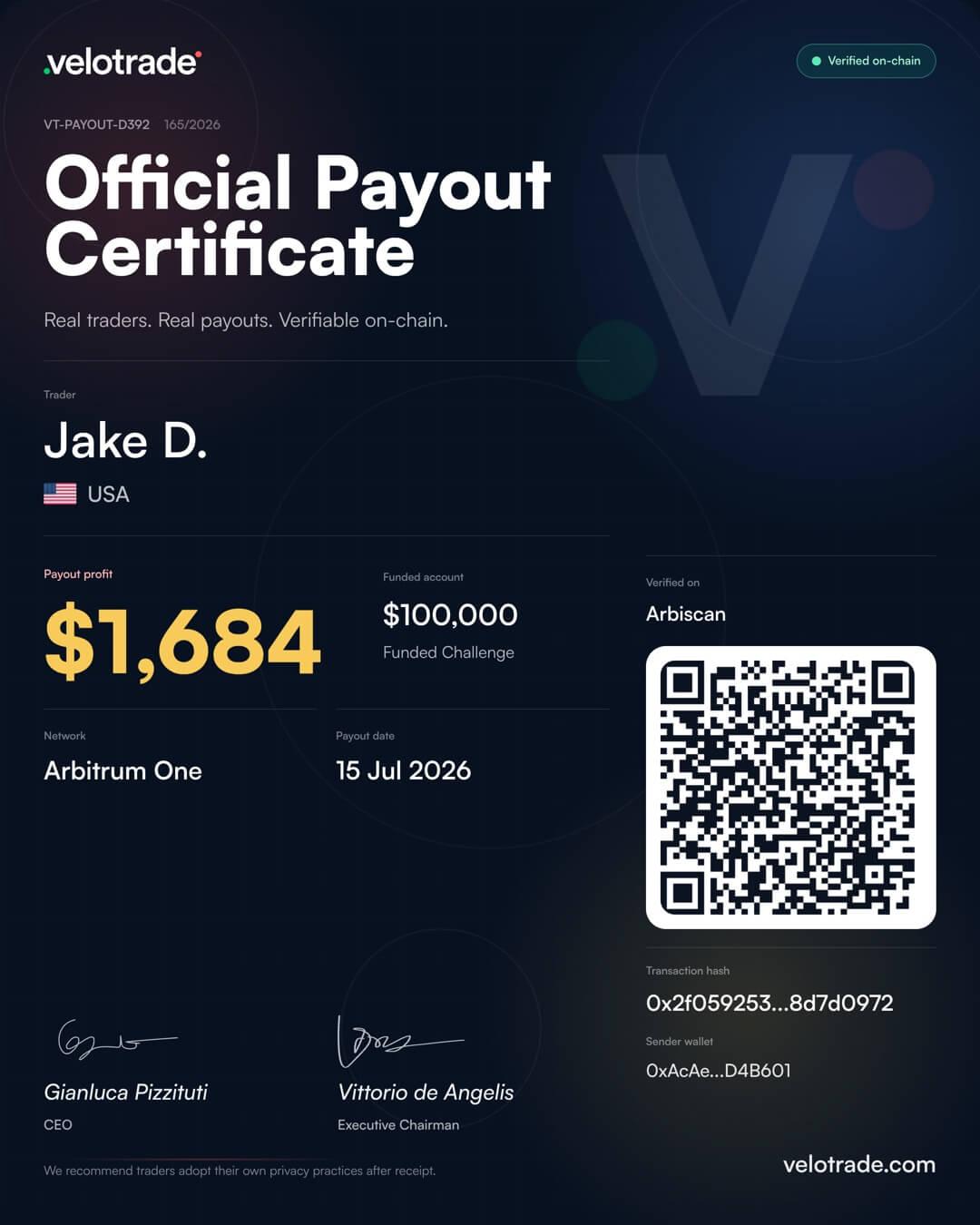
Payout proof
Fast, real payouts. Traceable on Arbitrum.
- Paid within 24 hours of approval
- Settled on Arbitrum in USDC or USDT
- Look up any transaction on Arbiscan

Key Differences at a Glance
| Aspect | Funded Trading | Leverage Trading |
|---|---|---|
| Capital ownership | Firm | Trader |
| Personal financial risk | Evaluation fees | Full deposited balance |
| Risk rules | Externally enforced | Self-defined |
| Profit retention | Shared (typically 70-90%) | 100% |
| Account termination | Automatic on rule breach | At trader's discretion |
| Psychological pressure type | Rule-based | Capital-based |
| Capital required to start | Evaluation fee ($100-$600 typically) | Deposit (varies widely) |
| Scalability | Determined by firm's account tiers | Limited only by capital |
| Regulation | Minimal (most jurisdictions) | Varies significantly |
Cost Structure: The Numbers Most Traders Get Wrong
The cost comparison between funded and leverage trading is rarely calculated honestly. Both models have real costs; they are just structured differently.
Leverage trading costs:
- Funding rates (perpetual futures): typically 0.01% per 8 hours, compounding continuously on open positions
- Spreads and trading fees per transaction
- Capital at risk: the full deposited balance is exposed to potential loss
- Liquidation costs: in volatile markets, positions can be liquidated at worse-than-stop prices due to slippage
On a $10,000 leveraged account trading perpetual futures at 10x leverage with typical 0.01% funding rates, holding positions for 30 days costs approximately $300+ in funding alone before any trade losses. A sequence of losing trades that liquidates the account costs the full $10,000.
Funded trading costs:
- Evaluation fee (one-time, non-refundable per attempt)
- The time cost of the evaluation period
- The profit split (giving up 10-30% of profits vs keeping 100%)
- Opportunity cost if the evaluation fails and must be retried

The comparison:
A trader who pays a $200 evaluation fee and passes a $50,000 funded challenge has risked $200 to access $50,000 in notional capital. A trader who deposits $50,000 to trade at equivalent notional exposure has risked $50,000.
The profit split reduces earnings per winning trade. But the exposure to catastrophic loss, a sequence of trades that wipes out capital, is structurally different. On a funded account, a catastrophic sequence costs the evaluation fee. On a leveraged account, it costs the deposit. To see exactly when the evaluation fee pays off and what 12 months of funded trading earnings look like at your target monthly profit rate, use the prop trading ROI calculator.
"The traders who adapt fastest to funded accounts are usually the ones who have already blown a leveraged account at least once. Once you have lost real capital, a $200 evaluation fee starts to look like the cheapest tuition you ever paid for the same lesson." - Velotrade trading team
Free calculator
Is prop trading worth it for you?
Enter your account size, expected monthly profit, and how many attempts to pass. See your break-even month and 12-month net in seconds.
Use the free ROI calculatorThis asymmetry is the primary financial argument for funded trading for traders who do not have significant personal capital. The counterargument is that the rules constraining the funded account may prevent the strategy from performing as well as it would on an unconstrained personal account.
Risk Exposure: What You Are Actually Risking in Each Model
Funded trading and leverage trading expose traders to different types of risk. Neither is risk-free. They are different in nature.
In funded trading, you risk:
- Non-refundable evaluation fees (typically $100-600 per attempt)
- Time invested in the evaluation period
- The psychological cost of failing and restarting
- Future earnings from the profit split structure
In leverage trading, you risk:
- The full deposited balance
- Cascading liquidations during extreme volatility events
- Funding rate costs compounding on losing positions
- Capital destruction from emotional decisions under financial pressure
The practical implication: if you have $5,000 to allocate to trading, a leveraged approach puts all $5,000 at risk of total loss. A funded approach might spend $200-400 on evaluation fees and, if successful, operate with far greater nominal capital without the $5,000 being at risk in the trading account.
Behavioural Impact: How Each Model Changes How You Trade
The behavioural dimension of this comparison is the least discussed and the most important.
Funded trading exposes behavioural weaknesses faster. Because rules are enforced without discretion, every emotional response to a loss, increasing size, widening stops, revenge trading, is punished immediately. This is both a liability and an asset. As a liability, it means traders with undisciplined habits fail quickly. As an asset, it forces traders to develop discipline that they might not develop on a personal account where the consequences of emotional decisions are slower and more forgiving.
Leverage trading can mask behavioural problems for longer. A trader who revenge trades on a personal account loses more money, but the account persists. They may attribute losses to market conditions rather than their behaviour. Without the hard stop of a daily loss limit or an account breach, the feedback loop for behavioural correction is slower.
Common behavioural effects specific to funded trading:
- Overtrading to reach profit targets: Deadline pressure creates urgency that lowers entry criteria
- Increasing size after losses: The impulse to recover before the session ends is stronger with an explicit rule ceiling than with abstract capital risk
- Ignoring daily limits under pressure: Traders who know exactly where the limit is sometimes treat it as a target rather than a ceiling
For a deeper look at why these patterns cause most failures, see: Why most retail traders fail prop challenges
Strategy Compatibility: Which Model Fits Your Approach?

Not every strategy is compatible with funded trading. The rules that govern funded accounts structurally prevent certain approaches from being executed.
Strategies that typically struggle in funded trading:
| Strategy Type | Why It Struggles |
|---|---|
| Martingale or averaging-down | Adds to losers, rapidly exhausts drawdown |
| High variance, high expectancy | Individual losses may exceed daily limits even when profitable long-term |
| Grid trading | Open position exposure can hit limits before the grid completes |
| Recovery-based approaches | Increasing size after losses is the fastest path to account termination |
| Very wide stop strategies | Single stop-out can consume most of the daily limit |
Strategies that adapt well to funded trading:
- Low drawdown, rule-driven systems with defined stops on every trade
- Consistent position sizing with no exceptions regardless of recent P&L
- Patient, selective execution: waiting for high-quality setups rather than forcing activity
- Strategies that are profitable at conservative position sizes
For leverage trading specifically:
More strategy types can function because there is no daily loss limit enforcement. Traders can manage drawdowns across days, weeks, or months rather than being subject to daily hard stops. The constraint is capital, not rules. A strategy that requires deep drawdowns before producing returns may not survive on a funded account but may work on a personal leverage account if the capital is sufficient.
For details on how specific rule types affect strategy execution, see: Crypto prop firm rules and drawdowns explained
Which Model Suits Which Trader?
There is no universally correct answer. Both models have succeeded for professional traders over time. The question is which one matches your current situation.
Funded trading may suit you if:
- You have a tested, low-drawdown strategy and limited personal capital
- You are comfortable operating under strict, externally enforced rules
- You benefit from having hard stops that prevent emotional decisions
- Your strategy is consistent and does not rely on recovery averaging
- You want access to larger nominal capital without putting significant personal funds at risk
- You run algorithmic or automated strategies - funded accounts at firms like Velotrade include full API access for bots and EAs with no extra fee
Leverage trading may suit you if:
- You have sufficient personal capital to absorb variance without existential risk to the account
- Your strategy requires flexibility that prop rules would prevent (wide stops, position averaging, etc.)
- You are comfortable managing risk entirely independently
- You accept full financial responsibility including the possibility of total loss
- You prefer keeping 100% of profits over the profit split structure
Neither model is appropriate if:
- You do not yet have a tested, profitable strategy
- You are still in the learning phase of trading
- You cannot afford to lose the evaluation fee multiple times
- You have not done basic risk management work: position sizing, defined stops, daily loss awareness
Can Traders Combine Both Models?
Some traders maintain both a personal leverage account and a funded account simultaneously. This creates certain advantages: the leverage account can be used for strategy testing or for approaches that don't fit within prop rules, while the funded account provides larger nominal exposure with limited personal capital at risk.
However, managing two rule sets, two risk profiles, and two psychological contexts adds complexity that most traders underestimate. The emotional state from a bad session on one account affects decision-making on the other. The mental accounting required to track drawdown floors, daily limits, and personal balance simultaneously is a genuine cognitive load.
If you are going to combine models, consider starting with one, reaching profitability and stability, and only then adding the second. For a deeper breakdown of how to think through this decision - including the economic comparison and which trader profiles suit each model - see crypto prop firm vs trading your own account.
Final Perspective
Funded trading and leverage trading solve different problems.
Funded trading trades autonomy for access and structure. You give up flexibility and a portion of profits in exchange for access to large capital without personal financial exposure.
Leverage trading trades access for autonomy and full exposure. You keep all profits and full control in exchange for putting real personal capital at risk.
Before choosing either path, assess honestly:
- How do you respond to strict external rules under pressure?
- How do you handle losses. Do you follow your plan, or do you react?
- How much personal capital can you afford to put at risk?
- Does your strategy work within prop firm constraints, or does it require flexibility?
These questions have different answers for different traders. The answer determines the right model.
Interested in Funded Trading?
If you want to access crypto, forex, stocks, indices, and commodities with a firm's capital rather than your own, review Velotrade's challenge options. 1-step and 2-step evaluations across $5,000 to $200,000 accounts, with up to 90% profit split. No consistency rule, news trading allowed, weekend holding allowed, and static drawdown on all plans.
Not sure where to start? Understand how a prop firm account works - account types, rules, and earnings potential explained. Then read our step-by-step guide on how to become a funded crypto trader, compare the leading options in our best crypto prop firms roundup, or read a full independent assessment in the Velotrade review 2026. Before your first payout, understand how funded trading income is taxed in your country - see crypto prop firm tax guide: what funded traders need to know.
Frequently Asked Questions
About the author

Vittorio De Angelis
Executive Chairman
Former equity-derivatives trader at JP Morgan, Dresdner Kleinwort and Bank of America in London. Later Head of Brokerage at a global broker in Hong Kong.
View author page