
See exactly how much room your account gives you
ExploreLoss aversion is the tendency to feel the pain of a loss much more strongly than the pleasure of an equal gain. In trading, it shows up as holding losing positions too long, closing winning positions too early and moving stops to avoid admitting a mistake. It is one of the best documented biases in behavioural finance and a core part of trading psychology.
Quick answer: Loss aversion in trading is the bias that makes a loss feel roughly twice as painful as an equal gain feels good. Research by Kahneman and Tversky estimated the ratio at about 2.25. Traders affected by loss aversion hold losers, cut winners early and move stop-losses, which turns small planned losses into large unplanned ones.
Highlights of this article
- Loss aversion means losses feel about 2.25 times as strong as equal gains, according to Tversky and Kahneman's 1992 estimate
- Prospect theory (Kahneman and Tversky, 1979) explains why outcomes framed as losses drive different choices
- In trading, loss aversion drives the disposition effect: selling winners too early and holding losers too long
- Moving a stop-loss further away is loss aversion in action, and it can turn a 1R loss into a 3R loss
- The fix is mechanical: pre-set stops, thinking in R-multiples, bracket orders, small position sizes and a weekly journal review
Funded accounts
Ready to get funded?
Trade up to $200,000 in firm capital with static drawdown, no consistency rule, and payouts within 24 hours. Pass the challenge and keep up to 90% of your profits.
Get funded from $40What is loss aversion?
Loss aversion is a cognitive bias in which a loss of a given size has a bigger emotional impact than a gain of the same size. Losing 100 dollars feels worse than winning 100 dollars feels good, even though the money involved is identical.
The term comes from behavioural economics, which studies how real people make decisions. A purely rational trader would treat a 100 dollar loss and a 100 dollar gain as equal and opposite. Real traders do not.
| Item | Detail |
|---|---|
| Definition | Losses feel more painful than equal gains feel pleasant |
| Rule of thumb | A loss feels about 2.25 times as strong as an equal gain (Tversky and Kahneman, 1992) |
| Worked example | A 100 dollar loss feels like giving up about 225 dollars of gains |
| Origin | Prospect theory, Kahneman and Tversky, 1979 |
| When it matters | Every time a position is in the red and you must decide to hold or close |
| Main risk | Small planned losses become large unplanned ones; winners are cut short |
| Related terms | Disposition effect, revenge trading, stop-loss, R-multiple |
What is prospect theory?
Prospect theory is a model of decision-making under risk, published by psychologists Daniel Kahneman and Amos Tversky in 1979. It describes how people evaluate outcomes as gains or losses relative to a reference point (such as the price you paid), rather than in terms of total wealth.
Prospect theory has three ideas that matter for traders:
- Reference point. People judge outcomes against a starting point. For a trader, that is usually the entry price. A position below entry feels like a loss, even if the account as a whole is up for the month.
- Diminishing sensitivity. The difference between losing 0 and losing 100 dollars feels bigger than the difference between losing 1,000 and losing 1,100 dollars. Once a trade is deep in the red, each extra dollar of loss hurts less, which makes it easier to keep holding.
- Loss aversion. The value curve is steeper for losses than for gains. In their 1992 follow-up paper on cumulative prospect theory, Tversky and Kahneman estimated a loss aversion coefficient of about 2.25.
What does the prospect theory value function look like?
The value function is an S-shaped curve: concave for gains, convex for losses, and much steeper on the loss side. The chart below plots it using the 1992 parameters.
Read the two ends of the curve. A gain of 100 dollars registers at about 57.5 units of perceived value. A loss of 100 dollars registers at about minus 129.5 units. Divide one by the other: 129.5 / 57.5 = 2.25. The same 100 dollars, moved in opposite directions, produces a feeling more than twice as strong when it is a loss.
The curve also flattens on the left: the first 20 dollars of loss costs about 31 units, while going from 80 to 100 dollars costs about 23. That is diminishing sensitivity, and it is why a trade already deep underwater can feel "no worse" if it falls further.
Why do losses hurt more than gains in trading?
Losses hurt more in trading because a closed loss forces you to admit the trade was wrong, while an open loss still leaves room for hope. Closing turns a paper loss into a realised one, and loss aversion makes that moment feel disproportionately painful, so the brain looks for ways to postpone it.
Gianluca Pizzituti, co-founder of Velotrade, a multi-asset prop trading firm, has traded for more than 25 years, institutionally and privately, including at banks in London and building algorithmic strategies. In the short video below he asks traders to think about who is on the other side of every trade. His point applies directly to loss aversion: a loss is information, and after a losing trade he suggests you "remember that somebody else was better positioned for that moment."
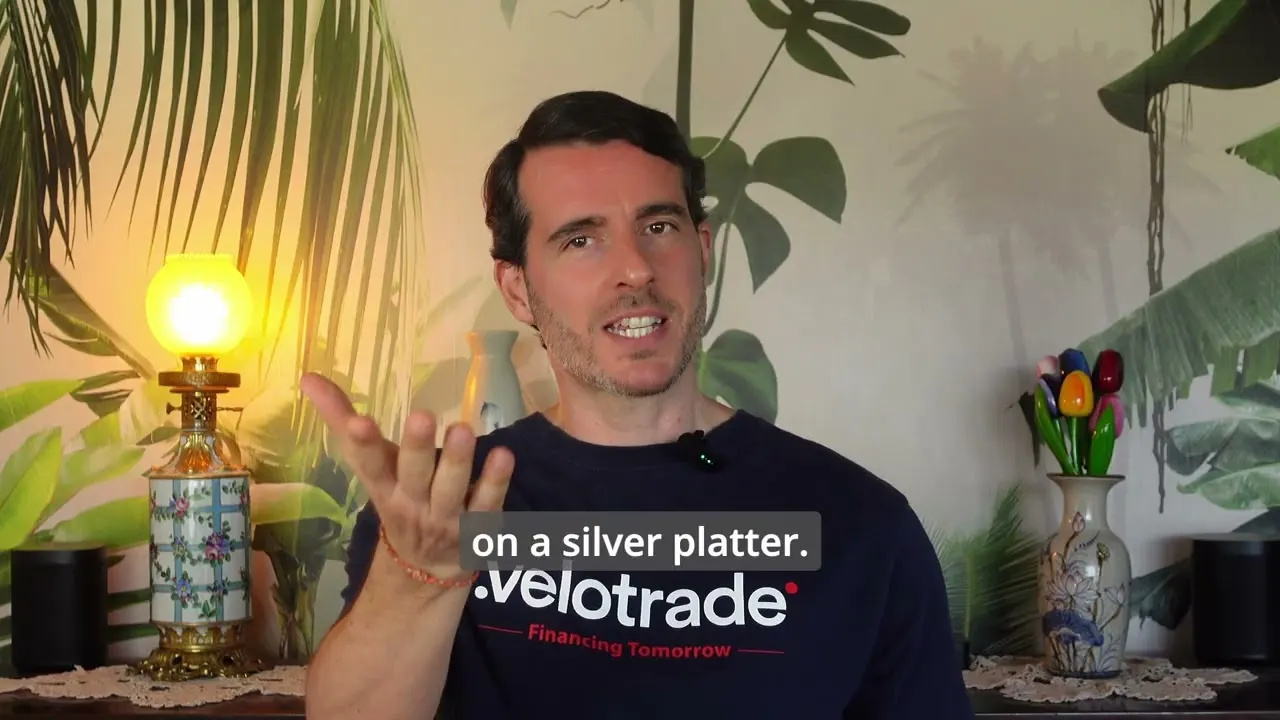 3:27
3:27Read the transcript
You just made $1,000 on a trade. Congratulations! Now, answer one simple question. Where did that $1,000 come from?
I am Gianluca Pizzituti, CEO of Velotrade. I've been trading for over 25 years, institutionally and privately. And the day you properly understand what I'm about to explain is the day you become a much humbler trader.
When we talk about short-term trading, especially in derivatives, your profit does not appear out of thin air. If you make $1,000, somebody else, or several participants collectively, has taken the corresponding economic loss.
And when you lose $1,000, that value has gone to somebody else. It might be another trader, it might be an institution, it might be spread across many different positions. The identity does not matter. What matters is that every trade has another side, before costs.
That is the basic logic of a zero-sum game. After fees, spreads and slippage, it becomes even harder, because the participants collectively have less money left.
Once you understand that, trading suddenly looks very different. You are not pressing buttons against an empty screen. You are competing with people who may have spent five, ten or twenty years developing their skills. They have studied, they have made mistakes, they have lost money, they have built systems.
And now you arrive with six months of experience and believe the market will hand you the money on a silver platter. Why would it? Nobody gives money away easily. If you want to take value from somebody else, you need to bring skills, preparation and discipline to the table.
This is why I do not believe the fantasy you see online: trade for two hours, spend the rest of the day on the beach and become a millionaire. Can somebody trade for two hours a day? Of course! But those two hours may sit on top of ten or twenty years of work.
The person on the other side may have spent the whole day researching, preparing and waiting for exactly that opportunity. The two hours you see are not the whole story. They are the visible result of the years you did not see.
Think about your own profession. Think about the skills you use every day. Could somebody arrive tomorrow with no experience and perform at your level immediately? Obviously not!
You worked for it, you made mistakes, you earned that experience. Trading is exactly the same. You can become successful, but you cannot skip the learning process. The market does not care how confident you feel. It only exposes what you actually know.
So next time you make money, ask yourself who was on the other side. And next time you lose, remember that somebody else was better positioned for that moment.
That thought should not discourage you. It should humble you. And humility is where real improvement begins.
Before this video, had you ever genuinely asked where your trading profit came from? Yes or no? Drop it in the comments.
A stop being hit is not a personal failure to avoid at any cost. It means another participant read the situation better this time. As Pizzituti puts it, "The market does not care how confident you feel."
Payout proof
Fast, real payouts. Traceable on Arbitrum.
- Paid within 24 hours of approval
- Settled on Arbitrum in USDC or USDT
- Look up any transaction on Arbiscan


How does loss aversion show up in trading?
Loss aversion shows up as a set of recognisable habits, all of which make losses larger and gains smaller than the plan intended.
Holding losers and cutting winners
The most common pattern is closing winners quickly to "lock in" the good feeling while holding losers in the hope they return to breakeven. The result is many small wins and a few large losses, the opposite of what most strategies need.
The disposition effect
Researchers Hersh Shefrin and Meir Statman named this pattern the disposition effect in 1985: investors tend to sell assets that have risen in value too early and hold assets that have fallen too long. Terrance Odean (1998) found the same pattern in real brokerage accounts. Research in behavioural finance suggests loss aversion is one of its main drivers.
Moving the stop-loss
Moving a stop further away as price approaches it is loss aversion in its purest form. The evidence against the trade has grown, yet the trader gives it more room because hitting the stop would make the loss real.
Refusing to take a loss at all
Some traders remove the stop entirely or add to a losing position to "average down" a better entry price. Both feel like action. Both increase exposure to a trade that is already proving wrong.
Revenge trading
When a loss is finally taken, loss aversion often turns into a need to win it back immediately. That is how revenge trading starts: bigger size, lower quality setups and a goal of erasing the red number rather than following the plan.

Worked example: how loss aversion turns 1R into 3R
Assume a 10,000 dollar account and a plan to risk 1% per trade, which is 100 dollars. One unit of planned risk is called 1R, so 1R = 100 dollars.
The planned trade: Buy at 50.00 with a stop at 49.00 and a target at 52.00. The stop is 1.00 away, so position size is 100 / 1.00 = 100 units. Risk is 100 dollars (1R) and the target pays 200 dollars (2R). That is a 1:2 risk-reward ratio.
What loss aversion does:
- Price falls to 49.20. The trader moves the stop to 48.00 "to give it room". Risk is now 2.00 x 100 = 200 dollars, or 2R.
- Price falls to 48.20. The stop moves again, to 47.00. Risk is now 3.00 x 100 = 300 dollars, or 3R.
- Price hits 47.00. The loss is 300 dollars, three times the plan.
Meanwhile, on the winning trades, the same trader closes at +1R instead of +2R because the profit "might disappear".
Compare two traders over 10 trades with a 40% hit rate (4 winners, 6 losers):
| Disciplined trader | Loss-averse trader | |
|---|---|---|
| Average win | +2R (200 dollars) | +1R (100 dollars) |
| Average loss | -1R (100 dollars) | -2R (200 dollars, stops moved on some trades) |
| 4 wins | +800 dollars | +400 dollars |
| 6 losses | -600 dollars | -1,200 dollars |
| Net result | +200 dollars | -800 dollars |
Same entries, same win rate, opposite outcomes. These numbers are illustrative, not a forecast; broker disclosures and academic studies consistently find that most retail day traders lose money, and poor loss management is one of the common reasons.
How do you overcome loss aversion in trading?
You overcome loss aversion by deciding your loss before you enter, then using tools that make that decision hard to change in the moment. Willpower rarely survives a red screen; structure does.
- Pre-set every stop before entry. Write down the level and why it sits there. No defined stop, no trade. The stop-loss guide covers placement methods.
- Think in R-multiples, not dollars. Record every trade as a multiple of planned risk: -1R, +2R, +0.5R. A -1R loss is a budgeted cost; a -3R loss is a rule break.
- Use bracket orders. A bracket order places the entry, stop-loss and take-profit together, so the exit plan exists in the platform before emotions arrive. Pizzituti's general preference for limit orders fits here too; see market order vs limit order.
- Size positions so each loss is small. If a single loss is 0.5% to 1% of the account, it is much easier to accept. Example: 10,000 dollar account, 0.5% risk = 50 dollars; with a stop 2% below entry, position size = 50 / 0.02 = 2,500 dollars. The position size calculator does this arithmetic for you.
- Never widen a stop, only tighten it.
- Review your journal weekly. Sort trades by R-multiple and look for losses larger than -1R and winners closed well before target. Those two lists are your loss aversion, measured. The trading journal guide shows what to log.
Fixed stops vs trailing stops
The chart below shows two stop types that fit these rules. The fixed stop defines the risk at entry; the trailing stop steps up under each higher low and never widens the original risk.
Loss aversion vs healthy risk management
Risk management accepts small losses on purpose to prevent large ones; loss aversion refuses small losses and ends up with large ones.
| Loss aversion | Healthy risk management | |
|---|---|---|
| Attitude to a loss | Avoid realising it | Accept it as a planned cost |
| Stop-loss | Moved, widened or removed | Set before entry, never widened |
| Winning trades | Closed early to feel safe | Managed to target or trailed |
| Position size | Often increased to win back losses | Fixed fraction of the account |
| Result over time | Few large losses, many small wins | Many small losses, room for larger wins |
The test is simple: did the actual loss match the planned loss? If yes, that is discipline. If it grew because you could not close the trade, that is loss aversion. See trading discipline and risk management in trading.
How does loss aversion affect a prop firm challenge?
Loss aversion is especially costly in a prop firm evaluation because the account has hard loss limits. Velotrade's simulated evaluations use two: a daily loss limit that resets at 00:30 UTC and is set from the higher of balance or equity (5% on CLASSIC 2-Step, 4% on CLASSIC 1-Step, 3% on PRO 1-Step), and a static maximum drawdown that is a fixed floor below the starting balance (10%, 7% and 3% respectively).
Those limits act as an external stop-loss on the whole account. On a 10,000 dollar CLASSIC 2-Step account, the daily limit is 500 dollars: five planned 1R losses of 100 dollars, or fewer than two loss-averse 3R losses. See the static maximum drawdown explainer and why traders fail prop challenges. There is no time limit (each phase has a minimum trading period), so there is no clock pushing you to recover losses quickly. This is educational content, not investment advice.
Can AI help with loss aversion?
AI tools can help you spot loss aversion in your own data: scanning a journal for losses larger than planned risk, flagging winners closed early, or backtesting fixed stops against discretionary exits. Our guides to AI trading strategies and backtesting trading strategies cover how that analysis works.
AI does not remove risk or the emotion of a live loss. You still have to set the stop, size the position and accept the outcome, so human judgement remains essential.
Sources
- Kahneman and Tversky, "Prospect Theory: An Analysis of Decision under Risk", Econometrica (1979): prospect theory and the reference point.
- Tversky and Kahneman, "Advances in prospect theory: Cumulative representation of uncertainty" (1992): loss aversion coefficient of about 2.25.
- Shefrin and Statman, "The Disposition to Sell Winners Too Early and Ride Losers Too Long" (1985): named the disposition effect.
- Odean, "Are Investors Reluctant to Realize Their Losses?", Journal of Finance (1998): disposition effect in real brokerage accounts.
Frequently Asked Questions
About the author

Gianluca Pizzituti
Chief Executive Officer
Formerly on the derivatives desk at Dresdner Kleinwort in London, then founded and ran a proprietary HFT firm in FX and equity indices out of Singapore.
View author page