One account, every market we offer
ExploreThe difference between a market order and a limit order comes down to one trade-off: certainty of execution versus control of price. A market order fills immediately at whatever price is available. A limit order fills only at the price you choose, or better, and may never fill at all. Most of the time the gap between the two looks small. On the wrong day it can be the difference between a normal loss and a wiped-out account.
Gianluca Pizzituti, Co-Founder and CEO of Velotrade, has traded for more than 25 years, institutionally and privately, including at a bank in London and building algorithmic strategies in Singapore. He calls the market order "the one order type that can quietly destroy your account," and after a quarter of a century he still does not use it. This guide explains how each order type works, where stop and stop-limit orders fit, what slippage and order book depth really mean, and when a market order is genuinely acceptable.
Quick answer: A market order buys or sells immediately at the best available price, guaranteeing a fill but not the price. A limit order trades only at your chosen price or better, guaranteeing the price but not the fill. Market orders risk slippage in thin or fast markets; limit orders risk missing the trade.
Highlights of this article
- A market order buys or sells immediately at the best available price, so you get certainty of a fill but no control over the price
- A limit order sets the worst price you will accept; you control the price, but the order may not fill
- Stop orders and stop-limit orders are triggers: a stop becomes a market order when hit, a stop-limit becomes a limit order
- Slippage happens when a market order "walks the book" through thin liquidity, which is worst after hours, in thin stocks and during crypto crashes
- On 10 October 2025, the largest liquidation event in crypto history, traders using market orders and stops were filled at prices they would never have chosen
- Gianluca's institutional rule: use market orders sparingly, if at all, and never in a thin or chaotic book
 3:25
3:25Read the transcript
Every time you use a market order, you are telling the market: fill me at whatever price you want. And one day it will.
I'm Gianluca Pizzituti, CEO of Velotrade. I've been trading for over 25 years, institutionally and privately, and I want to talk about the one order type that can quietly destroy your account.
There are two ways to get into a trade: a limit order and a market order. A limit order lets you set the exact price you are willing to buy or sell at. You are in control. If the market never reaches your price, you simply do not get filled.
A market order is a completely different animal. A market order says: I do not care about the price, just fill me now at whatever is available. And that one word, whatever, is where all the danger lives.
When I traded institutionally, the market order was taboo. I mean it. You did not touch it. Especially not after hours, and especially not on a thin book where there is barely anyone on the other side. It was drilled into us from day one: use a market order sparingly, if at all.
Because the moment liquidity dries up, a market order reaches up or down the order book and fills you at prices you would never agree to. And I will be honest with you, to this day I still never trade with a market order. Always limit orders. Always.
And here is where it gets brutal. This is exactly what happens, especially in crypto, when something horrible hits the market. Think about the 10th of October 2025.
Bitcoin fell more than $10,000 in a matter of minutes, and around $17,000 across the day, from roughly $122,000 down to about $105,000. It was the largest liquidation event in the history of crypto. Over $19 billion in leveraged positions wiped out. More than 1.6 million accounts gone.
Everybody got hurt that day. But the people who got wiped out completely were the ones sitting on market orders. Because when you fire a market order into chaos like that, you have handed your fill over on a silver platter.
You told the exchange: fill me at whatever is available. And it did. It filled you exactly where it suited the other side of the trade. And leveraged longs got destroyed.
So please understand this carefully. A market order is not a convenience. It is a dangerous tool. Use it very sparingly, and only when you fully understand the risk you're taking.
Because the day will come, maybe not today, maybe not this year, when your market orders cost you a multiple of what they should have.
So be honest with me. Do you trade with market orders or limit orders? And has a market order ever filled you somewhere brutal? Drop it in the comments. I want to hear your stories.
What is a market order?
As Investor.gov, the SEC's investor education site, explains, a market order is an instruction to buy or sell immediately at the best price currently available. You specify the instrument and the size, but not the price. The exchange or venue matches your order against whatever is resting on the other side of the order book right now.
A market buy is filled against the lowest offers (asks); a market sell against the highest bids. In a deep market such as a major forex pair or a large-cap stock during regular hours, you usually get a price very close to the one on your screen.
Gianluca puts the real meaning of a market order bluntly. "Every time you use a market order, you are telling the market: fill me at whatever price you want. And one day it will." The order says you do not care about the price, only about getting filled now. "And that one word, whatever, is where all the danger lives."
The appeal is speed and certainty: in a normal market you are filled instantly, with nothing left resting in the book. The cost is that you have no price control, you always pay the spread, and in thin or fast markets your average fill can land far from the last traded price.
What is a limit order?
A limit order is an instruction to buy or sell at a specific price or better. A buy limit at 100 will only fill at 100 or lower. A sell limit at 100 will only fill at 100 or higher. If the market never reaches your price, the order simply sits in the book until it fills, expires or you cancel it.
"A limit order lets you set the exact price you are willing to buy or sell at," Gianluca explains. "You are in control. If the market never reaches your price, you simply do not get filled."
The cost of a limit order is that you can miss a trade. That feels painful when price runs away without you, but a missed trade costs nothing. A terrible fill costs real money.
Limit orders also impose discipline, because you have to decide your level before you click instead of chasing. The trade-offs are partial fills (only part of your size trades at your price) and resting orders that need managing, or they can fill later when conditions have changed.
How do stop orders and stop-limit orders work?
Stop orders add a trigger: they sit dormant until price reaches a level you set, then turn into a market or limit order. They are mostly used to exit (a stop-loss), but can also enter on a breakout.
A stop order (often called a stop-market order) sits dormant until price touches your stop level. Once triggered, it becomes a market order. It inherits every weakness of a market order: if price gaps through your stop, or the book is thin when it triggers, you can be filled well beyond your stop level.
A stop-limit order has two prices: the stop price that triggers it and the limit price that caps the fill. When triggered, it becomes a limit order. You get price protection, but if the market moves straight through your limit, the order may not fill and you can be left in a losing position.
In short: a stop-market order guarantees you get out, but not at what price. A stop-limit order guarantees the price, but not that you get out.

Market vs limit vs stop vs stop-limit: comparison table
| Market order | Limit order | Stop order | Stop-limit order | |
|---|---|---|---|---|
| What it does | Fills immediately at best available price | Fills only at your price or better | Becomes a market order when the stop price is touched | Becomes a limit order when the stop price is touched |
| Price control | None | Full | None once triggered | Full once triggered |
| Guarantee of fill | Yes, if anyone is on the other side | No | Yes once triggered, at any price | No |
| Slippage risk | High in thin or fast markets | None beyond your limit | High, especially on gaps | None beyond your limit |
| Main risk | Terrible fill in a thin book | Missing the trade | Filled far past your stop | Not filled at all while price runs |
| Typical use | Small size in very liquid markets | Planned entries and profit targets | Emergency exits (breakout entries are safer as stop-limit orders) | Controlled exits and entries in volatile markets |
What causes slippage on a market order?
Slippage happens when a market order is larger than the liquidity resting at the best price, so it fills across several worse levels. To understand why market orders can hurt, you need to picture the order book. At any moment there is a ladder of resting buy orders (bids) below the price and resting sell orders (offers) above it. Each level holds a certain quantity. The total quantity available near the current price is what traders call depth.
Imagine a stock where the best offer is 50.00 for 200 shares, then 50.05 for 300 shares, then 50.20 for 500 shares. If you send a market order to buy 1,000 shares, you do not get 1,000 shares at 50.00. You get 200 at 50.00, 300 at 50.05 and 500 at 50.20. Your average price is about 50.12, not the 50.00 you saw on screen. That difference is slippage, and it happens because your order "walked the book."
In a deep market the levels are packed close together and slippage is tiny. In a thin market the gaps between levels are wide and the quantity at each level is small. "The moment liquidity dries up," Gianluca says, "a market order reaches up or down the order book and fills you at prices you would never agree to."
Slippage is not a fee. It is the price of demanding immediacy from a market without enough liquidity to give it to you cheaply. If you want to see who actually supplies that liquidity, and how big players read it, our guide to order flow trading goes deeper.
When does liquidity disappear?
- After hours and pre-market. Extended-hours stock and ETF sessions have far fewer participants, wider spreads and less depth.
- Thinly traded instruments. Small-cap stocks and low-volume tokens may have only a handful of orders near the price.
- Around major news. Market makers often pull their quotes seconds before releases like US payrolls. Our guide to NFP trading covers why spreads blow out in those moments.
- During crashes. When everyone wants to sell at once, bids vanish just as the selling arrives.
"The market order was taboo": an institutional view
Gianluca learned his order discipline on institutional desks, where poor execution was treated as a real cost, not bad luck. "When I traded institutionally, the market order was taboo," he recalls. "I mean it. You did not touch it. Especially not after hours, and especially not on a thin book where there is barely anyone on the other side."
The rule was drilled in from day one: use a market order sparingly, if at all. In effect, a market order sent into a thin book hands value to whoever is resting on the other side.
That connects to another of Gianluca's core lessons: every trade has someone on the other side. In short-term trading your profit before costs is broadly someone else's loss, and fees, spreads and slippage only make that game harder.
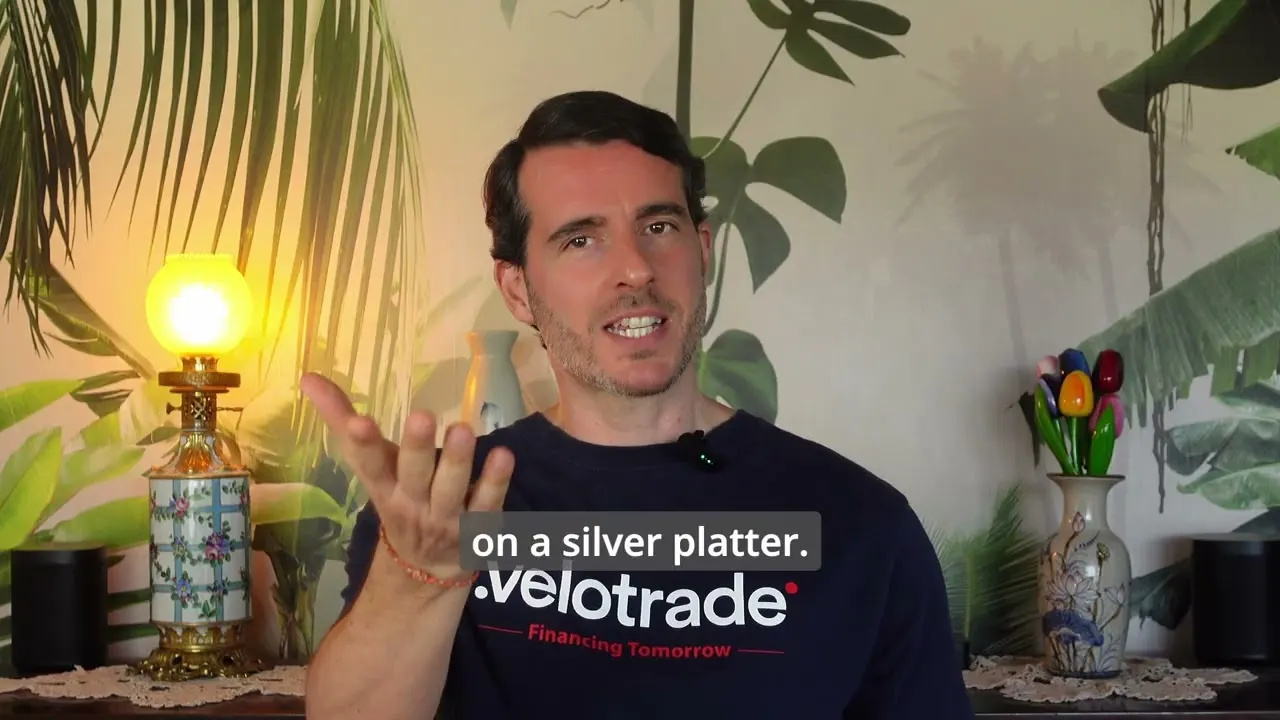 3:27
3:27Read the transcript
You just made $1,000 on a trade. Congratulations! Now, answer one simple question. Where did that $1,000 come from?
I am Gianluca Pizzituti, CEO of Velotrade. I've been trading for over 25 years, institutionally and privately. And the day you properly understand what I'm about to explain is the day you become a much humbler trader.
When we talk about short-term trading, especially in derivatives, your profit does not appear out of thin air. If you make $1,000, somebody else, or several participants collectively, has taken the corresponding economic loss.
And when you lose $1,000, that value has gone to somebody else. It might be another trader, it might be an institution, it might be spread across many different positions. The identity does not matter. What matters is that every trade has another side, before costs.
That is the basic logic of a zero-sum game. After fees, spreads and slippage, it becomes even harder, because the participants collectively have less money left.
Once you understand that, trading suddenly looks very different. You are not pressing buttons against an empty screen. You are competing with people who may have spent five, ten or twenty years developing their skills. They have studied, they have made mistakes, they have lost money, they have built systems.
And now you arrive with six months of experience and believe the market will hand you the money on a silver platter. Why would it? Nobody gives money away easily. If you want to take value from somebody else, you need to bring skills, preparation and discipline to the table.
This is why I do not believe the fantasy you see online: trade for two hours, spend the rest of the day on the beach and become a millionaire. Can somebody trade for two hours a day? Of course! But those two hours may sit on top of ten or twenty years of work.
The person on the other side may have spent the whole day researching, preparing and waiting for exactly that opportunity. The two hours you see are not the whole story. They are the visible result of the years you did not see.
Think about your own profession. Think about the skills you use every day. Could somebody arrive tomorrow with no experience and perform at your level immediately? Obviously not!
You worked for it, you made mistakes, you earned that experience. Trading is exactly the same. You can become successful, but you cannot skip the learning process. The market does not care how confident you feel. It only exposes what you actually know.
So next time you make money, ask yourself who was on the other side. And next time you lose, remember that somebody else was better positioned for that moment.
That thought should not discourage you. It should humble you. And humility is where real improvement begins.
Before this video, had you ever genuinely asked where your trading profit came from? Yes or no? Drop it in the comments.
With a market order you pay for immediacy, and those resting limit orders get paid. Gianluca's point is that immediacy is rarely worth that price. "To this day I still never trade with a market order," he says. "Always limit orders. Always."
10 October 2025: when market orders met a crash
The clearest recent example came on 10 October 2025. Following a sharp risk-off move in global markets that evening, crypto sold off violently. Bitcoin dropped by more than $10,000 within minutes, and across the session fell from around $122,000 toward roughly $105,000 at the lows on some venues. Many smaller tokens fell far further, with some briefly trading at a fraction of their prior price on certain exchanges.
Widely cited liquidation trackers recorded roughly $19 billion of leveraged positions liquidated, across more than 1.6 million trader accounts. It is regarded as the largest liquidation event in the history of crypto.
"Everybody got hurt that day," Gianluca says. "But the people who got wiped out completely were the ones sitting on market orders." When bids disappeared, every market order to sell, every stop that converted to a market order and every forced liquidation hit the same thin book at the same time. Each one pushed price lower and triggered the next. "You told the exchange: fill me at whatever is available. And it did. It filled you exactly where it suited the other side of the trade."
That is how a flash crash works: liquidity vanishes at the very moment demand for it peaks, and market orders have no defence against that. A sensible stop-loss offers little protection if it converts to a market order inside an empty book. If you trade with leverage, our explainer on what liquidation means in trading shows how quickly a margin buffer can disappear in a move like this.

When is a market order acceptable?
Gianluca calls the market order "not a convenience" but "a dangerous tool," to be used very sparingly and only when you fully understand the risk. It is most defensible when all of these are true:
- The instrument is highly liquid (major forex pairs, large-cap stocks, the largest crypto pairs) and you are trading during its main session
- Your size is small relative to the depth at the top of the book
- No major economic release or event is due in the next few minutes
- Getting out matters more than the price, for example closing a position that has broken your risk rules
Even when being filled is the priority, many experienced traders use an aggressive limit order (a buy limit placed slightly above the offer, or a sell limit slightly below the bid). It behaves almost like a market order in a normal book but caps the damage if the book is thin.
How can you protect yourself from bad fills?
- Default to limit orders. Decide the worst price you will accept before you click, and put it in the order.
- Check the spread and depth first. A wide spread is the market telling you liquidity is poor.
- Avoid market orders after hours and around news. If you must trade then, use limits.
- Understand how your stops execute. Know whether your stop becomes a market order or a limit order, and what happens if price gaps through it.
- Size so that slippage cannot break you. Base your position on the distance to your stop plus a buffer for bad fills. The free position size calculator helps with the maths, and our guide to the risk-reward ratio explains why planned exits matter.
- Respect hard loss limits. In a prop evaluation with a static maximum drawdown, one bad fill in a thin market can consume a large share of your buffer in seconds. Execution discipline is risk management.
Execution mistakes are one of the quieter reasons traders fail evaluations, usually as a series of fills slightly worse than planned. Our article on why traders fail prop challenges covers the broader patterns, and our guide to the top prop firms compares the loss limits those fills count against. If you want to practise building that discipline across crypto and other markets in a simulated environment, Velotrade's challenges are designed for exactly that kind of rules-based trading.
This article is educational and is not investment advice.
Sources
- Investor.gov (SEC), "Types of Orders": defines market, limit, stop and stop-limit orders.
- Investor.gov (SEC), "Market Order": market orders fill at the next available price.
- Investor.gov (SEC), "Stop Order": how stop orders trigger and execute.
- Investor.gov (SEC), "Bid Price/Ask Price": bids, asks and the spread a market order pays.
Frequently Asked Questions
About the author

Gianluca Pizzituti
Chief Executive Officer
Formerly on the derivatives desk at Dresdner Kleinwort in London, then founded and ran a proprietary HFT firm in FX and equity indices out of Singapore.
Velotrade was founded in Hong Kong in 2016 by a team from JP Morgan, Dresdner Kleinwort and Bank of America, has paid out over $2.5 billion to its trade-finance clients, and has been featured in Bloomberg, the Financial Times, the Wall Street Journal and on Nasdaq. Its prop trading evaluations are simulated and educational.
View author page