One account, every market we offer
ExplorePaper trading is practising trades with virtual money instead of real money. You place buy and sell orders on live or historical prices, the platform tracks your profit and loss, and nothing you do costs you anything. It is the standard way to learn a platform, test a plan and build routines before you risk capital, whichever of the types of trading you want to pursue.
Quick answer: Paper trading is simulated trading with virtual funds on real market prices, used to learn order types, test a strategy and build habits without financial risk. Paper trading results usually look better than live results because simulated fills ignore slippage and partial fills, and because trading imaginary money removes the fear and greed that drive real decisions.
Highlights of this article
- Paper trading means placing orders with virtual money on real prices, so mistakes cost nothing
- It is best for learning a platform, practising order types and testing whether a plan is followable
- Its limits are real: no emotional pressure, idealised fills, little or no slippage and often no costs
- Make it realistic by using the account size you will actually trade, logging every trade and subtracting costs
- Move on when you have a written plan, a sample of journaled trades and a positive result after costs
- A simulated prop evaluation sits between paper trading and a live account: the account is simulated, but the fee is real money and the rules are enforced
In this short video, Gianluca Pizzituti, Velotrade's co-founder, explains why trading is a profession that takes years to learn, and why practice alone does not show you how you will behave when real money is at stake.
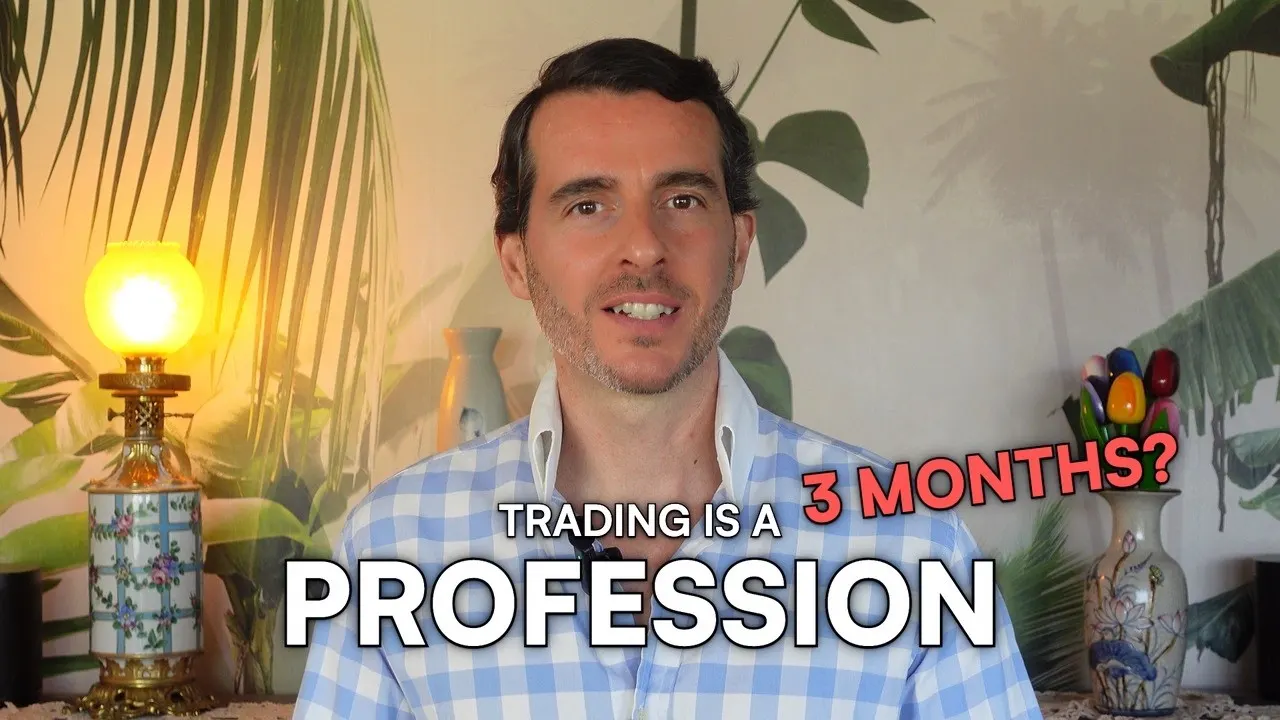 4:20
4:20Read the transcript
If trading is a profession, why do so many people expect to master it in three months?
After my last video about becoming a successful trader, I received several private messages. I am Gianluca Pizzituti, CEO of Velotrade. I've been trading for over 25 years, both institutionally and privately. So I want to expand on one point.
Trading can be a profession. You may do it for a living, or alongside another job. But if you call it a profession, you must approach it professionally, not casually. Not only when you feel like it.
Think about any serious profession. First, you research it. You understand what the work involves and decide whether it is genuinely what you want to pursue. Then you study. You learn the principles, the tools and the language of the profession.
After that, you begin applying what you've learned, slowly, through practice and experience. If you develop enough competence, you can operate consistently. Only then do you become capable of working in an environment that is supposed to be a profession.
Trading is no different. That environment does not need to be a bank or an office. You can create it at home.
How many hours will you commit every day or every week? How much capital can you responsibly allocate? Which markets will you study? Which tools and information sources do you need? When will you review your decisions and performance?
A profession receives a defined part of your time on a regular basis. If you only do it whenever you feel like it, you are treating it as a hobby.
Now, put all of that together. Do you genuinely believe you can go from zero to consistent professional success in three months? It is extremely unlikely. What about six months? That depends on your effort, background and objectives.
But even then, knowledge is not the same as developed skill. You can watch every trading video on YouTube. That does not mean you have built judgement. It doesn't mean you have experienced enough market conditions. And it does not mean you know how you will behave when real money is at stake.
Forget trading for a moment. Think about the profession you already know. How long did it take you to reach your current level? How many mistakes did you make? How many difficult situations did you need to experience before people could rely on your judgement?
It probably took years. So why would trading be the only profession you can master in three months? That is one of the most damaging misconceptions in retail trading.
The problem is not wanting to become successful quickly. Everybody wants that. The problem is believing a shortcut exists and building your expectations around it.
If you expect professional results without accepting the professional learning process, every setback will seem like failure. In reality, it is part of developing the skill.
And there is another important moment in that journey: the moment you realize paper trading is not the same as trading with real money. That deserves a separate video.
So before you call trading your profession, ask yourself whether your routine reflects that ambition. If you want professional results, you must treat trading like a profession long before it pays you like one.
Think about your current profession. How many years did it take you to become genuinely competent? Drop your answer in the comments or send me a message. See you in the next video.
What is paper trading?
Paper trading is trading on a simulated account without committing real money. The name comes from traders once writing hypothetical orders in a notebook. Now most brokers, charting platforms and exchanges offer a demo or "paper" account that mirrors live prices and fills your orders automatically.
The goal is not virtual profit. It is to answer practical questions before money is involved: Do you know how to place a limit order versus a market order? Can you set a stop loss without fumbling? Does your strategy produce trades you can actually take during the hours you are free?
| Item | Detail |
|---|---|
| Definition | Simulated trading with virtual funds on real or historical market prices |
| Cost | Usually free on broker, exchange and charting platforms |
| Best for | Learning the platform, practising order types, testing whether a plan is followable |
| Main limits | No emotional pressure, idealised fills, no slippage, costs often ignored |
| Main risk | Overconfidence from results that would not survive live conditions |
| How long | Until you have a written plan and a meaningful sample of journaled trades |
| Next step | Small live size, or a simulated prop evaluation with real rules and a real fee |
Want to try this in a prop firm evaluation? Most evaluations are decided by the loss limits and position sizing more than by the setup itself. Start with how to become a funded trader, then the best prop firms for beginners and why traders fail prop challenges.
How do you start paper trading?
You start paper trading by opening a demo account on the platform you intend to use live, then trading it exactly as you would trade real money. Follow these steps:
- Pick the platform you will actually use. Practising on one interface and trading on another wastes the main benefit, which is muscle memory with real order tickets.
- Choose one market and one style. Pick a single instrument group (for example a few forex pairs, an index ETF such as SPY, or bitcoin) and one approach from the trading styles you are considering.
- Set the virtual balance to your real budget. If you plan to trade 5,000 USD, reset the demo to 5,000 USD, not the default 100,000 USD.
- Write down your rules before the first trade. Entry signal, stop loss placement, profit target, maximum risk per trade and maximum trades per day. If you have no setup yet, pick one from our trading strategies guide.
- Size every position from your stop. Decide the amount you risk (for example 1% of the account), then use the position size calculator to turn that into a quantity.
- Log every trade in a journal. Record the setup, entry, exit, size, result and how you felt. A trading journal is what turns practice into learning.
- Review weekly. Look for rule breaks first, results second.
What are the limits of paper trading?
The limits of paper trading are that it removes emotion, assumes ideal execution and often ignores costs, so paper results almost always look better than live results. Knowing each gap lets you correct for it.
No emotions
A virtual loss does not hurt. You will hold a losing trade calmly, take every signal and let winners run, because nothing is at stake. With real money most beginners hesitate on entries, cut winners early and move stops to avoid taking a loss. Gianluca Pizzituti, Velotrade's co-founder, describes the moment you realise "paper trading is not the same as trading with real money" as an important step in every trader's development. Our guide to trading psychology covers the pressures that a demo account cannot recreate.
Perfect fills
Many paper platforms fill your order the instant price touches your level, at exactly your price, for your full size. In a live market a limit order at the exact high or low of a move may never fill, and a large order may only partly fill. This flatters strategies that buy at the precise bottom of a range.
No slippage
Slippage is the difference between the price you expected and the price you actually got. It is common on market orders and stop orders during fast moves or news releases. Paper accounts often fill stops at the stop price itself, while a live stop in a fast market can fill several ticks worse, because, as Investor.gov (SEC) explains, a triggered stop order fills at the next available price. A strategy with tight stops and small targets can turn from winning to losing on slippage alone.
Missing costs
Some demo accounts ignore commissions, the bid-ask spread or overnight financing. Short-term strategies pay these costs most often, so they are flattered most.
How do you make paper trading realistic?
You make paper trading realistic by trading the size you will use live, journaling every trade and deducting the costs a real account would charge. These habits close most of the gap between demo and live results.
Trade your real size
Use the balance and risk per trade you will actually use. A demo account of 100,000 USD with no plan encourages oversized bets that you would never place with 5,000 USD. If you risk 1% per trade on a 5,000 USD account, every trade risks 50 USD, and that number should be the same in practice and live.
Measure results in R
R is the amount you risk on a trade. If your stop is 50 USD away from entry in dollar terms, a trade that makes 100 USD is +2R and a full stop out is -1R. Measuring in R makes results comparable across instruments and position sizes.
The chart shows ten journaled trades: four winners (+2R, +1.5R, +3R and +2R) and six losers (five full losses of -1R and one -0.5R). That is a 40% win rate, yet the total is +3R, because the four winners add up to +8.5R and the six losers to -5.5R (8.5 minus 5.5 equals 3). This is the kind of sample a journal produces, and it shows why win rate alone tells you little.
Deduct costs and assume worse fills
Subtract a realistic spread and commission from every paper trade, and assume stops fill a little worse than the stop price. If your platform does not do this, do it in your journal. A simple rule: if the strategy only works when every fill is perfect, it does not work.
Know your break-even win rate
Before judging any paper results, know what win rate your reward-to-risk ratio requires. Our guide to the risk-reward ratio explains the maths in more depth.
The chart shows the break-even win rate falling as reward-to-risk rises: 50% at 1:1, 40% at 1:1.5, 33.3% at 1:2, 25% at 1:3 and 20% at 1:4. The formula is break-even win rate = 1 / (1 + reward-to-risk). For a 1:2 trade, that is 1 / (1 + 2) = 33.3%. These figures are before fees and spreads, so after costs the bar you need to clear on a paper account is higher.
Respect your schedule
Only count trades taken during the hours you will really be available. If you are learning intraday trading, our guide to day trading for beginners explains how sessions and routines fit together.
Is paper trading worth it?
Paper trading is worth it for learning mechanics and testing whether you can follow a plan, but it is not proof that you will be profitable with real stakes.
| Paper trading is good for | Paper trading is weak at |
|---|---|
| Learning the platform and order tickets | Recreating fear and greed |
| Practising stop loss and target placement | Realistic fills and slippage |
| Checking whether a plan produces trades you can take | Proving a strategy is profitable after costs |
| Building a journaling and review routine | Testing how you handle a losing streak with money at risk |
Backtesting applies rules to historical data, while paper trading runs them forward on live prices. A candlestick patterns or support and resistance setup is a good candidate for both: backtest it first, then paper trade it live.
When should you stop paper trading?
You should stop paper trading when you can follow your written plan consistently, have a meaningful sample of journaled trades and still show a positive result after deducting realistic costs. Practise for long enough to see a range of market conditions, not just one good week.
Signs you are ready to move on:
- You place orders, stops and targets without hesitation or errors
- You have a written plan and rarely break it
- Your journal covers enough trades to include losing streaks, not just a lucky run
- Your results stay positive after spreads, commissions and worse-than-perfect fills
- You know your average win and loss in R and your break-even win rate
You are not ready if your results depend on one or two big trades, you reset the demo after drawdowns, or you change strategy every few days.
Paper trading can also go on too long because it feels safe. As Gianluca Pizzituti puts it, "knowledge is not the same as developed skill", and skill under pressure only develops once something is at stake. Broker disclosures and academic studies consistently find that most retail day traders lose money (according to ESMA, between 74% and 89% of retail CFD accounts lose money), so the next step should be small and controlled.
What comes after paper trading?
After paper trading, most traders either trade a small live account or take a simulated prop evaluation as a middle step. Both add real consequences while keeping the potential loss limited. Our guide on how to become a funded trader maps that path step by step.
Trading a small live account
Real money at small size introduces the emotions and real fills a demo cannot. Keep risk small and keep journaling to see how much of your paper edge survives.
Simulated prop evaluations as a middle step
A prop firm evaluation sits between paper trading and a live brokerage account. At Velotrade, a multi-asset prop trading firm, the trading accounts are simulated too: no orders reach a real market. What changes is that the challenge fee is real money, and the rules are enforced, so breaking them ends the attempt. That adds real stakes and discipline, while your maximum cost is the fee.
On Velotrade evaluations:
- The daily loss limit is 5% on CLASSIC 2-Step, 4% on CLASSIC 1-Step and 3% on PRO 1-Step. It resets every day at 00:30 UTC and is set from the higher of your balance or equity at that time.
- The maximum drawdown is static: a fixed dollar floor set at account activation that does not trail your profits (see static maximum drawdown explained).
- Each phase has a minimum trading period but no maximum time limit, so there is no pressure to rush.
Sizing from your stop and journaling in R are exactly the habits these rules reward. If you want a free way to practise on live prices first, our roundup of the best crypto trading simulators compares paper accounts, testnets and trading games. You can compare evaluation plans on the challenges page.
Can AI help with paper trading?
AI can help with paper trading by analysing your journal, spotting patterns in your mistakes and helping you structure a backtest, but it does not remove the gap between simulated and real execution.
It cannot feel the pressure of a real position for you or guarantee that a strategy works, so its output still needs your judgement. Our guide to AI trading strategies covers where these tools fit and where they fall short.
Sources
- Investor.gov (SEC), "Types of Orders": market, limit and stop orders practised on a demo account.
- Investor.gov (SEC), "Stop Order": triggered stop orders fill at the next available price.
- Investor.gov (SEC), "Bid Price/Ask Price": bid, ask and the spread paper accounts often ignore.
- ESMA, "ESMA agrees to prohibit binary options and restrict CFDs to protect retail investors" (2018): 74% to 89% of retail CFD accounts lose money.
Frequently Asked Questions
About the author

Gianluca Pizzituti
Chief Executive Officer
Formerly on the derivatives desk at Dresdner Kleinwort in London, then founded and ran a proprietary HFT firm in FX and equity indices out of Singapore.
Velotrade was founded in Hong Kong in 2016 by a team from JP Morgan, Dresdner Kleinwort and Bank of America, has paid out over $2.5 billion to its trade-finance clients, and has been featured in Bloomberg, the Financial Times, the Wall Street Journal and on Nasdaq. Its prop trading evaluations are simulated and educational.
View author page