One account, every market we offer
ExploreAs the SEC's Investor.gov explains, a call option gives the buyer the right to buy an asset at a fixed price before or at a set date, and a put option gives the buyer the right to sell it at a fixed price. Buyers of calls profit when the price rises above the strike plus the premium; buyers of puts profit when the price falls below the strike minus the premium. Options are one of several instruments covered in our guide to the types of trading and trading styles, and they are the one where the gap between buying and selling matters most.
This guide defines both contracts, explains what buyers and sellers are each signing up for, and walks through the payoff at expiry with simple numbers: a strike of 100 and a premium of 3.
Quick answer: A call option is a contract that gives its buyer the right, but not the obligation, to buy an underlying asset at a set strike price until expiry. A put option gives its buyer the right to sell at the strike price. Option buyers pay a premium and can lose only that premium; option sellers collect the premium and take on the obligation.
Highlights of this article
- A call is the right to buy at the strike price; a put is the right to sell at the strike price
- The buyer pays a premium and holds a right; the seller receives the premium and carries an obligation
- With a strike of 100 and a premium of 3, a long call breaks even at 103 and a long put breaks even at 97
- Buying an option caps your loss at the premium; selling an option caps your gain at the premium
- A short call has an open-ended loss if price keeps rising, which is why selling options carries large risk
- Velotrade, a multi-asset prop trading firm, does not offer options trading; its evaluations cover crypto, forex, stocks, index ETFs and commodities
What is the difference between a call and a put?
The difference between a call and a put is direction: a call gains value when the underlying price rises, and a put gains value when the underlying price falls. Both are option contracts: one side holds a right, the other an obligation.
| Item | Detail |
|---|---|
| Call option | Right to buy the underlying at the strike price until expiry |
| Put option | Right to sell the underlying at the strike price until expiry |
| Strike price | The fixed price at which the option can be exercised |
| Premium | The price the buyer pays the seller for the option |
| Expiry | The date after which the option no longer exists |
| Contract size | Listed US equity options usually cover 100 shares per contract |
| Long call breakeven | Strike + premium (100 + 3 = 103) |
| Long put breakeven | Strike minus premium (100 minus 3 = 97) |
| Main risk for buyers | Losing the full premium if the option expires worthless |
| Main risk for sellers | Losses far larger than the premium received |
What are the key option terms?
The key option terms are the strike, the premium and the expiry, applied to an underlying asset such as a stock, an index, an ETF or a commodity. Every payoff in this article is built from these numbers.
What is the strike price?
The strike price is the fixed price written into the contract. A 100-strike call lets its buyer buy at 100; a 100-strike put lets its buyer sell at 100, wherever the market is trading at the time.
What is the premium?
The premium is the price of the option itself. The buyer pays it upfront and the seller keeps it whatever happens next. In our example the premium is 3 per share, so one contract covering 100 shares costs 3 × 100 = 300 USD.
What is expiry?
Expiry is the last date the option exists. After expiry, an option with no exercise value is worthless, and an option with exercise value is typically settled or exercised according to the exchange's rules.

What are the rights and obligations of buyers and sellers?
The buyer of an option holds a right, and the seller of an option holds an obligation. That asymmetry explains almost everything about how the four basic positions behave.
| Position | Pays or receives premium | What they hold |
|---|---|---|
| Call buyer (long call) | Pays | The right to buy at the strike |
| Call seller (short call) | Receives | The obligation to sell at the strike if assigned |
| Put buyer (long put) | Pays | The right to sell at the strike |
| Put seller (short put) | Receives | The obligation to buy at the strike if assigned |
"Assigned" means the buyer has exercised and the seller must deliver.
How does a long call or long put pay off at expiry?
A long call pays off when the underlying finishes above the strike plus the premium, and a long put pays off when it finishes below the strike minus the premium. In both cases the most the buyer can lose is the premium paid.
The chart below shows both positions at expiry. The flat line at minus 3 is the premium lost when the option finishes worthless. The dotted lines mark the two breakevens: 97 for the put and 103 for the call.
Long call worked example
You buy a 100-strike call for 3. At expiry, the payoff per share is the larger of (price minus 100) or zero, minus the 3 you paid.
| Price at expiry | Exercise value | Minus premium | Profit or loss |
|---|---|---|---|
| 90 | 0 | 3 | minus 3 |
| 103 | 3 | 3 | 0 (breakeven) |
| 110 | 10 | 3 | +7 |
| 120 | 20 | 3 | +17 |
On one contract of 100 shares, a finish at 120 is 17 × 100 = 1,700 USD profit, and any finish at or below 100 is a 300 USD loss.
Long put worked example
You buy a 100-strike put for 3. At expiry, the payoff per share is the larger of (100 minus price) or zero, minus the 3 you paid.
At 80 the put is worth 20, so the profit is 20 minus 3 = +17. At 90 it is +7. At 97 it breaks even. At 100 or above it expires worthless and the loss is the 3 premium.
A long put's maximum profit is the strike minus the premium: 100 minus 3 = 97 per share.
How do you calculate an option's breakeven?
You calculate a call's breakeven by adding the premium to the strike, and a put's breakeven by subtracting the premium from the strike. These formulas apply at expiry and ignore commissions.
For a call: 100 + 3 = 103. For a put: 100 minus 3 = 97. The underlying has to move past the breakeven, not just past the strike, for the trade to make money. Being right about direction is not enough if the move is too small or arrives after expiry.
What do ITM, ATM and OTM mean?
In the money (ITM), at the money (ATM) and out of the money (OTM) describe where the underlying price sits relative to the strike. The labels flip between calls and puts.
| Term | Call (strike 100) | Put (strike 100) | Exercise value |
|---|---|---|---|
| In the money (ITM) | Price above 100 | Price below 100 | Positive |
| At the money (ATM) | Price at or near 100 | Price at or near 100 | Roughly zero |
| Out of the money (OTM) | Price below 100 | Price above 100 | Zero |
ITM does not mean profitable. A 100-strike call with the price at 102 is in the money by 2, but the buyer who paid 3 is still down 1 at expiry. OTM options are cheaper because they need a larger move to pay off.
How does selling a call or put pay off at expiry?
Selling an option pays off when the option expires worthless, so the seller keeps the full premium; the seller loses when price moves through the strike by more than the premium. The maximum gain is always the premium received.
The chart below mirrors the previous one: both the short call and the short put earn +3 when the option finishes out of the money. Past the strike, the line slopes down: the short call loses as price rises, and the short put loses as price falls.
Short call worked example
You sell a 100-strike call for 3. If the price finishes at 95, the call expires worthless and you keep 3. At 103 you break even (3 received minus 3 owed). At 120 you owe 20 and keep 3, a loss of 17 per share, or 1,700 USD on one contract. If the price kept rising, the loss would keep growing, because there is no ceiling on how high a price can go.
Short put worked example
You sell a 100-strike put for 3. At 105 the put expires worthless and you keep 3. At 97 you break even. At 80 you owe 20 and keep 3, a loss of 17 per share. The worst case is the underlying falling to zero: a loss of 100 minus 3 = 97 per share, or 9,700 USD on one contract, against 300 USD of premium collected.
Long call vs long put vs short call vs short put: which is which?
The four basic option positions differ by outlook and by where the risk sits. Buyers have limited risk and large potential reward; sellers have limited reward and large potential risk.
| Position | Outlook | Max gain (per share) | Max loss (per share) | Breakeven |
|---|---|---|---|---|
| Long call | Bullish, expects a strong rise | Unlimited | Premium (3) | Strike + premium (103) |
| Long put | Bearish, expects a strong fall | Strike minus premium (97) | Premium (3) | Strike minus premium (97) |
| Short call | Neutral to bearish | Premium (3) | Unlimited | Strike + premium (103) |
| Short put | Neutral to bullish | Premium (3) | Strike minus premium (97) | Strike minus premium (97) |
Notice that the long call and short call share a breakeven, as do the long put and short put.
Why does selling options carry large risk?
Selling options carries large risk because the seller's gain is capped at the premium while the loss can be many times larger, and in the case of a short call it has no fixed limit. In our example, the seller of a call collects 300 USD per contract but could lose 1,700 USD at 120, and more beyond that.
Vittorio De Angelis, Velotrade's co-founder, spent his career on equity derivatives desks and explains this trade-off in the video below using a short call on the S&P 500. He says your upside is "capped at the amount of premium in your pocket, but your downside is unlimited."
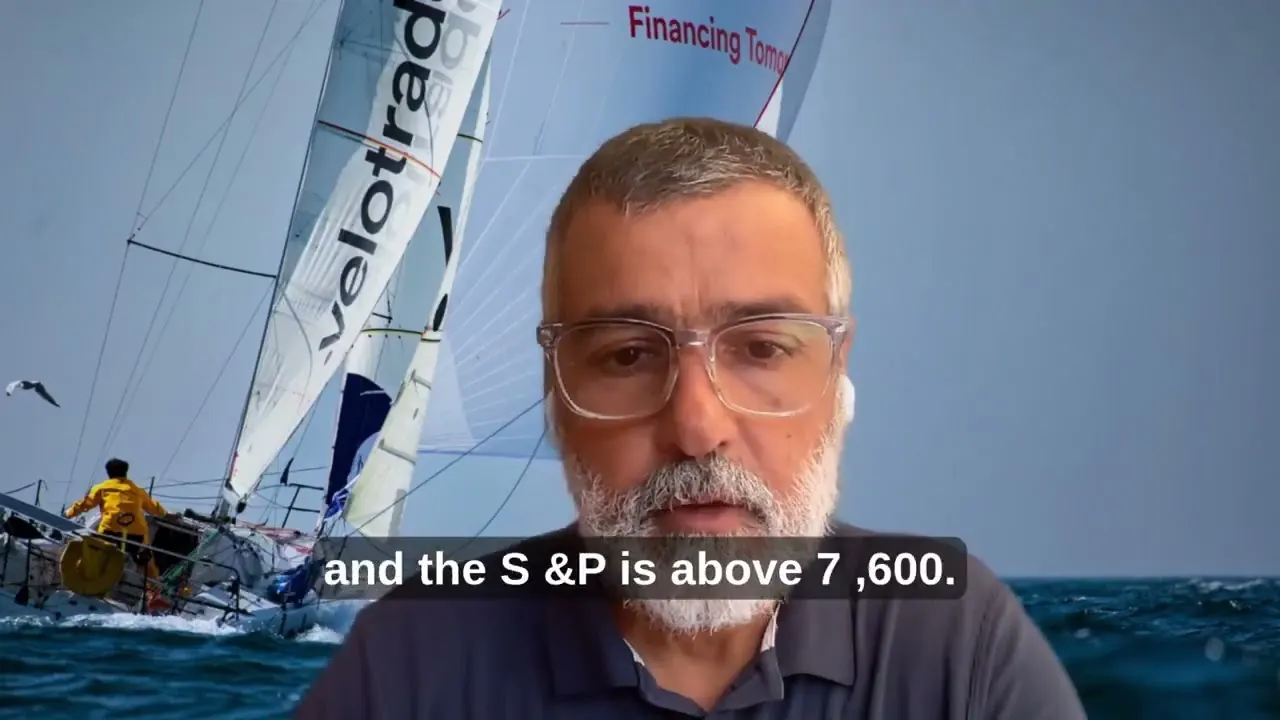 3:42
3:42Read the transcript
Today I would like to discuss trading direction on indices and single stocks by selling options. It's a strategy that can be profitable, but it can also be very, very dangerous. So you've been warned.
When you sell options, your upside is capped at the amount of premium in your pocket, but your downside is unlimited. So beware of what you do.
Let me give an example. The S&P is trading at 7500. I can sell a September 7600 call and pocket, let's say, 50 to 60 points. That money I make upfront, and if at expiry the S&P is below 7600, I pocket the entire premium.
This is great because it actually covers two out of three scenarios. What does that mean? It means that if the S&P doesn't move, I pocket the money, because the call finishes out of the money.
If the S&P goes down, which was my original view, I make all my money from the premium, because obviously the call will expire out of the money. And I'm even covered in the scenario in which the S&P rises a little, up to 7599. Of course, on any move above 7600 the call is in the money and I start losing money.
Again, the point I want to convey is that if the market doesn't move, you're still making money. If I had sold futures and the market didn't move, I wouldn't make money. I would make money only if the market went down.
Why is the call-selling strategy dangerous? Because of course you're pocketing 50 to 60 points, but if the S&P were to rally between now and expiry to, I don't know, 8000, well, you're down 400 points. So you've got a net loss of 350 points, which obviously is a massive multiple of the premium you pocketed.
So beware. Still, the fact that you're covered in two out of three scenarios makes it, per se, an interesting strategy.
Then there are some other little things you can do if you were wrong. Let's say we reach September and the S&P is above 7600, so my calls get exercised and I'm given futures. I end up being short futures at 7600, and realistically, if I've been exercised, it means the S&P is higher than that, so I'm actually losing money.
But I can try to reduce that loss by selling puts. I sell puts on the original strike, that's what I mainly do, 7600. If the S&P were then to come back down to the 7600 level or below, of course I'd be losing money on the short put, but I have the short futures, which make up for that.
So not only do I make up my original loss, I'm also making the extra profit of the premium on the put.
I know this sounds really confusing, so you might have to work it through with a piece of paper. If you're interested, I'm very happy to do it with some graphs and some little numbers, because it might help.
It's food for thought. These strategies can be employed on most underlyings where there is an active options market, and these days option markets, especially the short-dated ones, are extremely liquid. So there are many strategies you can work on with the same frame of mind.
Again, they can be very complex strategies, and they can be very dangerous. Please reach out if you want to discuss them in further detail.
He also points out why sellers accept that risk: a short call makes money if the market falls, if it does not move, or if it rises only a little, covering what he calls "two out of three scenarios". The danger is the fourth scenario that is not covered, a sharp rally, where one loss can wipe out many collected premiums. If you want to go deeper into how sellers manage that risk, read our guide to selling puts and covered calls, which works through his S&P example with numbers.
How do you choose between a call and a put?
You choose a call when you expect the underlying to rise and a put when you expect it to fall, then check whether the expected move is larger than the premium before expiry. A simple routine helps:
- Form a view on direction and on how far the price could travel. Charts help with levels such as support and resistance, but fundamentals and flows matter too (see fundamental vs technical analysis).
- Pick a strike and expiry, then calculate the breakeven.
- Decide the maximum you are willing to lose. For a buyer that is the premium; for a seller it must be set by a defined exit.
- Compare the potential reward with that risk using a risk-reward ratio.
- Plan the entry and exit orders in advance. Gianluca Pizzituti, Velotrade's co-founder, favours limit orders over market orders, which our guide to market order vs limit order explains.
Can AI help with options trading?
AI can help with research around options, such as screening underlyings, analysing a trading journal or backtesting on historical prices. Our guides to AI trading strategies and backtesting trading strategies cover how those workflows fit together.
AI does not remove risk. A model cannot know where a price will be at expiry. Human judgement is still needed to size positions, set exits and decide when not to trade.
Can you trade options at Velotrade?
No. Velotrade does not offer options trading. Its simulated evaluations cover crypto, forex, stocks, index ETFs (SPY, QQQ and IWM) and commodities, traded as direct positions rather than options. If options are your main focus, our guide to options prop firms shows which firms actually allow them.
The concepts in this guide still carry over. Thinking in terms of defined maximum loss, breakevens and risk-reward is exactly what a prop firm evaluation rewards, because every account has a daily loss limit and a static maximum drawdown. See the challenges page for plans. This article is educational and is not investment advice.
Sources
- Investor.gov (SEC), "Options": defines call and put options as rights to buy or sell.
- Investor.gov (SEC), "Types of Orders": how limit and market orders differ when planning entries and exits.
Frequently Asked Questions
About the author

Vittorio De Angelis
Executive Chairman
Former equity-derivatives trader at JP Morgan, Dresdner Kleinwort and Bank of America in London. Later Head of Brokerage at a global broker in Hong Kong.
Velotrade was founded in Hong Kong in 2016 by a team from JP Morgan, Dresdner Kleinwort and Bank of America, has paid out over $2.5 billion to its trade-finance clients, and has been featured in Bloomberg, the Financial Times, the Wall Street Journal and on Nasdaq. Its prop trading evaluations are simulated and educational.
View author page