One account, every market we offer
ExploreSelling options means collecting a premium up front in exchange for taking on an obligation. Selling puts, selling covered calls and selling naked calls are the three most common versions, and they share one trait: the most you can make is the premium, while the most you can lose is many times larger.
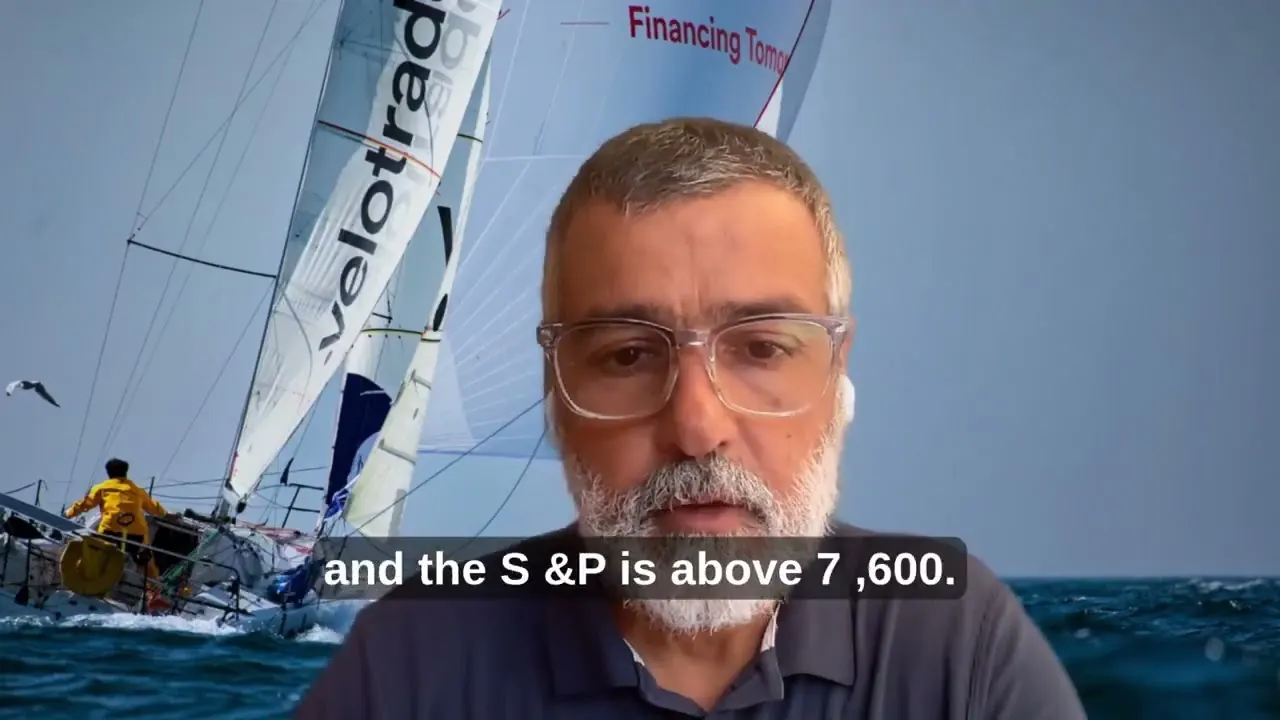
Vittorio De Angelis, Velotrade's Co-Founder and Executive Chairman, spent his career on equity derivatives desks at JP Morgan, Dresdner Kleinwort and Bank of America. In the video below he walks through a trade he likes on the S&P 500, and he opens with a warning: "It's a strategy that can be profitable, but it can also be very, very dangerous." This guide unpacks his example, explains how it differs from covered calls and cash-secured puts, and puts real numbers on every scenario.
Quick answer: Selling options means collecting a premium in exchange for an obligation: a put seller may have to buy the underlying at the strike, a call seller may have to sell it. Covered calls and cash-secured puts are backed by shares or cash; naked calls are not. Your maximum gain is the premium, while losses can be many times larger.
Highlights of this article
- Selling an option pays you a premium now; in return you may have to buy or sell the underlying at the strike price
- A covered call is sold against shares you own, a cash-secured put is backed by cash to buy shares, and a naked call has no offsetting position at all
- Option selling wins in two of three scenarios, but the losing one can cost many multiples of the premium
- Assignment, overnight gaps, margin calls and tail events are the real risks, not the day-to-day noise
- Vittorio's "repair" trick (selling puts at the original strike after being assigned) reduces a loss if the market comes back, but it does not remove the open-ended risk
What does selling options mean?
As Investor.gov, the SEC's investor education site, explains, an option is a contract that gives the buyer a right and the seller an obligation (our guide to call vs put options covers the basics). When you buy an option you pay a premium for the right. When you sell (or "write") an option you receive that premium and accept the obligation.
- Selling a call obliges you to sell the underlying at the strike price if the buyer exercises.
- Selling a put obliges you to buy the underlying at the strike price if the buyer exercises.
The premium is yours to keep whatever happens. If the option expires out of the money, it is your full profit. If it expires in the money, you settle the difference (or receive or deliver the underlying), offset only by the premium.
This is the core asymmetry Vittorio stresses: "When you sell options, your upside is capped at the amount of premium in your pocket, but your downside is unlimited." For a put the loss is technically limited, because a price cannot fall below zero, but on an index or a large stock it can still be enormous compared with the premium.
 3:42
3:42Read the transcript
Today I would like to discuss trading direction on indices and single stocks by selling options. It's a strategy that can be profitable, but it can also be very, very dangerous. So you've been warned.
When you sell options, your upside is capped at the amount of premium in your pocket, but your downside is unlimited. So beware of what you do.
Let me give an example. The S&P is trading at 7500. I can sell a September 7600 call and pocket, let's say, 50 to 60 points. That money I make upfront, and if at expiry the S&P is below 7600, I pocket the entire premium.
This is great because it actually covers two out of three scenarios. What does that mean? It means that if the S&P doesn't move, I pocket the money, because the call finishes out of the money.
If the S&P goes down, which was my original view, I make all my money from the premium, because obviously the call will expire out of the money. And I'm even covered in the scenario in which the S&P rises a little, up to 7599. Of course, on any move above 7600 the call is in the money and I start losing money.
Again, the point I want to convey is that if the market doesn't move, you're still making money. If I had sold futures and the market didn't move, I wouldn't make money. I would make money only if the market went down.
Why is the call-selling strategy dangerous? Because of course you're pocketing 50 to 60 points, but if the S&P were to rally between now and expiry to, I don't know, 8000, well, you're down 400 points. So you've got a net loss of 350 points, which obviously is a massive multiple of the premium you pocketed.
So beware. Still, the fact that you're covered in two out of three scenarios makes it, per se, an interesting strategy.
Then there are some other little things you can do if you were wrong. Let's say we reach September and the S&P is above 7600, so my calls get exercised and I'm given futures. I end up being short futures at 7600, and realistically, if I've been exercised, it means the S&P is higher than that, so I'm actually losing money.
But I can try to reduce that loss by selling puts. I sell puts on the original strike, that's what I mainly do, 7600. If the S&P were then to come back down to the 7600 level or below, of course I'd be losing money on the short put, but I have the short futures, which make up for that.
So not only do I make up my original loss, I'm also making the extra profit of the premium on the put.
I know this sounds really confusing, so you might have to work it through with a piece of paper. If you're interested, I'm very happy to do it with some graphs and some little numbers, because it might help.
It's food for thought. These strategies can be employed on most underlyings where there is an active options market, and these days option markets, especially the short-dated ones, are extremely liquid. So there are many strategies you can work on with the same frame of mind.
Again, they can be very complex strategies, and they can be very dangerous. Please reach out if you want to discuss them in further detail.
How do covered calls, cash-secured puts and naked calls differ?
The three most common option selling strategies look similar on a screen but carry very different risk. Vittorio's S&P 500 example is the third one, a naked call, so it is worth separating them clearly.
| Strategy | What you hold | What you sell | Max gain | Max loss | Typical view |
|---|---|---|---|---|---|
| Covered call | 100 shares per contract | A call above the current price | Premium plus the rise up to the strike | Share price falling to zero, minus the premium | Neutral to mildly bullish |
| Cash-secured put | Cash equal to strike x 100 | A put below the current price | The premium | Strike minus premium, x 100, if the stock goes to zero | Neutral to bullish, happy to buy lower |
| Naked (uncovered) call | Nothing | A call above the current price | The premium | Unlimited, the market can keep rising | Neutral to bearish |
A covered call and a cash-secured put have nearly the same payoff shape (put-call parity). The naked call is different in kind: nothing you own rises to offset the loss when the market rallies.
Selling covered calls: a worked example
Say you own 100 shares of a stock trading at $100 and sell one call with a $105 strike for a $2 premium ($200 per contract). Here is your position at expiry, compared with simply holding the shares.
| Stock price at expiry | Shares alone | Covered call (shares + short call) |
|---|---|---|
| $80 | -$2,000 | -$1,800 |
| $90 | -$1,000 | -$800 |
| $100 | $0 | +$200 |
| $105 | +$500 | +$700 |
| $120 | +$2,000 | +$700 |
Illustrative numbers, before commissions and taxes.
The premium cushions small declines and lifts returns in a flat market. The cost is the capped upside: above $105 your shares are called away. Selling covered calls does not protect you from a real sell-off. At $80 you are still down $1,800, so it is a way to earn income on shares you already want to own, not a hedge.
Selling puts: a worked example
Now say the same stock trades at $100 and you sell one $95 put for $2, setting aside $9,500 in cash in case you have to buy the shares.
| Stock price at expiry | What happens | Profit or loss |
|---|---|---|
| $105 | Put expires worthless | +$200 |
| $95 | Put expires at the money, worthless | +$200 |
| $90 | Assigned: buy 100 shares at $95 | -$300 |
| $80 | Assigned: buy 100 shares at $95 | -$1,300 |
| $60 | Assigned: buy 100 shares at $95 | -$3,300 |
Illustrative numbers, before commissions and taxes.
Your breakeven is $93 (strike minus premium). Selling puts is often described as "getting paid to place a limit order": if you were happy to buy at $95, you either keep the $200 or own shares at an effective $93. The trap is selling puts on stocks you would never want to own because the premium looks rich. Rich premiums usually mean the market expects a big move.
Vittorio's example: selling a call on the S&P 500
Vittorio's trade has no shares behind it. With the S&P 500 at 7,500 he sells a September 7,600 call and collects, in his words, roughly "50 to 60 points" of premium. Using 50 points for round numbers, the breakeven at expiry is 7,650 (strike plus premium).
His point is that the trade covers "two out of three scenarios":
- The market falls. That was his original view, and the call expires worthless. He keeps the full premium.
- The market does nothing. The call still expires out of the money. He keeps the premium.
- The market rises a little. Anything up to 7,600 at expiry still lets him keep the whole premium. Above 7,600 the call starts eating into the premium, and the trade becomes a net loss above 7,650.
As he explains it, "If the market doesn't move, you're still making money. If I had sold futures and the market didn't move, I wouldn't make money." A short future only pays if the price actually falls. A short call pays if the price does not rise much.

The scenario table, in points
| S&P 500 at September expiry | Short 7,600 call (50 pts premium) | Short future from 7,500 |
|---|---|---|
| 7,200 (down 300) | +50 | +300 |
| 7,500 (unchanged) | +50 | 0 |
| 7,599 (up 99) | +50 | -99 |
| 7,650 (up 150) | 0 (breakeven) | -150 |
| 7,700 (up 200) | -50 | -200 |
| 8,000 (up 500) | -350 | -500 |
Illustrative numbers. On E-mini S&P 500 futures options each index point is worth $50 per contract, so a 350-point loss is $17,500 per contract.
The call wins in more scenarios than the future, but gives up most of the reward when the bearish view is right: at 7,200 the future makes 300 points and the call 50. In a strong rally the call keeps losing point for point. Vittorio puts it bluntly: pocketing around 50 points and then watching the index run to 8,000 leaves "a net loss of 350 points, which obviously is a massive multiple of the premium you pocketed."
The repair: selling puts at the original strike
Vittorio also describes what he does when the trade goes wrong. His example uses options on S&P 500 futures, which deliver a futures position when exercised (in practice this applies to options on a later-dated future, such as serial or weekly options on the next quarterly contract; an option expiring with its own future simply settles in cash). (Standard SPX index options are cash-settled, so there is no assignment into a position; you simply pay the difference.)
Say September arrives with the index at 7,700. His call is exercised and he is now short a future at 7,600, already 100 points underwater, or 50 points net of the original premium. Instead of buying the future back, he sells a put at the same 7,600 strike in the next expiry. That put is 100 points out of the money; with time left to run, assume it still pays about 150 points.
| Index at the next expiry | Short future from 7,600 | Short 7,600 put (150 pts) | Total including the first 50 pts |
|---|---|---|---|
| 7,400 | +200 | -50 | +200 |
| 7,600 | 0 | +150 | +200 |
| 7,700 | -100 | +150 | +100 |
| 7,800 | -200 | +150 | 0 |
| 8,000 | -400 | +150 | -200 |
Illustrative numbers, ignoring the futures basis, costs and margin.
If the market drifts back to 7,600 or below, the short put loses money but the short future makes it back, and the put premium turns a loss into a profit. That is Vittorio's point: "So not only do I make up my original loss, I'm also making the extra profit of the premium on the put."
What the table also shows is that short future plus short put at the same strike is, in effect, a new short call. The repair collects a second premium and pushes the breakeven higher, but the open-ended risk to a continuing rally is still there. Vittorio admits it "sounds really confusing" and suggests working it out "with a piece of paper", which is good advice before trying any multi-leg option position.
What are the real risks of selling options?
The real risks are assignment, gap risk, margin and tail losses, not the day-to-day noise. The scenario tables make option selling look tidy. The risks that hurt sellers rarely show up in a single expiry table.
Assignment
US single-stock options are American-style, so a short option can be exercised early, not just at expiry. A short call is most likely to be assigned early just before an ex-dividend date, and a deep in-the-money short put can be assigned when the time value has gone. Assignment can leave you with a stock position you did not plan for, sometimes over a weekend.
Gap risk
Option sellers are exposed to moves they cannot react to: overnight, over weekends, and around earnings, central bank decisions or major data. A stop does not help if the price jumps straight past your level at the open.
Margin
Naked option selling requires a margin account (FINRA Rule 4210 sets the margin requirements for short positions) and usually a high options approval level. Margin requirements rise exactly when your position is losing, and a margin call can force you to close at the worst moment.
Volatility and tail losses
When markets fall sharply, implied volatility tends to spike, raising the value of the options you are short even before the price reaches your strike. Short option strategies typically produce many small gains followed by occasional large losses, a profile that can look excellent for years before one event removes most of it. Professionals size so that the worst plausible move, not the average one, is survivable. The risk-reward ratio guide covers why a high win rate on its own says little about whether a strategy is sound.
How do professionals approach option selling?
On a derivatives desk, options are sold when implied volatility looks higher than the volatility likely to occur, and the directional exposure (delta) is hedged as the market moves (the institutional hedging guide explains how). For an individual trader the lessons are simpler:
- Know which version you are selling. A covered call and a naked call can show the same premium on the screen and carry completely different risk.
- Decide the exit before the entry. Pick the level at which you buy the option back, and stick to it.
- Size for the tail, not the premium. Ask what the position loses on a 10% overnight gap and whether you can live with that number.
- Only sell puts on things you would own. Assignment is part of the strategy, not a malfunction.

Expressing index and stock views without options
Velotrade does not offer options trading. Its simulated evaluations cover crypto, forex, stocks, index ETFs and commodities, so a trader with a view on the S&P 500 or a single company expresses it on the underlying itself: SPY or QQQ on the indices page, or individual names on the stocks page. The how to trade indices guide covers the mechanics.
That changes the risk conversation in a useful way. A position in the underlying has a loss you can define with a stop and a position size, and Velotrade's simulated accounts use a static maximum drawdown, a fixed floor that does not move. The open-ended, gap-driven losses that make naked option selling dangerous are exactly what that kind of hard limit forces you to plan around. If options are central to your approach, the options prop firms comparison explains which firms support them and what to watch for.
This article is educational and not investment advice. Options are complex instruments, and losses on short options can exceed the premium received many times over.
Sources
- Investor.gov (SEC), "Options": defines calls, puts and the rights and obligations involved.
- FINRA Rule 4210, "Margin Requirements": margin rules for margin accounts and short positions.
- Investor.gov (SEC), "Margin Call": what a margin call is and when it happens.
- CME Group, "Introduction to Futures": futures basics, expiry, margin and settlement behind futures options.
Frequently Asked Questions
About the author

Vittorio De Angelis
Executive Chairman
Former equity-derivatives trader at JP Morgan, Dresdner Kleinwort and Bank of America in London. Later Head of Brokerage at a global broker in Hong Kong.
Velotrade was founded in Hong Kong in 2016 by a team from JP Morgan, Dresdner Kleinwort and Bank of America, has paid out over $2.5 billion to its trade-finance clients, and has been featured in Bloomberg, the Financial Times, the Wall Street Journal and on Nasdaq. Its prop trading evaluations are simulated and educational.
View author page