Trade crypto with funded capital
ExploreThe traditional prop firm model has a problem most firms won't admit: many of them profit when you lose. When a firm takes the other side of your trades, its rules tend to drift toward making you fail, and that explains a lot of the behavior traders find frustrating.
Strict rules with hidden traps. Trailing drawdowns that tighten when you're winning. Payout requests that mysteriously drag. These aren't arbitrary annoyances. They're symptoms of a model where the firm's interests and yours can point in opposite directions.
"Institutional hedging" is a phrase that comes up a lot in this debate, and it is often used loosely. This guide explains what it actually means, how Velotrade uses it, and why it lets the firm do well when you do, instead of when you fail.
Highlights of this article
- When a firm's revenue depends on traders failing, its rules drift toward making you fail
- Institutional hedging is how banks and trading firms manage risk: they offset exposure with their own capital and accept a cost to do it
- Velotrade uses an institutional hedging model: it mirrors selected trader positions and hedges them on Tier-1 exchanges, keeps some positions on an internal book, and insures part of its risk through providers
- Trader accounts are simulated and your orders are not routed to the market; the hedging is Velotrade's own trading, with its own money
- Your consistent profits become low-risk revenue for the firm, which is why Velotrade's rules are built for traders who last: static drawdown, no consistency rule, news trading allowed, up to 90% profit split
Failure-dependent firms vs institutional hedging
| Feature | Failure-dependent model | Velotrade's institutional hedging |
|---|---|---|
| Where revenue comes from | Mostly evaluation fees and trader losses | Consistent trader profits become low-risk revenue for the firm |
| How risk is managed | The firm keeps it and hopes traders fail | Selected positions mirrored and hedged on Tier-1 exchanges, an internal book for some positions, insurance hedging via providers |
| Whose capital is used | Pooled fees | Velotrade's own capital |
| Trader success = firm success | No | Yes |
| Rule design incentive | Rules that cause failures | Rules built for traders who last |
The problem with traditional prop firm models
Most retail prop firms operate on a simple premise: collect evaluation fees from thousands of traders, knowing that the vast majority will fail. The few who succeed get paid from a pool of evaluation fees, with the firm pocketing the difference.
This is sometimes called the "B-book" model, borrowed from retail forex brokerage, where the broker takes the other side of client trades rather than routing them to the market. When the client wins, the broker loses. When the client loses, the broker wins.
Even among firms that don't literally trade against you, many are structured so that payout obligations are funded primarily by other traders' evaluation fees. That puts pressure on rule design regardless of intent.
This adversarial dynamic explains a great deal. It explains why some firms have consistency rules designed to cap your best days. It explains trailing drawdown structures that tighten on profitable accounts. It explains slow payout processes that hope you'll breach before you collect.
What institutional hedging actually is
Hedging is a risk management technique used by banks, hedge funds and trading firms. A desk that has taken on exposure, for example by writing options for a client, offsets part of that exposure with other positions so that a move in the market does not hurt it more than it can accept. Hedging reduces or transfers risk; it is not free and it is not a source of guaranteed returns. Protection costs money, and a hedge that never pays out still had to be paid for.
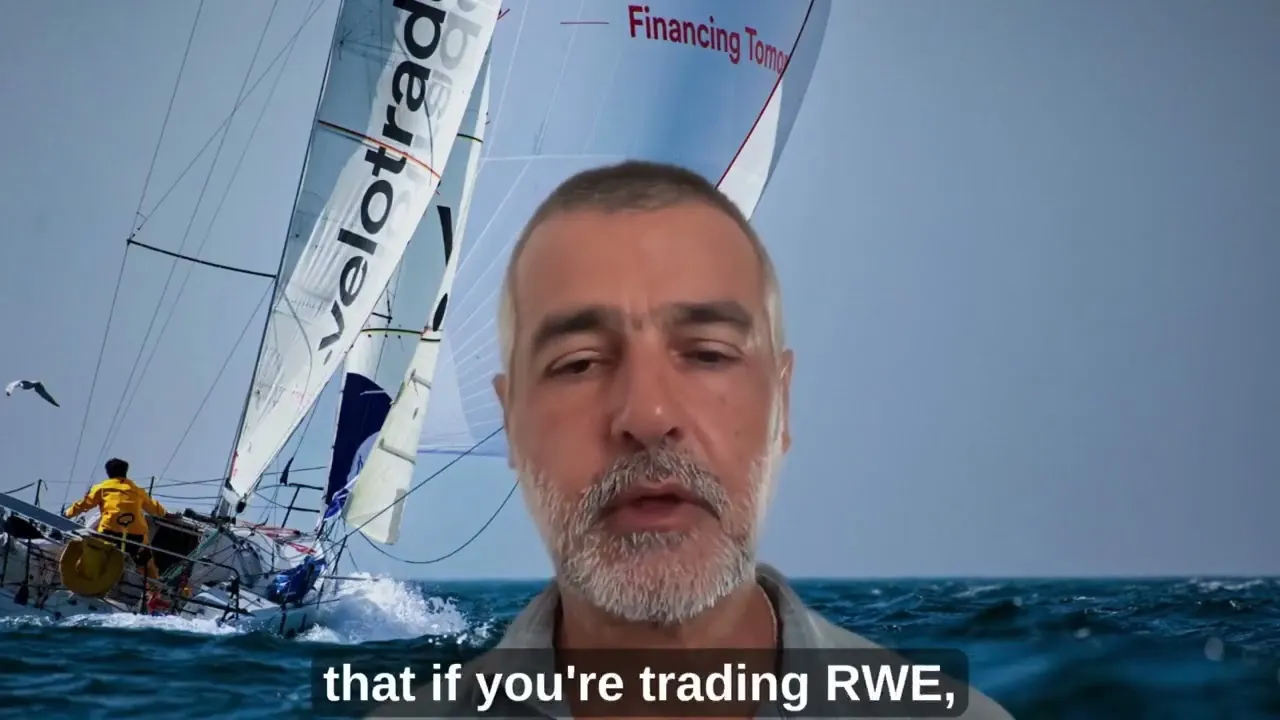
Hedging is daily routine on a bank desk. Vittorio De Angelis, Velotrade's co-founder, describes hedging a large corporate derivatives trade on RWE: buying the delta in the market, then selling vega to cut the volatility exposure the trade left him with, and how those hedging flows move prices that retail traders never see coming. The same video covers early 2008, when Jérôme Kerviel's hidden futures buying kept European indices flat on days the US opened lower:
 5:24
5:24Read the transcript
A couple more stories from the trenches. War stories.
The reason I like sharing these stories is to make all investors aware that sometimes an investor sits in front of his screen, has access to a huge amount of information, is very good at looking at charts, but there are always elements that the investor will never know about, or is unlikely ever to know about. Two examples.
The first: I was trading RWE, which is a German utility company, and we had a corporate trade. We called them corporate trades when they were extremely large and generally initiated by a corporate.
The transaction entailed the client going synthetically long RWE, so the client was buying calls and selling puts. I'm not sure why he needed to do that. Maybe he was not allowed to buy more shares, maybe there was some corporate agreement that prevented him from increasing his exposure to the company further.
Anyway, it took us a couple of days, maybe a week, to price the transaction. It was very large. Eventually the client said done, and of course, as I was buying the puts and selling the calls, I had to go and buy the delta in the market, which was a very large transaction.
Then, once the transaction was booked, I also had to hedge the volatility, because this transaction put me very, very long vega. The strike of the put I was buying was much closer to the money than the call I was selling. And at the time I was not overly bullish on volatility. So I went out and sold two or three million dollars' worth of vega, which is a ton of options.
The reason I'm mentioning this is that if you are trading RWE, you can look at all the charts in the world, but you'll never know when the client says done to the investment bank, and you don't know when the bank is going to go out there and execute the delta.
In this case, I had to buy a very large amount of shares. I was buying puts, so I had to hedge the puts. I was selling calls, so I had to hedge those as well. And obviously the flows I was executing hugely distorted the market, at least in the short term.
I had an added bonus on that transaction, because buying puts and selling calls left me long dividends. As I mentioned previously, because of structured products, dividends were priced very low in the market. So when RWE eventually reported results and gave news on the dividend, I made a lot of P&L.
The second example actually cost me, as a professional, a fair amount of money. I believe it was January 2008. There was a trader at Société Générale, Jérôme Kerviel, who had experience in the back office, which is generally a somewhat dangerous combination.
Because once he came to the front office, he started trading and accumulated a massive rogue position. He was able to hide it because he knew how the back office worked. He knew the weaknesses of the reporting systems.
He built a long futures position on, I believe, the Euro Stoxx, the CAC and a bunch of European indices, of around 50 billion euros. When he was eventually caught, unwinding it cost the bank about 4.9 billion euros.
The reason I'm mentioning it is that I had some danger on the downside, meaning I had some structured products in my books that could be dangerous if the market went down. So I decided to buy options on the Euro Stoxx, to buy some gamma.
As I explained previously, if you are long options, the more the market moves, the more money you make. However, to hold long options you are paying theta. When you buy options you have to pay a premium, and that premium decays over time. It can be a really substantial amount of money.
So what happened there? Because Jérôme Kerviel was buying an enormous amount of futures, the market never actually went down. You had occasions on which the US opened 1% or 2% lower and Europe opened flat. Not because the correlation broke down, but because there was an individual buying a huge amount of futures at that level.
So of course my options never performed. They decayed slowly but surely, and it cost me a lot of money.
And that was as a professional, so I had very good access to information. Imagine if you're a retail trader trading the Euro Stoxx and there is an event like that happening. You're obviously at a disadvantage.
I'm not telling people not to trade. I'm sharing my experiences so that next time you think you know it all, you bear in mind that there is a certain amount of information that is not shared. Speak soon.
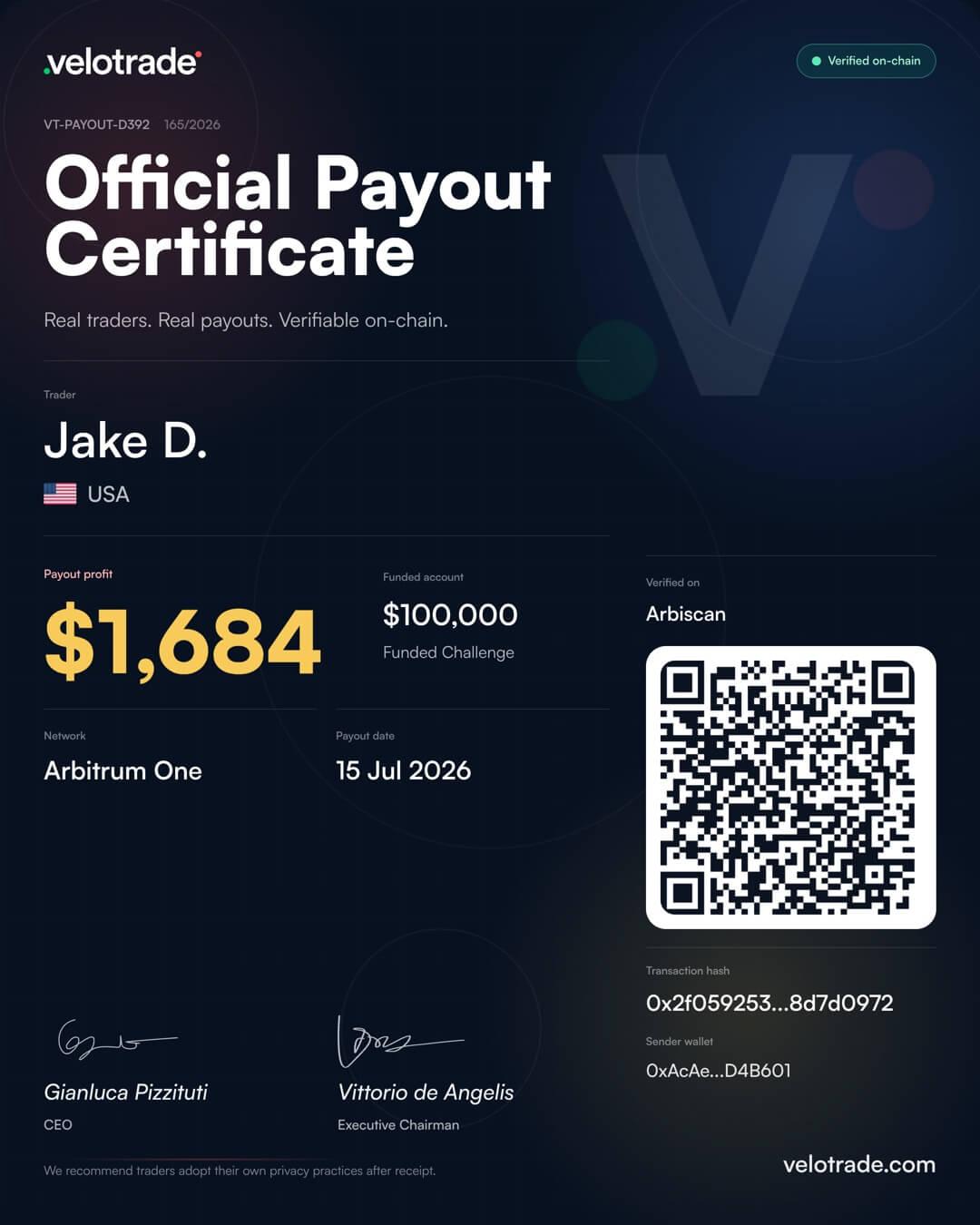
Payout proof
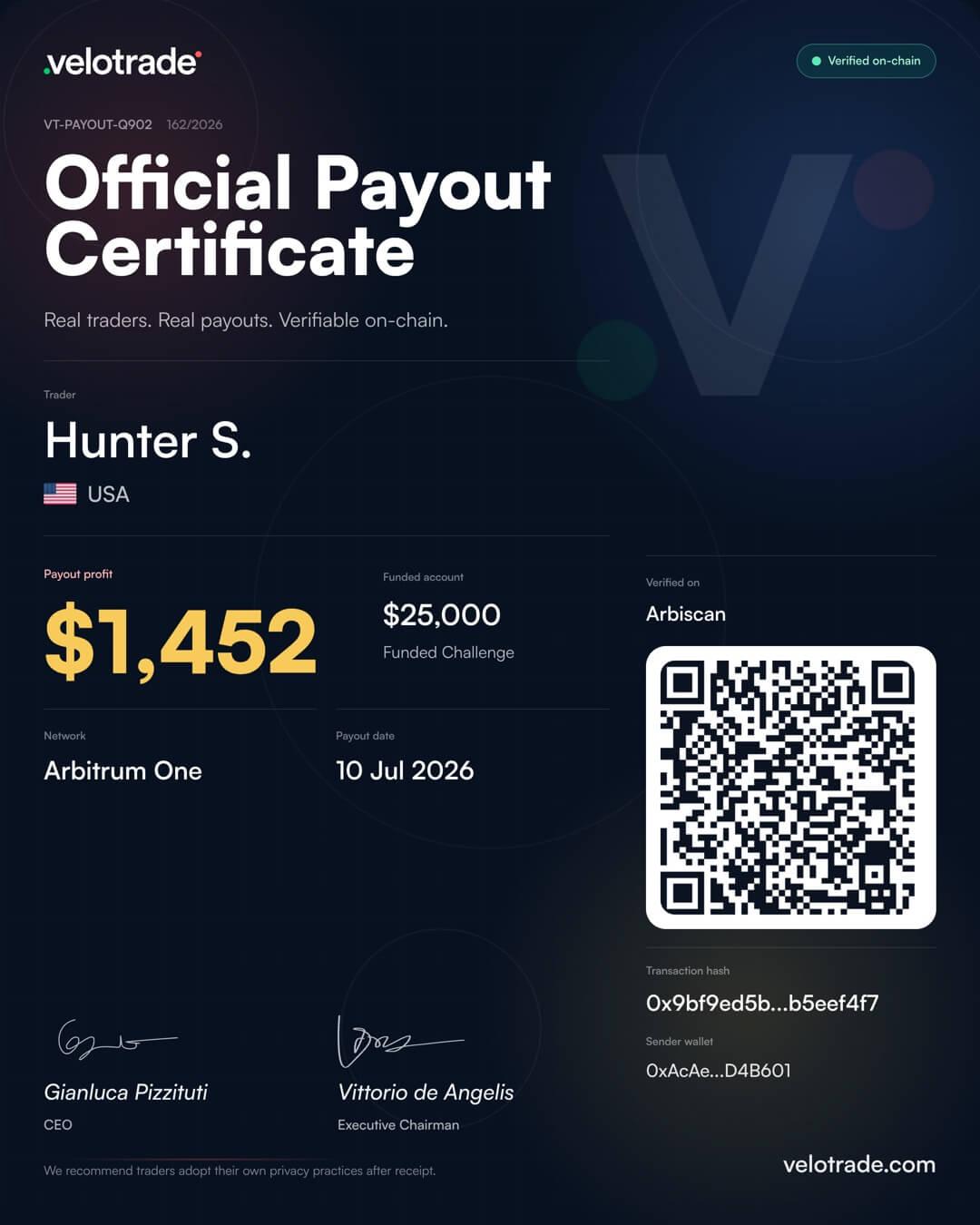
Fast, real payouts. Traceable on Arbitrum.
- Paid within 24 hours of approval
- Settled on Arbitrum in USDC or USDT
- Look up any transaction on Arbiscan
How it works at Velotrade
Velotrade uses an institutional hedging model with three parts:
- A-Book: Velotrade mirrors certain trader positions and hedges them on Tier-1 exchanges.
- B-Book: some positions are kept on an internal book.
- C-Book: part of the risk is covered by insurance hedging through providers.
All of this is the firm's own trading, done with its own money. Your Velotrade account is a simulated trading account: your orders are not routed to an exchange, and the hedging does not change your account, your fills or your rules. What it changes is the firm's incentive. Because selected positions of consistent, profitable traders are mirrored in the real market, your consistent profits become low-risk revenue for the firm rather than a cost it wants to avoid.
Why this aligns our interests
With institutional hedging, Velotrade does well when you do. The better and more consistently you trade, the more the firm earns from mirroring your positions.
That is why we want you to manage risk well and trade for the long term: disciplined, consistent traders are the ones whose positions are worth hedging. It is also why the rules are built the way they are. A firm that earns from consistent traders has no reason to set traps that end accounts early.
Judge a firm by its rules
Want to see what trader-friendly rules actually look like? View Velotrade's challenge options.
Labels about business models are easy to print and hard to verify. Rules are published and testable. A firm that wants traders to last builds rules that a disciplined trader can live with, and it pays on time.

The real cost of the conflict-of-interest model
It's worth being specific about what a failure-dependent model actually costs traders, because it's not just a philosophical objection.
Tick-by-tick trailing drawdown. Many prop firms trail the drawdown floor against every intraday equity peak. If your account spikes to a new high mid-session and then pulls back, the floor has already moved up. A normal pullback from that intraday high breaches the account even though you're still profitable on the day. That model protects the firm's downside, not yours.
Consistency rules. Capping how much any single trading day contributes to your evaluation profit sounds fair until you realize it specifically penalizes traders whose style produces occasional strong days: news traders, momentum traders, high-conviction swing traders. These rules make challenges harder to pass without making anyone a better trader.
Payout friction. Some firms create multi-step verification processes, mandatory waiting periods, and arbitrary review stages for payouts. Where payouts are treated as a cost to be delayed, friction creeps in.
Why the founders' background matters
Velotrade's founders come from institutional finance, with careers at banks including JP Morgan, Dresdner Kleinwort and Bank of America, where managing a book and hedging risk are everyday tools. That background shapes how the firm manages its own risk, and how it writes rules: as plainly as possible, so a trader always knows where the limits are.

What this means for your challenge rules
These are the rules you trade under at Velotrade, and they stand on their own:
Static drawdown. Your floor is fixed from your starting balance and never moves: not intraday, not at end of day. If you spike during a session, the floor doesn't move; if you close at a new high, it still doesn't move. You always know exactly where your limit sits from day one. See the full crypto prop firm rules explained for details.
No consistency rule. There is no cap on how much of your profit can come from your best day, so a strong session counts in full.
News trading allowed. You can hold and open positions through scheduled macro events.
Up to 90% profit split. You keep 80% of your profits by default, or up to 90% with the profit split add-on, from the first payout.
For a side-by-side look at how Velotrade's rules compare to other firms in the space, see best crypto prop firms 2026. See crypto prop firms with no consistency rule for a full breakdown of that rule, and why traders fail prop challenges for the rule traps that end most attempts. Failure-dependent models and the traps they create are also covered in top crypto prop firm red flags. For retail traders considering the funded path, see how to become a funded crypto trader and crypto funded trading accounts explained.
Ready to trade with a firm that does well when you do? View challenge options
This article is for informational purposes only and does not constitute financial or investment advice. Velotrade accounts are simulated.
Frequently Asked Questions
About the author

Vittorio De Angelis
Executive Chairman
Former equity-derivatives trader at JP Morgan, Dresdner Kleinwort and Bank of America in London. Later Head of Brokerage at a global broker in Hong Kong.
Velotrade was founded in Hong Kong in 2016 by a team from JP Morgan, Dresdner Kleinwort and Bank of America, has paid out over $2.5 billion to its trade-finance clients, and has been featured in Bloomberg, the Financial Times, the Wall Street Journal and on Nasdaq. Its prop trading evaluations are simulated and educational.
View author page