One account, every market we offer
ExploreThe bid-ask spread is the gap between the highest price a buyer will pay (the bid) and the lowest price a seller will accept (the ask). You cross that gap every time you open and close a trade, so it is a cost paid before the market moves in your favour. It matters in every market and every one of the types of trading, but it matters most for short-term trading styles that take many small profits.
Quick answer: The bid-ask spread is the difference between the bid price (the highest price buyers will pay) and the ask price (the lowest price sellers will accept) for an asset. Traders buy at the ask and sell at the bid, so the spread is a built-in trading cost. Liquid markets have tight spreads; thin or volatile markets have wide spreads.
Highlights of this article
- The bid is what buyers will pay, the ask is what sellers will accept, and the spread is the ask minus the bid
- You buy at the ask and sell at the bid, so a round trip at an unchanged price loses exactly the spread
- Forex spreads are measured in pips, stock spreads in cents, and any spread as a percentage of the mid price
- Spreads widen in thin liquidity, outside main sessions, around news and in fast, volatile markets
- On one standard lot of EURUSD, every 1 pip of spread costs 10 USD per round trip
- The spread eats a bigger share of small targets, so it matters most for scalpers
What is the bid-ask spread?
The bid-ask spread is the difference between the best available buying price and the best available selling price for an asset at a given moment. If EURUSD is quoted at 1.0850 / 1.0851, the bid is 1.0850, the ask is 1.0851, and the spread is 0.0001, or 1 pip.
Most charts plot only the bid price, which is why a buy order can appear to fill "above the chart". That gap is the spread.
| Item | Detail |
|---|---|
| Definition | The difference between the ask price and the bid price |
| Formula | Spread = Ask minus Bid |
| Mid price | (Bid + Ask) divided by 2 |
| Percentage spread | Spread divided by mid price, times 100 |
| Forex example | EURUSD 1.0850 / 1.0851 = 1 pip spread |
| Stock example | 50.00 / 50.02 = 2 cent spread (0.04%) |
| Crypto example | BTC 60,000 / 60,010 = 10 USD spread (about 0.017%) |
| What widens it | Low liquidity, off-hours sessions, news releases, high volatility |
| Who it hurts most | Scalpers and day traders with small profit targets |
If you trade this on a funded account, the rules around it matter as much as the setup. Useful next reads: the best prop firms for forex traders, how a static maximum drawdown works and why traders fail prop challenges.
What are the bid, the ask and the mid price?
The SEC's Investor.gov defines the bid as the highest price a buyer is currently willing to pay. To sell immediately, you sell at the bid.
The ask (also called the offer) is the lowest price a seller is currently willing to accept. To buy immediately, you buy at the ask.
The mid price is the halfway point between the bid and the ask, a reference price you usually cannot trade at. With EURUSD at 1.0850 / 1.0851, the mid price is (1.0850 + 1.0851) / 2 = 1.08505.
How do you calculate the bid-ask spread?
You calculate the bid-ask spread by subtracting the bid from the ask. To compare spreads across assets with very different prices, you then express it as a percentage of the mid price.
- Note the bid and the ask at the same moment.
- Subtract: spread = ask minus bid.
- Convert to the market's unit (pips for forex, cents or points for stocks and indices, dollars for crypto).
- For a percentage: divide the spread by the mid price and multiply by 100.
Forex spread in pips
A pip is the fourth decimal place on most currency pairs (0.0001) and the second decimal place on yen pairs (0.01). The what is a pip guide covers this in detail.
- EURUSD bid 1.0850, ask 1.0852. Spread = 1.0852 minus 1.0850 = 0.0002 = 2 pips.
- USDJPY bid 150.10, ask 150.12. Spread = 0.02 = 2 pips (yen pair, so one pip is 0.01).
- Percentage on the EURUSD quote: 0.0002 / 1.0851 x 100 = about 0.018%.
Stock spread in cents and percent
Stocks and index ETFs are quoted in dollars and cents, so the spread is simply the cent difference.
- A stock at bid 50.00, ask 50.02 has a spread of 2 cents. Mid price 50.01. Percentage: 0.02 / 50.01 x 100 = about 0.04%.
- A small, thinly traded stock at bid 4.95, ask 5.05 has a spread of 10 cents. Mid price 5.00. Percentage: 0.10 / 5.00 x 100 = 2%.
Relative to price, the second spread is fifty times more expensive.
Crypto spread in dollars and percent
Crypto spreads are usually quoted in the quote currency (often USD or USDT).
- BTC bid 60,000, ask 60,010. Spread = 10 USD. Mid price 60,005. Percentage: 10 / 60,005 x 100 = about 0.017%.
Smaller coins with thin order books can have percentage spreads many times wider.
What makes the bid-ask spread wider or tighter?
The spread widens when fewer participants quote competitive prices and tightens when many buyers and sellers are active. Four factors drive most of the change.
Liquidity
Liquidity is how easily an asset can be bought or sold without moving its price. Major forex pairs, large-cap stocks, index ETFs and the biggest cryptocurrencies have deep order books, so spreads are tight. Exotic pairs, small-cap stocks and small altcoins have fewer participants, so the best bid and ask sit further apart.
Trading sessions
Spreads change with the time of day. In forex, spreads are usually tightest when the major sessions overlap and widest around the daily rollover and in quiet hours (see forex market hours for session times). In US stocks, the difference between sessions is even clearer.
The chart shows the three US stock sessions in Eastern Time: pre-market from 04:00 to 09:30, the regular session from 09:30 to 16:00, and after-hours from 16:00 to 20:00. Pre-market and after-hours trade with far fewer participants, so spreads are typically wider than during the regular session. The highlighted opening and closing hours are the busiest periods.
News and economic data
Spreads often widen just before and just after major releases such as central bank decisions, inflation data or the US jobs report. Liquidity providers pull or widen quotes because the next price is uncertain, so a pair that normally trades under 1 pip can briefly show several pips.
Volatility
Volatility is how far and how fast prices move. When prices jump around, quoting is riskier, so quotes move further apart, and in a sharp sell-off the next available bid can sit well below the last traded price.
How much does the spread cost per trade?
The spread costs you the spread width multiplied by your position size, once per round trip. If the price does not move between entry and exit, you lose exactly the spread. The forex profit calculator adds commission and swap on top, so you see what a trade nets.
The chart shows the cost of crossing the spread once on one standard lot of EURUSD (100,000 units), where one pip is worth 10 USD. A 0.1 pip spread costs 1 USD, a 0.5 pip spread 5 USD, a 1 pip spread 10 USD, a 2 pip spread 20 USD and a 5 pip spread 50 USD.
Worked example: forex
You buy 1 standard lot of EURUSD with the quote at 1.0850 / 1.0851.
- You buy at the ask: 1.0851.
- A moment later the quote is unchanged, and you close by selling at the bid: 1.0850.
- Loss = 1.0851 minus 1.0850 = 1 pip.
- Cost = 1 pip x 10 USD per pip = 10 USD.
To break even, the bid has to rise to your entry price of 1.0851. The free pip value calculator gives the dollar value of a pip for other pairs and lot sizes.
Worked example: stocks and crypto
- Stock: you buy 500 shares at the ask of 50.02 and could sell at the bid of 50.00. Spread cost = 0.02 x 500 = 10 USD.
- Crypto: you buy 0.5 BTC at the ask of 60,010 with the bid at 60,000. Spread cost = 10 x 0.5 = 5 USD.
The spread as a share of your target
The spread matters most when you compare it to the profit you are trying to make.
| Profit target | Spread | Spread as share of target |
|---|---|---|
| 5 pips | 1 pip | 20% |
| 20 pips | 1 pip | 5% |
| 150 pips | 1 pip | about 0.7% |
A 1 pip spread is barely noticeable on a 150 pip swing trade, but it eats a fifth of a 5 pip scalp. That changes the risk-reward ratio you actually achieve after costs.
How do market and limit orders interact with the spread?
A market order always crosses the spread, while a limit order can avoid crossing it at the cost of possibly not being filled.
- A market buy fills at the ask, and a market sell fills at the bid. You pay the full spread, and in a fast or thin market the order can work through the book to worse prices, called slippage.
- A limit buy placed at or below the bid waits for a seller to come to you. If it fills, you do not pay the spread on that side. The trade-off is that the market may never reach your price, and you miss the trade.
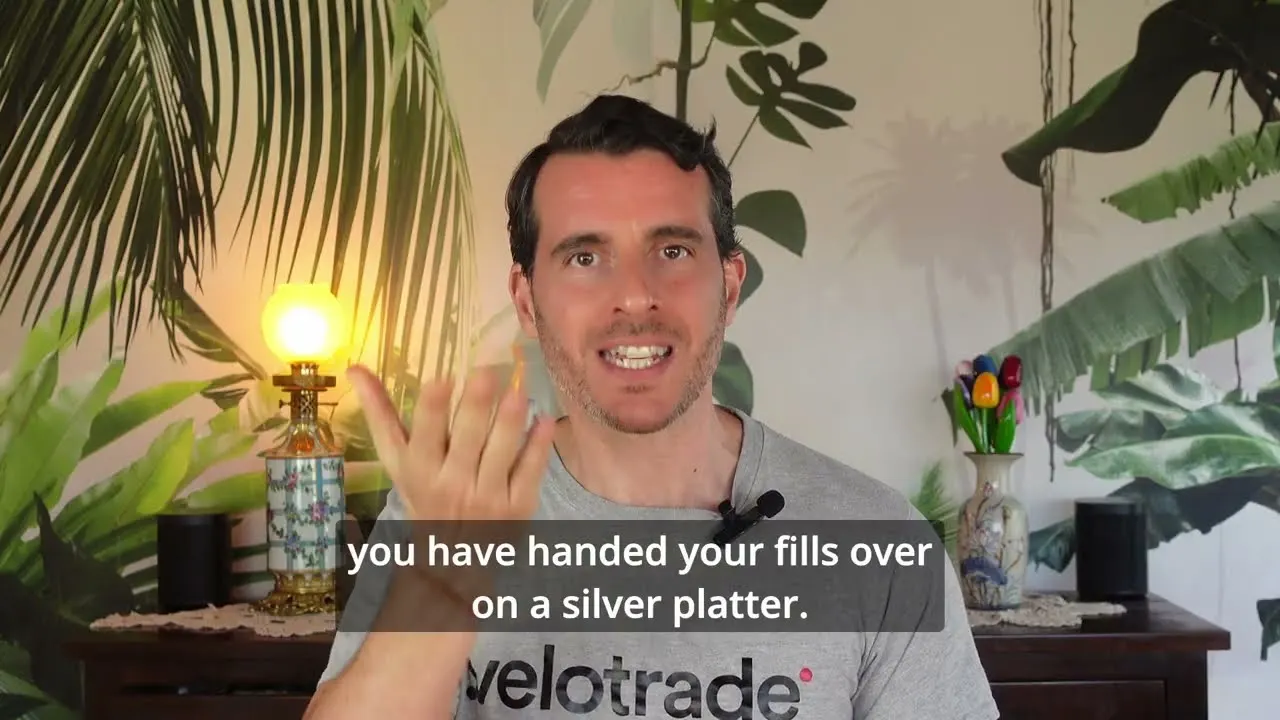
The full comparison is in market order vs limit order. In the video below, Gianluca Pizzituti, Velotrade's co-founder, explains why he avoids market orders entirely, describing his own approach as "Always limit orders. Always." He also warns that "A market order is not a convenience," particularly when liquidity dries up and spreads blow out.
 3:25
3:25Read the transcript
Every time you use a market order, you are telling the market: fill me at whatever price you want. And one day it will.
I'm Gianluca Pizzituti, CEO of Velotrade. I've been trading for over 25 years, institutionally and privately, and I want to talk about the one order type that can quietly destroy your account.
There are two ways to get into a trade: a limit order and a market order. A limit order lets you set the exact price you are willing to buy or sell at. You are in control. If the market never reaches your price, you simply do not get filled.
A market order is a completely different animal. A market order says: I do not care about the price, just fill me now at whatever is available. And that one word, whatever, is where all the danger lives.
When I traded institutionally, the market order was taboo. I mean it. You did not touch it. Especially not after hours, and especially not on a thin book where there is barely anyone on the other side. It was drilled into us from day one: use a market order sparingly, if at all.
Because the moment liquidity dries up, a market order reaches up or down the order book and fills you at prices you would never agree to. And I will be honest with you, to this day I still never trade with a market order. Always limit orders. Always.
And here is where it gets brutal. This is exactly what happens, especially in crypto, when something horrible hits the market. Think about the 10th of October 2025.
Bitcoin fell more than $10,000 in a matter of minutes, and around $17,000 across the day, from roughly $122,000 down to about $105,000. It was the largest liquidation event in the history of crypto. Over $19 billion in leveraged positions wiped out. More than 1.6 million accounts gone.
Everybody got hurt that day. But the people who got wiped out completely were the ones sitting on market orders. Because when you fire a market order into chaos like that, you have handed your fill over on a silver platter.
You told the exchange: fill me at whatever is available. And it did. It filled you exactly where it suited the other side of the trade. And leveraged longs got destroyed.
So please understand this carefully. A market order is not a convenience. It is a dangerous tool. Use it very sparingly, and only when you fully understand the risk you're taking.
Because the day will come, maybe not today, maybe not this year, when your market orders cost you a multiple of what they should have.
So be honest with me. Do you trade with market orders or limit orders? And has a market order ever filled you somewhere brutal? Drop it in the comments. I want to hear your stories.
What is the difference between spread and commission?
The spread is an indirect cost built into the price, while a commission is a separate fee charged per trade. Both reduce your result, and you need to add them together to know your true cost.
- Spread: never a line item on a statement; it shows up as a worse entry and exit price.
- Commission: charged explicitly per lot, per share or as a percentage, often on both sides.
Some venues offer "zero commission" pricing with wider spreads, others tight raw spreads plus a commission. As an illustration, a 1 pip spread on one standard lot of EURUSD costs 10 USD per round trip; a 0.2 pip spread costs 2 USD, but if that comes with a commission of 3.50 USD per side, the round trip costs 2 + 7 = 9 USD. Always compare the total cost on the same trade size.
Why does the bid-ask spread matter most for scalpers?
The bid-ask spread matters most for scalpers because scalpers aim for very small profits on many trades, so the fixed cost of crossing the spread is a large share of each target and is paid many times a day.
A swing trader pays the spread a few times a month against large targets. If a scalper pays 1 pip on each of 30 round trips in a day, that is 30 pips of cost before any profit, or 300 USD on one standard lot per trade.
That is why short-term traders tend to:
- Trade only the most liquid instruments, where spreads are tightest.
- Trade during the busiest hours, such as session overlaps in forex or the regular session in US stocks.
- Avoid the minutes around major news releases.
- Use limit orders where possible.
- Track spread and commission costs in a trading journal, so costs are visible in their results.
The scalping guide and day trading for beginners cover these styles in full. The VWAP indicator and ATR indicator help judge whether a move is large enough to justify the cost. Broker disclosures and academic studies consistently find that most retail day traders lose money, and costs are one reason small edges disappear. At the extreme, high-frequency trading firms earn the spread as market makers, an industrial game that prop firms ban.
How does the spread work in a prop firm evaluation?
In a prop firm evaluation, the spread affects your simulated profit and loss as it would elsewhere, and that cost counts toward your risk limits. Spreads and commissions differ between firms, which is one reason to compare the best prop trading firms before you buy a challenge.
At Velotrade, a multi-asset prop trading firm offering simulated evaluations in crypto, forex, stocks, index ETFs and commodities, the daily loss limit resets at 00:30 UTC and is set from the higher of your balance or equity (5% on CLASSIC 2-Step, 4% on CLASSIC 1-Step, 3% on PRO 1-Step), and the maximum drawdown is static. News trading is allowed, but a position opened into a news spike can start further in the red than usual. Factor the spread into your stop distance and size with the position size calculator. Velotrade evaluations are simulated and educational, not investment advice.
Can AI help you manage bid-ask spread costs?
AI can help you understand spread costs by analysing your trade history, flagging the hours or instruments where costs are highest, and including realistic spreads when you test a strategy on past data.
AI does not remove risk or guarantee tighter fills, and its output still needs human judgement about when and what to trade. See AI trading strategies and backtesting trading strategies for how to test ideas with costs included.
Sources
- Investor.gov (SEC), "Bid Price/Ask Price": defines the bid, the ask and the spread between them.
- Investor.gov (SEC), "Market Order": market orders fill at the next available price.
- Investor.gov (SEC), "Types of Orders": how market and limit orders trade off price against fill.
- BIS, "OTC foreign exchange turnover in April 2022" (2022): forex market depth and liquidity behind tight major-pair spreads.
Frequently Asked Questions
About the author

Gianluca Pizzituti
Chief Executive Officer
Formerly on the derivatives desk at Dresdner Kleinwort in London, then founded and ran a proprietary HFT firm in FX and equity indices out of Singapore.
Velotrade was founded in Hong Kong in 2016 by a team from JP Morgan, Dresdner Kleinwort and Bank of America, has paid out over $2.5 billion to its trade-finance clients, and has been featured in Bloomberg, the Financial Times, the Wall Street Journal and on Nasdaq. Its prop trading evaluations are simulated and educational.
View author page