One account, every market we offer
ExploreScalping is a trading style that aims to capture very small price moves, holding each position for seconds to a few minutes and repeating the process many times a day. Scalpers work on 1-minute and 5-minute charts, trade only the most liquid markets, and live or die by their costs, because the spread and commission take a large share of every small profit.
Scalping is the fastest of the main types of trading. This guide covers how it works, the cost arithmetic, the main strategies, and why most retail scalpers struggle.
Quick answer: Scalping trading is a short-term trading style in which a trader opens and closes positions within seconds to a few minutes to capture small price moves, often many times per day. Scalpers use 1-minute and 5-minute charts, trade highly liquid markets, and need very low spreads and commissions, because trading costs consume a large share of each small gain.
Highlights of this article
- Scalping holds trades for seconds to minutes and targets small moves
- Spread and commission can take a third or more of a small target
- A 5 pip target with a 5 pip stop can need about two winners in three to break even
- Scalpers need deep liquidity, so session timing matters
- Common approaches are range scalping, VWAP scalping and momentum bursts read from the order flow
- Limit orders, a daily loss limit and a trade cap guard against slippage and overtrading
 3:27
3:27Read the transcript
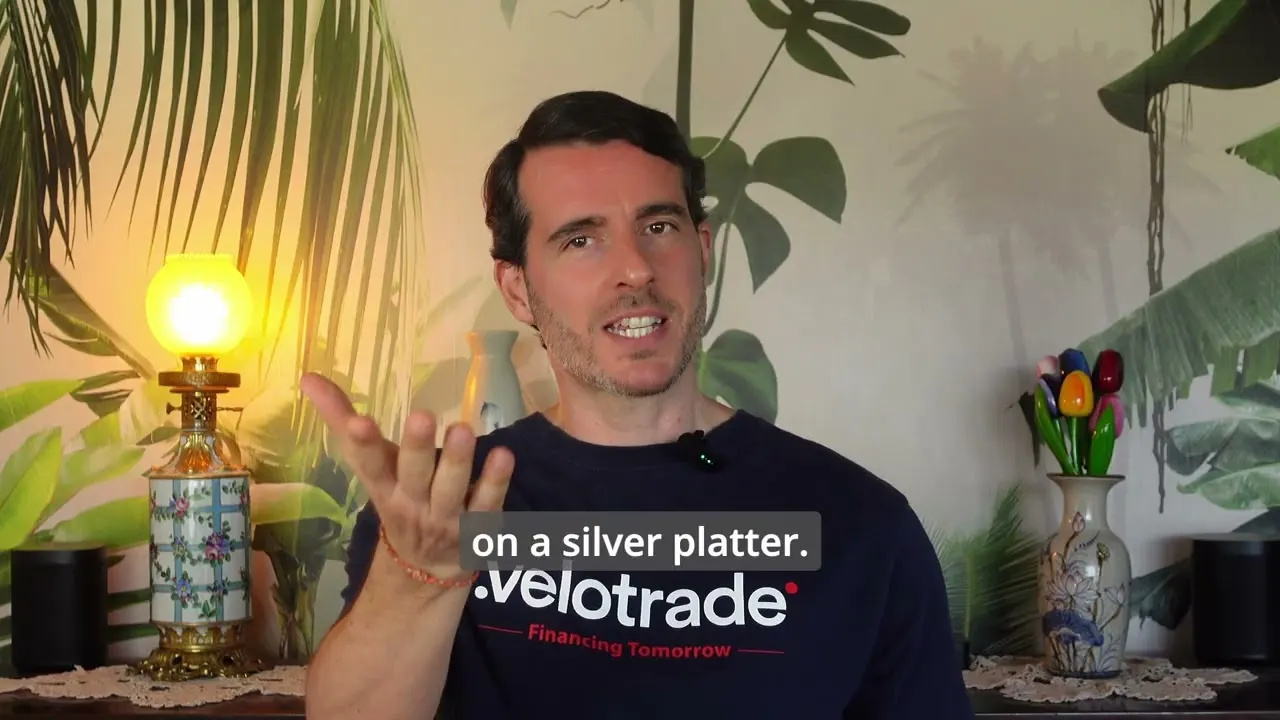
You just made $1,000 on a trade. Congratulations! Now, answer one simple question. Where did that $1,000 come from?
I am Gianluca Pizzituti, CEO of Velotrade. I've been trading for over 25 years, institutionally and privately. And the day you properly understand what I'm about to explain is the day you become a much humbler trader.
When we talk about short-term trading, especially in derivatives, your profit does not appear out of thin air. If you make $1,000, somebody else, or several participants collectively, has taken the corresponding economic loss.
And when you lose $1,000, that value has gone to somebody else. It might be another trader, it might be an institution, it might be spread across many different positions. The identity does not matter. What matters is that every trade has another side, before costs.
That is the basic logic of a zero-sum game. After fees, spreads and slippage, it becomes even harder, because the participants collectively have less money left.
Once you understand that, trading suddenly looks very different. You are not pressing buttons against an empty screen. You are competing with people who may have spent five, ten or twenty years developing their skills. They have studied, they have made mistakes, they have lost money, they have built systems.
And now you arrive with six months of experience and believe the market will hand you the money on a silver platter. Why would it? Nobody gives money away easily. If you want to take value from somebody else, you need to bring skills, preparation and discipline to the table.
This is why I do not believe the fantasy you see online: trade for two hours, spend the rest of the day on the beach and become a millionaire. Can somebody trade for two hours a day? Of course! But those two hours may sit on top of ten or twenty years of work.
The person on the other side may have spent the whole day researching, preparing and waiting for exactly that opportunity. The two hours you see are not the whole story. They are the visible result of the years you did not see.
Think about your own profession. Think about the skills you use every day. Could somebody arrive tomorrow with no experience and perform at your level immediately? Obviously not!
You worked for it, you made mistakes, you earned that experience. Trading is exactly the same. You can become successful, but you cannot skip the learning process. The market does not care how confident you feel. It only exposes what you actually know.
So next time you make money, ask yourself who was on the other side. And next time you lose, remember that somebody else was better positioned for that moment.
That thought should not discourage you. It should humble you. And humility is where real improvement begins.
Before this video, had you ever genuinely asked where your trading profit came from? Yes or no? Drop it in the comments.
In this short video, Gianluca Pizzituti, Velotrade's co-founder, explains where short-term trading profits come from. He points out that "every trade has another side, before costs", and that "After fees, spreads and slippage, it becomes even harder". Both matter most for scalpers, who trade the most often for the smallest moves.
What is scalping in trading?
Scalping is the practice of making many small, very short trades to collect small price moves, instead of holding for a larger trend. A scalper might buy a stock at 100.20 and sell at 100.45 three minutes later. Each profit is small, so the scalper relies on frequency and tight risk control rather than any single big win.
Compared with other trading styles, scalping sits at the extreme short end. Day trading holds for minutes to hours, swing trading for days to weeks, and position trading for weeks to months. The shorter the holding time, the more your costs and execution decide the outcome.
Scalping key facts
| Item | Detail |
|---|---|
| Typical holding time | Seconds to a few minutes |
| Typical timeframes | 1-minute and 5-minute charts, sometimes tick charts |
| Trades per day | Often 10 to 50 or more, depending on the trader and market |
| Time commitment | Full attention during the trading window; no multitasking |
| Key tools | Fast platform, VWAP, support and resistance, order book or volume |
| Main costs | Bid-ask spread, commission, slippage |
| Main risk | Costs and overtrading slowly draining the account |
| Suits | Disciplined, fast decision makers with access to very low costs |
How does scalping work?
Scalping works by repeatedly entering where price is likely to move a short distance, taking a small profit, and getting out before the picture changes. The question is narrow: will price move a few ticks my way in the next few minutes before it moves a few ticks against me?
The chart below shows the idea on a 1-minute chart. Price is trading in an intraday range around VWAP (the volume-weighted average price). The scalper buys three times near the lows of the range and sells near the highs, and each trade lasts only a few candles.
Each buy happens below VWAP near the bottom of the range, and each sell above it near the top. Each move is less than one point on a 100 price, so costs become the central issue.
Which timeframes do scalpers use?
Most scalpers use the 1-minute chart for entries and exits and the 5-minute or 15-minute chart for context, so they do not buy a 1-minute dip inside a steep higher-timeframe downtrend.
Why do spread and commission dominate scalping?
Spread and commission dominate scalping because they are a fixed cost per trade, while the scalper's profit per trade is small. The bid-ask spread is the gap between the buying price (ask) and the selling price (bid), paid on every round trip.
The chart below shows what crossing the spread costs on one standard lot of EURUSD (100,000 units), where one pip is worth 10 US dollars.
A 1 pip spread costs 10 dollars per trade and a 5 pip spread costs 50. For a scalper aiming for 5 pips, a 1 pip spread is a fifth of the target before any commission. (See what is a pip if the unit is new to you, and the pip value calculator for pairs not quoted in US dollars.)
Worked example: the cost of a 5 pip scalp
Suppose you scalp one standard lot of EURUSD with a 5 pip profit target and a 5 pip stop loss. Assume a 1 pip spread and a commission of 7 US dollars per round trip (open and close). These costs are illustrative.
- Gross target: 5 pips x 10 USD = 50 USD.
- Costs per trade: spread 10 USD + commission 7 USD = 17 USD.
- Net winner: 50 - 17 = 33 USD.
- Net loser: 50 + 17 = 67 USD (you lose the 5 pips and still pay the costs).
- Break-even win rate: 67 / (33 + 67) = 67%.
On paper the trade is 1:1. After costs, you need to win about two trades in three just to stay flat, and costs eat 34% of the gross target (17 / 50). The forex profit calculator runs the same net-of-costs check on your own pair, lots and target.
Compare a swing trade with a 100 pip target and stop and the same 17 USD of costs: the net winner is 983 USD, the net loser 1,017 USD, and the break-even win rate about 51% (1,017 / 2,000). The smaller your target, the higher the win rate you need. Our risk-reward ratio guide shows how the break-even win rate changes across ratios.
Why do liquidity and trading sessions matter for scalpers?
Liquidity matters because scalpers need tight spreads and fills close to their intended price, which only exist when many buyers and sellers are active. In thin markets spreads widen and orders slip.
Practical rules of thumb:
- Forex: the London session and the London and New York overlap usually offer the tightest spreads on major pairs. The hours after the New York close are often the worst. Our forex market hours guide shows the sessions.
- US stocks and index ETFs: the first and last hour of the regular session (09:30 to 16:00 ET) carry the most volume. Extended hours are thinner.
- Crypto: trades around the clock, but liquidity still varies and spreads can widen in fast moves.
- News releases: spreads often widen and prices can jump around major data.

What are the main scalping strategies?
The main scalping strategies are range scalping, VWAP scalping and momentum (order flow) scalping. All three use a defined entry level, a small target, a small stop and a quick exit. Our overview of trading strategies shows how scalping fits next to slower styles.
Range scalping
Range scalping buys near the bottom of an intraday range and sells near the top, as in the chart above. It works when the market is rotating. The risk is the breakout, so place the stop just outside the range and stop fading after a clean break. Our guide to support and resistance covers how to mark these levels. Some range scalpers add Bollinger Bands to see when price is stretched toward the edge of the range.
VWAP scalping
VWAP scalping uses the volume-weighted average price as the session's fair value. In a balanced market, scalpers fade moves away from VWAP; in a trend, they buy or sell pullbacks to it. See the VWAP indicator guide.
Order book and momentum bursts
Momentum scalping tries to catch short bursts when buyers or sellers suddenly overwhelm the other side, for example when price breaks a level and volume spikes. Some scalpers read the order book (the list of resting bids and offers) to see where large orders sit and whether they are being absorbed. Bursts fade quickly and false breaks are common. A volume profile shows which prices traded the most volume, where a burst is more likely to stall. The ATR indicator helps fit stops to current volatility.
For a crypto-specific playbook, see our crypto scalping strategy guide.
How should scalpers execute trades?
Scalpers should plan every order, because execution quality is part of the edge. As Investor.gov (SEC) explains in its guide to order types, a market order fills immediately but can slip in a fast market. A limit order fills only at your price or better, but may not fill at all. Our guide to market vs limit orders explains the trade-off.
Gianluca Pizzituti, Velotrade's co-founder, prefers limit orders for entries, and that habit suits scalping well: with a target of a few pips, a single bad fill can wipe out the trade's whole expected profit.
A simple scalping execution routine:
- Mark the session range, VWAP and key levels before the session.
- Decide entry, stop and target first, and size from the stop distance with the position size calculator (or the forex lot size calculator if you scalp currency pairs).
- Enter with a limit order at your level where possible.
- Place the stop loss immediately.
- Exit at target or stop, or early if the trade stalls.
- Log the trade, including the costs, in your trading journal.
Is scalping profitable?
Scalping can be profitable for a small number of skilled traders with very low costs and excellent execution, but most retail scalpers struggle. Broker disclosures and academic studies consistently find that most retail day traders lose money (according to ESMA, between 74% and 89% of retail CFD accounts lose money), and scalping concentrates the same problems into more trades.
Why most retail scalpers struggle
- Costs: as the worked example shows, small targets push the break-even win rate very high.
- Competition and execution: you face professional firms with faster technology, and slippage chips away at small targets.
- Skewed outcomes and fatigue: one missed stop can erase dozens of small winners, and hours of fast decisions wear down judgement.
A profitable trade is not the same as a good trade: a scalp that hit its target after you moved your stop was a bad trade with a lucky outcome.
How does overtrading hurt scalpers?
Overtrading hurts scalpers because every extra trade carries its full cost, while weak setups add little expected profit. A scalper who takes 40 trades a day at 17 USD of costs each pays 680 USD a day before winning anything. Cut that to 15 well-chosen trades and the daily cost drops to 255 USD.
Overtrading usually starts from boredom or revenge after a loss. Practical guards:
- Set a maximum number of trades per session and stop when you reach it.
- Set a daily loss limit in dollars and stop for the day when you hit it.
- Trade only your defined windows, and walk away outside them. Not trading is a decision too.
- Review your journal weekly and drop losing hours and setups.
See our guide to trading psychology.
How does scalping work in a prop firm evaluation?
Scalping works the same way in a simulated evaluation, but the risk rules make discipline mandatory. At Velotrade, a multi-asset prop trading firm, traders take a simulated evaluation across crypto, forex, stocks, index ETFs (SPY, QQQ, IWM) and commodities.
- Daily loss limit: it resets every day at 00:30 UTC and is set from the higher of your balance or equity at that time: 5% on CLASSIC 2-Step, 4% on CLASSIC 1-Step and 3% on PRO 1-Step. Strings of small losing scalps reach it fast.
- Static maximum drawdown: a fixed dollar floor set at account activation that does not move. See static maximum drawdown explained.
- No time limit to pass, with a minimum number of trading days per phase, so there is no reason to force trades.
- News trading and EAs are allowed, though spreads still widen around news.
If you are comparing firms for this style, our best prop firms for scalpers guide covers what to check.
Can AI help with scalping?
AI can help scalpers with research and review, but it does not remove the risk of trading. It can screen markets for liquidity, test a scalping rule on historical data, or analyse your journal for losing hours and setups. See our guides to AI trading strategies and backtesting trading strategies.
Very short-term backtests are highly sensitive to cost and slippage assumptions, so a rule that looks profitable before costs can lose after them. Any AI output needs human judgement and a strict risk plan.
Sources
- Investor.gov (SEC), "Bid Price/Ask Price": bid, ask and the spread scalpers pay on every round trip.
- Investor.gov (SEC), "Types of Orders": market orders versus limit orders and how each fills.
- ESMA, "ESMA agrees to prohibit binary options and restrict CFDs to protect retail investors" (2018): 74% to 89% of retail CFD accounts lose money.
- Barber and Odean, "Trading Is Hazardous to Your Wealth", Journal of Finance (2000): the most active traders earn the lowest net returns.
Frequently Asked Questions
About the author

Gianluca Pizzituti
Chief Executive Officer
Formerly on the derivatives desk at Dresdner Kleinwort in London, then founded and ran a proprietary HFT firm in FX and equity indices out of Singapore.
Velotrade was founded in Hong Kong in 2016 by a team from JP Morgan, Dresdner Kleinwort and Bank of America, has paid out over $2.5 billion to its trade-finance clients, and has been featured in Bloomberg, the Financial Times, the Wall Street Journal and on Nasdaq. Its prop trading evaluations are simulated and educational.
View author page