Trade crypto with funded capital
ExploreA crypto trading simulator lets you trade or predict markets with virtual funds, so you can practise without risking your own money. Some are pure learning tools with no stakes at all. A small number are games where top players win real prizes. This guide covers the main options in 2026, what each one is good for, and where the line sits between a simulator that only teaches and one that can actually pay you.
Highlights of this article
- A crypto trading simulator replaces real money with virtual funds so you can practise risk-free
- Pure simulators (TradingView paper trading, exchange testnets, broker demos) teach mechanics but pay nothing
- Competitions and games add prizes, ranging from merch and vouchers to funded trading accounts
- Velotrade's Sprint Trading is a free game on the live BTC/USDT price where top players win real funded challenge accounts
- The right tool depends on your goal: learning, strategy testing, or playing for real stakes
What a Crypto Trading Simulator Is
A crypto trading simulator mirrors a real market but settles in virtual currency. You place trades, watch them move against live or historical prices, and see a profit and loss figure update, without a single real coin changing hands. The interface looks and behaves like a real exchange or broker, so the muscle memory you build transfers directly.
Traders use simulators for three main reasons.
- Learn the mechanics. Placing orders, setting stops, reading a chart, and managing open positions are all skills you can drill for free before any money is involved.
- Test a strategy. A simulator lets you run an idea over many trades and see whether it holds up, without paying for the lesson in real losses.
- Build a record. A demo track record is evidence. It shows whether you can stay consistent across a full cycle, which is exactly what a prop firm wants to see.
Not all simulators are the same. Some are pure practice with nothing on the line. Others wrap the practice in a contest with a leaderboard and prizes. That distinction decides which tool fits your goal, so it is worth being clear about before you pick one.
Pure Simulators: Practise With No Stakes
A pure simulator has no prize attached. You trade virtual funds, learn, and move on. These are the safest possible entry point because there is genuinely nothing to lose. Here are the main types in 2026.
TradingView paper trading
TradingView is the charting platform most active traders already use, and it includes a built-in paper trading mode. You connect a virtual account, place simulated orders straight from the chart, and trade against live market data. It is one of the most realistic ways to practise because the charts (see how to read stock charts), indicators, and order types are the same ones you would use with real money. It is best for traders who want to test entries and exits on live prices without committing capital.
Exchange demo and testnet accounts
Most large crypto exchanges offer a demo mode or a testnet. A demo account funds you with virtual balance on the real exchange interface, so you learn that specific platform exactly as it works. A testnet runs on a separate test network where the coins have no value, which is useful for practising deposits, withdrawals, and order flow. Both are free. They are best for getting comfortable with one exchange before you fund it.
Broker demo accounts
Brokers that offer crypto alongside forex, stocks, or futures usually provide a demo account. You get a virtual balance and the broker's full platform. The advantage is breadth: you can practise crypto next to other asset classes in one place, which matters if you plan to trade more than coins. Demo accounts often reset or expire after a set period, so they suit a focused learning sprint rather than an open-ended habit.
Investopedia-style stock and crypto simulators
Education-focused simulators in the Investopedia mould give you a virtual portfolio and a simple interface aimed at beginners. They lean toward stocks but increasingly include crypto. The strength is the learning layer: explanations, glossaries, and a forgiving environment. They are best for someone new to markets entirely, less so for an experienced trader refining a fast strategy.

The common thread is that nothing is at stake and nothing is paid out. They exist to teach. If your goal is to learn the mechanics or test an idea, a pure simulator is the right tool.

Games and Competitions: Practise With Prizes
The next tier adds a prize. A crypto trading game or competition still runs on virtual funds in most cases, but it ranks players on a leaderboard and rewards the top finishers. This changes the experience. You are no longer just practising against yourself; you are competing, and there is something to win.
Wall Street Survivor-style trading games
Games in the Wall Street Survivor mould turn investing into a structured contest, often with lessons, missions, and a virtual portfolio you grow over time. They gamify learning with badges and rankings. Prizes, where they exist, tend to be small, and the focus is education rather than payout. They are best for beginners who learn better with game mechanics than with a plain demo.
Paper trading competitions
A paper trading competition is a timed contest on demo balances. Everyone trades the same window under the same rules, and a leaderboard ranks them by return, accuracy, or volume. Nothing is at risk because no money is deposited. Prizes are usually modest: vouchers, merchandise, or small cash. They are a good way to test your skill under pressure and build a record. For a deeper look at how these contests are scored and won, see our guide to crypto trading competitions.
Exchange-run trading competitions
Exchanges run competitions to drive activity. Rewards are often paid in the exchange's own token or as fee discounts, and the scoring frequently favours trading volume over actual profit. Read the rules closely, because "winning" can mean trading the most rather than trading the best. They suit active traders who already use that exchange.
Prediction games
A growing category lets you score points by predicting market direction rather than trading positions. You forecast whether a price will go up or down over a window, and your accuracy is what counts. This is the same instinct behind prediction markets, where participants stake on outcomes instead of holding assets, except a prediction game keeps it on virtual funds. These games reward reading momentum and managing your calls, and they are the bridge between a pure simulator and a real-stakes contest.
The dividing line across this tier is what you can actually win. Most of these games pay nothing meaningful, or pay in vouchers and tokens that only matter if you keep using one platform. The exception, and the reason the next section exists, is a game whose prize is real trading capital.
Comparison: Crypto Trading Simulators and Games in 2026
Here is how the main options compare on type, cost, whether real prizes are on the table, and who each one suits best.
| Tool | Type | Cost | Real prizes? | Best for |
|---|---|---|---|---|
| TradingView paper trading | Pure simulator | Free | No | Testing entries and exits on live charts |
| Exchange demo / testnet | Pure simulator | Free | No | Learning one specific exchange |
| Broker demo account | Pure simulator | Free | No | Practising crypto next to other assets |
| Investopedia-style simulator | Pure simulator | Free | No | Complete beginners learning markets |
| Wall Street Survivor-style game | Game | Free | Small / occasional | Beginners who prefer gamified learning |
| Paper trading competition | Competition | Usually free | Vouchers, small cash | Testing skill under pressure |
| Exchange-run competition | Competition | Free to enter | Tokens, fee discounts | Active traders on that exchange |
| Sprint Trading | Prediction game | Free | Funded challenge accounts | Practising for real trading capital |
The pattern is clear. Free simulators teach but pay nothing. Most games add only small or platform-locked rewards. One option pays out something durable: a real funded trading account. That is worth a section of its own.
Sprint Trading: A Live-BTC Simulator That Pays Out Funded Accounts
See how to win a funded account for free through Sprint Trading.
Sprint Trading is a free game played on the real BTC/USDT price, where top players win real Velotrade funded challenge accounts. It is not a backtest and not a fake house price. Every round is decided by the live market, which makes it a genuine simulator of short-term direction reading, with a prize structure almost no free game offers.
How a sprint works. You predict whether BTC will go UP or DOWN over a 5-minute sprint. The live BTC/USDT price decides the outcome, with no simulation and no house price in between. You get a 10-second warning before each round locks, so you choose your direction and commit before the window closes. A winning call pays 1.8x into your Competition Vault.
Free demo tokens. You receive 100 free demo tokens per day, and they reset at 12:00 UTC. They cannot be purchased. They are demo only, so no real money is ever at risk. Because the tokens carry no real-money value and the outcome depends on your prediction accuracy, Sprint Trading is skill-based. It is not gambling and it is not a real-money binary option. You are competing on how well you read the market, not on how much you can stake.
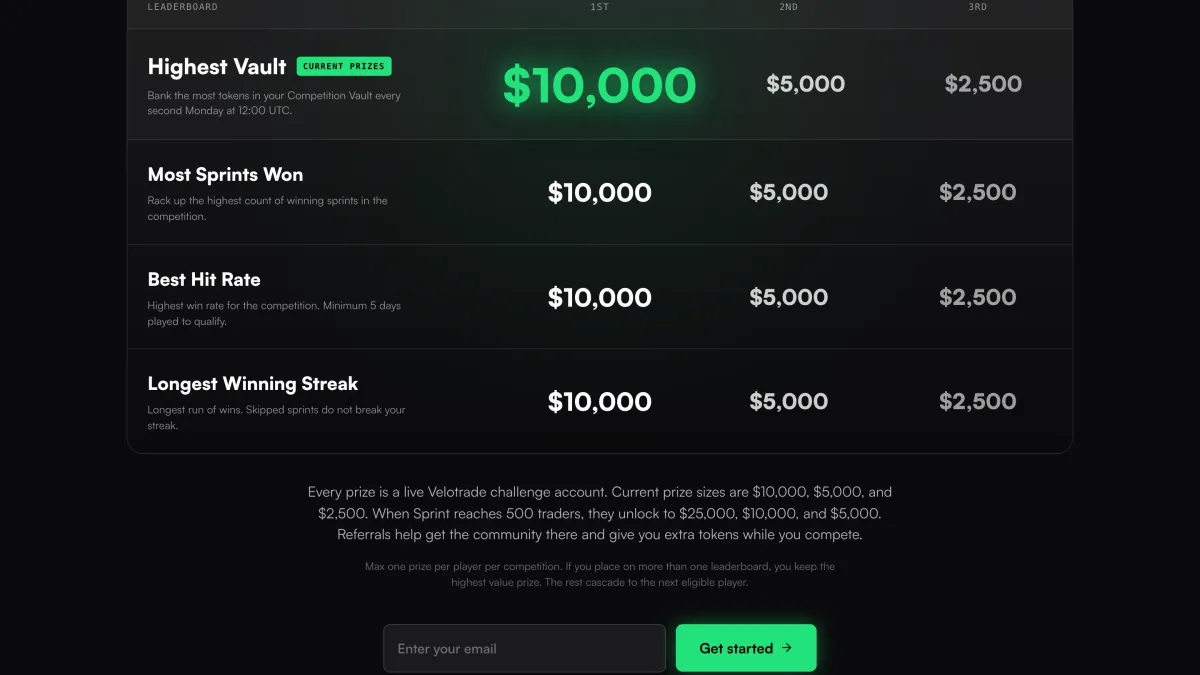
Four leaderboards. Sprint Trading ranks players on four separate boards, so more than one style of player can win:
| Leaderboard | What it rewards | Winning style |
|---|---|---|
| Highest Vault | Total demo tokens accumulated | Volume plus accuracy over the cycle |
| Most Sprints Won | Raw count of winning calls | Frequency with a positive edge |
| Best Hit Rate | Percentage of correct calls | Selectivity and patience |
| Longest Winning Streak | Consecutive correct calls in a row | Consistency under pressure |
The prizes. A new competition runs every second Monday, every two weeks. Each cycle awards 12 winners, the top 3 on each of the 4 leaderboards, with a maximum of one prize per player. Prizes are free Velotrade challenge accounts, starting at $10,000, $5,000, and $2,500 sizes and scaling up as more traders join. There is no fixed grand total. The pool grows with participation.
Why free practice that can win real capital is rare. Almost no free game pays out a funded account. The reason is simple economics. A funded account is a standing commitment of trading capital, so firms normally gate it behind a paid evaluation. Free games pay cash, vouchers, or tokens because those are cheap to give away once and never again. Sprint Trading inverts that model: a free, no-risk game on the real BTC price whose top finishers earn a real funded challenge account. That combination, free practice that can win you actual trading capital, is what makes it different from every pure simulator above.
If you want to sharpen the exact skill Sprint Trading tests, our guide on how to predict the Bitcoin price breaks down reading short-term direction. Sprint Trading is a closed beta with limited seats. You can join the waitlist at /start/sprint-trading.
Which Crypto Trading Simulator Should You Use?
The best tool depends on what you are trying to do. Here are the three most common goals and the clearest pick for each.
Best free simulator for learning the mechanics. TradingView paper trading. It runs on live charts with the same order types and indicators you would use for real, so the skills transfer directly. An exchange demo is the better choice if your goal is to learn one specific platform before funding it.
Best for strategy testing. A broker demo account or TradingView paper trading, depending on breadth. If you trade crypto alongside other assets, a broker demo lets you test across them in one place. If you live on the charts, TradingView gives you the deepest tooling to run an idea over many trades.
Best for real stakes. Sprint Trading. It is the only option here where free, no-risk practice can win you a real funded trading account. You compete on prediction accuracy against the live BTC price, across four leaderboards, with no money at risk and a real prize at the end of each cycle.
A simulator and a funded account are two ends of the same path. You practise for free to build the skill, then trade real capital once you can prove it. Sprint Trading connects the two directly: it is practice that pays out the next step. If you would rather skip the competition cycle and go straight to funded capital, you can start a paid evaluation any time. For where Velotrade sits against other firms, see the best crypto prop firms, and for how the capital itself works, see how a crypto funded trading account works.
This article is educational and not financial advice. Simulators and Velotrade challenge accounts use virtual or simulated funds; trading involves risk and outcomes vary by trader.
Related reading: Prediction Markets vs Gambling vs Sports Betting.
Frequently Asked Questions
About the author

Vittorio De Angelis
Executive Chairman
Former equity-derivatives trader at JP Morgan, Dresdner Kleinwort and Bank of America in London. Later Head of Brokerage at a global broker in Hong Kong.
Velotrade was founded in Hong Kong in 2016 by a team from JP Morgan, Dresdner Kleinwort and Bank of America, has paid out over $2.5 billion to its trade-finance clients, and has been featured in Bloomberg, the Financial Times, the Wall Street Journal and on Nasdaq. Its prop trading evaluations are simulated and educational.
View author page