Trade crypto with funded capital
ExploreA crypto trading competition is a timed contest where traders are ranked on a public leaderboard and the top finishers win prizes. Most run on demo accounts or live exchange balances, with scoring based on return, accuracy, or volume. The most valuable competitions do not pay cash at all. They pay out a funded trading account you keep trading with, which is what this article is about.
Highlights of this article
- A crypto trading competition is a timed, leaderboard-ranked contest scored by return, hit rate, or volume
- Types range from paper trading competitions to live exchange contests and prop-firm-sponsored events
- The best prize is not cash. It is a funded account you can keep trading and withdraw from
- Winning comes down to risk control and consistency, not one lucky trade
- Velotrade's Sprint Trading is a free crypto trading competition where prizes are real funded challenge accounts
What a Crypto Trading Competition Is
A crypto trading competition is a contest with a fixed start and end. Every entrant trades the same instruments under the same rules over the same window. Performance is tracked live, and a leaderboard ranks traders against each other in real time.
The scoring metric defines the game. Three are common:
- Return. The highest percentage gain on the starting balance wins. This rewards aggressive sizing and rewards risk-takers.
- Accuracy or hit rate. The highest percentage of winning trades or correct calls wins. This rewards selectivity over size.
- Volume. The largest traded notional wins. Exchanges run these to drive activity, and they reward frequency, not skill.
Competitions can last an hour, a weekend, or several weeks. Some run continuously in fixed cycles. The format matters because it changes the strategy that wins. A return-based sprint rewards different behaviour than an accuracy-based one, and understanding the scoring before you enter is the single most useful thing you can do.
If you are new to the idea of trading on the direction of a market without owning the asset, a crypto trading game or simulator is a low-stakes way to learn the mechanics. The same skills that win a contest, reading momentum and managing exposure, also sit behind prediction markets, where participants stake on outcomes rather than hold positions.
Sprint Trading is free to play, and top players win free challenge accounts. Velotrade challenges are a separate paid evaluation, starting from $40.
Types of Crypto Trading Competition
Not every competition is the same, and the prize structure tells you what kind you are looking at. The four main types differ in cost, risk, and what you actually win.
| Type | What you trade | Money at risk | Typical prize | Best for |
|---|---|---|---|---|
| Paper trading competition | Demo balance | None | Cash, vouchers, merch | Learning, building a record |
| Live-account competition | Your own deposited funds | Yes, your capital | Cash bonus or fee rebate | Confident traders with capital |
| Exchange-run competition | Exchange demo or live | Varies | Token rewards, fee discounts | Active traders on that exchange |
| Prop-firm-sponsored competition | Demo or simulator | None | A funded trading account | Traders who want capital, not cash |
A paper trading competition runs on a demo balance. Nothing is at risk because no real money is deposited. These are the safest entry point and the most common form of crypto trading game. The trade-off is that prizes tend to be small: gift cards, merchandise, or modest cash.
A live-account competition ranks traders by the performance of their own deposited funds. The leaderboard is real money, which means the risk is real money too. A leaderboard sorted by raw return pushes entrants toward oversized positions, and most blow up chasing the top spot.
Exchange-run competitions exist to drive trading volume. Rewards are often paid in the exchange's own token or as fee discounts, and the scoring frequently favours volume over profit. Read the rules closely, because "winning" can mean trading the most, not trading the best.
Prop-firm-sponsored competitions are the outlier. The firm runs a contest, usually on a demo or simulator so no entrant risks money, and the prize is a funded account. Instead of a one-time cash payout, the winner gets ongoing capital to trade. That is a far larger and more durable reward, and it is the model Velotrade uses.

What You Can Actually Win
Prizes fall into three tiers, and they are not close in value.
Cash. The most common prize. A return-based contest might pay the top three a fixed amount. Cash is simple, but it is a one-time event. You win it, you spend it, and the next competition starts from zero.
Vouchers, tokens, and fee discounts. Exchange competitions lean on these. A fee rebate or a token allocation has value, but only if you keep trading on that platform, and the value is usually small relative to the time invested.
A funded trading account. This is the prize that changes things. Instead of a single payout, you receive capital to trade with on an ongoing basis. You keep a share of the profits you generate, and you can withdraw repeatedly. A $10,000 funded account at a 90% profit split that produces even a modest monthly return will out-earn most cash prizes within weeks, and it keeps producing.
The difference is durability. Cash ends. A funded account compounds, because every withdrawal is repeatable and the capital stays in play. This is why the phrase "win a funded account" carries more weight than "win $500." One is a moment; the other is a job. You can win one free through Sprint Trading. For a full picture of how funded capital works in crypto, see how a crypto funded trading account works.
How to Actually Win a Crypto Trading Competition
Winning a leaderboard contest is not about a single big trade. It is about being the trader still standing, and still scoring, at the end. Four habits decide it.
Control risk first. The traders who go all-in to climb a return leaderboard are the same traders who drop off it on a bad print. Cap your risk per trade. On a demo competition where there is nothing to lose, the discipline still matters, because it is the only thing that produces a consistent score across a full cycle.
Be consistent, not explosive. Most leaderboard formats reward a steady accumulation more than a single spike. A trader who is right 58% of the time with controlled losses will usually finish above one who doubles up and then gives it all back. Consistency is also exactly what a prop firm wants to see, because it is what survives once real capital is involved.
Size positions deliberately. Match your position to the setup, not to the leaderboard. Increasing size because you are behind is how good runs end. The traders at the top of a hit-rate or streak leaderboard are sizing for survival, not for a comeback.
Do not over-trade. More trades is not more score unless the scoring rewards volume. On accuracy and streak formats, every marginal trade is a chance to break a run. Take the setups you have an edge on and skip the rest. Patience is a strategy.
These are the same disciplines that separate funded traders from blown accounts. A competition is a compressed version of the funded journey, which is why prop firms use them as a filter. If you can rank near the top of a leaderboard under pressure, you can probably handle a funded crypto trading account. For the specific rules and habits that get traders through a paid evaluation, see how to pass a crypto prop challenge.
Sprint Trading: A Free Crypto Trading Competition
Sprint Trading is a free crypto trading competition where the prizes are real funded challenge accounts. It is the clearest example of the prop-firm-sponsored model, and the mechanic is simple enough to learn in one round.
How a sprint works. You predict whether BTC will be UP or DOWN over a 5-minute sprint. The live BTC/USDT price decides the outcome. You get a 10-second warning before each round locks, so you choose your direction and commit before the window closes. A winning call pays 1.8x into your Competition Vault. No real money is deposited, and nothing is ever at risk.
Free demo tokens. You receive 100 free demo tokens per day, and they reset at 12:00 UTC. They cannot be purchased, only earned by playing, so no one buys their way up the board. During an active competition, each successful referral adds 25 bonus tokens. Because the tokens are demo only, Sprint Trading is skill-based, not gambling, and it is not a real-money binary option. You are competing on prediction accuracy, not staking deposited cash.
Four leaderboards. Sprint Trading does not rank everyone on one metric, which means more than one type of trader can win:
| Leaderboard | What it rewards | Winning style |
|---|---|---|
| Highest Vault | Total demo tokens accumulated | Volume plus accuracy over the cycle |
| Most Sprints Won | Raw count of winning calls | Frequency with a positive edge |
| Best Hit Rate | Percentage of correct calls | Selectivity and patience |
| Longest Winning Streak | Consecutive correct calls in a row | Consistency under pressure |
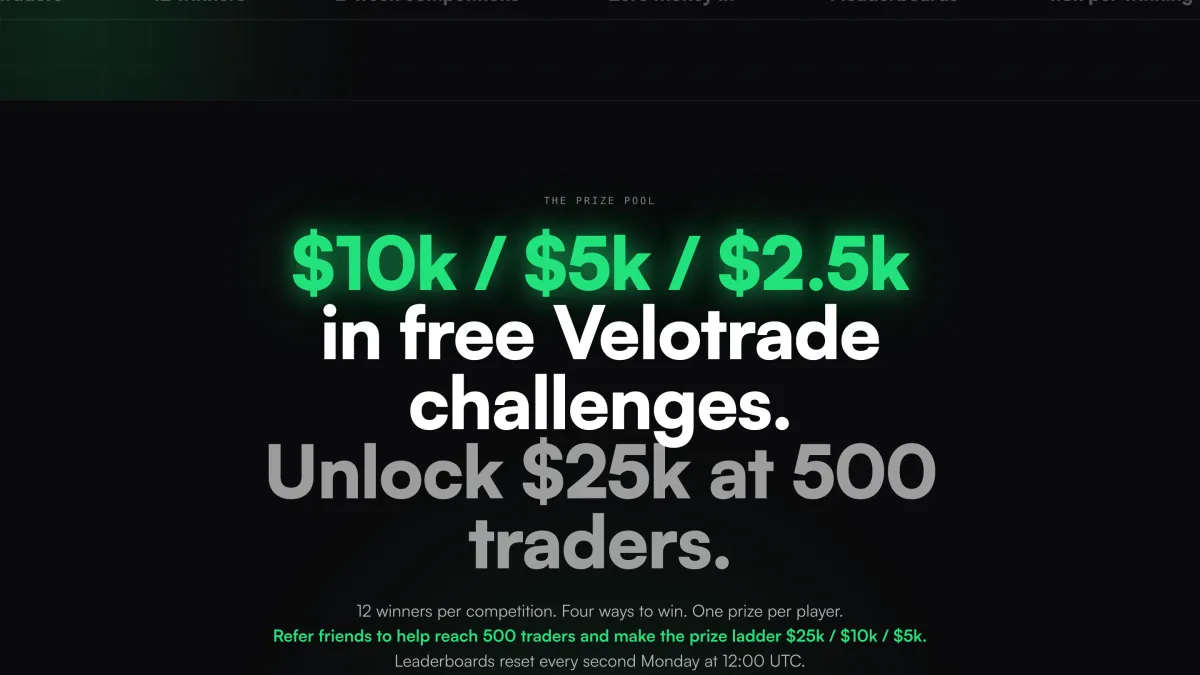
The prizes. A new competition runs every second Monday, every two weeks. Each cycle awards 12 winners, the top 3 on each of the 4 leaderboards, with a maximum of one prize per player. Prizes are free Velotrade challenge accounts, starting at $10,000, $5,000, and $2,500 sizes and scaling up toward $25,000, $10,000, and $5,000 as more traders join. The pool grows with participation.
Why this is unusual. Almost no free competition pays out funded accounts. Free contests pay cash or vouchers because those are cheap to give away. A funded account is a standing commitment of capital, so firms normally gate it behind a paid evaluation. Sprint Trading inverts that: a free, no-risk demo game whose top finishers earn a real funded challenge account. The closest comparison is the way Polymarket and Kalshi turned market prediction into a scored, public activity, except here the payoff is trading capital rather than a settled bet.
Sprint Trading is a closed beta with limited seats. You can join the waitlist at /start/sprint-trading.
From Winning to Funded: How a Velotrade Account Works
Whether you win a Sprint Trading prize or skip the competition and go straight to a paid evaluation, the funded path is the same. A Velotrade challenge account is an evaluation: you trade to a profit target inside a clear rule set, and when you pass, you trade firm capital and keep a share of the profit.
What the accounts include:
- Static maximum drawdown. Your loss limit is fixed at the start. It does not trail your balance upward, so a green day cannot tighten your room the next day.
- No consistency rule. You are not penalised for one strong day. A single good trade will not disqualify a passing account.
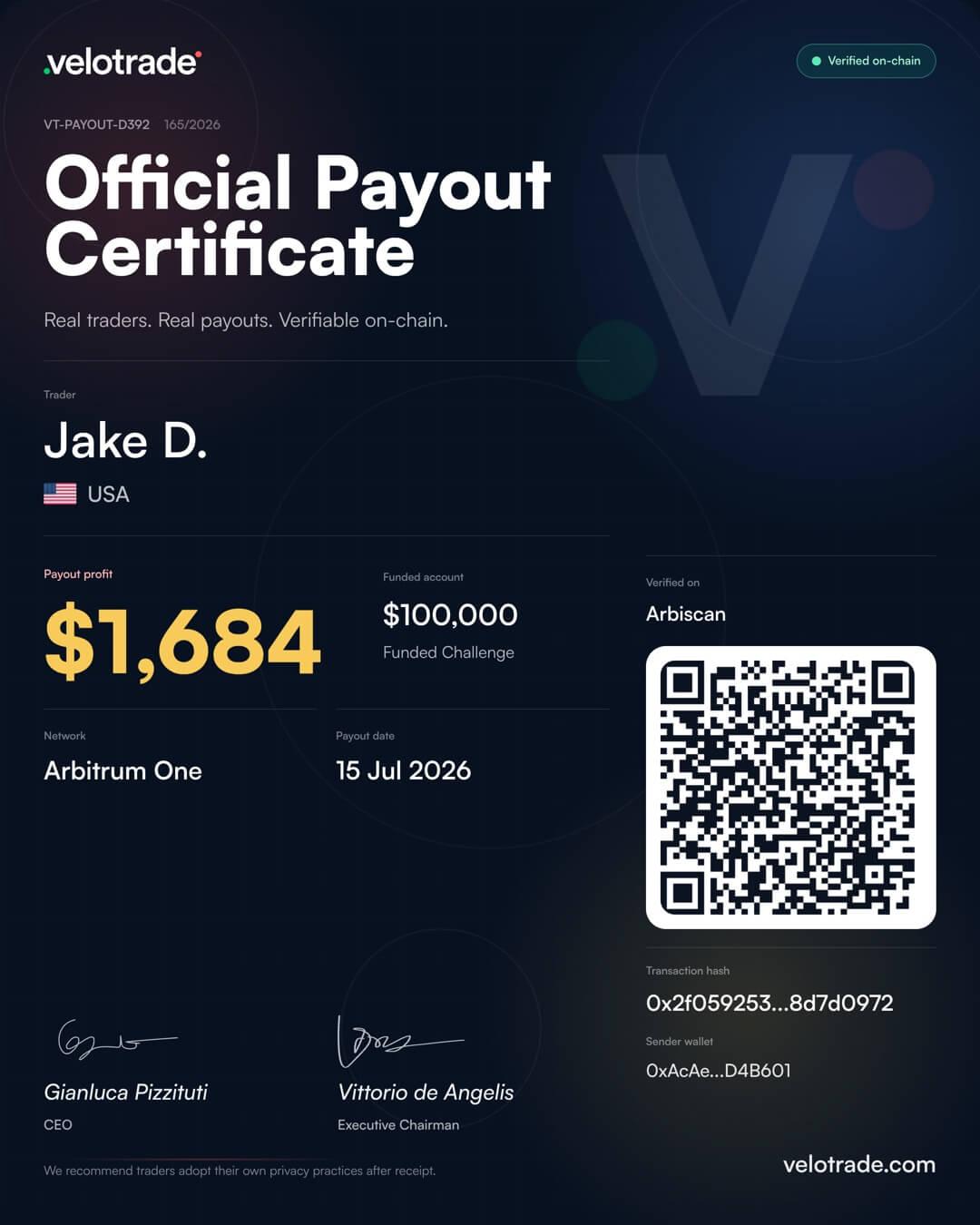
- Payouts within 24 hours. Approved withdrawals are processed fast, not on a monthly cycle.
- Up to 90% profit split. You keep the large majority of what you generate.
- Capital up to $200,000. Account sizes scale as you grow.
- Multi-asset. Trade crypto, forex, stocks, indices, and commodities, not crypto alone.
A Sprint Trading prize hands you one of these accounts for free. From there, passing the evaluation works the same as it does for any trader who paid to enter. If you would rather not wait for a competition cycle, you can start a paid challenge today and use the same rules. For a side-by-side of where Velotrade sits against other firms, see the best crypto prop firms. If you are weighing free entry points, free prop firm challenges explains what is real and what is marketing.
This article is educational and not financial advice. Velotrade challenge accounts are evaluations on simulated capital; trading involves risk and outcomes vary by trader.
Related reading: Best Prediction Market Apps and Platforms in 2026, Prediction Markets vs Gambling vs Sports Betting.
Related reading: How to Predict Bitcoin's Price Direction.
Frequently Asked Questions
About the author

Vittorio De Angelis
Executive Chairman
Former equity-derivatives trader at JP Morgan, Dresdner Kleinwort and Bank of America in London. Later Head of Brokerage at a global broker in Hong Kong.
Velotrade was founded in Hong Kong in 2016 by a team from JP Morgan, Dresdner Kleinwort and Bank of America, has paid out over $2.5 billion to its trade-finance clients, and has been featured in Bloomberg, the Financial Times, the Wall Street Journal and on Nasdaq. Its prop trading evaluations are simulated and educational.
View author page