One account, every market we offer
ExplorePolymarket vs Kalshi is the most common matchup for anyone trying to call real-world events for money. They look similar from the outside, you pick an outcome and you get paid if you are right, but underneath they are built very differently. This article compares the two on regulation, US access, the kinds of markets they run, how you fund an account, fees, and how each one settles, so you can pick the platform that actually fits how you want to trade.
Highlights of this article
- Kalshi is a CFTC-regulated US exchange; Polymarket is a crypto-native, on-chain market that has historically restricted US users
- Kalshi takes US dollars through normal payment rails; Polymarket settles in USDC stablecoin on-chain
- Polymarket has historically listed a very wide range of event markets; Kalshi lists regulated event contracts and has expanded its catalogue over time
- Both resolve each market to a single yes or no outcome, but the resolution process and oversight differ
- If what you actually want is to call crypto price direction, a prediction market is an indirect way to do it, and there are more direct paths
Quick verdict: Polymarket vs Kalshi at a glance
If you are in the United States and want a regulated venue with normal dollar funding, Kalshi is the natural fit. If you are comfortable with crypto wallets, stablecoins, and on-chain settlement, and you want the broadest possible range of event markets, Polymarket is built for that. Both let you take a position on a future event and get paid if you call it correctly. The differences are in who regulates them, who can use them, and how money moves in and out.
Here is the short version side by side.
| Polymarket | Kalshi | |
|---|---|---|
| Regulation | Crypto-native, decentralized settlement; not a CFTC-registered US exchange | CFTC-regulated US designated contract market |
| US availability | Historically restricted for US users | Built for US users |
| Market types | Very broad range of event markets | Regulated event contracts, catalogue expanded over time |
| Currency / payment | USDC stablecoin, on-chain | US dollars via standard payment methods |
| Fees | Crypto network and trading costs; verify current schedule | Exchange trading fees; verify current schedule |
| How it resolves | Market resolves to yes or no via its on-chain resolution process | Contract settles to yes or no under exchange rules and CFTC oversight |
Treat the fee rows as categories rather than exact numbers. Both platforms publish their own current fee schedules, and those change, so confirm the live figures on each site before you commit capital. For a plain-language primer on the whole category, see what prediction markets are.
What Polymarket is
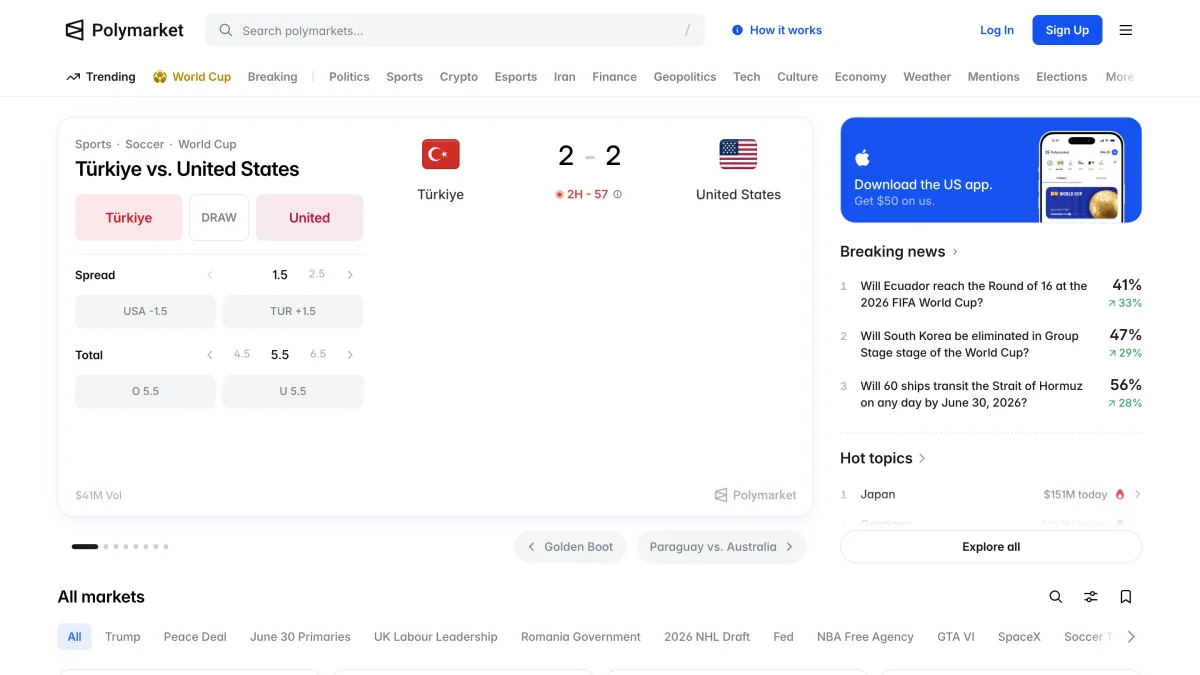
Polymarket is a crypto-native prediction market. You connect a wallet, fund it with USDC (a US dollar stablecoin), and buy shares in the outcome of a future event. Each market is a yes or no question, for example whether a specific event happens by a certain date. Shares trade between 0 and 1 dollar. If your side resolves true, each share is worth 1 dollar; if it resolves false, it is worth nothing. The price along the way reflects the market's running estimate of how likely the outcome is.
How does Polymarket work mechanically? It runs on-chain, which means trades and settlement are recorded on a public blockchain rather than on a single company's internal ledger. Settlement is in USDC, so you are moving stablecoins in and out of a wallet rather than wiring dollars to a broker. This is why Polymarket appeals to people already comfortable with crypto: the funding, the trading, and the payout all live in the same on-chain stablecoin environment.
The range of markets has historically been very broad, covering many categories of real-world events. That breadth is part of the appeal. The trade-off is that Polymarket has historically restricted access for users in the United States, and the on-chain model assumes you are willing to manage a wallet, hold a stablecoin, and deal with crypto network mechanics.
What Kalshi is
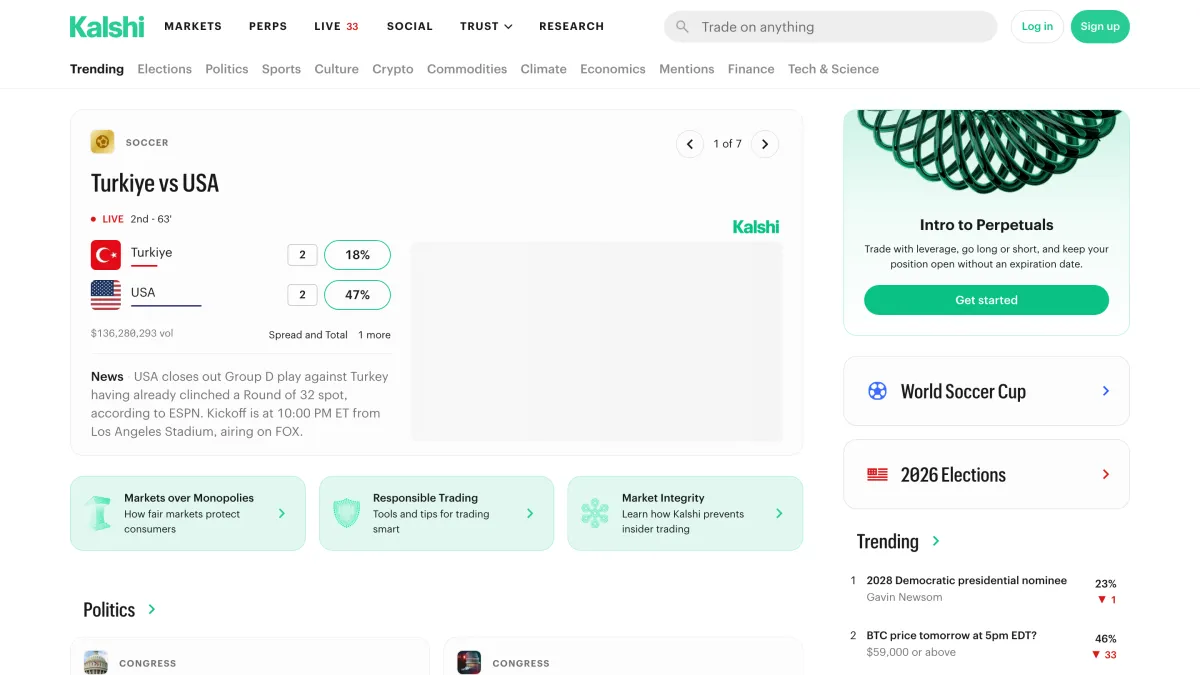
Kalshi is a US-based, CFTC-regulated exchange for event contracts. The key word is regulated. Kalshi operates as a designated contract market under the oversight of the Commodity Futures Trading Commission, the same regulator that oversees US futures markets. That regulatory status is the single biggest thing that separates it from a crypto-native venue.
On Kalshi you trade event contracts that pay out based on whether a defined event happens. Like Polymarket, each contract resolves to a yes or no outcome, and prices move between the floor and the cap as the market's view of the probability shifts. The difference is in the plumbing. You fund a Kalshi account in US dollars through standard payment methods, not by bridging stablecoins into a wallet. Settlement happens under exchange rules with regulatory oversight rather than through an on-chain resolution process.
What is Kalshi best at? It is the straightforward answer for a US-based user who wants a regulated, dollar-denominated venue and does not want to touch crypto rails at all. Its catalogue of event contracts has expanded over time within the bounds of what a regulated exchange can list, so the specific markets available will differ from the wide-open range you might see on a crypto-native platform.
Key differences between Polymarket and Kalshi
The platforms rhyme, but the details that matter for a real user diverge sharply. Here are the differences worth understanding before you fund either one.
Regulation. Kalshi is a CFTC-regulated US exchange. Polymarket is a crypto-native market with on-chain settlement and is not a CFTC-registered US exchange. If regulatory status is a priority for you, that is the cleanest dividing line between the two.
US access. Kalshi is built for US users. Polymarket has historically restricted US access. This is often the deciding factor on its own. If you are in the United States, your practical options are shaped by this before anything else.
How you fund and pay. Kalshi uses US dollars through normal payment methods. Polymarket uses USDC and on-chain wallets. One assumes a bank account and a card; the other assumes a crypto wallet and a stablecoin balance. Neither is harder in the abstract, but they suit different people.
Market breadth. Polymarket has historically listed a very wide range of event markets. Kalshi lists event contracts within a regulated framework and has grown its catalogue over time. If sheer breadth of obscure markets is what you want, the crypto-native venue has historically offered more of it.
Resolution and settlement. Both resolve each market to yes or no. Kalshi settles contracts under exchange rules with CFTC oversight. Polymarket resolves markets through its on-chain resolution process. The end state is the same shape, a binary payout, but the mechanism and the accountability behind it are different.
Fees. Both charge for trading, and Polymarket also exposes you to crypto network costs when you move funds on-chain. Describe these to yourself as categories, not fixed numbers, and check each platform's current schedule before trading. Fees change, and the live figures are what matter.
Is Polymarket legal, and who can use each platform
Is Polymarket legal? The honest answer is that it depends on where you are. Polymarket is a crypto-native platform that has historically restricted access for users in the United States, and the legal treatment of on-chain prediction markets varies by jurisdiction. If you are outside the United States and comfortable with crypto, it may be available to you, but you should confirm the current rules for your own location rather than assume. Do not treat a general article as a ruling on your specific situation.
Kalshi's position is more clear-cut for a US audience. It operates as a CFTC-regulated exchange, which is precisely why it is a common answer for US users who want a venue with formal oversight. Regulation does not mean risk-free, and it does not mean every market on the platform is right for you, but it does mean there is a defined regulatory framework around how the exchange operates.
The practical takeaway: your location and your comfort with crypto rails usually decide this before any feature comparison does. A US-based user who wants to stay in dollars and inside a regulated venue leans Kalshi. A crypto-comfortable user outside the US who wants the widest market selection leans Polymarket.
Which one to choose, by user type
There is no single winner. The right pick depends on who you are and what you are trying to do.
Choose Kalshi if you are in the United States, you want a regulated exchange, you prefer to fund in dollars, and you have no interest in managing a crypto wallet. The regulatory framework and the simple dollar funding are the whole point.
Choose Polymarket if you are comfortable with crypto wallets and stablecoins, you want the broadest possible range of event markets, on-chain settlement does not bother you, and you have confirmed it is available and legal in your location. The breadth and the crypto-native design are the draw.
Consider neither, and look at something more direct, if what you actually care about is calling crypto price moves. This is more common than people admit. A lot of prediction-market users are really trying to express a view on where Bitcoin or another asset is going. A prediction market is an indirect, event-shaped way to do that. If the underlying goal is crypto direction, there are cleaner paths.
If it is crypto price direction you actually care about
Here is the part most comparisons skip. A large share of people drawn to prediction markets are not really interested in the event mechanics. They want to call crypto. They want to be right about whether Bitcoin goes up or down, and a yes or no market is just the wrapper they found first.
If that is you, Velotrade's Sprint Trading is a more direct way to test that exact skill, with zero money at risk. To be clear about what it is and is not: Sprint Trading is not a prediction market like Polymarket or Kalshi. It is a free, skill-based game played with demo tokens. You are never risking real money, and it is not betting and not a real-money binary option. It is a competition that feeds into Velotrade's funded crypto trading.
Here is how it works. At sprint.velotrade.com you predict whether BTC will go UP or DOWN over a 5-minute sprint, and the live BTC/USDT price decides the result. You get a 10-second warning before the call locks. You start with 100 free demo tokens per day, which reset at 12:00 UTC and cannot be purchased, so there is no real money in play at any point. A winning call pays 1.8x into your Competition Vault.
The competitive layer is what turns it from a toy into a path. There are 4 leaderboards: Highest Vault, Most Sprints Won, Best Hit Rate, and Longest Winning Streak. A new competition starts every second Monday, every two weeks, and each competition has 12 winners, with a maximum of one prize each. The prizes are free Velotrade challenge accounts, starting at $10,000, $5,000, and $2,500, and scaling up as more traders join.
That is the bridge into funded crypto trading. Sprint Trading lets you sharpen short-horizon BTC direction calls for free, top players win a free funded challenge account, and from there the path runs into a real evaluation and a funded account. If you want to see how the competitive side works in more depth, read about the crypto trading competition, and if you are weighing where to get funded, compare the best crypto prop firms.
You can also join the waitlist at /start/sprint-trading if you want in early. The point is simple: if the real itch is calling crypto direction, scratch it directly with a free skill game rather than through an event-market wrapper, and let it lead somewhere, a funded account, instead of nowhere.
For traders who decide they want to go all the way to funded, the free prop firm challenge guide explains what a no-cost or fee-refund path into evaluation actually looks like.
This article is for informational purposes only and is not financial, investment, or legal advice. Platform features, fees, regulatory status, and availability change frequently and vary by location. Confirm the current terms directly with each platform before trading.
More on prediction markets: Are Prediction Markets Legal? US and Global Status, Crypto Prediction Markets, Prediction Markets vs Gambling vs Sports Betting.
Frequently Asked Questions
About the author

Vittorio De Angelis
Executive Chairman
Former equity-derivatives trader at JP Morgan, Dresdner Kleinwort and Bank of America in London. Later Head of Brokerage at a global broker in Hong Kong.
Velotrade was founded in Hong Kong in 2016 by a team from JP Morgan, Dresdner Kleinwort and Bank of America, has paid out over $2.5 billion to its trade-finance clients, and has been featured in Bloomberg, the Financial Times, the Wall Street Journal and on Nasdaq. Its prop trading evaluations are simulated and educational.
View author page