Trade crypto with funded capital
ExploreCrypto prediction markets let you trade contracts on the outcome of a crypto event, such as whether Bitcoin will be above a price by a set date. The contract price acts as the market's implied probability of that outcome. This guide explains how these markets work, how on-chain platforms differ from regulated ones, and how calling crypto direction connects to actually trading it.
Highlights of this article
- A crypto prediction market trades contracts on crypto outcomes, with price equal to implied probability
- On-chain platforms settle in stablecoins like USDC and resolve through oracles
- Regulated venues offer crypto event contracts under a financial framework instead
- A prediction contract pays a fixed outcome, while trading captures the size of the move
- Velotrade's Sprint Trading is a free way to call Bitcoin direction with no money at risk
What a Crypto Prediction Market Is
A prediction market is a market for outcomes. Instead of trading the asset itself, you trade a contract that pays out if a specific event happens.
In crypto, the events are things people can measure. Will Bitcoin close above a level by Friday. Will Ethereum reach a milestone this quarter. Will a network upgrade ship on time. Each market offers contracts on the yes and no sides, and the price moves as traders take positions.
The price is the useful part. A contract trading at 70 cents on the dollar implies the market thinks the outcome is about 70 percent likely. As new information arrives, the price moves, and the market aggregates many opinions into a single probability. That is the same mechanism described in prediction markets explained, applied to crypto outcomes.

How Crypto Prediction Markets Work
There are two broad models, and the difference matters for how you use them.
On-chain, crypto-settled markets
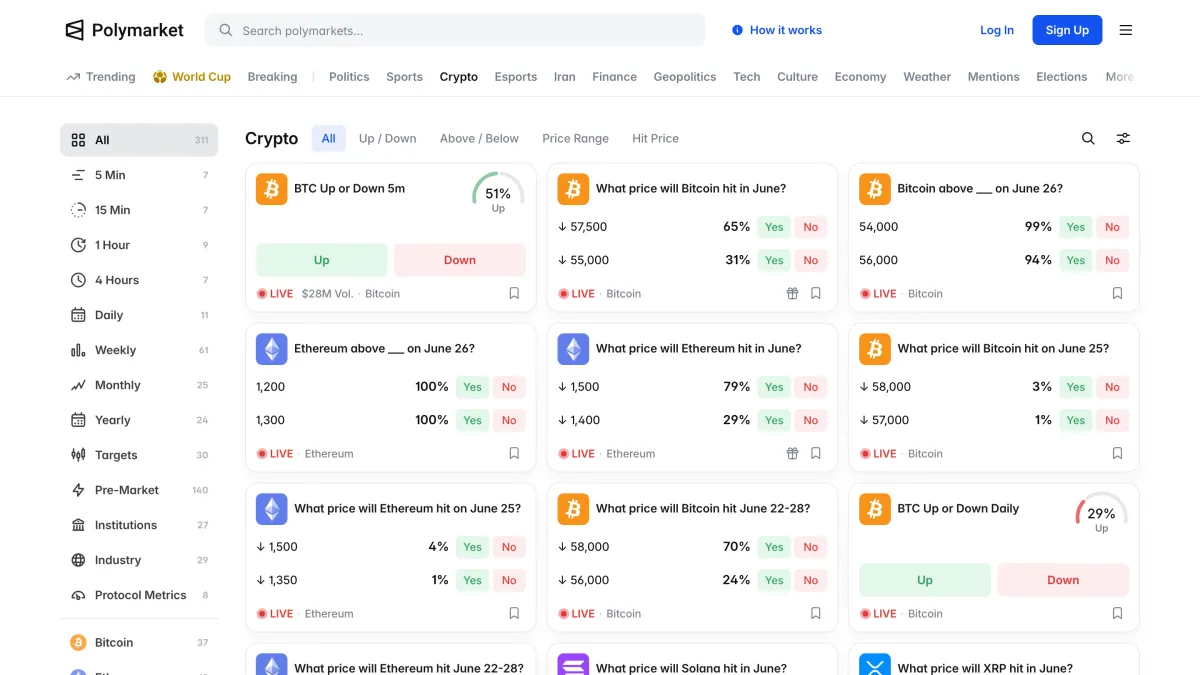
On-chain platforms run on a blockchain and settle in a stablecoin, usually USDC. You connect a wallet, buy yes or no shares, and the contract resolves when the event is decided. Resolution often relies on an oracle, a system that reports the real-world result back to the blockchain so the contract can pay out. Polymarket is the best known example of this model.
The advantages are open access and transparent settlement. The trade-offs are wallet and gas friction, and a regulatory status that varies by country. Many on-chain markets restrict users in jurisdictions where they are not licensed.
Regulated event-contract venues
The second model is a regulated exchange that offers crypto-linked event contracts under financial rules. Here the contract is treated as a financial instrument, and the venue answers to a regulator. Access is cleaner for users in supported countries, and the framework is more familiar to traditional traders.
For a side-by-side look at the two leading platforms across these models, see Polymarket vs Kalshi. For a broader roundup of platforms, see best prediction market apps. For where each is available, see are prediction markets legal.
| Feature | On-chain market | Regulated venue |
|---|---|---|
| Settlement | Stablecoin on-chain | Cash through the exchange |
| Resolution | Oracle reporting | Exchange settlement |
| Access | Wallet, varies by country | Account, supported countries |
| Treatment | Often unregulated | Financial instrument |
Price-Direction Markets Specifically
The most trading-relevant category is the price-direction market. These ask a simple question: will the price be up or above a level by a certain time.
This is close to how a trader thinks, but it is not the same as trading. A direction contract pays a fixed amount if you are right and nothing if you are wrong. The size of the move does not change your payout. A trader who is right by a small amount and a trader who is right by a large amount get the same result on the contract.
Crypto Prediction vs Crypto Trading
This is the distinction that decides which path suits you.
A prediction-market contract is binary in spirit. You are paid for being correct about an outcome, full stop. Your edge is reading probability better than the market.
Trading the asset is different. When you trade a funded crypto account, you capture the move itself. Position sizing, entries, exits, and risk management all change the result. Being right by more makes you more. Being wrong is controlled by your stop and your drawdown rules, not by a fixed loss on a contract.
This is why many people who enjoy calling crypto direction eventually move toward trading. The skill, reading where price goes next, is the same. Trading just rewards that skill in proportion to how right you are, and lets you manage risk actively. If you are new to that side, start with what is crypto prop trading.
Reading a Contract Price as a Probability
The single most useful skill in a prediction market is reading the price correctly.
A contract that trades at 65 cents is the market saying the outcome is roughly 65 percent likely. If you think the true probability is higher, the contract is cheap and worth buying. If you think it is lower, the contract is expensive and worth selling or avoiding. Your edge is not predicting the outcome with certainty. It is judging whether the crowd has priced the probability too high or too low.
This is why prediction markets reward information over luck. A trader who reads an upcoming event better than the crowd, and acts before the price adjusts, captures the gap. When the news arrives and the price moves to reflect it, the early, better-informed position is already profitable. The same logic drives trading: price reflects what is currently known, and the edge comes from reading what the market has not fully priced yet.
The discipline transfers directly. Whether you are pricing a yes or no contract or sizing a directional trade, you are always asking the same question. Is the current price too generous, or too greedy, given what I know.
Risks to Watch in Crypto Prediction Markets
Crypto prediction markets carry risks beyond being wrong about the outcome.
Resolution risk is the first. A market is only as reliable as the oracle or rule that settles it. Ambiguous questions, delayed data, or disputed results can hold up payouts or resolve in ways traders did not expect. Always read exactly how a market is defined before taking a position.
Liquidity is the second. Thin markets can have wide spreads, so entering and exiting costs more than the headline price suggests. A contract that looks mispriced can stay that way simply because there is not enough volume to move it.
Platform and custody risk is the third. On-chain markets hold value in a wallet and depend on smart-contract security and the platform's solvency. Offshore venues may also restrict withdrawals or access for users in certain countries. These are the same diligence questions that apply across crypto, and they matter as much as the call itself.
A Free Bridge: Sprint Trading
See how to win a funded account for free through Sprint Trading.
The cleanest way to test your directional read on crypto, without a wallet, a deposit, or any money at risk, is Sprint Trading.
Sprint Trading is a free game at sprint.velotrade.com. You predict whether Bitcoin will be up or down over the next 5-minute sprint, and the live BTC/USDT price decides the result. No simulation and no house price. You get 10 seconds of warning before each sprint locks.
You receive 100 free demo tokens a day, reset at 12:00 UTC, and you cannot buy more. A winning call pays 1.8x into your Competition Vault. There are four leaderboards: Highest Vault, Most Sprints Won, Best Hit Rate, and Longest Winning Streak. A new competition runs every second Monday, with 12 winners per competition and one prize maximum per player.
The prizes are real Velotrade challenge accounts, with sizes starting at $10,000, $5,000, and $2,500 and scaling up as more traders join. That is the graduation point from calling direction for fun to trading firm capital for real. A Velotrade funded account runs on a static maximum drawdown, has no consistency rule, pays out in under 24 hours once you request a withdrawal (the first after 14 days, then weekly), and offers up to a 90 percent profit split on capital up to $200,000 across multiple asset classes.
If you want the next step after Sprint Trading, a crypto funded trading account explains how funded trading works, and you can compare firms in best crypto prop firms. To go deeper on calling direction, see how to predict Bitcoin's price, and to win an account through a free contest see crypto trading competitions.
Sprint Trading is a skill game using demo tokens. It is not a prediction market, not gambling, and not real-money binary options. For why prediction markets themselves are not simply betting, see prediction markets vs gambling.
Frequently Asked Questions
About the author

Vittorio De Angelis
Executive Chairman
Former equity-derivatives trader at JP Morgan, Dresdner Kleinwort and Bank of America in London. Later Head of Brokerage at a global broker in Hong Kong.
Velotrade was founded in Hong Kong in 2016 by a team from JP Morgan, Dresdner Kleinwort and Bank of America, has paid out over $2.5 billion to its trade-finance clients, and has been featured in Bloomberg, the Financial Times, the Wall Street Journal and on Nasdaq. Its prop trading evaluations are simulated and educational.
View author page