Trade crypto with funded capital
ExploreThe best crypto prop firms in 2026 are not all built the same, and the differences between them will determine whether you get funded, stay funded, and actually get paid.
This guide ranks and reviews the top firms by what matters in practice: payout track record, rule transparency, profit splits, platform quality, and whether they are genuinely crypto-focused or a forex firm that bolted crypto onto its offer later. For the underlying data, see our prop firm transparency report. Of the 16 firms we track, only 4 remove the consistency rule entirely and only 5 use a static drawdown, and just two, Velotrade and Bitfunded, do both, the combination that most affects whether you keep a funded account.
We also include a side-by-side comparison table and a decision framework to help you select the best fit for your specific profile.
Quick answer: The best crypto prop firm in 2026 depends on your priority. For 24/7 crypto trading with static drawdown, no consistency rule, and fast crypto payouts, Velotrade ranks first. FTMO has the longest verified payout history, and FundedNext the widest instrument range. Weigh payout track record and drawdown model above the headline profit split.
Last reviewed: July 2026. Rankings are updated as firms change their rules, splits, and payout terms.
If you are new to how this model works, start with what crypto prop trading is and how it works or what is a prop firm account for a breakdown of account types, rules, and earnings potential. If you already understand the model and are comparing providers, read on.
Highlights of this article
- Payout track record is more important than headline split marketing
- Crypto-native firms are usually better calibrated than forex-first firms for 24/7 volatility
- Rule clarity and drawdown model determine pass rate more than most traders realize
- Platform quality and payout speed directly impact long-term viability
- The right firm depends on your trader profile, not generic "top 10" lists
What makes a crypto prop firm worth your money?
Before rankings, the criteria must be clear.
Most "best firm" lists in this category are driven by affiliate economics, not trader outcomes. That distorts comparisons and hides the variables that actually drive success rate and payout reliability.
Here are the six factors that determine whether a crypto prop firm is worth paying for.
1) Payout track record
This is the most important factor and the one most sites skip.
Any firm can advertise an 80% or 90% split. The real question is whether that split has been paid consistently, at scale, over time, and under normal business cycles. For a breakdown of which firms offer the highest splits and what the starting split actually is, see crypto prop firms with the highest profit split.
Look for firms that:
- publish payout evidence or aggregate statistics
- have verifiable trader feedback across independent channels
- have operated long enough to establish real payment history
A very new firm can still be good, but the uncertainty premium is objectively higher when operating history is thin.
2) Crypto-only vs forex-first architecture
Several large prop brands started in forex and later added crypto. That matters for strategy fit.
Forex-first firms often design rules and risk assumptions around forex volatility. Large forex-first multi-asset firms like FundingPips, E8 Markets, and the budget-priced Aqua Funded fall into this category, and the CFD-focused FunderPro belongs to the same group. For head-to-head crypto comparisons, see FundingPips vs Velotrade and FunderPro vs Velotrade. Crypto has different behavior: 24/7 sessions, sharper intraday expansion, and different liquidity conditions around macro events.
A crypto-native firm usually calibrates restrictions and risk controls to those realities, which can reduce structural mismatch for dedicated crypto traders.
3) Rule transparency and fairness
Most traders fail evaluations because of rules, not because they have no edge.
Consistency caps, restricted windows, minimum trading day requirements, weekend rules, and ambiguous breach definitions can invalidate otherwise profitable traders.
Before buying any challenge, read the full policy stack. For a deeper framework, review crypto prop firm rules and drawdowns explained, or filter straight to crypto prop firms with no consistency rule.
4) Drawdown structure
Drawdown model is one of the biggest hidden pass-rate variables.
Two common structures are:
- Fixed drawdown: based on starting balance, never moves
- EOD trailing drawdown: tracks end-of-day equity highs only. Floor moves up when you profit at close, never intraday
- Tick-by-tick trailing drawdown: tracks every intraday equity peak. Most aggressive, tightens the floor even on brief unrealised gains
Tick-by-tick trailing models are the hardest to manage and can trigger breaches during profitable runs. EOD trailing is more forgiving. Intraday volatility does not affect your floor.
5) Platform quality
Platform and execution quality affect everything from slippage tolerance to order management and confidence under volatility.
DXtrade, MT5, and cTrader are generally credible standards. Opaque in-house stacks can work, but increase trust risk because independent benchmarking is limited. If you are new to DXtrade, see how to use DXtrade for crypto prop trading for a full platform walkthrough.
6) Profit split and payout speed
In 2026, 80% is market baseline. Any lower split needs a strong compensating advantage.
Free calculator
What does passing actually pay you?
Plug in your account size and see your profit target, max drawdown, and first payout - before you commit to a challenge.
Use the free prop challenge calculatorPayout cadence matters equally. Weekly or on-demand workflows are increasingly expected among top operators. Slow payout cycles and unclear processing requirements should be treated as negative quality signals. For a full breakdown of what drives payout speed and what to verify before you commit, see crypto prop firm payout speed: what traders need to check.
"When traders ask us how to pick a crypto prop firm, we always say the same thing: ignore the headline split percentage and read the drawdown rules first. A 90% split means nothing if the evaluation is structured to fail you on a tick-by-tick model or a consistency cap that catches you on your best day.", Velotrade trading team
For a filterable side-by-side view of all major firms including drawdown model, rules, and trading conditions, see the crypto prop firm directory. For a written side-by-side comparison covering 7 firms across drawdown model, consistency rule, news policy, and payout track record, see prop firm comparison 2026.
The best crypto prop firms in 2026 (ranked)
1) Velotrade, best overall for serious crypto traders
HQ: Hong Kong Platform: DXtrade Max funding: Up to $200,000
Velotrade stands apart on two fronts: its crypto accounts run on a crypto-native multi-asset platform, and it is backed by a founding team with institutional financial market backgrounds spanning JP Morgan, Bank of America, Dresdner Kleinwort, and Nasdaq-listed entities.
"We built Velotrade as the firm we would have wanted to trade with ourselves. Crypto-native rules designed around how the market actually moves, and payouts processed within 24 hours, not when it suits the firm.", Velotrade founding team
In a category populated largely by retail-first operators, that institutional pedigree is a meaningful signal, not as a proxy for prop trading tenure, but as an indicator of how risk, capital, and counterparty obligations are understood at the organizational level. Velotrade uses an institutional hedging model that mirrors and hedges selected trader positions, which structurally aligns the firm's interests with the trader's success.
What Velotrade offers:
- structured crypto prop challenges
- profit split up to 90%
- static drawdown (floor fixed from your starting balance, never trails)
- news trading allowed
- weekend holding allowed
- no consistency rule
That rule profile is important. Many firms introduce hidden friction by forcing traders into artificial consistency patterns that do not reflect how real edge manifests in crypto markets.
Velotrade's conditions are built for traders who run robust strategy logic and need operationally fair constraints, not arbitrary pattern constraints.
Who it is for:
- experienced crypto traders
- strategy-driven traders who need flexibility around event risk and weekend structure
- traders who prioritize reliability and policy clarity over short-term promotional gimmicks
Ready to review specifics? Audit challenge structures and account options, then validate enforcement details in the full rules. For a detailed independent assessment, see our full Velotrade review.
There is also a no-fee way to get funded if you would rather not pay an evaluation fee upfront.
2) HyroTrader, best for real exchange connectivity
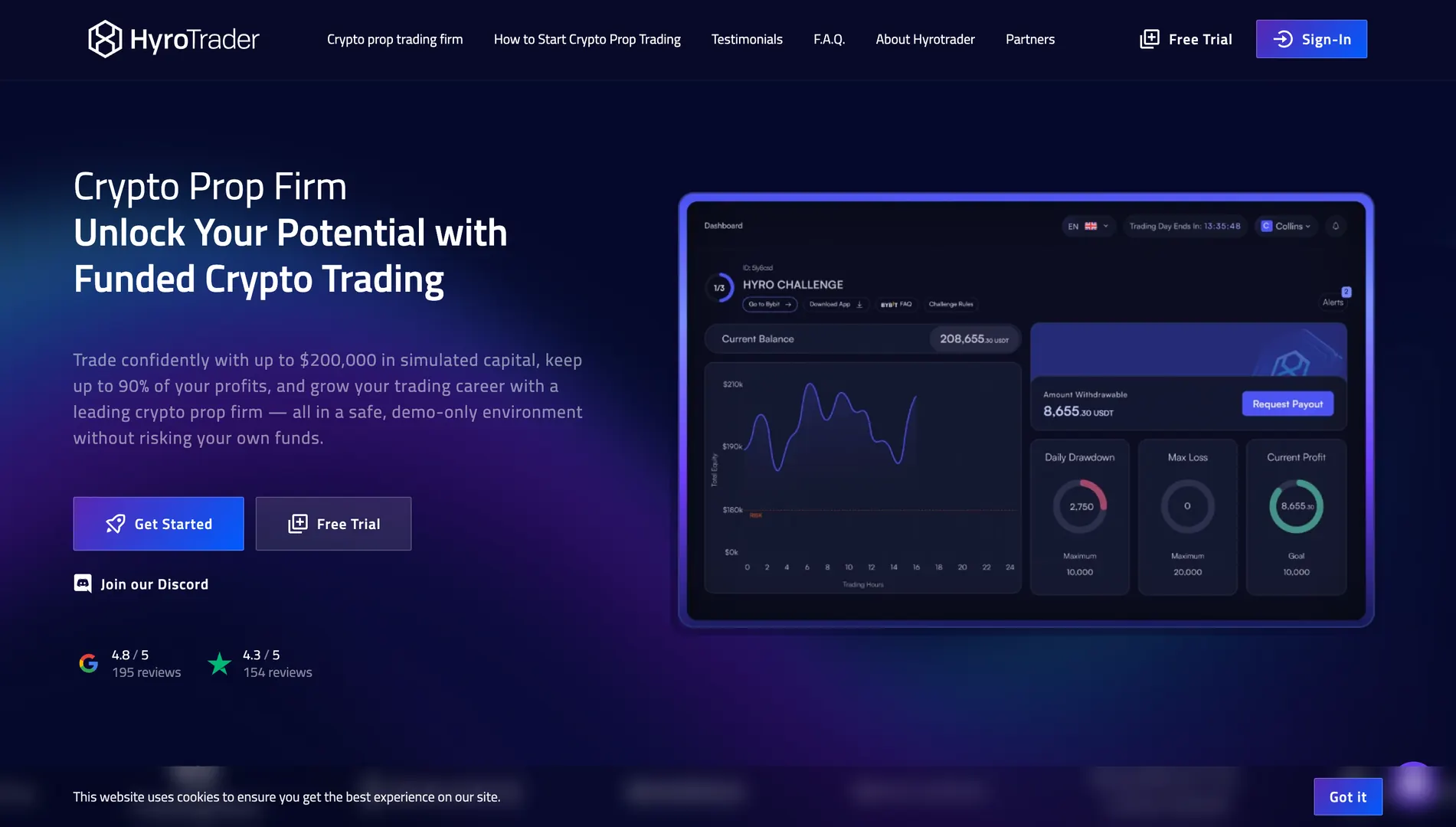
Founded: 2023
HQ: Bratislava, Slovakia
Platform: Bybit + CLEO
Max funding: Up to $1,000,000
HyroTrader's core differentiator is real exchange context through Bybit-linked infrastructure.
For traders who specifically want exchange-native execution behavior instead of purely synthetic challenge environments, that is a meaningful advantage.
Strengths:
- 500+ crypto pairs
- fast payout workflows in stablecoins
- fee refund model on first funded payout
Trade-offs:
- limited long-term operating history
- starting split below top-market baseline in many setups
- dependency on one exchange ecosystem
Who it is for:
- traders who prioritize real exchange connectivity first
- traders willing to accept lower starting economics in exchange for execution model preference
For a detailed side-by-side breakdown of both firms, see HyroTrader vs Velotrade. For a full standalone review of HyroTrader's challenge structure, drawdown model, and payout mechanics, see HyroTrader review 2026. For a direct comparison between HyroTrader and BrightFunded on drawdown model, consistency rule, and platform, see HyroTrader vs BrightFunded. For HyroTrader's full rule profile and fees, see the HyroTrader directory page.
3) BrightFunded, best for beginners
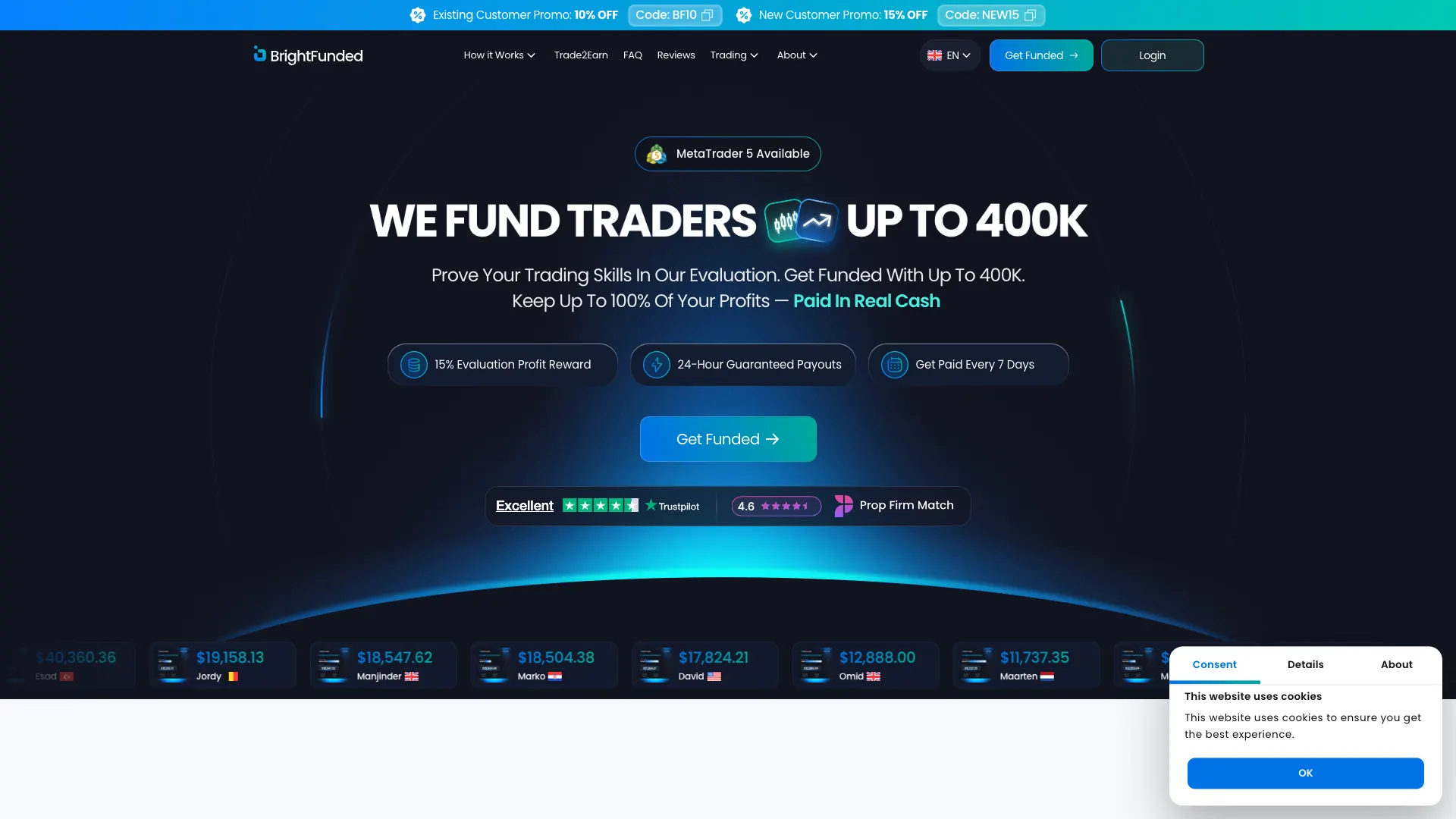
Founded: 2023
HQ: Amsterdam
Platform: Proprietary + MT5/cTrader/DXtrade
Max funding: Up to $400,000
BrightFunded is one of the most beginner-accessible options in this cohort.
Its challenge structure is straightforward, onboarding is approachable, and progression features are designed to keep early-stage traders in a structured learning loop.
Strengths:
- beginner-friendly challenge flow
- news and weekend holding generally available
- broad platform support and automation compatibility
Trade-offs:
- young operating profile
- transparency is improving, but long-horizon payment history is naturally shorter than mature operators
Who it is for:
- newer traders building first funded-account process discipline
- traders who value guided structure over maximal flexibility
For a detailed side-by-side breakdown of how BrightFunded and Velotrade compare on every rule that matters, see BrightFunded vs Velotrade. For a full standalone review of BrightFunded's structure and where it fits, see BrightFunded review 2026. For BrightFunded's full rule profile and fees, see the BrightFunded directory page.
4) DNA Funded, best for low-cost entry
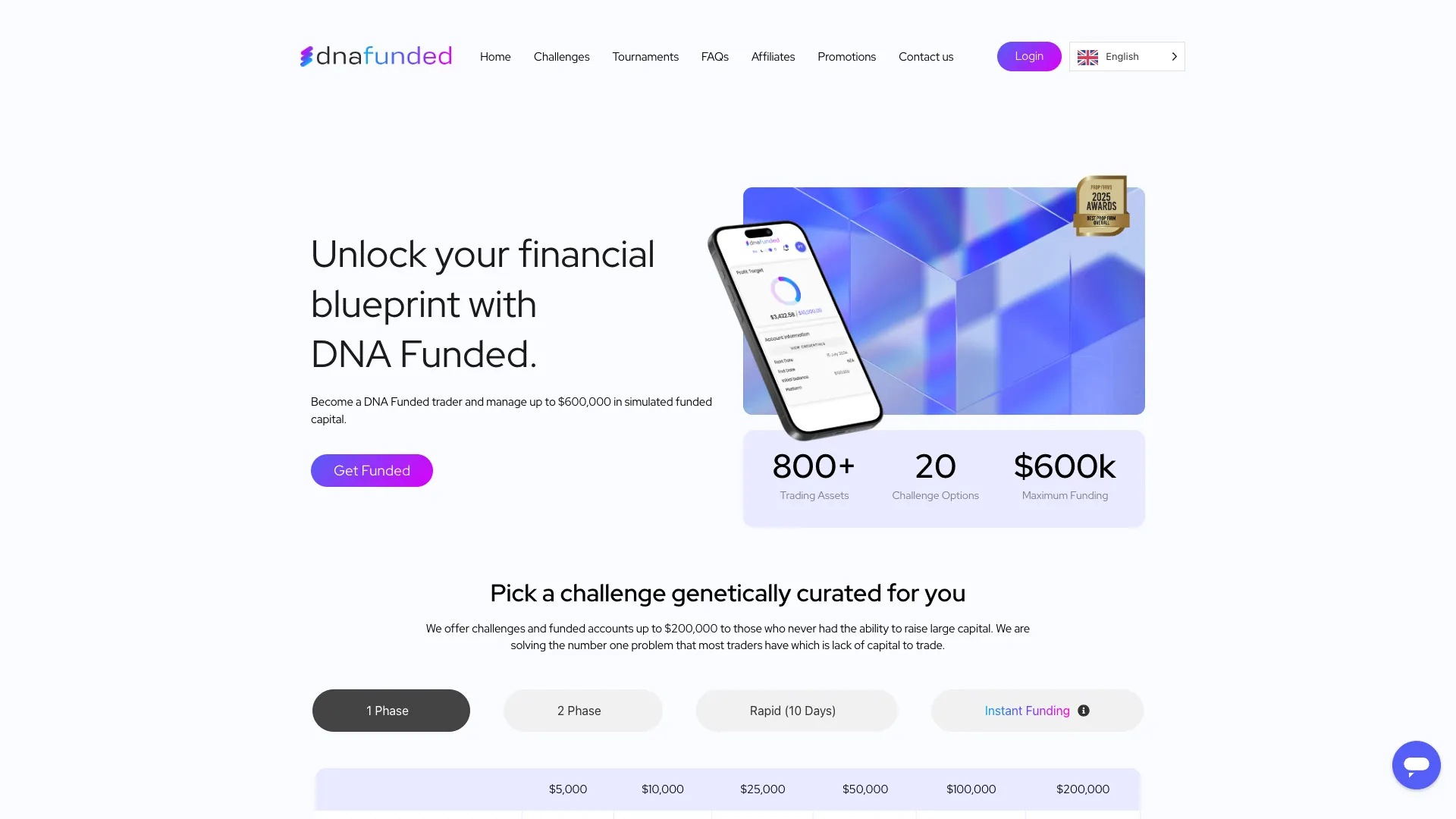
Founded: 2022
Platform: MT5/dxTrade
Max funding: Up to $600,000 (across multiple accounts)
DNA Funded is often selected for low entry cost and broad instrument access.
It is a practical option for traders who want to test a funded path without large upfront exposure.
Strengths:
- lower challenge cost profile
- broad crypto market coverage
- straightforward operational setup
Trade-offs:
- forex-first product history
- shorter track record than legacy operators
- scaling profile is less differentiated than premium competitors
Who it is for:
- cost-sensitive traders who still want broad market access
- traders testing funded workflows before scaling capital commitment
For a detailed side-by-side breakdown of how DNA Funded and Velotrade compare, see DNA Funded vs Velotrade. For a full standalone review of DNA Funded's structure and what to verify before purchasing, see DNA Funded review 2026. For DNA Funded's full rule profile and fees, see the DNA Funded directory page.
5) FundedNext, best for platform flexibility

Founded: 2022
HQ: UAE
Platform: MT4, MT5, cTrader, Match-Trader
Max funding: Up to $4,000,000 (scaling)
FundedNext is strongest on two fronts: broad platform optionality and high headline split potential.
That makes it attractive for traders who run multi-market workflows and need tooling flexibility.
Strengths:
- wide platform support
- high advertised split ceiling
Trade-offs:
- forex-first operating architecture
- crypto product depth is usually secondary to forex core
- crypto-specific flexibility can be narrower than crypto-native firms
Who it is for:
- cross-market traders who value platform breadth first
- traders comfortable with forex-centric policy design
For a detailed side-by-side breakdown of how FundedNext and Velotrade compare, see FundedNext vs Velotrade. For a standalone review of FundedNext's challenge models and payout structure, see FundedNext review 2026. For FundedNext's full rule profile and fees, see the FundedNext directory page.
6) FTMO, strongest legacy track record but forex-first
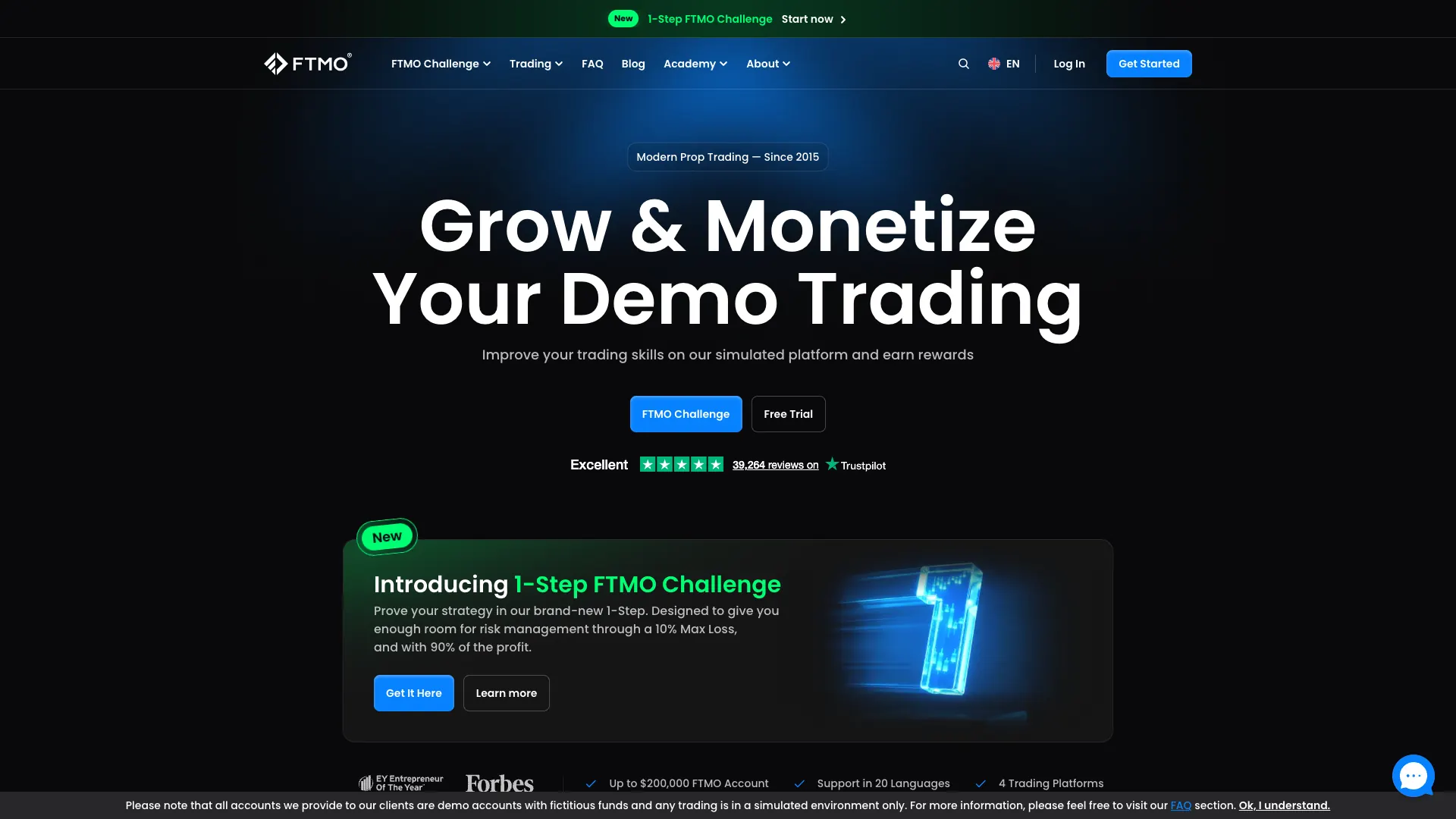
Founded: 2014
HQ: Prague
Platform: MT4/MT5
Max funding: Up to $200,000
FTMO remains one of the most recognized global names in prop trading with a long reliability reputation.
Its strongest asset is operating maturity and market trust.
Strengths:
- long-standing brand and payout credibility
- robust global recognition
Trade-offs for crypto specialists:
- forex-centered product logic
- crypto is available but not primary
- crypto breadth and flexibility are typically lower than crypto-native alternatives
Who it is for:
- traders who prioritize legacy brand confidence and are comfortable with forex-first structure
For crypto traders specifically evaluating FTMO vs a crypto-native alternative, see Best FTMO Alternative for Crypto Traders or the head-to-head FTMO vs Velotrade comparison. For a full standalone review of FTMO's challenge structure, rules, and who it suits, see FTMO review 2026. For FTMO's full rule profile and fees, see the FTMO directory page. For traders coming from Topstep's futures model, see Best Topstep Alternative for Crypto Traders, or the full Topstep review 2026 and Topstep vs Velotrade comparison.
Payout proof
Fast, real payouts. Traceable on Arbitrum.
- Paid within 24 hours of approval
- Settled on Arbitrum in USDC or USDT
- Look up any transaction on Arbiscan


Head-to-head comparison table
| Firm | Crypto-native | Max funding | Profit split | Platform | News trading | Weekend holding | Consistency rule |
|---|---|---|---|---|---|---|---|
| Velotrade | Multi-asset | $200,000 | Up to 90% | DXtrade | Yes | Yes | None |
| HyroTrader | Yes | $1,000,000 | 70-90% | Bybit/CLEO | Yes | Yes | 40% (evaluation only) |
| BrightFunded | No (multi-asset) | $400,000 | Up to 90% | MT5/cTrader/DXtrade | Yes | Yes | None |
| DNA Funded | No (multi-asset) | $600,000 | Up to 90% | MT5/dxTrade | Yes | Yes | 30% of payout (funded) |
| FundedNext | No (forex-first) | $4,000,000 | Up to 95% | MT4/MT5/cTrader | Yes | Limited | 40% on some products |
| FTMO | No (forex-first) | $200,000 | 80-90% | MT4/MT5 | Limited | Limited | Yes |
Which crypto prop firm is right for you?
The right answer depends on what you optimize for: maturity, execution model, onboarding simplicity, or cost efficiency.
If you are an experienced crypto trader and want maximum credibility
Choose Velotrade.
It combines crypto-native conditions, an institutionally-pedigreed founding team, and strategy-friendly constraints. That combination is rare in a category populated largely by retail-first operators.
The static drawdown model is specifically valuable for experienced traders. The loss floor is fixed from your starting balance and never trails your equity up, so intraday volatility never tightens it and banked profit widens your buffer instead of moving the failure line closer. For traders who hold through intraday swings, that is a more forgiving and more predictable limit than any trailing model.
Add to that: no consistency rule, news trading allowed, and a 90% split ceiling. That full combination, policy stability, intraday drawdown protection, and maximum profit share, is what experienced traders should optimize for when they already have a proven edge to deploy.
If you want real exchange execution behavior
Choose HyroTrader.
Bybit-linked infrastructure is a genuine differentiator if exchange context is non-negotiable for your strategy.
The practical difference is fills and transparency: when your challenge trades execute against a real exchange order book, slippage behavior, liquidity depth, and execution timing more closely resemble live market conditions than purely synthetic environments. For traders who run strategies sensitive to execution quality, momentum, breakout, or order-flow approaches, this distinction can matter in ways that are hard to replicate.
The trade-off is that HyroTrader's starting profit split and operating track record are currently shorter than the top of this list. Weigh execution model preference against those variables before deciding.
If you are starting out
Choose BrightFunded.
It offers a more accessible challenge path than most alternatives, with lower cognitive overhead for traders who are still building process discipline.
The most common mistake new funded traders make is choosing a large account for a "better deal" and then managing it under psychological conditions they are not yet calibrated for. BrightFunded's tiered structure allows you to start at a scale that lets you focus on rule compliance and drawdown behavior before increasing exposure. Learn how the funded model works on a smaller account, prove your payout process, and then scale. That sequence produces better outcomes than starting large and failing fast.
If your priority is low entry cost
Choose DNA Funded.
It is often the most practical budget-first path with broad crypto coverage and straightforward setup.
Low challenge cost is relevant for traders at the start of the funded path who want to validate their strategy in a live challenge environment without significant upfront capital commitment. DNA Funded's pricing often allows multiple attempt cycles at a cost that does not materially affect overall trading capital. That said, cost efficiency should not override policy quality. Confirm drawdown structure, rule fairness, and payout consistency before treating challenge fee as your only selection variable.
If you trade forex and crypto and need platform range
Choose FundedNext.
It is better suited to multi-market traders who prioritize platform flexibility over crypto-specialized design.
FundedNext's support for MT4, MT5, cTrader, and Match-Trader means traders who run different strategies on different instruments can operate within a single firm relationship. That matters when you have automation workflows, signal services, or specific platform integrations already built. The trade-off is that crypto conditions, drawdown model, news policies, weekend rules, are designed within a broader multi-asset framework rather than around crypto-specific market behavior. If your crypto allocation is a primary focus rather than a secondary book, a crypto-native firm will usually offer better-calibrated conditions. For a full ranked breakdown of the best prop firms for forex traders, see best prop firm for forex. For stock and index traders, see best prop firm for stocks.
How to compare challenge terms before you buy
Rankings and reviews can only take you so far. Before paying any challenge fee, run a structured comparison across these four dimensions, and estimate your odds of passing with a challenge pass calculator:
1. Drawdown model specifics. Ask the firm directly whether trailing stops move intraday or only at day close. Most marketing materials use "trailing drawdown" loosely. The mechanics matter more than the label. If a firm cannot explain clearly, treat that as a risk signal.
2. Rule documentation. The full rules should be available before purchase, not just after. Any firm that makes you buy before you can read the complete policy stack is not meeting a reasonable transparency standard. Pay attention to consistency rule presence, minimum trading day requirements, and any restrictions on trade timing.
3. Payout terms and processing requirements. Find out the minimum profit target before a payout is available, the processing window, and whether there are administrative requirements like ID verification cycles that can delay payment. The headline split is less important than payout reliability.
4. Independent payout evidence. Social media screenshots self-posted by firms are not independent validation. Look for payout confirmations across third-party forums, review platforms, and trader communities with verifiable timestamps and context. Volume and consistency of confirmed payouts across time is what you want, not a handful of screenshots. The strongest version of this is proof of paid withdrawals settled on-chain, which anyone can independently verify.
If you want to run a formal evaluation before committing to any firm, the complete evaluation framework for crypto prop firms covers all of these criteria in depth.
Red flags to watch out for
The category has expanded quickly, and quality dispersion is high.
Watch for these warning signs before paying any challenge fee:
- Founded recently with no verifiable payout history
- Vague rules or frequent policy changes after purchase
- Trailing drawdown not explained clearly with concrete examples
- No identifiable team, legal footprint, or credible external validation
- Fee economics that appear optimized for repeat failure monetization
If you want a formal screening process, use how to evaluate a crypto prop firm before committing.
How to get started with a crypto prop firm
Before choosing a firm, it helps to understand exactly what a crypto funded trading account involves and how the funding process works, then open a funded trading account when you are ready. If you are newer to this model, the guide on how to become a funded crypto trader walks through each step from evaluation to withdrawal. If you are still deciding whether a prop firm makes sense versus trading your own capital, see crypto prop firm vs trading your own account.
Step 1: Choose account size conservatively
The percentage targets are similar across sizes, but psychological pressure is not. Start small while you calibrate to a specific rule stack.
Step 2: Read full rules before your first trade
Most failures are procedural, not strategic. Confirm drawdown behavior, restrictions, and breach conditions before execution.
If needed, use our rules deep dive to avoid avoidable mistakes.
Step 3: Trade your strategy, not the challenge story
The best funded traders execute their tested process inside constraints. Traders who "switch style to pass" usually increase risk-of-breach.
Step 4: Track drawdown daily
Keep a precise view of daily and total drawdown distance at all times. Most hard breaches are preventable with disciplined monitoring.
Step 5: Treat funded status like institutional capital
Know payout windows, thresholds, and split progression before requesting withdrawals.
See challenge options and start your application.
For style-specific firm comparisons, see best prop firm for scalpers and best prop firm for swing traders. For options and derivatives traders, see best prop firm for options trading. For traders based in the region, see best crypto prop firms in Asia. For a broader overview across all trading markets including forex and futures, see top prop firms in 2026 or, for futures specifically, the best prop firm for futures.
AI trading offer
20% off all challenges
Use code AITRADE20 at checkout. Applies to every account size.
Get 20% off your challenge →Frequently Asked Questions
About the author

Vittorio De Angelis
Executive Chairman
Former equity-derivatives trader at JP Morgan, Dresdner Kleinwort and Bank of America in London. Later Head of Brokerage at a global broker in Hong Kong.
View author page