Trade crypto with funded capital
ExploreTwo low-barrier crypto prop firms. One built for crypto from day one. Here is how they compare where it counts.
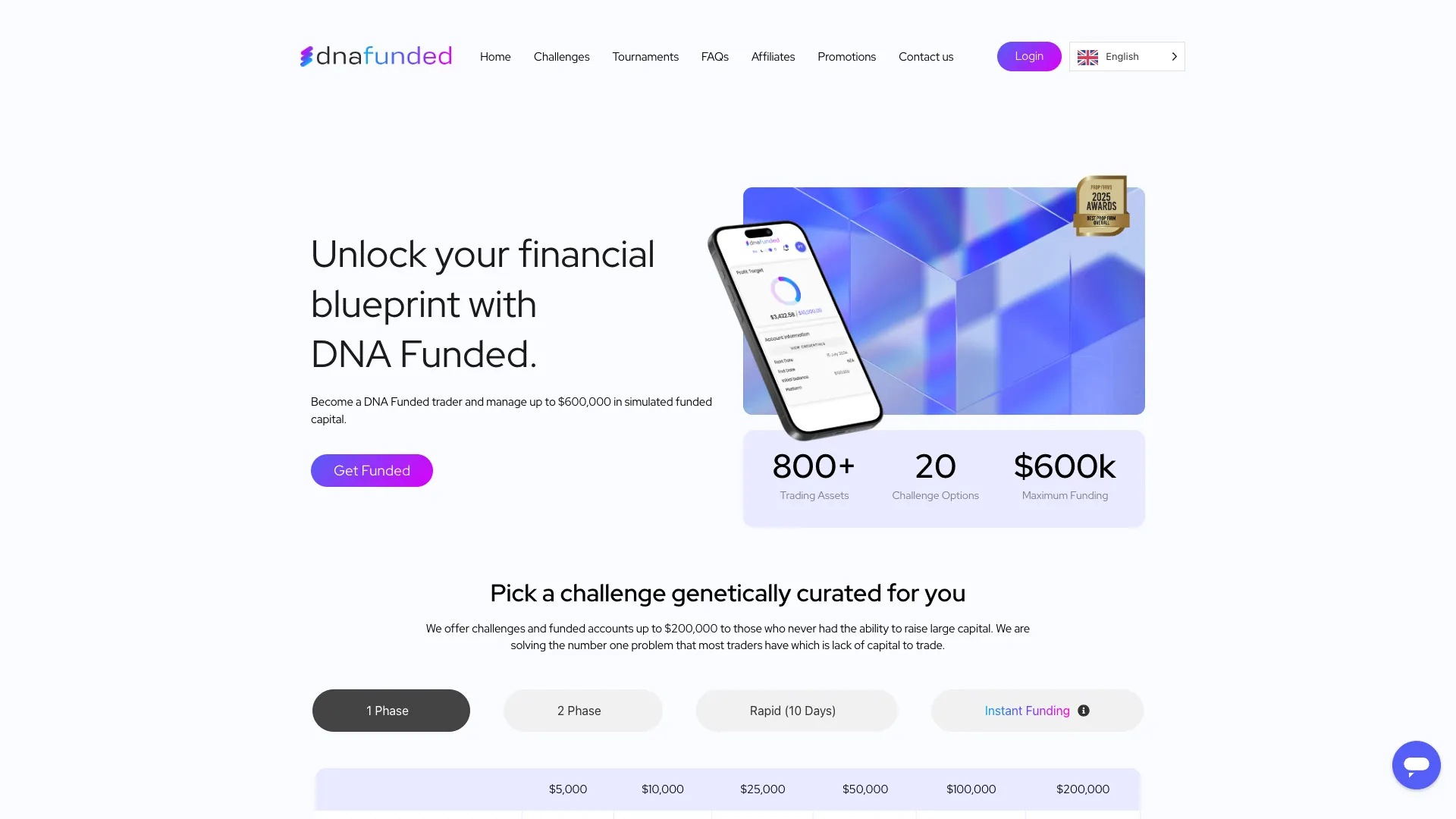
DNA Funded and Velotrade both appeal to traders looking for accessible entry into funded crypto trading. DNA Funded markets itself on low challenge cost and broad instrument access. Velotrade takes a crypto-native, multi-asset position with a cleaner rule set: no consistency rule, no cap on early payouts, and news trading allowed on funded accounts. If you are trying to choose between them, this comparison covers every metric that drives funded account outcomes: profit targets, drawdown model, consistency rules, profit split, platform, and pricing. For a broader overview of how both fit into the funded trading landscape, see what a crypto funded trading account actually involves.
Highlights of this article
- Velotrade uses static drawdown on every plan; DNA Funded's drawdown varies by product (challenge accounts static, Instant Funding trailing at 4%)
- Both firms offer up to 90% profit split
- DNA Funded runs on TradeLocker; Velotrade runs on DXtrade
- Velotrade is crypto-native with no consistency rule, news trading allowed, and weekend holding allowed
- DNA Funded has a multi-asset, forex-first product history; crypto coverage is broad but not the architectural focus
- DNA Funded's cheapest $5,000 challenge is $49 (2-Phase); Velotrade's is $40 (PRO 1-Step), or $54 on the 2-Step
- DNA Funded applies a 30% daily profit distribution rule, a 5% cap on the first three payouts, and a funded-account news window; Velotrade applies none of them
Quick Comparison: DNA Funded vs Velotrade
| Velotrade | DNA Funded | |
|---|---|---|
| Challenge types | 1-Step, 2-Step | 1-Phase, 2-Phase, Rapid, Instant Funding, 24-hour |
| Account sizes | $5k to $200k | $5k to $200k (up to $600k combined) |
| Phase 1 profit target | 10% | 8% (2-Phase) / 10% (1-Phase) |
| Phase 2 profit target | 5% | 5% |
| Daily loss limit | 5% (2-Step) | 5% (2-Phase), 4% (1-Phase) |
| Max drawdown | Static on every plan (2-Step 10%, 1-Step 7%, PRO 3%) | Static on challenges (1-Phase 6%, 2-Phase 8%, Rapid 5%); Instant Funding 4% trailing |
| Min trading days | 5 qualifying days | 5 per stage |
| Consistency rule | None | 30% daily profit distribution (funded) |
| Early payout cap | First two payouts capped at 20x the challenge fee, none after | 5% of account size, first three payouts |
| News trading | Allowed | Funded: no trades ±5 min around high-impact news |
| Weekend holding | Allowed | 1-Phase and 2-Phase only |
| EAs / automation | Allowed | 1-Phase, 2-Phase, Rapid only |
| Platform | DXtrade | TradeLocker |
| Max funding | $200k | Up to $600k (multi-account) |
| Profit split | Up to 90% | 80% default, 90% add-on |
| Challenge fee refund | No | No |
Profit Targets and Drawdown: What the Numbers Actually Mean
On a 2-step challenge, Velotrade sets a 10% Phase 1 profit target and 5% in Phase 2. The maximum drawdown is 10% static, with a 5% daily loss limit.
Static means the floor that sets your breach threshold is fixed from your starting balance and never moves. It does not move intraday, and it does not move at the end of the day either. This model is materially more forgiving than tick-by-tick trailing drawdowns, which tighten your floor every time unrealised gains touch a new high, even briefly. It is also more forgiving than end-of-day trailing, because the floor never rises at all as you profit.
DNA Funded's drawdown varies by product. Its challenge accounts use a static max loss fixed from the initial balance (1-Phase 6%, 2-Phase 8%, Rapid 5%), so on a challenge you get the same forgiving static model. The difference is the Instant Funding product, which uses a 4% trailing drawdown that tightens as your equity climbs. Velotrade applies static on every plan, with no trailing product in the range. To calculate your exact floor, daily limit, and trade capacity on a Velotrade account, use the prop trading drawdown calculator.

For a detailed breakdown of how drawdown models affect challenge pass rates and funded account longevity, read crypto prop firm rules and drawdowns explained.
Consistency Rule: Velotrade Has None, DNA Funded Applies One
Consistency rules cap how much of your profit can come from a single trading day. A firm that limits any one day to around 30% of the total means a single large day, even a valid one, can hold up a payout or an evaluation.
Velotrade does not enforce a consistency rule at any stage. This is explicitly documented. Your profit distribution across days is not evaluated at any point. Whether your target profit comes from 1 session or 20 does not matter, provided you stay within the drawdown and daily loss limits.
DNA Funded applies a daily profit distribution rule on funded accounts: no single day can make up more than 30% of the profit in a payout request. It also caps the first three payouts at 5% of the account size, with any profit above the cap forfeited when the account resets.
This is especially important for news traders and volatility traders who naturally concentrate returns into fewer, higher-conviction setups. Forcing artificial daily distribution does not reflect how real edge works in crypto markets, and it is one of the clearest structural gaps between the two firms.
To understand why the consistency rule remains one of the most impactful hidden costs at many prop firms, read crypto prop firms with no consistency rule.
News Trading and Weekend Holding
The firms differ on news trading. Velotrade allows it outright: you can hold positions through scheduled macro events, central bank announcements, and other high-impact data releases without rule-based position closure requirements. DNA Funded restricts it on funded accounts: no trades can be opened or closed from 5 minutes before to 5 minutes after a high-impact release. For traders whose edge is built around these releases, that window is a real constraint.
Both firms permit weekend holding, though at DNA Funded only on the 1-Phase and 2-Phase challenges (not Rapid, Instant Funding, or the 24-hour challenge). Positions can remain open over the weekend without triggering a breach. For crypto traders running swing trades or multi-day positions across weekends, this is a meaningful structural advantage over firms that force Friday-close position management.
Velotrade's weekend holding and unrestricted news policy are clearly documented as part of its core rule set. DNA Funded's published rules set out its weekend limits by product and the funded-account news window above.
Platform: TradeLocker vs DXtrade
DNA Funded runs on TradeLocker only. MT5 is not offered, so MQL5 indicators and EAs cannot be carried over, and traders at either firm will be working in a browser-first platform rather than MetaTrader.
Velotrade uses DXtrade exclusively. DXtrade is a purpose-built prop trading platform with native challenge management, rules monitoring, and account performance dashboards integrated at the system level. It was designed specifically for the funded account model, which means the evaluation environment and account management tools are more tightly integrated than in a retail MT5 stack adapted for prop use.
For traders new to DXtrade, there is a short adjustment period. For traders already familiar with it from other firms, the transition is straightforward.

Crypto-Native vs Multi-Asset Architecture
This is the structural difference that matters most for dedicated crypto traders.
Velotrade is built around crypto trading. Its rule design, drawdown calibration, and platform choice are all oriented to 24/7 markets, higher volatility, and crypto-specific liquidity behavior. No forex legacy constraints are inherited.
DNA Funded has a multi-asset, forex-first product history. Crypto coverage is broad and the platform supports it, but the firm's original architecture was built for a different market structure. Its crypto leverage is capped at 1:2, against 1:50 on forex. For traders running exclusively crypto strategies, this is worth considering when evaluating whether rule calibration and risk controls are designed with crypto volatility in mind.
Neither position is inherently disqualifying. But if your entire strategy is built around crypto-specific market behavior, a crypto-native firm is less likely to introduce structural friction through rules calibrated for forex.
For a deeper argument on why this distinction matters for practical outcomes, read why crypto-native infrastructure matters.
Profit Split: 80% Default at Both
Both firms offer up to 90%. At DNA Funded, 80% is the default and 90% costs 20% on top of the access fee.
Where they differ is what happens around the split. Both allow a first payout 14 days in, but DNA Funded caps the first three payouts at 5% of the account size and applies its 30% daily distribution rule, so a strong early run can pay out less than the split suggests. Velotrade applies neither.
Minimum Trading Days
Velotrade requires 5 qualifying trading days to pass the evaluation. Each qualifying day must close with at least 0.8% net profit on the starting account balance. Passing the profit target and completing 5 qualifying days in the same window is all that is required. There is no overall time limit imposed.
DNA Funded requires 5 trading days per evaluation stage (3 on Rapid) and 5 days on the funded account before a payout, with trades held for at least 60 seconds. Unlike Velotrade, there is no minimum profit per day.
Pricing: Side-by-Side Challenge Fees
| Account Size | Velotrade 2-Step | Velotrade 1-Step | DNA Funded 2-Phase | DNA Funded 1-Phase |
|---|---|---|---|---|
| $5,000 | $54 | $67 | $49 | $59 |
| $10,000 | $100 | $127 | $79 | $89 |
| $25,000 | $225 | $290 | $159 | $179 |
| $50,000 | $419 | $543 | $289 | $319 |
| $100,000 | $769 | $1,075 | $549 | $619 |
The Velotrade 2-Step and 1-Step above are CLASSIC plans, which cap at $100,000. The $200,000 size is available on the PRO 1-Step only (base fee $1,114).
DNA Funded's challenges are cheaper than Velotrade's CLASSIC plans at every size, and its $200,000 2-Phase costs $1,079. Velotrade's cheapest entry is the PRO 1-Step at $40 for $5,000. DNA Funded prices are from its published rules (August 31 2026) and exclude add-ons.
Velotrade pricing is fixed and transparently published. The 1-step option adds a small premium over the 2-step fee in exchange for a single-phase evaluation rather than two.
What Each Firm Suits Best
Choose Velotrade if:
- You want no consistency rule and no cap on your first payouts
- You want a crypto-native rule set designed for 24/7 volatile markets, not forex-inherited constraints
- You prefer a 1-step challenge option for a faster evaluation path
- You are comfortable with DXtrade and want a purpose-built prop trading environment
- You want to trade through high-impact news on a funded account
Choose DNA Funded if:
- Low challenge cost is your primary filter and you want to test funded workflows with minimal upfront commitment
- You want TradeLocker, or the 2-Phase's lower 8% first target
- You want higher maximum capital allocation across multiple accounts (up to $600,000)
- You trade forex or indices more than crypto
- You are a cost-sensitive trader calibrating to a funded account model for the first time
Where They Overlap, and Where Velotrade Pulls Ahead
For traders coming from more restrictive prop firm environments, both DNA Funded and Velotrade offer a better operating baseline than legacy forex firms, but the freedoms are not identical:
- Weekend holding allowed: neither forces position closure on Friday close (at DNA Funded, on the 1-Phase and 2-Phase challenges)
- EAs and automation permitted: algorithmic strategies are supported at both firms (at DNA Funded, not on Instant Funding or the 24-hour challenge). Velotrade provides full open API access on every account with no extra fee or approval process.
- Broad crypto access: both cover major and mid-cap crypto pairs
- Static challenge drawdown: both use a static max loss on their challenge accounts, though only Velotrade keeps it static across every product (DNA Funded's Instant Funding trails at 4%)
Velotrade pulls ahead on the constraints DNA Funded still applies: no consistency rule versus DNA Funded's 30% daily distribution rule and 5% early-payout cap (Velotrade only caps the first two payouts, at 20x the challenge fee), and unrestricted news trading versus DNA Funded's 5-minute funded-account news window. On a Velotrade account you get the full combination, static drawdown on every plan, no consistency rule, unrestricted news, weekend holding, multi-asset, crypto-native infrastructure, and full API access, on one account.
For context on how each of these permissions affects strategy design and challenge pass rates, see crypto prop firm rules explained.
Which Crypto Prop Firm Is Better?
For traders who want a crypto-native firm with clearly documented rules, transparent drawdown mechanics, and no caps on early payouts, Velotrade is the stronger structural choice. The static drawdown applies on every plan and the rule stack is designed for crypto volatility.
For cost-sensitive traders who want to test a funded account workflow with low upfront commitment and access to higher capital allocation across multiple accounts, DNA Funded is a practical starting point.
Both decisions are defensible depending on what you are optimizing for. If you choose DNA Funded, note the trade-offs its rule set carries: the Instant Funding product trails at 4%, a 30% daily profit distribution rule and a 5% cap on the first three payouts apply, and funded-account trades are blocked within 5 minutes of high-impact releases. Confirm the payout structure and minimum trading day definitions before paying, since the details at that level determine outcomes more than any headline comparison.
For a full market view of where both firms sit, see best crypto prop firms in 2026. For Velotrade's complete rule set, payout structure, and account details, see Velotrade review 2026. For a step-by-step guide from evaluation to first payout, see how to become a funded crypto trader. For DNA Funded's full challenge profile and side-by-side rule comparison with other firms, see the DNA Funded directory page. For a standalone review of DNA Funded's challenge structure, rules, and what to verify before purchasing, see DNA Funded review 2026.
Ready to start a Velotrade challenge? View challenge options and pricing
This article is for informational purposes only and does not constitute financial or investment advice. Prop firm rules, fees, and structures change frequently. Always review each firm's official terms and conditions before making any decisions. This comparison reflects DNA Funded's published Rules and Conditions (version 2.1, August 31 2026) and Velotrade's terms as of September 2026.
Frequently Asked Questions
About the author

Vittorio De Angelis
Executive Chairman
Former equity-derivatives trader at JP Morgan, Dresdner Kleinwort and Bank of America in London. Later Head of Brokerage at a global broker in Hong Kong.
Velotrade was founded in Hong Kong in 2016 by a team from JP Morgan, Dresdner Kleinwort and Bank of America, has paid out over $2.5 billion to its trade-finance clients, and has been featured in Bloomberg, the Financial Times, the Wall Street Journal and on Nasdaq. Its prop trading evaluations are simulated and educational.
View author page