Trade crypto with funded capital
ExploreYou had a great trading day. You caught a clean breakout, sized up correctly, and booked 6% on your account in a single session. Then you get an email saying your evaluation has been voided, not because you broke a drawdown rule, but because too much of your profit came from one day.
This is the consistency rule. And it catches more traders off guard than almost any other prop firm restriction. We compared the consistency rules at six firms line by line to show exactly where each one lives.
This article explains exactly what the consistency rule is, why most firms use it, and what to look for when choosing a firm based on this criterion. Looking for the current list instead? See crypto prop firms with no consistency rule, verified from official sources.
Highlights of this article
- The consistency rule limits how much of your evaluation profit can come from any single trading day (typically 30%)
- In crypto's event-driven market, this rule directly penalizes news traders, momentum traders, and high-conviction swing traders
- Velotrade has no consistency rule at any stage. DNA Funded removes it from evaluation formats but applies a 30% daily profit limit to funded payouts
- Without it, a strong single session counts in full toward your profit target, not against you
- Drawdown limits and minimum trading days still apply; removing the consistency rule is targeted, not a weakening of risk controls
What is the consistency rule in prop trading?
The consistency rule, sometimes called the profit consistency rule or daily profit cap, limits how much of your total evaluation profit can come from any single trading day.
A typical version looks like this: no single trading day can account for more than 30% of your total profit during the evaluation period.
So if you're targeting a 10% profit goal on a $50,000 account ($5,000), no single day can contribute more than $1,500 to that total. Earn $2,000 in one day? You're in breach, even if your drawdown was perfect and your overall profit was well within the target.
The rule is designed to weed out traders who got lucky on a single high-volatility event. In theory, it favours consistent, disciplined traders. In practice, it penalises legitimate trading styles. If you want the broader background first, start with what crypto prop trading is.
Why the consistency rule is a problem for crypto traders
The consistency rule creates a specific problem in crypto markets that doesn't exist in the same way in forex or equities.
Crypto is a high-volatility, event-driven market. A Fed announcement, a major protocol upgrade, a regulatory decision, or a single whale liquidation can move BTC/USD 5-8% in hours. Skilled traders who identify these setups and size into them appropriately will naturally generate outsized single-day returns.
This isn't luck. It's crypto trading done well.

The consistency rule doesn't distinguish between a skilled trader who nailed a high-conviction trade and a gambler who went all-in on a coin flip. Both get flagged the same way.
Additional problems the consistency rule creates:
| Problem | What it means in practice |
|---|---|
| Forces artificial smoothing | Traders spread positions across days they don't want to trade, just to satisfy the rule |
| Punishes news trading | High-volatility events are when the best setups appear, and the rule discourages capitalising on them |
| Disadvantages scalpers and momentum traders | Strategies that generate large single-session P&L are inherently penalised |
| Creates ambiguity | Traders must constantly calculate their running profit-per-day ratio, adding cognitive load |
| Fails its own objective | A trader with 5% of profit in day 1 and 28% in day 2 can still pass, so the rule does not actually measure skill |
Which crypto prop firms have a consistency rule?
Most do. The consistency rule is widespread across both crypto and forex prop firms. It typically appears in one of these forms:
- Daily profit cap (30% rule): No single day's profit can exceed 30% of total evaluation profit
- Single-day percentage cap: No single day can exceed a fixed % of account size (e.g. 2% in one day)
- Minimum trading days combined with smoothing requirements: Must trade at least X days with relatively even distribution
Firms that have enforced consistency rules (in various forms) include FTMO and the majority of forex-first prop firms that have added crypto. The exact percentages vary, but the principle is the same: your profits must be smooth. FundedNext's consistency rule status varies by product, see FundedNext vs Velotrade for the current rules breakdown. For the wider comparison set, see Best Crypto Prop Firms in 2026. If you are coming from FTMO specifically, see Best FTMO Alternative for Crypto Traders.


Crypto prop firms with no consistency rule
A smaller number of firms, especially those built specifically for crypto traders, have removed the consistency rule entirely or never implemented it.
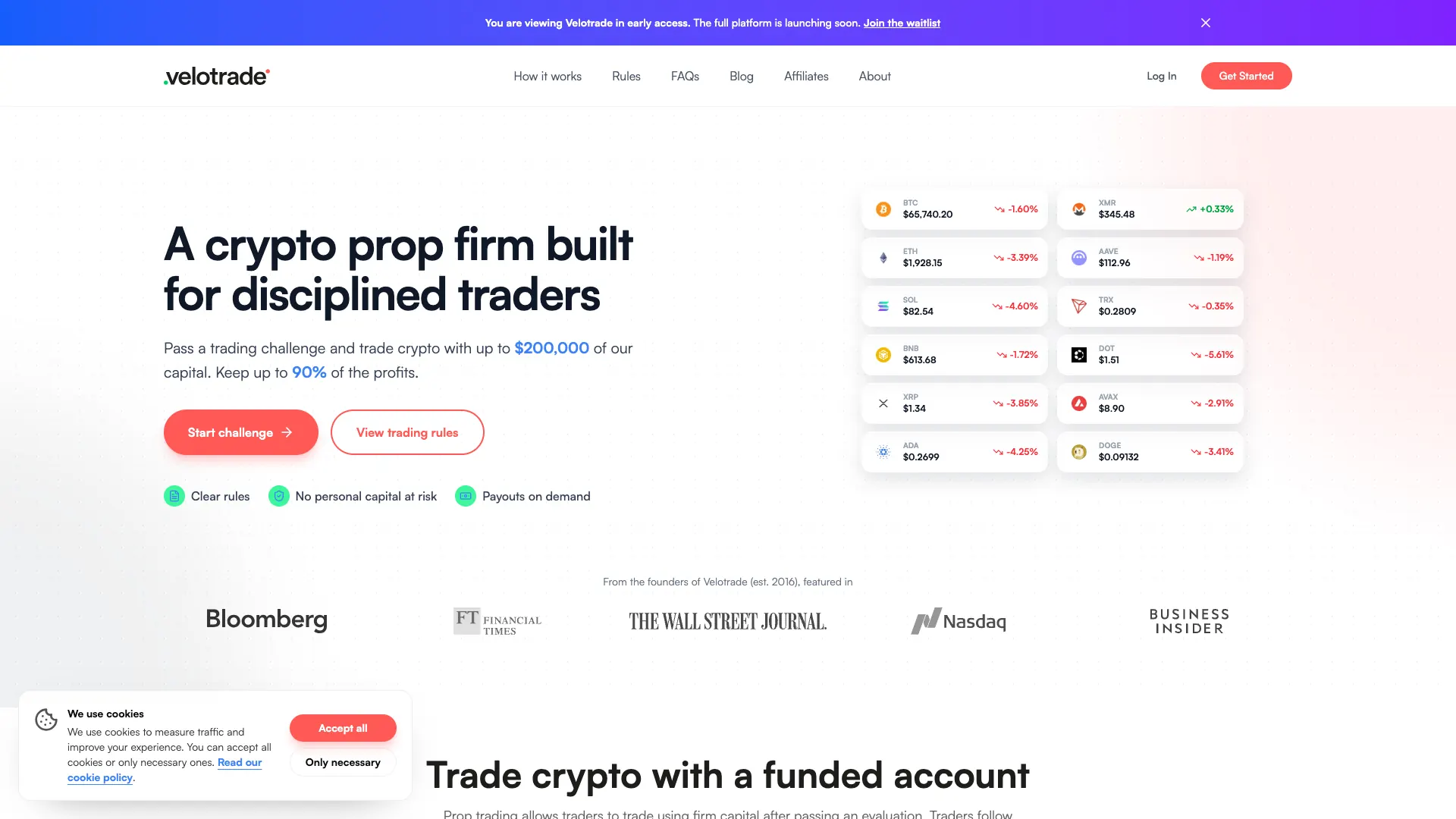
Velotrade has no consistency rule. Their published rules state this explicitly, and a full breakdown of what their crypto funded trading account looks like, including drawdown model and payout structure, is available in the dedicated guide.
DNA Funded does not enforce a consistency rule during its evaluation, but in the funded stage profit from any single day can only count for up to 30% of a payout request on purchases made after February 3 (40% on earlier ones). The excess is deducted from the payout and the account is not breached. For a side-by-side comparison with Velotrade on drawdown model, profit split, platform, and pricing, see DNA Funded vs Velotrade.
"You are not required to spread your profits evenly across trading days, limit any single day's profit to a percentage of your total, maintain a fixed position size across trades, or achieve profits in a specific pattern."
The evaluation focuses on equity management, staying within daily loss and maximum drawdown limits, not on how evenly distributed your profits are across the calendar.
This is a meaningful distinction for traders whose edge depends on concentrating risk at high-conviction moments.
What Velotrade enforces instead
Removing the consistency rule doesn't mean anything goes. Velotrade enforces the rules that actually matter for risk management:
| Rule | 2-Step | 1-Step |
|---|---|---|
| Maximum daily loss | 5% | 4% |
| Maximum drawdown | 10% | 7% |
| Profit target (Phase 1) | 10% | 10% |
| Profit target (Phase 2) | 5% | N/A |
| Minimum trading days | 5 | 5 |
| Consistency rule | None | None |
| News trading | Allowed | Allowed |
| Weekend holding | Allowed | Allowed |
The drawdown model at Velotrade is static. The floor is fixed from your starting balance and never moves, Classic 2-Step at 90% of the starting balance (10%), Classic 1-Step at 93% (7%), Pro 1-Step at 97% (3%). It does not trail your equity upward, does not move intraday, and does not move at day close. This means day-to-day you can see exactly where your limit sits without worrying that a brief unrealised gain has tightened your risk room, and because the floor never moves, every dollar of profit adds directly to your buffer.
For a full breakdown of how drawdowns work, see: Crypto prop firm rules and drawdowns explained
Why no consistency rule matters for your trading style
Whether the consistency rule matters to you depends entirely on your strategy.
It matters most for:
- News traders: You trade around scheduled macro events like CPI, Fed decisions, and employment data. By definition, these sessions generate outsized single-day P&L. A consistency rule makes your best days a liability.
- Momentum traders and scalpers: You trade when volatility is highest. Concentrated profits are the natural output of this approach. For a full guide to adapting a scalping strategy to prop firm rules, see scalping strategy for crypto prop challenges.
- Swing traders who hold through events: You hold positions into volatility and exit at key levels. Your P&L is lumpy by design.
- Low-frequency traders: You make a small number of high-conviction trades per month. A consistency rule is particularly punishing when you have few data points.
It matters less for:
- Day traders who trade every session with similar position sizes
- Traders who already self-impose a daily profit cap for psychological reasons
- Traders with a naturally smooth equity curve
If you're in the first group, trading with a firm that enforces a consistency rule means your strategy and the evaluation are structurally misaligned. You may be a skilled trader who consistently fails evaluations for the wrong reason. That is one reason many profitable traders still fail prop challenges.
How to verify whether a firm has a consistency rule
Before paying for any evaluation, check the following. For the broader due-diligence process, see How to Evaluate a Crypto Prop Firm. For the full list of structural red flags to screen for, see top crypto prop firm red flags.
- Read the full rules document. Consistency rules are often buried in terms or presented as a positive feature ("we reward consistency"). Don't skim.
- Look for daily profit cap language. Phrases like "no single day should represent more than X% of your total profit" are the tell.
- Check for minimum trading day requirements combined with smoothing language. Some firms phrase it differently but enforce the same constraint.
- Ask support directly. Ask: "Is there any rule that limits how much profit I can make in a single trading day relative to my total?" A direct answer tells you more than marketing copy.
- Check community forums. Reddit threads in r/Forex and r/CryptoCurrency often have trader experiences with specific rule enforcement.
Velotrade challenge structure
Velotrade offers two evaluation paths, both without a consistency rule:
2-Step Evaluation
- Phase 1: 10% profit target, 5% daily loss, 10% max drawdown, 5 minimum trading days
- Phase 2: 5% profit target, same drawdown rules
- On passing: funded account, up to 90% profit split
1-Step Evaluation
- Single phase: 10% profit target, 4% daily loss, 7% max drawdown, 5 minimum trading days
- On passing: funded account, up to 90% profit split
Account sizes range from $5,000 to $200,000. Evaluations run on the DXtrade platform and are multi-asset, covering five asset classes (crypto, forex, stocks, indices, and commodities), not crypto alone. For a step-by-step guide on the full process from evaluation to funded account, see how to become a funded crypto trader. For a full independent assessment of Velotrade's rules, drawdown model, and payout structure, see Velotrade review 2026. View all challenge options and pricing.
Summary
The consistency rule is one of the most commonly misunderstood rules in prop trading. It's framed as a measure of trading discipline, but in crypto markets, where high-volatility events create legitimate concentrated-profit opportunities, it functions as a structural disadvantage for experienced traders.
Firms that have removed it, like Velotrade, focus evaluation on the metrics that actually reflect risk management: staying within drawdown limits, meeting profit targets, and trading for a minimum number of days.
If your strategy produces lumpy, event-driven profits, trade with a firm whose rules are compatible with how you actually trade.
Frequently Asked Questions
About the author

Vittorio De Angelis
Executive Chairman
Former equity-derivatives trader at JP Morgan, Dresdner Kleinwort and Bank of America in London. Later Head of Brokerage at a global broker in Hong Kong.
Velotrade was founded in Hong Kong in 2016 by a team from JP Morgan, Dresdner Kleinwort and Bank of America, has paid out over $2.5 billion to its trade-finance clients, and has been featured in Bloomberg, the Financial Times, the Wall Street Journal and on Nasdaq. Its prop trading evaluations are simulated and educational.
View author page