One account, every market we offer
ExploreVelotrade is a multi-asset prop trading firm that offers funded accounts up to $200,000 with a profit split of up to 90%. It launched its prop trading offering in early 2026 and covers crypto, forex, stocks (TSLA, NVDA, AAPL), index ETFs (SPY, QQQ, IWM), and commodities (gold, silver, WTI crude).
This review covers challenge structure, drawdown rules, trading conditions, platform, payout mechanics, and who this firm is realistically suited for. The goal is an accurate assessment, not a promotional summary.
If you are new to the funded trading model and want to understand how it works before evaluating specific firms, read what crypto prop trading is first.
Highlights of this article
- Velotrade launched its prop offering in early 2026 with an institutional team background in professional finance
- Three challenge formats: CLASSIC 2-Step, CLASSIC 1-Step, and PRO 1-Step (from $5,000 to $200,000)
- All challenges use static drawdown, fixed from the initial balance. The floor never trails, intraday or at day close, so your buffer grows as you profit
- No consistency rule, news trading allowed, and weekend holding permitted across all challenge formats
- Profit split is 80% by default and 90% with the profit-share add-on. First payout 14 days after the first funded trade, then weekly, $100 minimum, paid in USDC or USDT
- Commission only, no spread markup: 0.004% per side on forex, 0.01% on commodities, 0.03% on crypto, indices and stocks
About Velotrade
Velotrade launched its prop trading offering in early 2026, built around a specific diagnosis of what is broken in the existing market.
Most prop firms that added crypto started in forex. They built their rule architecture around forex assumptions, markets that close on Friday, volatility calibrated to pip ranges, news trading restricted around a handful of scheduled economic events, and then added crypto instruments on top without reworking the underlying policy logic.
The result is a structural mismatch that creates avoidable friction for traders:
- Tick-by-tick trailing drawdowns that recalculate your breach level on every intraday equity spike, punishing profitable runs and creating breaches that have nothing to do with strategy failure
- Consistency rules that cap how much profit you can generate on any single day, forcing traders to pass on high-conviction setups to avoid a technical disqualification
- Weekend holding bans imported from legacy market assumptions. Applied to crypto, which trades 24/7, they serve no real risk management function
- News trading restrictions calibrated for old event windows, blocking traders from participating in some of the highest-quality directional setups in the market
- Vague rule language written without institutional precision, leaving enforcement gaps that get resolved against the trader
Velotrade was built to remove those friction points by design. The founding team has backgrounds at Dresdner Kleinwort, JP Morgan, and Bank of America, and the wider group has been featured in Bloomberg, the Financial Times, the Wall Street Journal, and on Nasdaq. That professional finance background produces a different kind of rule document: precise, internally consistent, and written so that a trader can read it once and know exactly where they stand.
Velotrade is a multi-asset prop trading firm. Tradable instruments span crypto, forex, stocks (TSLA, NVDA, AAPL), index ETFs (SPY, QQQ, IWM), and commodities (gold, silver, WTI crude). Every rule, risk parameter, and platform decision is calibrated to how markets actually behave rather than borrowed from outdated assumptions in other asset classes. For traders making the move from crypto to multi-asset prop trading, this calibration is what keeps the rules coherent across instruments.


Challenge structure
Velotrade offers three evaluation formats and six account sizes. For a broader guide on what a crypto funded trading account involves across the industry, that article covers the full model in detail.
CLASSIC 2-Step
The CLASSIC 2-Step challenge requires traders to pass two sequential evaluation phases before accessing a funded account.
| Parameter | Phase 1 | Phase 2 | Funded |
|---|---|---|---|
| Profit target | 10% | 5% | - |
| Max daily loss | 5% | 5% | 5% |
| Max overall loss | 10% static | 10% static | 10% static |
| Min trading days | 5 qualifying days | 5 qualifying days | 5 qualifying days before the first payout |
| Trading period | Unlimited | Unlimited | Indefinite |
| Profit split | - | - | Up to 90% |
CLASSIC 1-Step
The CLASSIC 1-Step has a single evaluation phase with tighter parameters in exchange for a faster path to funding.
| Parameter | Phase 1 | Funded |
|---|---|---|
| Profit target | 10% | - |
| Max daily loss | 4% | 4% |
| Max overall loss | 7% static | 7% static |
| Min trading days | 5 qualifying days | - |
| Trading period | Unlimited | Indefinite |
| Profit split | - | Up to 90% |
The CLASSIC 1-Step has a narrower daily loss limit (4% vs 5%) and a tighter overall drawdown (7% vs 10%). The trade-off is a simpler evaluation path for traders who are confident in their consistency.
PRO 1-Step
The PRO 1-Step is a distinct product. It is available from $5,000 to $200,000, with the $5,000 account priced at $40, the lowest entry point Velotrade offers.
| Parameter | Phase 1 | Funded |
|---|---|---|
| Profit target | 10% | - |
| Max daily loss | 3% | 3% |
| Max overall loss | 3% static | 3% static |
| Min trading days | 5 qualifying days | - |
| Trading period | Unlimited | Indefinite |
| Profit split | - | Up to 90% |
The key difference is the tighter risk parameters. Like the CLASSIC plans, the PRO 1-Step uses a static drawdown floor, here fixed at 97% of the initial balance, which never moves. This means the dollar buffer between your equity and the floor grows as you profit. On a $5,000 account at $5,500 you have $650 of room; at $6,000 you have $1,150. The PRO 1-Step is designed for traders who want the static floor structure and are prepared to operate within tighter initial limits. For a direct comparison of both challenge types, see 1-Step Pro vs 1-Step Classic.
The daily loss limit of 3% on a $5,000 account is $150. That is tight. One or two losing trades can consume a meaningful portion of the daily budget. Traders using the PRO 1-Step need disciplined per-trade sizing from session one.
The risk limits do not change once you are funded. The daily loss limit and the maximum drawdown that apply during the evaluation continue to apply, unchanged, on the funded account: 4% daily and 7% static on the CLASSIC 1-Step, 5% daily and 10% static on the CLASSIC 2-Step, and 3% daily and 3% static on the PRO 1-Step. There is no separate, looser rule set after funding.
Account sizes and pricing
| Account size | CLASSIC 2-Step | CLASSIC 1-Step | PRO 1-Step |
|---|---|---|---|
| $5,000 | $54 | $67 | $40 |
| $10,000 | $100 | $127 | $74 |
| $25,000 | $225 | $290 | $165 |
| $50,000 | $419 | $543 | $305 |
| $100,000 | $769 | $1,075 | $558 |
| $200,000 | - | - | $1,114 |
Confirm current PRO 1-Step availability across account sizes on the challenges page.
Drawdown model
Velotrade uses a single drawdown model across every challenge: static maximum drawdown.
All challenges (CLASSIC 1-Step, CLASSIC 2-Step, and PRO 1-Step): static drawdown. The maximum drawdown floor is set once as a percentage of your initial account balance and never moves, not intraday and not at day close. On the CLASSIC 2-Step the floor sits at 90% of the initial balance (10% static), on the CLASSIC 1-Step at 93% (7% static), and on the PRO 1-Step at 97% (3% static).
This is materially different from tick-by-tick trailing drawdown used by many other prop firms, where every intraday equity peak immediately tightens the floor. Tick-by-tick trailing catches traders through normal intraday volatility. A brief unrealised gain becomes a permanently higher floor. A static floor does not have this problem.
Because the floor is fixed, the dollar room grows as your account grows. On a $50,000 CLASSIC 2-Step the floor is set at $45,000. If you build the account to $60,000, that same fixed floor now sits $15,000 below your equity, more room in absolute terms.
On the PRO 1-Step the floor is fixed at 97% of the initial account balance. Because it stays fixed, the dollar gap between your equity and the floor grows with every profitable session. This is structurally different from any trailing model.
The daily loss limit also recalculates each day at 00:30 UTC from the higher of your balance or equity, not the original starting balance. A growing CLASSIC account gets a larger absolute daily loss allowance. On the PRO 1-Step, the daily loss limit is 3% of that same figure.
To calculate your exact drawdown floor and daily budget for any Velotrade account size, use the prop trading drawdown calculator.
For a full breakdown of drawdown types and how they affect pass rates, read crypto prop firm rules and drawdowns explained. For a direct technical comparison of EOD vs tick-by-tick trailing models, see EOD trailing vs tick-by-tick trailing drawdown explained.
Trading rules
What is allowed
- News trading: Permitted. There are no restricted windows around economic data releases or macro events. Single stocks have their own rule: close any position at least 24 hours before the company's earnings release or ex-dividend date and reopen no earlier than 24 hours after.
- Weekend holding: Permitted. Positions can be held across the weekend close.
- Full API access: Open to all accounts from evaluation through funded. Connect any system in any language via the DXtrade REST and WebSocket API. No additional fee or approval required. See the full API announcement and the step-by-step bot setup guide for how to set up automated trading.
- Expert advisors (EAs): Permitted within defined risk parameters. Latency exploitation and tick-scalping strategies that abuse data feed behavior are prohibited.
- Copy trading: Permitted under standard conditions. Coordinated copy-trading across multiple accounts to manipulate results is not.
- VPN and VPS: Permitted for legitimate routing and execution purposes.
- Overnight holding: Permitted.
- Hedging: Permitted within defined parameters.
A qualifying trading day is one you close with realised profit of at least 0.8% of the starting balance. The five days do not need to be consecutive, and holding a position overnight does not add one.
What is not allowed
- Latency arbitrage and tick scalping
- Coordinated account manipulation
- Strategies specifically designed to exploit the simulation environment rather than reflect real market behavior
The full policy stack is available on the rules page. Reading it completely before placing a first trade is not optional if you want to avoid procedural disqualification.
No consistency rule
Velotrade does not enforce a consistency rule. Some firms require traders to avoid generating more than a set percentage of total profit on any single trading day, a constraint that penalizes high-conviction trades and forces artificial behavioral patterns.
Without a consistency rule, traders can execute concentrated positions when their edge is clearest without risk of technical breach for a single outsized win.
Platform
Velotrade operates on DXtrade, an institutional-grade platform with a credible track record across professional trading environments.
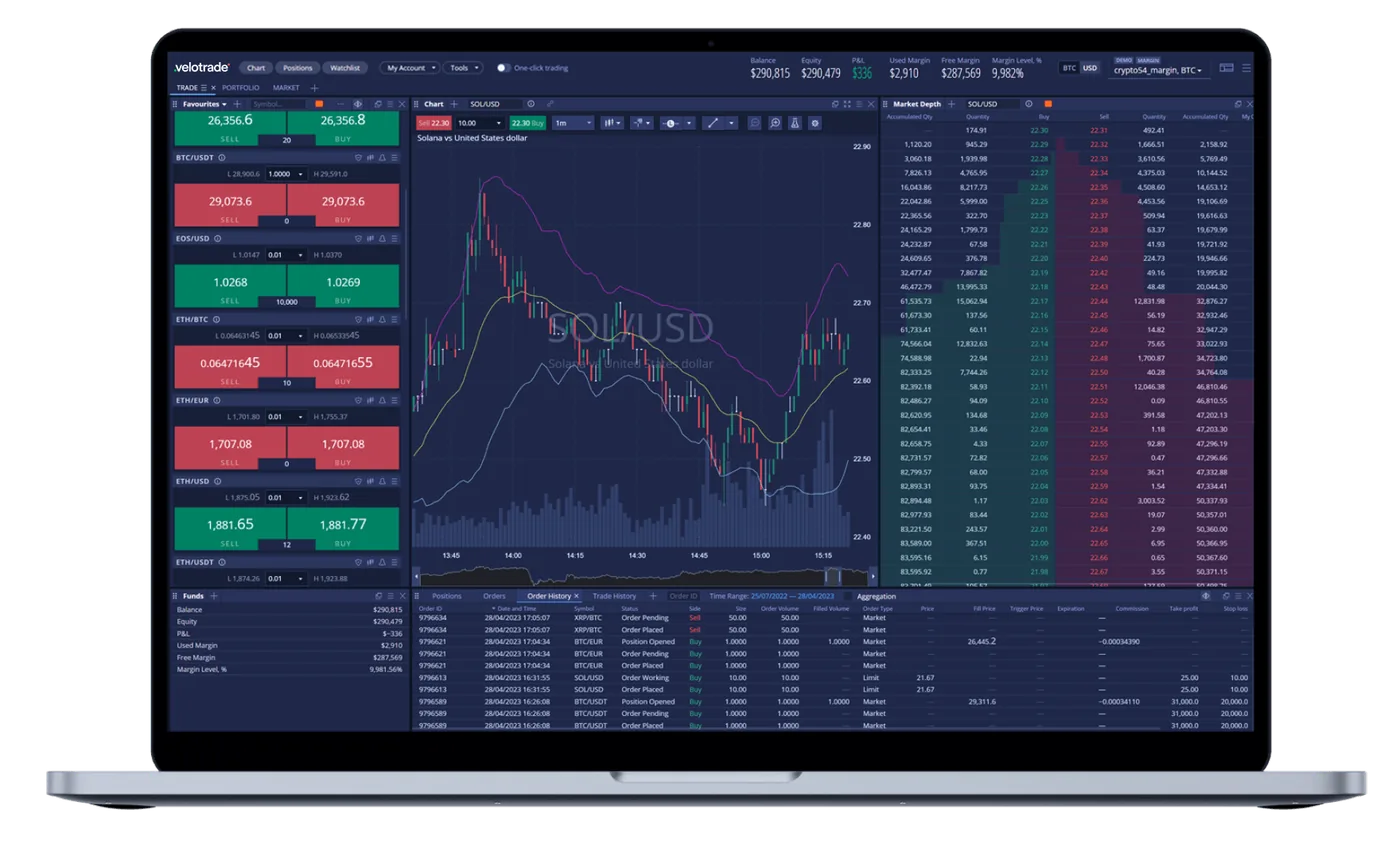
DXtrade supports advanced order types, real-time P&L tracking, and reliable execution under volatile conditions, characteristics that matter across all asset classes when market conditions move quickly.
Traders who have used DXtrade in other contexts will find the environment familiar. Those new to it face a short learning curve, but nothing that should affect evaluation performance for traders with established strategy processes. For a full walkthrough of the platform including order types, drawdown monitoring, and EA setup, see how to use DXtrade for crypto prop trading.
Trading costs, leverage and overnight fees
Velotrade charges a commission on each side of a trade, once on open and once on close, on the notional value. There is no spread markup, so the commission is the full trading cost.
| Asset class | Commission per side | Leverage (Challenge / Funded) |
|---|---|---|
| Forex majors | 0.004% | 50x / 30x |
| Commodities | 0.01% | 6x / 5x |
| Bitcoin | 0.03% | 10x / 5x |
| ETH and SOL | 0.03% | 6x / 5x |
| Index ETFs (SPY, QQQ, IWM) | 0.03% | 6x / 5x |
| Single stocks | 0.03% | 5x / 3x |
Forex minors and exotics run at 30x / 20x and 20x / 10x, mid-cap crypto at 3x / 2x, and other crypto at 2x / 2x. Leverage is the same on CLASSIC and PRO plans.
An overnight fee of 0.05% of the notional value applies to positions still open at 00:30 UTC on crypto, indices, commodities and single stocks, including weekends. On forex it is charged at the 21:00 UTC rollover, at three times the rate on Wednesday to cover the weekend. The rate is flat for long and short positions.
Payouts and profit split
The standard profit split on a funded Velotrade account is 80%. A paid add-on raises it to 90%, and it applies from the first payout with no time-based ramp.
How payouts work:
- First payout: can be requested 14 calendar days after your first funded trade, once you have completed the required qualifying trading days on the funded account.
- After that: you can request a payout every week. The minimum withdrawal is $100.
- Review: when you request a withdrawal the account is halted while the risk team reviews it. This generally takes less than 24 hours and can take longer in busy periods.
- Currency: payouts are sent as USDC or USDT to your wallet address.
- KYC: none during the evaluation. Verification is completed after you pass, before the funded account is issued.
- Fees: challenge fees are non-refundable, and nothing else is charged to your card. Commission and overnight fees come out of the trading account as you trade.
As a firm that launched its funded trading platform in March 2026, Velotrade does not yet have a multi-year payout track record to point to. The institutional background of the founding team provides above-average credibility signals, and completed withdrawals are published as verifiable on-chain payout proof, so payout history will build in public. For a broader comparison of payout structures and speed across crypto prop firms, see crypto prop firm payout speed: what traders need to check.
Pros and cons
What works
- Built around a specific diagnosis: Velotrade launched to fix five known problems in the category: tick-by-tick trailing drawdowns, consistency rules, weekend and news restrictions, and vague rule language. Every one of those is addressed in the rule set by design.
- Multi-asset instrument range: Trade crypto, forex, stocks (TSLA, NVDA, AAPL), index ETFs (SPY, QQQ, IWM), and commodities (gold, silver, WTI crude) all on one funded account.
- Open API access: Full programmatic access on every account from evaluation through funded. Run algo trading, bots, and automated execution in any language with no extra fee or approval. See algo and bot trading in crypto prop firms for what is permitted.
- Institutional hedging model: Velotrade uses an institutional hedging model that mirrors and hedges selected trader positions, so consistent trader profits become revenue for the firm, aligning firm and trader incentives. See how institutional hedging works in crypto prop trading for a full explanation of why this matters.
- Static drawdown (all challenges): The floor is fixed from your initial balance and never moves, intraday or at day close. Intraday spikes don't tighten your limit, and your buffer grows as you profit.
- Commission-only costs: 0.004% to 0.03% per side with no spread markup, and every fee is published.
- No consistency rule: Traders can run concentrated positions without artificial behavioral constraints.
- News and weekend flexibility: No restricted windows around events, no forced position closure at weekends.
- Institutional founding team: Professional finance background produces cleaner, more precise policy design than many operator-built alternatives.
What to weigh
- Maximum funding cap of $200,000: Firms like HyroTrader and FundedNext offer higher headline maximums. For traders targeting multi-hundred-thousand-dollar funded accounts in a single pass, that is a relevant constraint. See the HyroTrader vs Velotrade comparison for a full side-by-side breakdown of how the two firms differ, or the HyroTrader review 2026 for a standalone look at HyroTrader's full rule set.
- Platform learning curve: DXtrade is capable but less universally familiar than MT4/MT5. Traders new to the platform should account for an adjustment period before their evaluation.
- Newer operator: Velotrade launched in early 2026 and does not yet have the multi-year payout track record of legacy firms. Verify current payout terms directly before committing.
Who is Velotrade for?
Velotrade is best suited to traders who meet most of the following profile:
- Multi-asset traders who want one funded account. Crypto, forex, stocks (TSLA, NVDA, AAPL), index ETFs (SPY, QQQ, IWM), and commodities (gold, silver, WTI crude) are all accessible on a single account.
- Strategy-driven with defined risk parameters. The rule stack rewards traders who run systematic, process-consistent approaches rather than discretionary improvisation.
- Prioritizing reliability over promotional economics. If your primary filter is headline profit split, several newer firms advertise marginally higher ceilings. If your primary filter is operator credibility, payout track record, and policy integrity, Velotrade is consistently near the top of a peer comparison.
- Running strategies that benefit from flexibility. News trading, weekend holding, and no consistency cap make Velotrade well-suited to event-driven or momentum strategies that concentrate around specific market conditions.
It is less suited to:
- Beginners looking for a structured learning environment. For newer traders, the challenge mechanics will be difficult to navigate without a strong prior foundation.
- Traders who need maximum account size above $200,000. Other firms offer higher caps.
Verdict
Velotrade is new to the prop trading space and is transparent about that. What it brings instead is a clear-eyed diagnosis of what is broken across the category, tick-by-tick trailing drawdowns, consistency caps, weekend restrictions, vague enforcement language, and a rule set designed from scratch to avoid all of it, applied across a full multi-asset instrument range.
Whether that bet pays off will depend on execution over time. But the structural decisions are already made, and they are among the most trader-friendly in the current peer set. For experienced traders who have lost funded status to a technicality, or passed on a setup to avoid a consistency breach, Velotrade is worth examining carefully.
If you are still deciding whether prop trading is the right path, the guide on how to become a funded crypto trader covers what the process looks like from start to first payout. To see how Velotrade compares against all major firms in 2026, see best crypto prop firms in 2026 or filter every firm side by side in the crypto prop firm directory.
Review the full challenge options and pricing, then validate all enforcement detail in the rules before buying.
Platform help: follow the step-by-step getting started guide or browse all Velotrade guides.
Frequently Asked Questions
About the author

Vittorio De Angelis
Executive Chairman
Former equity-derivatives trader at JP Morgan, Dresdner Kleinwort and Bank of America in London. Later Head of Brokerage at a global broker in Hong Kong.
Velotrade was founded in Hong Kong in 2016 by a team from JP Morgan, Dresdner Kleinwort and Bank of America, has paid out over $2.5 billion to its trade-finance clients, and has been featured in Bloomberg, the Financial Times, the Wall Street Journal and on Nasdaq. Its prop trading evaluations are simulated and educational.
View author page