Trade crypto with funded capital
ExploreTwo crypto prop firms. Similar account sizes. Very different rules.
Velotrade and HyroTrader both target serious crypto traders who want crypto funded trading accounts without risking their own capital. But underneath the similar packaging, the evaluation structures diverge in ways that matter, particularly if you trade around news events, run high-conviction single-day positions, or use automated strategies.
This comparison breaks down both firms across every metric that actually affects whether you pass the evaluation and keep your funded account.
Highlights of this article
- Velotrade has no consistency rule at any stage. HyroTrader caps any single day at 40% of total eval profit
- HyroTrader caps the realised loss on any single position at 3% of the initial balance. Velotrade sets no per-trade cap at all
- Both firms require 5 trading days per phase. Velotrade counts only qualifying days that close at least 0.8% net profit; HyroTrader counts any day with a position opened
- Velotrade offers up to 90% from the first payout. HyroTrader starts at 80% and reaches 90% after about eight months of consistent performance
- Both firms allow news trading, weekend holding, overnight holding, and EAs
- Platform differs: Velotrade uses DXtrade; HyroTrader connects to Binance and ByBit via CLEO
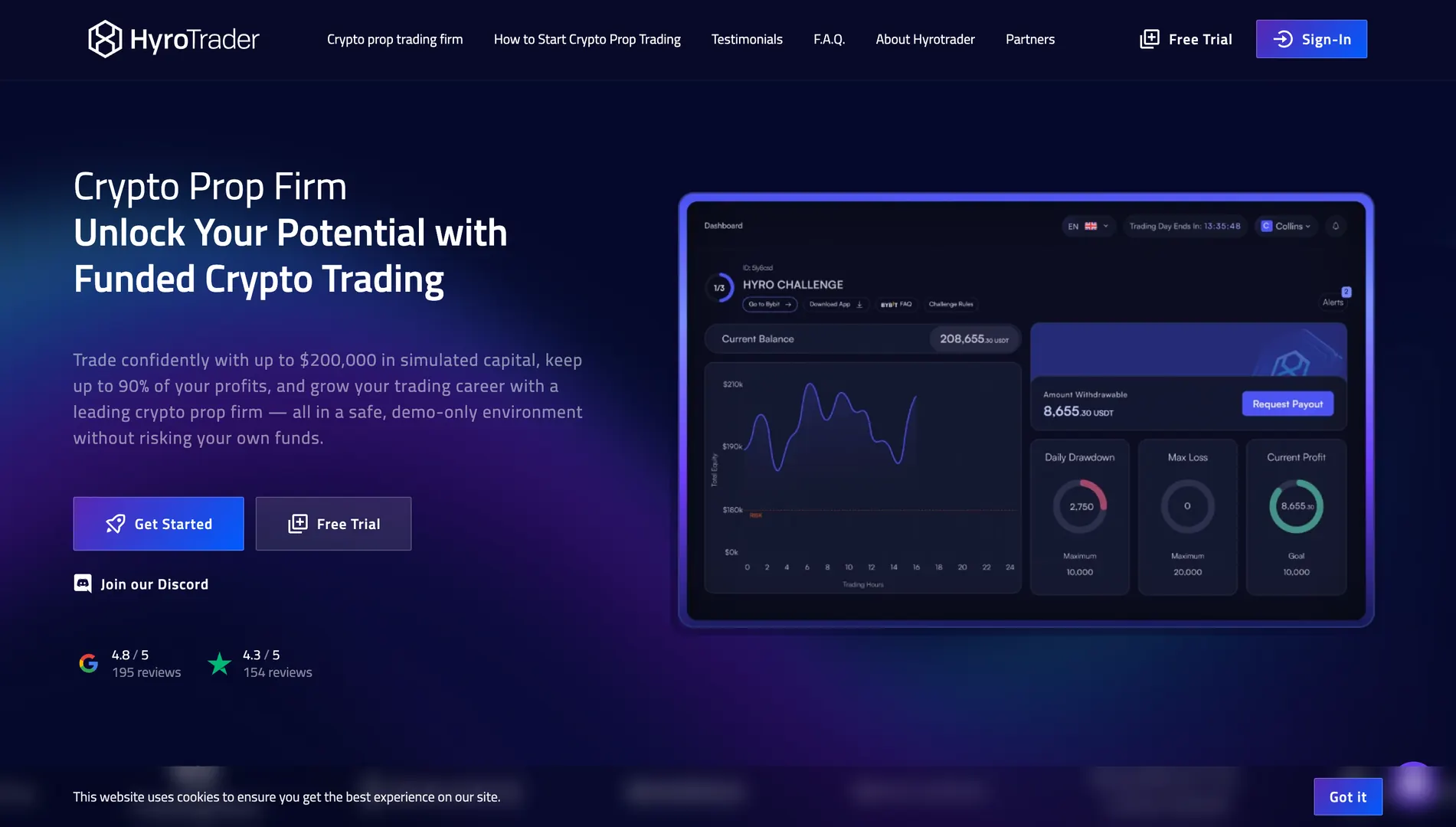
Quick Comparison: HyroTrader vs Velotrade
| Velotrade | HyroTrader | |
|---|---|---|
| Challenge types | 1-Step, 2-Step | 1-Step, 2-Step |
| Account sizes | $5k to $200k | $5k to $200k |
| Phase 1 profit target | 10% | 10% |
| Phase 2 profit target | 5% | 5% |
| Daily loss limit (2-Step) | 5% | 5% |
| Max drawdown (2-Step) | 10% static | 10% |
| Min trading days | 5 qualifying days per phase | 5 days per phase |
| Consistency rule | None | 40% cap per day (eval only) |
| Cap on risk per trade | None | Max 3% realised loss per position |
| Profit split | Up to 90% from the first payout | 80% to 90% (rises with consistent performance) |
| News trading | Allowed | Allowed |
| Weekend holding | Allowed | Allowed |
| EAs / automation | Allowed | Allowed |
| Platform | DXtrade | Binance / ByBit via CLEO |
| Challenge fee refund | No | Yes (on first payout) |


Evaluation Rules: Where the Real Differences Are
Consistency Rule
This is the single most important rule difference between the two firms.
HyroTrader enforces a 40% consistency rule during evaluations: no single trading day can account for more than 40% of your total evaluation profit. If you're targeting 10% on a $50,000 account ($5,000), no single day can contribute more than $2,000 to that total.
For most traders this may sound reasonable. But for crypto traders who concentrate capital into high-conviction macro events, Fed decisions, CPI prints, major protocol news, this rule directly limits how you can earn your pass.
Velotrade has no consistency rule. None during the evaluation, none on the funded account. If you close your entire 10% target in a single session, that's a pass. Your profit pattern is not evaluated. Only your risk management is.
If you're a news trader, momentum trader, or anyone who takes fewer but larger positions, this difference alone may determine which firm suits you.
The Per-Trade Loss Cap
Neither firm requires a stop-loss. HyroTrader used to require one within five minutes of entry; that rule has been withdrawn and the firm now states that positions may be opened without one.
What HyroTrader does enforce is a ceiling on the result: the realised loss on any single position must not exceed 3% of the initial account balance. On a $100,000 account that is $3,000 per trade, regardless of how many trades you take. Funded accounts add two exposure limits on top, 25% of the initial balance as total margin and a notional cap of 2x the balance.
Velotrade sets no cap on risk per trade and no maximum lot size. Your only sizing limit is the static drawdown. For a trader who sizes dynamically by conviction, that is the difference between a rule you design around and no rule at all.
Worth knowing where these numbers live: HyroTrader's 3% cap appears in its FAQ, not on its trading rules page, whose only loss figure is the 6% maximum.
Minimum Trading Days
HyroTrader requires 5 minimum trading days per evaluation phase. At least one position must be opened on each of those days.
Velotrade requires 5 qualifying trading days per phase, each with at least 0.8% net profit on the initial account balance.
The practical difference is what counts as a day. At HyroTrader, any day with an opened position counts. At Velotrade, only days that close at least 0.8% net profit count. At both firms, hitting the profit target early does not skip the remaining required days.
At Velotrade, the 5-day requirement exists with no overall time limit. If you hit your profit target and your 5 qualifying days in the same period, you pass.
Profit Split: From the First Payout vs Scaled Over Time
HyroTrader's profit split starts at 80% and rises by 5% every 4 months of consistent performance, reaching 85% at 4 months and 90% at 8 months.
Velotrade's profit split is up to 90% from the first payout.
The gap is in the early months. On $10,000 profit in the first 4 months: at 80% you take home $8,000; at 90% you take home $9,000.
HyroTrader does refund the challenge fee on your first profit split payout, which partially offsets this. Velotrade doesn't offer a fee refund.

Pricing: Side-by-Side Challenge Fees
| Account Size | Velotrade 2-Step | Velotrade 1-Step | HyroTrader 2-Step |
|---|---|---|---|
| $5,000 | $54 | $67 | $59 |
| $10,000 | $100 | $127 | $119 |
| $25,000 | $225 | $290 | $249 |
| $50,000 | $419 | $543 | $379 |
| $100,000 | $769 | $1,075 | $579 |
| $200,000 | Not offered (PRO 1-Step: $1,114) | Not offered | $969 |
Note: HyroTrader refunds the challenge fee on the first payout. Factor this into cost comparison if you expect to pass.
Platform: DXtrade vs Binance / ByBit via CLEO
Velotrade uses DXtrade, a purpose-built prop trading platform. It's designed for the prop firm evaluation environment and runs independently of retail exchange accounts.
HyroTrader connects traders directly to Binance and ByBit via CLEO integration. This means you're trading on real exchange infrastructure with live order books and real execution.
The CLEO integration has a practical advantage for traders already familiar with Binance or ByBit order types, funding rates, and interface. The DXtrade advantage is in its prop-firm-specific design: rules monitoring, account management, and payout tracking are built in. For a full walkthrough of the DXtrade interface including order types, drawdown panel, and EA setup, see how to use DXtrade for crypto prop trading.
Neither is objectively better. It depends on your existing familiarity and preferences.
What Each Firm Suits Best
Choose Velotrade if:
- You trade news events or high-volatility setups where single-day returns matter
- You run high-conviction positions and don't want a per-trade risk cap
- You want up to 90% profit split from your first payout, not after eight months
- You use automated strategies and want no stop-loss placement obligation
- You want a crypto-native multi-asset firm with an institutional-grade founding team background
Choose HyroTrader if:
- You want any day with a position opened to count toward the minimum, with no per-day profit threshold
- The 40% consistency cap doesn't conflict with your strategy (you naturally spread profits)
- You want a refundable challenge fee to reduce the upfront cost
- You trade primarily on Binance or ByBit and prefer native exchange connectivity
- You're content scaling your profit split over time rather than buying the 90% add-on
Both Firms Get Right: Shared Strengths
There are areas where Velotrade and HyroTrader are aligned, and both deserve credit for getting these right compared to older, generalist prop firms:
- Crypto focus: both firms are built for crypto traders
- News trading allowed: both permit trading through scheduled and unscheduled events
- Weekend holding allowed: neither forces position closure on Friday
- EAs and automation permitted: both support algorithmic trading strategies, for a detailed breakdown of what is and is not allowed across prop firms, see algo and bot trading in crypto prop firms
- No time limit on evaluations: both allow unlimited time to hit profit targets
For context on why these permissions matter, see why traders fail prop challenges. Many failures trace back to firms with restrictive rules that force traders out of their natural strategy.
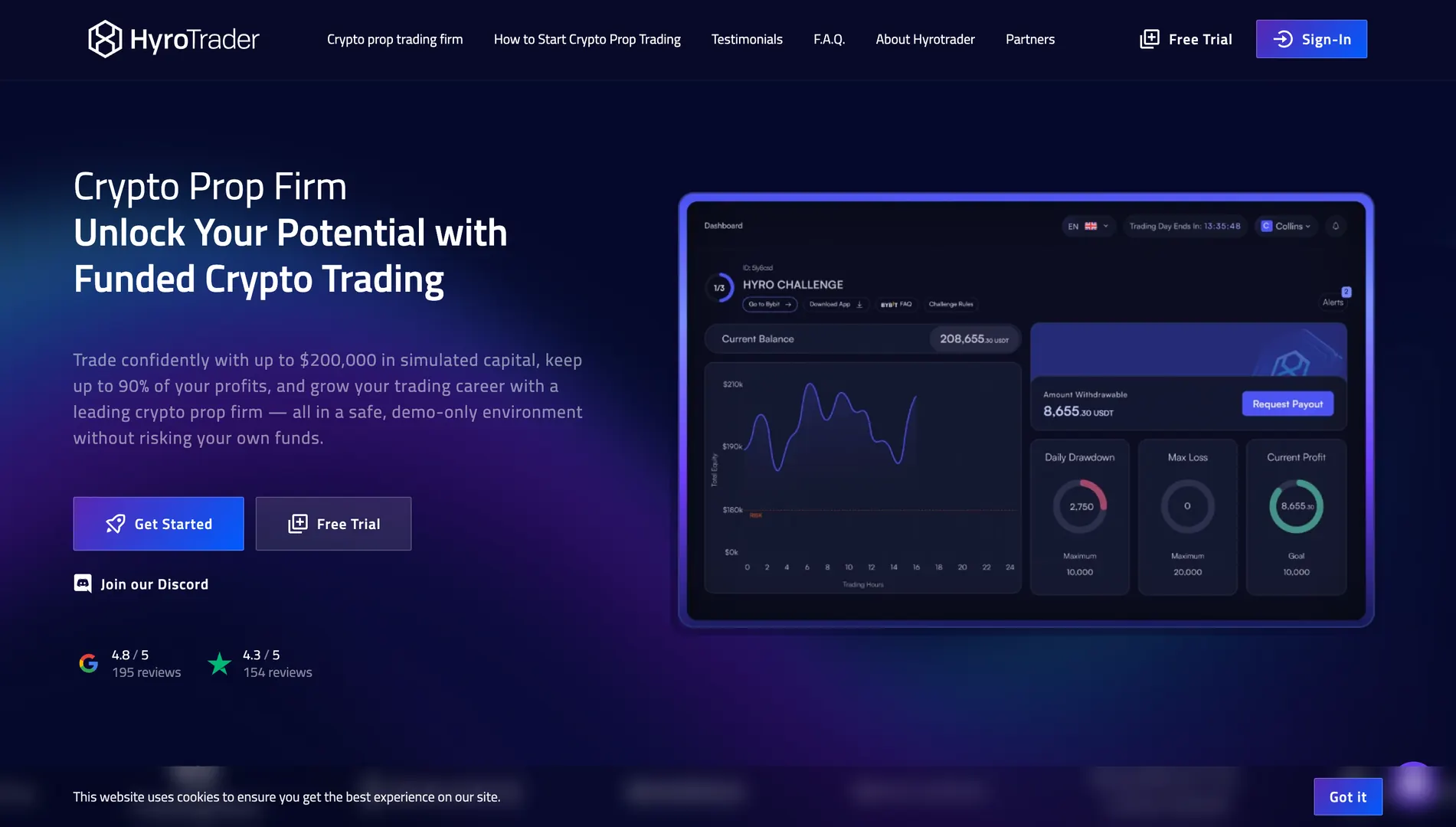
Where the Rules Actually Live: A Detail Most Comparisons Miss
Most HyroTrader vs Velotrade comparisons focus on drawdown and profit split. The more useful difference is how findable each firm's rules are, and how consistent they are with each other.
HyroTrader publishes its hard 3% per-trade loss cap in its FAQ rather than on its trading rules page. It also publishes two different daily drawdown figures, 4% on the rules page and 5% on the FAQ for the 2-step, on undated pages. Its terms were rewritten on September 29, 2026 to permit automation of your own strategy, after an earlier version banned bots "except where expressly permitted in the Trading Rules" and pointed at a page that was silent on the subject.
None of that makes HyroTrader a bad firm. It does mean a trader cannot establish the rule set from one document, and an automated trader should still read the current terms and confirm how the platform connects before paying a fee.
At Velotrade, your drawdown limits are the boundaries. How you manage risk within those limits, stop-losses, position sizing, scaling in and out, is your decision. To see your exact floor, daily budget, and how many losing trades you can take at any risk level, use the prop trading drawdown calculator.
Which Crypto Prop Firm Is Better?
There's no universal answer. Both firms are legitimate, both allow the strategies that matter for crypto trading, and both have passed traders to funded accounts.
The decision comes down to your trading style:
If you trade for concentrated, high-conviction moves, news events, macro setups, single-session opportunities, Velotrade's no consistency rule and no mandatory SL requirement removes constraints that would directly interfere with your strategy.
If you trade systematically across many sessions and your natural approach spreads profits broadly, HyroTrader's consistency rule may never trigger anyway, and the refundable fee reduces upfront cost.
For a broader view of the crypto prop firm landscape and how other firms compare, see best crypto prop firms in 2026 or browse the full crypto prop firm directory to filter by drawdown model, rules, and trading conditions. For a deeper look at Velotrade specifically, including full challenge pricing and rule detail, see our Velotrade review. For a standalone review of HyroTrader covering drawdown model, trading rules, and payout mechanics in full detail, see HyroTrader review 2026. For HyroTrader's verified challenge profile and side-by-side rule comparison, see the HyroTrader directory page.
If you are also considering BrightFunded, see BrightFunded vs Velotrade for a direct comparison on profit targets, profit split, and platform choice. For a direct head-to-head between HyroTrader and BrightFunded on drawdown model, stop-loss requirements, and platform, see HyroTrader vs BrightFunded.
To understand how Velotrade's rules work in full, including drawdown mechanics, inactivity rules, and breach consequences, see crypto prop firm rules explained. For a deep dive into how EOD trailing drawdown differs from tick-by-tick trailing, and why the distinction matters, see EOD trailing vs tick-by-tick drawdown explained.
Ready to start a Velotrade challenge? View challenge options and pricing →
This article is for informational purposes only and does not constitute financial or investment advice. Prop firm rules, fees, and structures change frequently. Always review each firm's official terms and conditions before making any decisions. This comparison reflects publicly available information as of March 2026.
Frequently Asked Questions
About the author

Vittorio De Angelis
Executive Chairman
Former equity-derivatives trader at JP Morgan, Dresdner Kleinwort and Bank of America in London. Later Head of Brokerage at a global broker in Hong Kong.
Velotrade was founded in Hong Kong in 2016 by a team from JP Morgan, Dresdner Kleinwort and Bank of America, has paid out over $2.5 billion to its trade-finance clients, and has been featured in Bloomberg, the Financial Times, the Wall Street Journal and on Nasdaq. Its prop trading evaluations are simulated and educational.
View author page