Trade crypto with funded capital
Explore2 crypto prop firms founded in 2023. One built for real exchange execution on Bybit and Binance. One built for multi-platform flexibility with a static 2-Step floor. Here is how they compare.
HyroTrader and BrightFunded are both newer-generation crypto prop firms that launched in 2023 and have built active funded trader bases. HyroTrader positions itself on real exchange execution and fee refunds. BrightFunded competes on drawdown model, platform range, and scaling. If you are evaluating which one suits your strategy, this comparison covers every metric that drives funded account outcomes: drawdown model, consistency rule, profit split, platform, weekend holding, and pricing. For a broader overview of the funded trading landscape, see what crypto prop trading is.
Highlights of this article
- Both use a static maximum loss on their 2-step plans; the difference is the daily limit (HyroTrader's trails intraday by default) and BrightFunded's trailing 1-Step
- BrightFunded has no consistency rule; HyroTrader enforces a 40% cap during evaluations (drops on funded accounts)
- HyroTrader executes on real Bybit and Binance accounts via CLEO; BrightFunded uses MT5, cTrader, and DXtrade
- Neither firm requires a stop-loss, but HyroTrader caps the realised loss on any single position at 3% of the initial balance; BrightFunded sets no per-trade cap
- Both firms allow news trading and weekend holding
- HyroTrader refunds the challenge fee on first payout; BrightFunded offers a first-payout refund only as a paid add-on
- Both start at an 80% split: HyroTrader rises to 90% over about eight months of consistent performance, BrightFunded sells 90% as an add-on
Quick Comparison: HyroTrader vs BrightFunded
| HyroTrader | BrightFunded | |
|---|---|---|
| Founded | 2023 | 2023 |
| HQ | Czech Republic | Dubai, UAE |
| Markets | Crypto only | Crypto, FX, Indices, Commodities |
| Challenge types | 1-Step, 2-Step | 1-Step, 2-Step Bright, 2-Step Classic |
| Account sizes | $5K to $200K | $5K to $200K (scales beyond) |
| Phase 1 profit target | 10% | 8% (Bright) / 10% (Classic) |
| Phase 2 profit target | 5% | 5% |
| Daily loss limit | 5% (trails intraday unless swing upgrade) | 4% (Bright) / 5% (Classic) |
| Max drawdown | 10% static | 8% (Bright) / 10% (Classic) static; 1-Step 6% trailing |
| Consistency rule | 40% cap (evaluation only) | None |
| Stop-loss requirement | No (3% cap on any single position's loss) | None |
| News trading | Allowed | Evaluation: allowed. Funded: no trades ±5 min around high-impact news |
| Weekend holding | Allowed | Allowed |
| EAs / automation | Allowed | Allowed |
| Platform | CLEO (Bybit + Binance) | MT5, cTrader, DXtrade |
| Min trading days | 5 per phase | 5 per phase |
| Profit split | 80% rising to 90% (about 8 months) | 80% base, 90% add-on, 100% via scaling |
| Fee refund | Yes (first payout) | Paid add-on |
| Scaling plan | Yes (25% per 4 months, to 1M USDT) | Yes (30% per 4 months, uncapped) |
| Max funding | $200K (1M USDT via scaling) | Uncapped via scaling |
Drawdown: The Most Important Structural Difference
This is the single most consequential difference between the two firms.
Both firms use a static maximum loss on their 2-step plans. At HyroTrader, 2-Step equity must stay above 90% of the initial balance. At BrightFunded, the 2-Step Bright floor sits at 92% and the Classic at 90%. Neither floor moves as you profit.
The difference is the daily limit. HyroTrader's default daily drawdown trails: it is measured from each day's highest equity, updated in real time including floating profit, so a position that runs up and retraces can breach it. A paid swing upgrade fixes the daily limit at the start of the day. BrightFunded's daily limit is measured from the higher of balance or equity at the start of the day and does not trail intraday.
On the 1-Step, BrightFunded's maximum loss trails your equity high in real time until you are 6% up, then locks at the starting balance.
For crypto traders, the calculation method matters more than the percentage itself. Crypto's higher intraday amplitude means any limit that trails intraday highs can tighten on sessions that close near flat. For a full technical breakdown, see EOD trailing vs tick-by-tick drawdown explained. To model your exact floor and trade capacity on any setup, use the prop trading drawdown calculator.

Consistency Rule: BrightFunded Wins Clearly
BrightFunded has no consistency rule. Profit distribution across trading days is not evaluated at any stage. You can concentrate your entire evaluation profit into 1 session or spread it across 20, neither outcome affects the pass condition.
HyroTrader enforces a 40% consistency rule during evaluations. No single trading day can account for more than 40% of your total evaluation profit. A session where you hit 45% of the profit target in one day fails the evaluation on this rule, even if all drawdown and daily loss limits were respected. The rule drops completely on funded accounts.
For traders running event-driven strategies, news trading setups, or any approach that naturally concentrates returns into fewer high-conviction sessions, HyroTrader's consistency rule is a real constraint during the evaluation. BrightFunded's absence of a consistency rule eliminates that friction entirely.
For context on why the consistency rule is one of the most impactful hidden costs in the funded trading model, see crypto prop firms with no consistency rule.
Per-Trade Risk: A Practical Difference
Neither firm requires a stop-loss. HyroTrader previously required one within five minutes of entry; that rule has been withdrawn, and the firm now states that positions may be opened without one.
HyroTrader does cap the outcome. The realised loss on any single position must not exceed 3% of the initial account balance. On funded accounts it adds two exposure limits: total margin capped at 25% of the initial balance, and total notional at 2x the balance.
BrightFunded sets no per-trade cap. Risk is bounded only by the daily loss limit and the maximum drawdown. Position sizing and individual trade risk are left entirely to the trader.
The 3% cap constrains some strategy types more than others. Position-building approaches, where no single entry defines the risk level, need to account for the cap applying per position rather than per idea. Traders running wide initial stops before active management should check that a full stop-out stays under 3% of the initial balance, not of current equity.
For traders who manage risk at the portfolio level rather than per-trade, BrightFunded's approach gives more flexibility.


Platform: Real Exchange vs Multi-Platform
This is the sharpest structural divergence between the two firms.
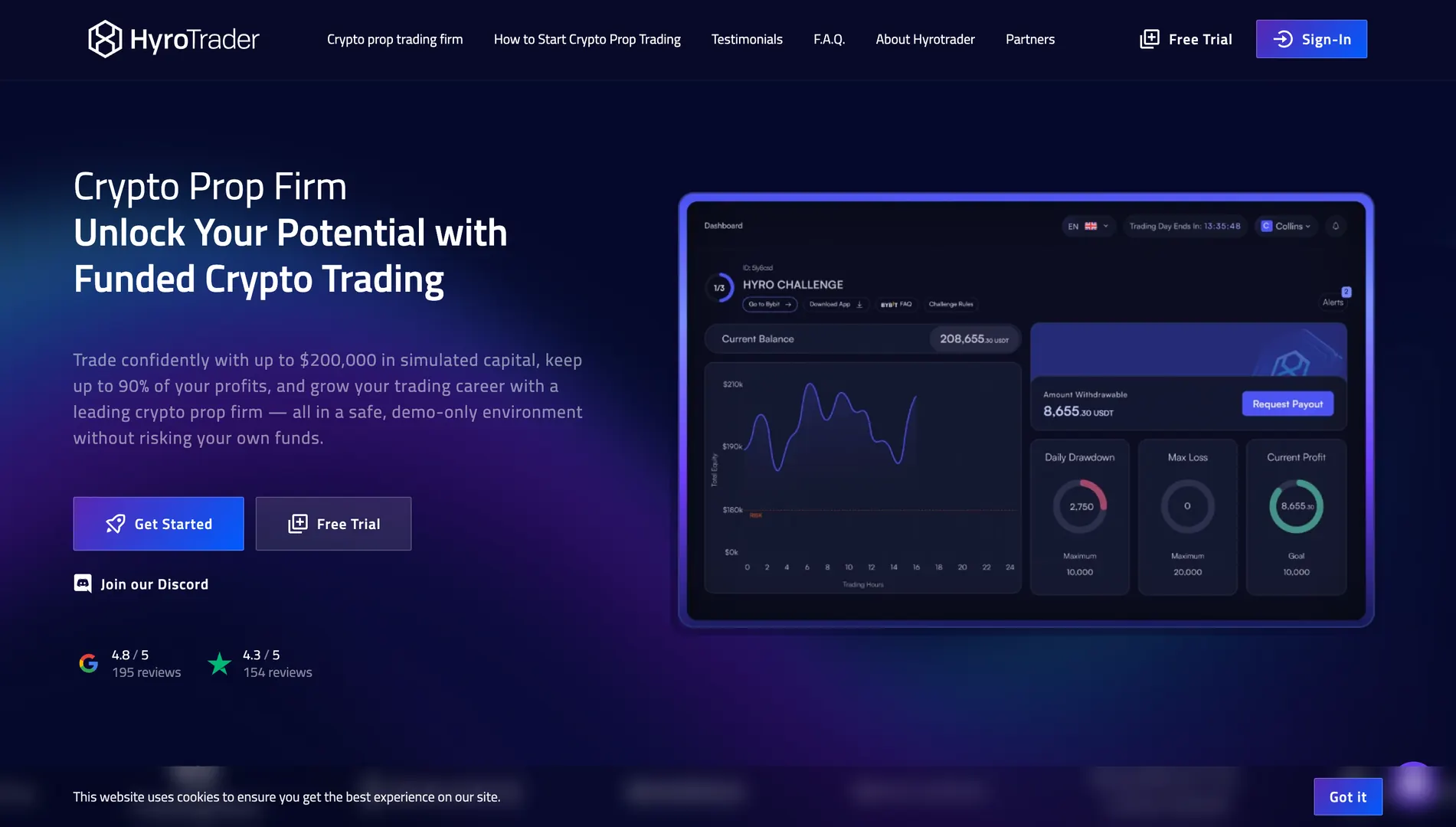
HyroTrader executes on real Bybit and Binance accounts via the CLEO platform. Your trades are not simulated on a prop firm internal system; they are placed on actual exchange infrastructure. This means real order book depth, real funding rates, and real execution quality. For traders who want their funded account performance to reflect what they would experience on a live exchange, this is a meaningful advantage.
The tradeoff is platform constraint. CLEO is HyroTrader's proprietary interface for Bybit and Binance. Traders who already run MT5 or cTrader tooling, custom indicators, or EAs on those platforms need to rebuild or adapt their setups.
BrightFunded supports MT5, cTrader, and DXtrade. This is the widest platform selection among the two firms by a significant margin. If you already operate on any of these three platforms, you bring your existing setup directly into the evaluation. No rebuilding.

Profit Split: Different Structures, Similar Headlines
HyroTrader starts at 80% and rises to 90%. The split increases by 5 points every four months of consistent performance, so the top rate is reachable after about eight months. The trade-off is the waits relative to firms that offer 90% from day one.
BrightFunded starts at 80%, with an optional upgrade to 90% available for an additional fee at checkout (typically +20% on the challenge fee). If you pay for the 90% add-on upfront, you receive the top split from your first funded payout. If you do not pay for the add-on, you hold at 80% indefinitely.
On $10,000 profit: 80% returns $8,000 and 90% returns $9,000. Both firms start at 80%; HyroTrader gets you to 90% with time, BrightFunded with an add-on fee, and BrightFunded can go to 100% through its scaling plan.
Fee Refund: Standard at HyroTrader, an Add-On at BrightFunded
HyroTrader returns the challenge deposit with your first funded payout. BrightFunded only refunds the fee if you buy its refund add-on at checkout; otherwise it refunds untraded challenges within 30 days.
At most prop firms, the challenge fee is non-refundable. A refund on first payout reduces the net entry cost for successful traders to zero on the evaluation itself.
Scaling Plans: Both Firms Have One
BrightFunded has a defined scaling plan. Funded traders who generate 10% net profit and are profitable in at least 2 of any 4 months receive a 30% increase in account size. This compounds over time. Starting at $100,000, a trader who meets the criteria every cycle reaches $130,000, then $169,000, then beyond $200,000.
HyroTrader also scales accounts. Every four months you can request a 25% increase on the initial balance, up to 1,000,000 USDT, if you made at least 20% total profit over the period, finished at least two of the four months positive, and took at least two payouts.
BrightFunded's criteria are easier (10% profit rather than 20%) and its increases larger (30% rather than 25%), with no upper limit and a 100% split from the third scale-up. HyroTrader's plan is capped at 1M USDT.
Pricing: Side-by-Side Challenge Fees
| Account Size | HyroTrader 2-Step | HyroTrader 1-Step | BrightFunded 2-Step |
|---|---|---|---|
| $5,000 | $89 | $119 | ~€55 (confirm current rate) |
| $10,000 | $149 | $199 | ~€95 (confirm current rate) |
| $25,000 | $249 | $329 | Confirm on BrightFunded website |
| $50,000 | $349 | $499 | Confirm on BrightFunded website |
| $100,000 | $599 | $849 | Confirm on BrightFunded website |
| $200,000 | $999 | $1,399 | Confirm on BrightFunded website |
BrightFunded fees are in EUR. The EUR/USD rate affects the USD-equivalent cost. Confirm the full fee schedule on BrightFunded's website before purchasing, including the 90% split add-on pricing. Challenge fee refund on first payout applies at both firms.
What Each Firm Suits Best
Choose HyroTrader if:
- Real exchange execution on Bybit or Binance is important for your strategy and you want funded account performance that mirrors live exchange conditions
- You are comfortable capping the realised loss on any single position at 3% of the initial balance
- You want a 1-step challenge option for a faster, single-phase evaluation path
- The 40% consistency rule is unlikely to trigger based on how your daily returns are distributed
- A split that starts at 80% and reaches 90% after about eight months works within your planning horizon
- You want full challenge fee refund on first funded payout
Choose BrightFunded if:
- You want a daily limit that does not trail intraday, with a static floor on the 2-Step
- You have no consistency rule requirement: your strategy concentrates returns into fewer sessions and any daily cap creates evaluation risk
- You already operate on MT5, cTrader, or DXtrade and want to bring your existing setup directly
- You want no per-trade loss cap at all, because your strategy occasionally needs a single position to carry more than 3% of the balance
- You want the easier scaling plan (10% profit per 4 months, 30% increases, no cap)
- You want to access 90% split from the first funded payout by paying the add-on fee upfront
Which Firm Is Better?
For traders whose primary concern is the daily limit and consistency rule, BrightFunded's 2-Step is the cleaner structural fit: its daily limit does not trail intraday, and it has no consistency rule, which removes the evaluation risk HyroTrader's 40% cap introduces for event-driven strategies.
For traders who want real exchange execution and are building a strategy that will eventually live on Bybit or Binance, HyroTrader's CLEO infrastructure offers a genuine live-market alignment that BrightFunded's simulated environment does not match.
Both allow weekend holding and both have paid funded traders in 2024 and 2025. Neither is the obviously dominant choice: the decision comes down to the daily-limit model, platform, the per-trade loss cap, and how you plan to scale capital over time.
For the full market view of where both firms sit, see best crypto prop firms in 2026. For HyroTrader's complete rule set and evaluation details, see HyroTrader review 2026. For BrightFunded's complete rule set, see BrightFunded review 2026. For how each compares to Velotrade specifically, see HyroTrader vs Velotrade and BrightFunded vs Velotrade. For HyroTrader's full challenge profile in the directory, see HyroTrader directory page. For BrightFunded's directory profile, see BrightFunded directory page.
Ready to start a Velotrade challenge? View challenge options and pricing
This article is for informational purposes only and does not constitute financial or investment advice. Prop firm rules, fees, and structures change frequently. Always review each firm's official terms and conditions before making any decisions. This comparison reflects both firms' websites as of September 2026.
Frequently Asked Questions
About the author

Vittorio De Angelis
Executive Chairman
Former equity-derivatives trader at JP Morgan, Dresdner Kleinwort and Bank of America in London. Later Head of Brokerage at a global broker in Hong Kong.
Velotrade was founded in Hong Kong in 2016 by a team from JP Morgan, Dresdner Kleinwort and Bank of America, has paid out over $2.5 billion to its trade-finance clients, and has been featured in Bloomberg, the Financial Times, the Wall Street Journal and on Nasdaq. Its prop trading evaluations are simulated and educational.
View author page