Trade crypto with funded capital
ExploreTwo firms that get a lot right, with a couple of structural differences that decide it.
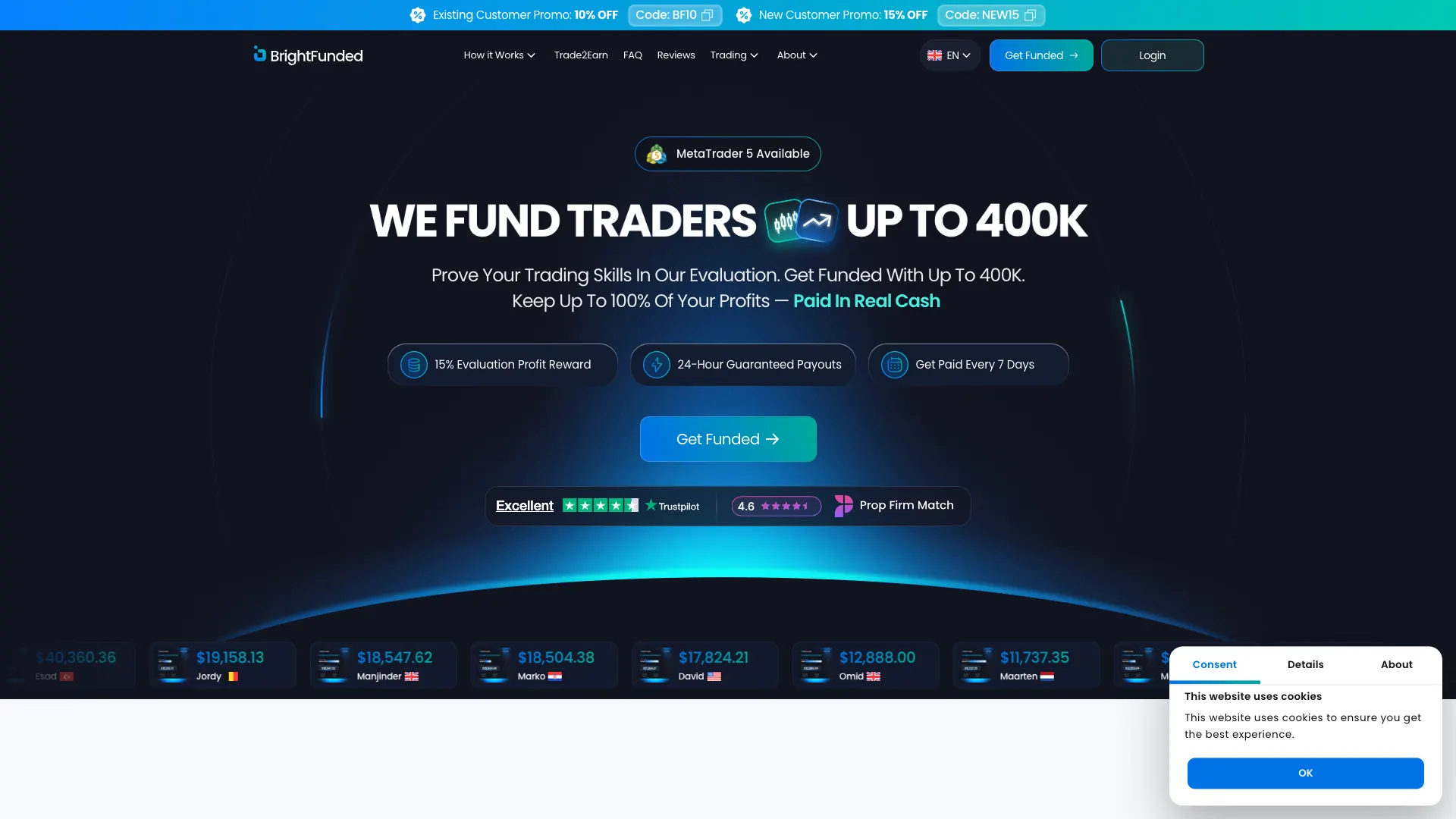
BrightFunded and Velotrade are among the more trader-friendly crypto prop firms currently operating. Both have no consistency rule, both allow weekend crypto trading, and both avoid the punishing tick-by-tick drawdown model that many firms use. The overlap is genuine. But they handle drawdown differently: Velotrade uses a static floor on every plan that never moves, while BrightFunded's varies by plan (its 1-Step trails until it locks at +6%, its 2-Step is static), and that difference matters.
But the differences that do exist are meaningful. This comparison works through every metric that matters for a trader deciding between them: profit targets, drawdown structure, minimum trading days, profit split, platform choice, and the scaling model each firm offers. If you are also weighing up what kind of crypto funded trading account is right for you, this breakdown covers all the structural details you need.
Highlights of this article
- BrightFunded's 2-Step Bright sets an 8% Phase 1 target vs Velotrade's 10%, a lower bar to pass (its 2-Step Classic matches Velotrade at 10%)
- Velotrade uses a static drawdown on every plan (floor fixed from your starting balance, never moves); BrightFunded's varies by plan (1-Step trailing that locks at +6%, 2-Step static). Neither firm has a consistency rule
- Both firms offer up to 90% profit split; BrightFunded adds a path to 100% through its scaling plan
- Both offer 1-step and 2-step challenges, but Velotrade's 1-step uses a static drawdown while BrightFunded's 1-step uses a 6% trailing drawdown that locks at +6%
- BrightFunded supports MT5, cTrader, and DXtrade. Velotrade uses DXtrade exclusively
- BrightFunded has a structured scaling plan and a Trade2Earn token reward system
- Both allow overnight positions and EAs; on funded accounts, Velotrade allows news trading while BrightFunded blocks trades within 5 minutes of high-impact releases

Quick Comparison: BrightFunded vs Velotrade
| Velotrade | BrightFunded | |
|---|---|---|
| Challenge types | 1-Step, 2-Step | 1-Step, 2-Step |
| Account sizes | $5k to $200k | $5k to $200k |
| Phase 1 profit target | 10% | 8% (Bright) / 10% (Classic) |
| Phase 2 profit target | 5% | 5% |
| Daily loss limit (2-Step) | 5% | 4% (Bright) / 5% (Classic) |
| Max drawdown | Static, plan-specific (2-Step 10%, 1-Step 7%, PRO 3%) | Varies by plan (1-Step trailing, 2-Step static) |
| Min trading days | 5 qualifying days (0.8%+ profit each) | 5 trading days per phase |
| Consistency rule | None | None |
| Mandatory stop-loss | No | No |
| Profit split | Up to 90% | 80% default, 90% add-on, 100% via scaling |
| News trading | Allowed | Evaluation: allowed. Funded: no trades ±5 min around high-impact news |
| Weekend holding | Allowed | Allowed |
| EAs / automation | Allowed | Allowed |
| Platform | DXtrade | MT5, cTrader, DXtrade |
| Scaling plan | No | Yes (30% every 4 months) |
| Challenge fee refund | No | Paid add-on |
Profit Targets: BrightFunded Asks for Less to Pass
The most tangible structural difference is the Phase 1 profit target.
BrightFunded requires 8% in Phase 1. Velotrade requires 10%.
On a $50,000 account, that gap is $1,000: BrightFunded sets the pass bar at $4,000, Velotrade at $5,000. Both firms share the same Phase 2 target of 5%, so the difference is concentrated in the evaluation's opening phase.
The 8% target belongs to the 2-Step Bright plan, which pairs it with a tighter 8% static floor and a 4% daily limit, so a lower target does not make the evaluation easier overall. BrightFunded's 2-Step Classic matches Velotrade's 2-Step on paper: 10% then 5%, a 5% daily limit, and a 10% static floor.
For conservative traders or those entering at larger account sizes where absolute dollar targets are significant, this 2-percentage-point difference is worth factoring in.
Drawdown Model: Static on Every Plan vs Varies by Plan
Both firms now use a static max loss on their 2-Step accounts, so this is no longer a blanket static-vs-trailing split. The difference sits on the 1-Step, and there it favours Velotrade.
Velotrade uses a static drawdown on every plan, including its 1-Step. Your floor is fixed from your starting balance and never moves for the life of the account. On a $50,000 account with a 10% max drawdown, the breach level sits at $45,000 and stays there whether you are up 2% or up 40%. Profit you bank is never clawed back into a rising floor.
BrightFunded's drawdown varies by plan after its 2.0 relaunch. Its 2-Step (Bright and Classic) is now static too, a max loss fixed from the starting balance, matching Velotrade on those accounts. Its 1-Step uses a trailing max drawdown that moves up with your equity and locks once your equity is 6% above the initial balance. Until that lock, the floor still ratchets up, so a run-up followed by a pullback can breach you at an equity level a static floor would have kept safe.
Both firms avoid the tick-by-tick trailing model used by many others, where every intraday equity peak immediately tightens the breach level and a profitable open trade can permanently raise your floor. So both are trader-friendlier than the market norm. The remaining gap is on the 1-Step: Velotrade's 1-Step uses the same static floor as its other plans and never trails, while BrightFunded's 1-Step trails until it locks at +6%. To calculate your exact drawdown floor and daily budget for any account size on either platform, use the prop trading drawdown calculator. For a full breakdown of how drawdown models affect your funded account risk, see crypto prop firm rules and drawdowns explained.
Free calculator
How many losing trades before you breach?
See your drawdown floor, daily loss budget, and losing trade capacity for any account size - before you place a single trade.
Use the free drawdown calculator
No Consistency Rule: Both Firms Get This Right
Many prop firms, particularly those that started in forex and moved into crypto, enforce consistency rules that cap how much any single day can contribute to total evaluation profit. Velotrade and BrightFunded both explicitly reject this.
Neither firm has a consistency rule at any stage. Not during the evaluation, not on the funded account.
If you close your entire profit target in one session off a high-conviction news trade or macro move, that is a legitimate pass at both firms. Your profit distribution is not evaluated. Only your compliance with drawdown and daily loss limits matters.
For traders whose strategies naturally concentrate returns into fewer, larger setups: news traders, momentum traders, or anyone who avoids low-conviction activity. This shared rule is the single most important thing both firms have in common. See crypto prop firms with no consistency rule for context on why this matters and which firms still enforce it.
Profit Split: Same Default, Different Ceiling
On split, the two firms start in the same place.
Velotrade offers up to 90% from the first payout through a checkout add-on, with no time-based scaling of the split.
BrightFunded's default split is also 80%, with a paid 90% add-on at checkout.
The 10-point difference in split compounds over time. On $10,000 profit, 80% returns $8,000 and 90% returns $9,000. Over a full year of consistent trading, the gap is material.
Where they differ is the ceiling. BrightFunded has a path to a 100% split: traders who reach their third scale-up under the scaling plan unlock the 100% tier without any add-on. That rewards sustained performance, and it is a ceiling Velotrade does not match.
On payout timing, BrightFunded's first reward split is available 30 days after your first funded trade, then every 14 days (faster with a paid add-on). Velotrade's first payout is available 14 days after you are funded, then weekly on request.
Neither firm refunds the challenge fee by default. BrightFunded sells a fee refund as a checkout add-on; Velotrade does not offer one.
Minimum Trading Days
Velotrade requires 5 qualifying trading days. Each session must close with at least 0.8% net profit on the starting balance. Hit your profit target and your 5 qualifying days within the same window, you pass. There is no overall time limit.
BrightFunded requires 5 trading days per phase. A day counts when at least one trade stays open for 60 seconds or more. There is no minimum profit-per-day condition.
In practice, both requirements are straightforward to meet during a normal evaluation run. The Velotrade approach asks for more from each qualifying day (minimum 0.8% profit), while BrightFunded's 5-day floor is purely attendance-based.
Payout proof
Fast, real payouts. Traceable on Arbitrum.
- Paid within 24 hours of approval
- Settled on Arbitrum in USDC or USDT
- Look up any transaction on Arbiscan


Platform: Choice vs Specialisation
BrightFunded supports three platforms: MT5, cTrader, and DXtrade. Traders choose their preferred environment at signup.
Velotrade uses DXtrade exclusively, a prop-firm-native platform purpose-built for the evaluation environment, with built-in rules monitoring, account management, and payout tracking.
If you already work in MT5 or cTrader and want to run the same tools, indicators, and EAs you have built in those environments, BrightFunded removes the friction of adapting to new software. Two limits apply: MT5 is not available to US or UAE residents and cTrader is not available to US residents, and BrightFunded does not support API or automated trading on DXtrade.
Velotrade's DXtrade consolidation keeps the experience consistent but narrows your options. Traders unfamiliar with the platform face a learning curve that does not exist if they are evaluating at BrightFunded on their preferred platform.
BrightFunded's Scaling Plan
BrightFunded operates a formal scaling program. Every 4 months, if a funded trader meets three criteria: at least 10% total profit across the period, profitable in at least 2 of those 4 months, and at least 2 payouts processed, their account balance increases by 30% of the original account size.
There is no stated cap on the total account size that can be reached through scaling. BrightFunded advertises a maximum initial allocation of $400,000 per trader, expandable through the scaling program.
Velotrade does not currently have a published structured scaling plan of this kind.
For traders who are building toward larger capital allocation as a primary goal, BrightFunded's scaling model provides a defined roadmap that Velotrade does not currently match.
Pricing: Side-by-Side Challenge Fees
| Account Size | Velotrade 2-Step | Velotrade 1-Step | BrightFunded 2-Step Bright | BrightFunded 2-Step Classic |
|---|---|---|---|---|
| $5,000 | $54 | $67 | €47 | €49 |
| $10,000 | $100 | $127 | €87 | €97 |
| $25,000 | $225 | $290 | €187 | €197 |
| $50,000 | $419 | $543 | €277 | €297 |
| $100,000 | $769 | $1,075 | €477 | €497 |
| $200,000 | Not offered (max $100K) | Not offered (max $100K) | €947 | €997 |
BrightFunded fees are charged in EUR and shown at list price before promotional codes (September 2026). Add-ons such as the 90% split, faster payouts, or a fee refund raise the price at both firms where offered.
At the $100,000 tier, BrightFunded's list price is meaningfully lower. At $5,000, Velotrade's PRO 1-Step ($40) is the cheapest entry of either firm. Velotrade's CLASSIC plans cap at $100,000; its $200,000 size is offered only on the PRO 1-Step ($1,114).
What Each Firm Suits Best
Choose Velotrade if:
- You want to trade through high-impact news on a funded account
- You want a static drawdown on every plan, including the 1-step, so your floor never trails as you profit
- You want a 1-step challenge whose drawdown is static and never trails (BrightFunded's 1-step uses a 6% trailing floor)
- You prefer a structured qualifying-day model (5 qualifying days with a minimum profit threshold each day)
- You are comfortable with DXtrade and want a purpose-built prop trading environment
- You value a crypto-focused founding team with institutional background
Choose BrightFunded if:
- A lower Phase 1 profit target (8% vs 10%) better fits your conservative approach
- You want platform choice: MT5, cTrader, or DXtrade based on what you already use
- The structured scaling plan and path to 100% split matter to your long-term trading goals
- You want the option to buy a challenge fee refund at checkout
- You trade across crypto, forex, and commodities and want access to a broader asset range
Both Firms Get Right: Shared Strengths
For traders coming from generalist prop firms with restrictive forex-inherited rules, both BrightFunded and Velotrade represent a meaningfully better environment:
- No tick-by-tick drawdown: neither firm uses tick-by-tick trailing models that punish intraday equity spikes (Velotrade is static on every plan; BrightFunded's 2-Step is static and its 1-Step trails until it locks at +6%)
- No consistency rule: profit distribution across trading days is not evaluated at either firm
- News trading in the evaluation: both permit it (on funded accounts, only Velotrade does)
- Weekend crypto trading: both allow it
- EAs and automation permitted: both support algorithmic strategies with no stop-loss placement mandate. Velotrade additionally provides full open API access on every account with no extra fee or approval.
- No mandatory stop-loss: how you manage risk within the drawdown limits is your decision
For context on why each of these permissions matters, and how many firms still restrict them, see why most retail traders fail prop challenges.
Which Crypto Prop Firm Is Better?
For traders who want to trade news on a funded account, a static floor on the 1-step, and a first payout after 14 days, Velotrade is the stronger fit, and its $40 PRO 1-Step is the cheapest way into either firm.
For traders who value platform flexibility, a lower Phase 1 hurdle, and a defined long-term scaling roadmap, BrightFunded's structure is genuinely appealing, especially at larger account sizes where the fee differential is significant and the scaling plan compounds over time.
Both firms are legitimate, both share the rules infrastructure that actually matters for crypto trading strategies, and either is a reasonable choice depending on your priorities.
For a broader view of where both firms sit in the market, see best crypto prop firms in 2026 or compare all major firms in the crypto prop firm directory. For a full standalone review of BrightFunded's challenge structure, drawdown mechanics, and scaling plan, see BrightFunded review 2026. For BrightFunded's verified rules and fees in one place, see the BrightFunded directory page. To understand how Velotrade's full rule set works in detail, see Velotrade review 2026 and crypto prop firm rules explained.
To see how Velotrade compares to HyroTrader, read HyroTrader vs Velotrade. For a direct head-to-head between BrightFunded and HyroTrader on drawdown model, consistency rule, and platform, see HyroTrader vs BrightFunded.
Ready to start a Velotrade challenge? View challenge options and pricing →
This article is for informational purposes only and does not constitute financial or investment advice. Prop firm rules, fees, and structures change frequently. Always review each firm's official terms and conditions before making any decisions. This comparison reflects BrightFunded's website and help center as of September 2026.
Frequently Asked Questions
About the author

Vittorio De Angelis
Executive Chairman
Former equity-derivatives trader at JP Morgan, Dresdner Kleinwort and Bank of America in London. Later Head of Brokerage at a global broker in Hong Kong.
Velotrade was founded in Hong Kong in 2016 by a team from JP Morgan, Dresdner Kleinwort and Bank of America, has paid out over $2.5 billion to its trade-finance clients, and has been featured in Bloomberg, the Financial Times, the Wall Street Journal and on Nasdaq. Its prop trading evaluations are simulated and educational.
View author page