Trade crypto with funded capital
ExploreMost lists of the best prop firms in 2026 rank FTMO, Topstep, and E8 at the top. Those are credible firms. But they are built for forex and futures traders. If crypto is your primary market, those lists will point you in the wrong direction.
This guide ranks the best prop firms specifically for crypto traders. That means evaluating firms on the criteria that actually matter for crypto: 24/7 session rules, crypto-calibrated drawdown models, weekend holding policy, and whether the firm was designed for crypto markets or simply added crypto to an existing forex product.
If you want a standard prop firm overview, this is not the right guide. If you trade crypto and want funded capital, read on.
Quick answer: For crypto traders in 2026, the best prop firm is one built for 24/7 markets, not a forex firm with crypto bolted on. Velotrade ranks first on crypto-calibrated drawdown, weekend holding, and no consistency rule. The right pick still depends on your experience level, strategy, and risk tolerance, which the rankings below break down.
Highlights of this article
- Most top-ranked prop firms are forex-first. Crypto traders using those lists will land in the wrong product.
- Drawdown model is the biggest hidden pass-rate variable for crypto traders specifically
- Crypto-native firms calibrate rules to 24/7 markets. Forex-first firms often do not.
- The best prop firm for a crypto trader depends on experience level, strategy type, and risk tolerance
- Payout track record matters more than headline split percentage
Why standard prop firm rankings do not work for crypto traders
When someone searches for the best prop firms, they typically find the same names. FTMO has 10 years of operating history and a strong global reputation. Topstep is the dominant brand in futures prop trading. E8 Markets has built a large retail following; for a crypto-focused comparison, see E8 Markets vs Velotrade.
These are real businesses with real payout histories. For forex and futures traders, they are legitimate options worth evaluating.
For crypto traders, the picture is different.
The 24/7 market problem
Forex markets close on Friday and reopen Sunday. Most forex prop firm rules are designed around that structure. Daily drawdown resets, news trading windows, and weekend holding policies are all calibrated for a market that has consistent downtime.
Crypto does not close. It trades continuously, including weekends. A firm that restricts weekend holding is removing a significant portion of your trading window. A firm that applies daily drawdown logic designed for forex may produce different outcomes in a market where overnight gaps and weekend volatility behave differently.
The drawdown calibration problem
Drawdown rules that work fine for EUR/USD can create structural friction in BTC/USD. Crypto's intraday volatility range is typically higher. A tick-by-tick trailing drawdown model that tightens on every equity peak can be activated multiple times within a single session in a way that would rarely occur in a low-volatility forex pair.
A prop firm that uses EOD trailing drawdown (where the floor only moves at day close) is objectively more compatible with crypto's intraday behavior. The rule designed for forex volatility may penalize you simply for the asset you trade.
The instrument access problem
Many forex-first prop firms added crypto instruments as a secondary product. That often means fewer pairs, different leverage conditions, and rule structures that were not designed with crypto behavior in mind. A crypto-native firm builds around BTC/USD and ETH/USD first. Everything else follows from that.
What to look for in a prop firm as a crypto trader
Before the rankings, the criteria.
1) Drawdown model
This is the single most important variable for crypto traders. Ask whether the trailing drawdown moves intraday or only at day close.
- EOD trailing: floor only moves at end-of-day equity high. Intraday swings do not tighten your buffer.
- Tick-by-tick trailing: every intraday equity peak permanently raises your floor. This is the most aggressive model.
- Static maximum drawdown: fixed from opening balance, never trails. Most predictable.
For crypto specifically, EOD trailing is the most practical model. It does not penalize you for volatility during your session. For a full breakdown of how these models compare in practice, see EOD trailing vs tick-by-tick drawdown explained.
2) Weekend holding
If a prop firm prohibits weekend holding, you lose access to a full 48-hour window every week. For a swing trader or anyone who holds positions across sessions, this is a material restriction. Confirm this explicitly before purchasing any challenge.
3) News trading
Macro events drive some of the highest-probability setups in crypto. A firm that restricts trading during news windows effectively blocks access to the conditions that produce outsized moves. Check whether this applies to crypto instruments specifically, not just forex pairs.
4) Consistency rule
A consistency rule forces you to generate a minimum percentage of your total profits on any single trading day. On your best trading day, if you exceed that cap, you may be disqualified even if you were net profitable overall. For crypto traders who may capture a large portion of a month's return during a single high-volatility session, this rule creates artificial ceiling risk. Avoid firms that impose one unless you understand it fully.
5) Payout track record
Any firm can advertise a 90% profit split. What matters is whether payouts have been processed consistently, at scale, over time, and without disputes. Look for verifiable evidence from independent sources, not just firm-published screenshots. For a framework to evaluate this before committing, see how to evaluate a crypto prop firm, and our prop firm transparency report for the payout and rule data compared across the major firms.
Free calculator
What does passing actually pay you?
Plug in your account size and see your profit target, max drawdown, and first payout - before you commit to a challenge.
Use the free prop challenge calculatorThe best prop firms for crypto traders in 2026 (ranked)
1) Velotrade, best overall for crypto traders

HQ: Hong Kong Platform: DXtrade Max funding: Up to $200,000 Multi-asset: Yes (crypto, forex, stocks, indices, commodities)
Velotrade is the only firm in this comparison built crypto-first. Every rule, every condition, and every policy decision was designed around crypto market behavior, then carried across its full multi-asset lineup of crypto, forex, stocks, indices, and commodities. Nothing was retrofitted from a forex product. It also runs on DXtrade rather than MetaTrader, so it stays open to US-based traders locked out of MT5 firms.
The founding team includes backgrounds from JP Morgan, Bank of America, Dresdner Kleinwort, and Nasdaq-listed entities. That institutional pedigree shapes how risk and capital are managed at the organizational level. Velotrade uses an institutional hedging model that mirrors and hedges selected trader positions, which structurally aligns the firm's interest with trader success rather than against it.
What Velotrade offers:
- Static drawdown (floor fixed from your starting balance, never moves)
- No consistency rule
- News trading allowed
- Weekend holding allowed
- Profit split up to 90%
- Full REST and WebSocket API access on all accounts
- DXtrade platform with no platform-related restrictions
That combination (static drawdown, no consistency rule, news and weekend freedom) is genuinely rare. Most firms offer one or two of those conditions. Velotrade offers all of them simultaneously.
Who it is for:
- Experienced crypto traders who need flexibility around event risk and weekend structure
- Algo and bot traders who require API access without restriction
- Strategy-driven traders who want rules that do not create artificial friction
For full challenge options and account sizes, see Velotrade challenges. For the full rule stack, see Velotrade rules. For a detailed independent review, see Velotrade review 2026.
2) HyroTrader, best for exchange-connected crypto trading
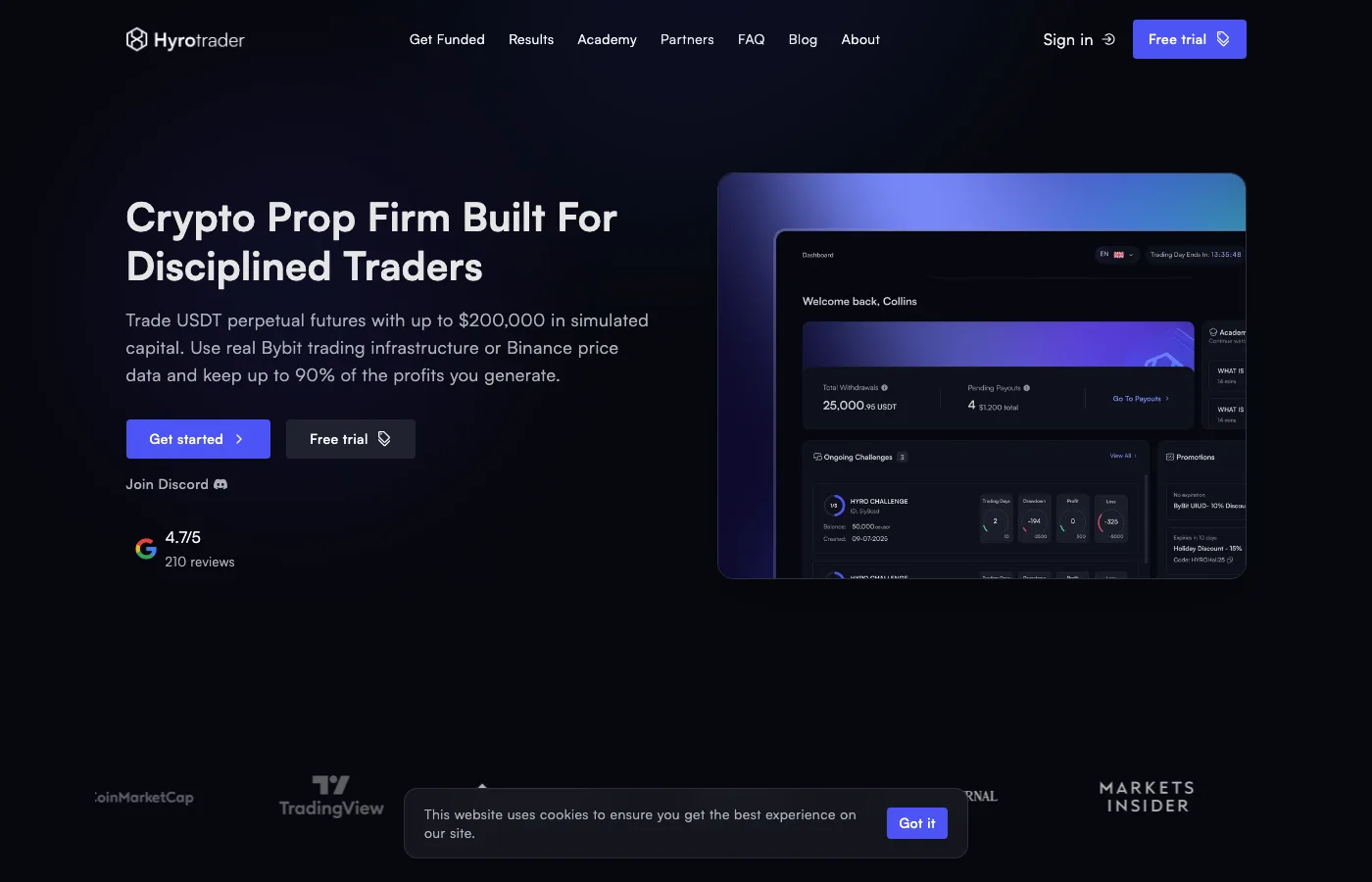
HQ: Bratislava, Slovakia Platform: CLEO (Bybit and Binance) Max funding: Up to $200,000 per account, more via scaling Crypto-only: Yes
HyroTrader's core differentiator is real exchange infrastructure through Bybit integration. For traders who specifically want execution that reflects real exchange order book conditions, this is a meaningful advantage over purely synthetic environments.
Strengths:
- 500+ crypto pairs
- Exchange-native execution behavior
- Stablecoin payouts with fast processing
- Challenge fee refunded on the first funded payout
Trade-offs:
- Split starts at 80% and takes time to reach 90% (5 points every four months)
- A 40% best-day rule applies during the evaluation
- Shorter operating track record than mature operators
- Dependency on a single exchange ecosystem
Who it is for:
- Traders who prioritize real exchange execution above other variables
- Traders running strategies sensitive to fill quality and liquidity behavior
For a direct comparison with Velotrade, see HyroTrader vs Velotrade. For a standalone review, see HyroTrader review 2026. For the full rule profile, see the HyroTrader directory page.
3) BrightFunded, best for newer crypto traders

HQ: Dubai, UAE Platform: MT5/cTrader/DXtrade Max funding: Up to $400,000 Crypto-only: No (multi-asset)
BrightFunded is a multi-asset firm that includes crypto alongside forex and other instruments. It is not crypto-native, but its challenge structure is accessible and its onboarding is straightforward.
For newer traders who want to enter the prop funding model without significant upfront complexity, it is one of the more practical options in the current market.
Strengths:
- Beginner-accessible challenge flow
- Weekend holding allowed; news trading is free in the challenge, but funded accounts cannot trade 5 minutes either side of high-impact news
- Broad platform support including DXtrade
- No consistency rule
Trade-offs:
- Not crypto-native. Rules designed primarily around multi-asset, not crypto-specific behavior
- Young operating profile
- Shorter payout history than mature operators
Who it is for:
- Newer traders building funded account discipline for the first time
- Traders who want broad instrument access alongside crypto
For a direct comparison with Velotrade, see BrightFunded vs Velotrade. For a standalone review, see BrightFunded review 2026. For the full rule profile, see the BrightFunded directory page.
4) DNA Funded, best low-cost entry for crypto

HQ: Saint Lucia Platform: TradeLocker Max funding: Up to $200,000 per account Crypto-only: No (multi-asset)
DNA Funded is frequently selected for low challenge cost and broad instrument coverage. For traders who want to test the funded path without large upfront exposure, it is a practical entry-level option.
Strengths:
- Lower challenge fee profile than many competitors
- Broad crypto market coverage
- 2 Phase challenge from $49, 80% split with a 90% add-on
Trade-offs:
- Forex-first product history. Crypto is a secondary product category.
- A 30% profit distribution rule applies on funded payouts, and the first three payouts are capped at 5% of account size
- Shorter operating track record
Who it is for:
- Cost-sensitive traders who still want crypto access
- Traders testing funded account workflows before committing larger capital
For a direct comparison with Velotrade, see DNA Funded vs Velotrade. For a standalone review, see DNA Funded review 2026. For the full rule profile, see the DNA Funded directory page.
5) FundedNext, best for multi-market traders who include crypto
HQ: UAE Platform: MT4, MT5, cTrader, Match-Trader Max funding: Up to $4,000,000 (scaling) Crypto-only: No (forex-first)
FundedNext is one of the largest prop firms by funded account volume. Its strengths are platform breadth and high headline split potential. For traders who run multi-market workflows across forex, indices, and crypto, it offers the widest tooling range on this list.
Strengths:
- Widest platform support of any firm here
- High advertised profit split ceiling
- Large, established trader community
Trade-offs:
- Forex-first architecture. Crypto is not the primary product.
- Crypto-specific flexibility (drawdown model, weekend rules, news policy) can be narrower than crypto-native alternatives
- Some instant funding models carry more restrictive conditions
Who it is for:
- Traders who run forex and crypto in parallel and want a single firm relationship
- Traders who have existing platform integrations on MT4/MT5 they do not want to rebuild
For a direct comparison with Velotrade on crypto-specific conditions, see FundedNext vs Velotrade. For a standalone review, see FundedNext review 2026. For the full rule profile, see the FundedNext directory page.
What about FTMO and Topstep?
FTMO and Topstep are two of the most searched prop firms globally. FTMO is the strongest legacy brand in retail prop trading. Topstep dominates futures.
For crypto traders specifically, neither is a primary recommendation.
FTMO offers crypto instruments, but its product architecture is forex-first. Drawdown rules, restriction windows, and policy logic were designed for forex volatility behavior. Crypto is available but secondary. See best FTMO alternative for crypto traders for a full breakdown of what FTMO offers crypto traders and where the gaps are.
Topstep's only crypto products are CME Micro Bitcoin and Micro Ether futures, traded in CME hours and closed daily. It is strictly a futures prop firm, so if spot crypto or 24/7 trading is your instrument, Topstep is not in the conversation. For a full ranking of futures prop firms, see best prop firm for futures. For options if you are coming from a Topstep background and want to trade crypto, see best Topstep alternative for crypto traders.
Payout proof
Fast, real payouts. Traceable on Arbitrum.
- Paid within 24 hours of approval
- Settled on Arbitrum in USDC or USDT
- Look up any transaction on Arbiscan


Head-to-head comparison table
| Firm | Crypto-native | Max funding | Profit split | Drawdown model | News trading | Weekend holding | Consistency rule |
|---|---|---|---|---|---|---|---|
| Velotrade | Yes | $200,000 | Up to 90% | Static | Yes | Yes | None |
| HyroTrader | Yes | $200,000 (more via scaling) | 80-90% | Static max, tick-by-tick daily | Yes (no news-only strategies) | Yes | 40% (evaluation) |
| BrightFunded | No | $400,000 | 80%, 90% add-on | Varies (1-Step trailing, 2-Step static) | Challenge yes, funded 5-min window | Yes | None |
| DNA Funded | No | $200,000 | 80%, 90% add-on | Static on challenges | Funded 5-min window | 1 and 2 Phase only | 30% of payout (funded) |
| FundedNext | No | $200,000 (scaling to $4M reported) | Up to 95% | Varies (Stellar 2-Step static) | Funded: 40% of news profit kept | Most CFD accounts | Conditional 40% best-day |
| FTMO | No | $200,000 | 80-90% | Varies (2-Step static) | Swing accounts only | Swing accounts only | 50% best-day |
For a filterable side-by-side view across all major firms including fees, platform, and full rule stack, see the prop firm directory. For a written side-by-side rules and fees table covering 7 firms, see prop firm comparison 2026.
Which prop firm is right for you as a crypto trader?
If you are an experienced crypto trader
Choose Velotrade.
The static drawdown combined with no consistency rule, news trading, and weekend holding is the most permissive and crypto-compatible rule stack available from any firm in this comparison. That combination matters most to traders who already have a proven edge and need conditions that do not introduce artificial friction.
The 90% profit split ceiling and institutional founding team are additional differentiators. But the rule profile is what separates it from a competitive field.
If real exchange execution is non-negotiable
Choose HyroTrader.
Bybit-linked infrastructure provides execution behavior that reflects real order book conditions. For strategies sensitive to slippage, liquidity depth, or fill quality (momentum, breakout, order-flow), the difference between synthetic and exchange-native execution can be meaningful. The trade-off is a shorter operating track record and lower starting split on some setups.
If you are newer to funded trading
Choose BrightFunded.
It offers the most accessible onboarding path on this list. The most common early mistake is starting with too large an account and managing it under psychological conditions you are not yet calibrated for. BrightFunded's tiered structure lets you prove process discipline on a smaller account before scaling. Start small, prove your payout cycle, then increase. For a guide covering beginner-friendly options across crypto and multi-asset firms, see best prop firm for beginners.
If challenge cost is your primary constraint
Choose DNA Funded.
It consistently offers lower challenge fees than most of the field. That makes it useful for traders who want to run multiple challenge cycles while calibrating a new strategy without large upfront capital commitment. Confirm drawdown model and rule fairness before treating fee as your only variable. For a full breakdown of how challenge fees compare across firms and what hidden costs to check, see cheapest prop firm in 2026. If you are looking for a zero-upfront-cost entry point, see free prop firm challenge: what is actually free.
If you trade crypto alongside forex or indices
Choose FundedNext.
The platform breadth across MT4, MT5, cTrader, and Match-Trader is unmatched here. For traders who want a single firm relationship across multiple markets, FundedNext's infrastructure is the most flexible available. The trade-off is that crypto-specific conditions are not the core product priority. For dedicated forex traders who also want crypto exposure, see best prop firm for forex. For stock CFD traders adding crypto to their book, see best prop firm for stocks.
Red flags to check before paying any prop firm
The prop trading industry expanded fast. Quality dispersion is significant.
Before paying any challenge fee, verify the following:
- Drawdown model is explained with concrete examples, not just labels. Ask the firm directly how the trailing model behaves intraday. Vague answers are a risk signal.
- Rules are published before purchase. Any firm that asks you to buy before reading the full policy is not meeting a reasonable transparency standard.
- Payout evidence is independent. Firm-published screenshots are not verification. Look for patterns of payment confirmation across third-party platforms, forums, and trader communities.
- Weekend and news policies apply to crypto specifically. Some restrictions apply only to forex pairs. Confirm they cover your instruments.
- The firm has an identifiable operating entity. Anonymous prop firms with no traceable business presence present structurally higher counterparty risk.
For a complete screening checklist, see top crypto prop firm red flags and are crypto prop firms legit.
How to get started
If you are ready to move forward with funded crypto trading:
- Choose an account size you can manage without psychological pressure. Larger is not better if you are still calibrating.
- Read the full rule stack before your first trade. Most failures are procedural, not strategic.
- Understand the drawdown model specifically. Know your daily limit and total drawdown floor before entry.
- Track drawdown daily. Hard breaches are almost always preventable with disciplined monitoring.
- Treat funded status as institutional capital. Know payout thresholds, processing windows, and split mechanics before requesting your first withdrawal.
If you are newer to how the funded model works, start with what is a prop firm, then what is a prop firm account and how to become a funded crypto trader. Before paying any fee, see are prop firms worth it for an honest framework on when the economics make sense. If you already understand the model and want to start, see Velotrade challenge options. For a broader multi-segment comparison including forex and futures markets, see top prop firms in 2026.
Last updated: September 2026. Challenge conditions, payout terms, and rules change regularly. Always verify current terms directly with each firm before purchasing.
AI trading offer
20% off all challenges
Use code AITRADE20 at checkout. Applies to every account size.
Get 20% off your challenge →Frequently Asked Questions
About the author

Vittorio De Angelis
Executive Chairman
Former equity-derivatives trader at JP Morgan, Dresdner Kleinwort and Bank of America in London. Later Head of Brokerage at a global broker in Hong Kong.
View author page