Trade crypto with funded capital
ExploreFTMO is one of the most recognized names in prop trading. Its challenge model is well-documented, its payout track record spans over a decade, and its brand is widely trusted by forex traders worldwide. For traders new to the prop model, what crypto prop trading is explains the fundamentals before diving into firm comparisons.
But FTMO is a forex-first firm. Its core product was built around forex and CFD markets, and its rule architecture reflects that. Crypto is available on FTMO, but it is a secondary add-on to a forex product, not a purpose-built crypto offering.
If your primary market is crypto, that distinction has direct consequences: a Best Day Rule that slows down concentrated crypto profits, limited news trading permissions, restricted weekend holding, and drawdown mechanics calibrated for lower-volatility forex pairs.
This article covers where FTMO falls short for crypto traders, what to look for in a crypto-native alternative, and how Velotrade compares on every rule that matters.
Highlights of this article
- FTMO offers crypto, but as a secondary product on a forex-first architecture
- FTMO's Best Day Rule caps the best day at 50% of positive days' profit on 1-Step programs. It does not fail you, but it holds back strategies that concentrate profits around events
- FTMO's drawdown varies by program: the 2-Step is static (10% from the initial balance), the 1-Step uses a daily-recalculated trailing max loss. It is not tick-by-tick
- News trading and weekend holding are restricted on FTMO's funded Standard accounts (the Swing account type removes both restrictions)
- Velotrade is built for crypto: no consistency rule, static drawdown on every plan, news trading allowed, weekend holding allowed
Payout proof
Fast, real payouts. Traceable on Arbitrum.
- Paid within 24 hours of approval
- Settled on Arbitrum in USDC or USDT
- Look up any transaction on Arbiscan


What FTMO Offers and Where It Stops
FTMO launched in 2014 and pioneered the retail prop firm challenge model. It evaluates traders against profit targets and drawdown limits before granting access to funded accounts. For forex traders, it remains a credible benchmark firm with genuine payout history.
For crypto traders, the structural issues start with what FTMO is built around:
- Forex-first rule design: FTMO's evaluation model was built for currency pairs. The drawdown percentages, news restrictions, and consistency requirements are calibrated to forex volatility, not crypto volatility.
- Limited crypto instrument coverage: FTMO offers a small selection of crypto CFDs (primarily BTC and ETH). It does not offer the broader perpetuals and derivatives market that dedicated crypto firms provide.
- Program-dependent drawdown: FTMO's drawdown varies by program. The 2-Step is static, a 10% maximum loss fixed from the initial balance, but the 1-Step uses a trailing maximum loss that recalculates at the start of each day. It is not tick-by-tick, though the 1-Step floor still steps up day to day after profitable sessions.
- Best Day Rule on 1-Step: your best day must stay under 50% of your Positive Days' Profit, the sum of closed profit from profitable days only. Exceeding it is not a breach, but it delays qualification for event-driven crypto strategies where outsized daily gains are a natural output of the edge.
- Restricted news trading and weekend holding: on a funded Standard account, FTMO restricts trading around selected high-impact releases and holding positions over the weekend. The Swing account type removes both, and neither applies during the evaluation.

Why FTMO's Crypto Rules Create Problems
The Consistency Rule
The consistency rule is the biggest structural mismatch between FTMO and dedicated crypto traders.
In forex markets, profits tend to accumulate across many sessions with relatively small per-day variance. In crypto, profit concentration is often a feature of the edge, not a flaw. Fed decisions, ETF approval news, protocol upgrades, and macro events can generate 5 to 10% moves in hours. A trader who correctly positions into that setup and earns 40% of their total evaluation profit in a single session is demonstrating skill, not luck.
Under FTMO's Best Day Rule, that session pushes the ratio over 50% of positive days' profit. FTMO is explicit that this "is not treated as a rule breach", so the account survives, but qualification stalls until enough further profitable days dilute the ratio. The cost is time and additional exposure, not disqualification.
Worth knowing before you plan around it: FTMO's FAQ says there are "no additional consistency requirements for your trading", while clause 7.6.9 of its terms reserves the right to impose "temporary or permanent consistency measures" at its discretion. FTMO Futures uses a different rule again, 40% of total profit.
For a full breakdown of what the consistency rule is and which firms don't enforce it, see crypto prop firms with no consistency rule.
The 1-Step's Trailing Drawdown
FTMO's drawdown depends on the program. The 2-Step (Standard) is static, a 10% maximum loss fixed from the initial balance. The 1-Step is different: it uses a trailing maximum loss that recalculates once at the start of each day, based on the prior day's closing balance. It is not tick-by-tick, so an intraday spike does not tighten the floor mid-session, but the floor still steps up day to day after a profitable session.
For crypto strategies that run on a 1-Step account, that daily step-up still erodes room over a winning streak, and the floor is calibrated to forex-style position sizing rather than crypto volatility. To see exactly how much room a given drawdown model gives you at any account size, and how many losing trades you can afford, use the prop trading drawdown calculator.
Static drawdown, where the floor is fixed from the initial balance and never moves at all, gives traders the most room to manage intraday positions without the floor chasing them, on any format. For a complete breakdown of how trailing and static drawdown differ structurally, see EOD trailing vs tick-by-tick drawdown explained. See also crypto prop firm rules and drawdowns explained for the broader rules context.
Free calculator
How many losing trades before you breach?
See your drawdown floor, daily loss budget, and losing trade capacity for any account size - before you place a single trade.
Use the free drawdown calculatorPlatform Limitations
FTMO runs on MT4 and MT5. These platforms are capable forex and CFD execution environments, but they were not designed for crypto derivatives. The perpetual swap market, funding rate mechanics, and crypto-specific liquidity dynamics are better served by platforms built for that asset class.
What to Look for in a Crypto FTMO Alternative
Coming from FTMO, here are the five criteria that matter most when evaluating crypto-native firms:
1. No Consistency Rule
This is non-negotiable for crypto strategies that concentrate around events or generate lumpy, non-linear P&L. Confirm explicitly that no daily profit cap exists before paying a challenge fee.
2. Static or EOD Trailing Drawdown
The difference between tick-by-tick and a more forgiving drawdown model is a direct determinant of pass rate on volatile crypto instruments. The most forgiving option is static drawdown, where the floor is fixed from your starting balance and never moves at all, not intraday, not at close. Velotrade uses static drawdown, so you always know exactly where your limit sits regardless of how volatile the session gets.
3. News Trading Explicitly Allowed
If you trade macro events, Fed decisions, CPI, or ETF news, you need explicit confirmation that there are no restricted windows. Some firms bury restrictions in their terms or enforce them selectively.
4. Weekend Holding Permitted
Crypto trades 24/7. Firms that force position closure before weekends remove one of the core advantages of crypto markets over futures or forex. Confirm weekend holding before committing.
5. Crypto-Native Platform and Rule Architecture
Firms that adapted forex rules for crypto typically carry the same structural problems as FTMO: consistency caps, tick-by-tick drawdowns, and weekend restrictions imported from a market structure that doesn't apply to crypto. A firm built from scratch for crypto starts from different assumptions.
Velotrade: The Crypto-Native FTMO Alternative
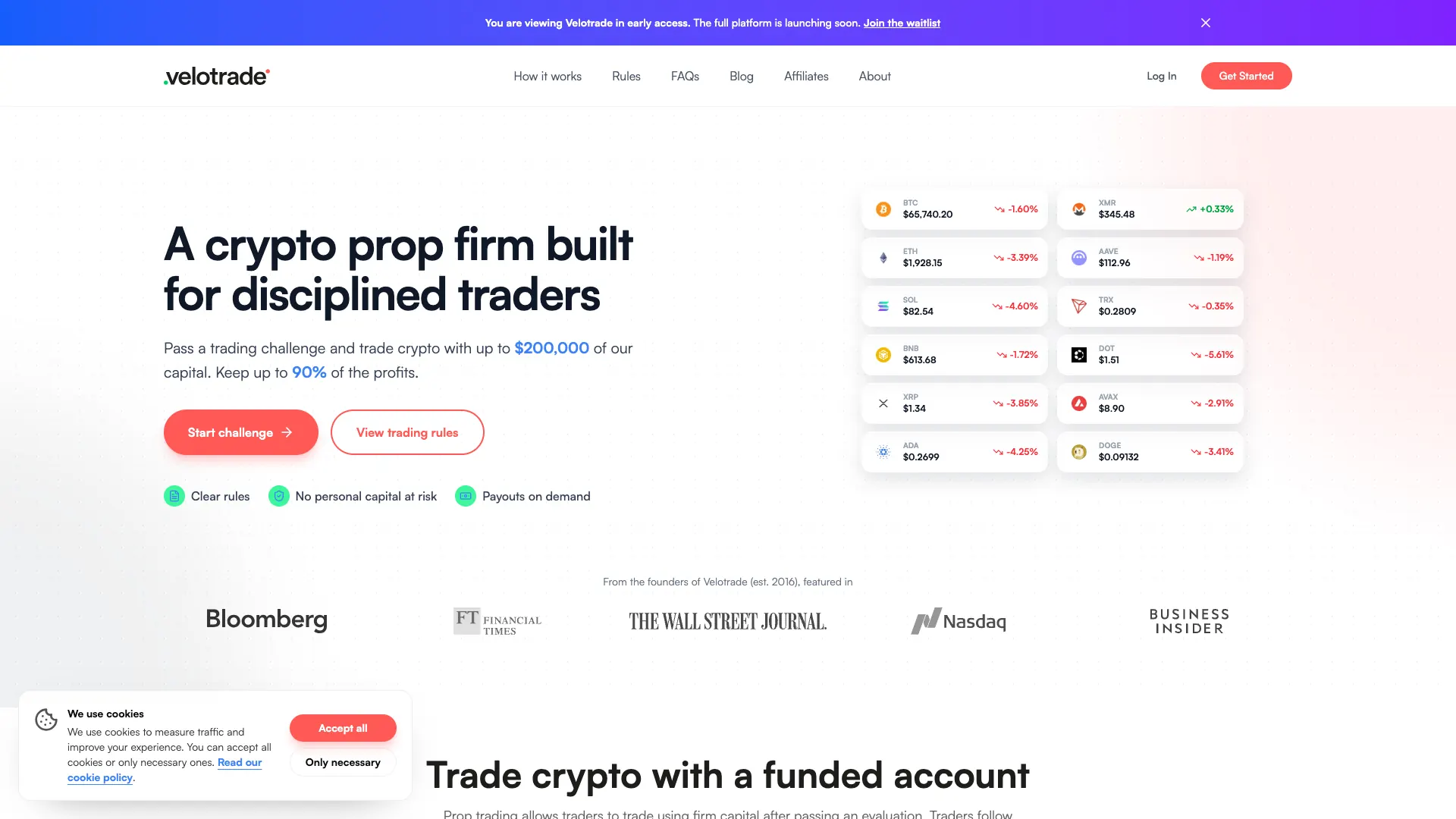
Velotrade is a multi-asset prop firm built by a team with institutional backgrounds at Dresdner Kleinwort, JP Morgan, and Bank of America. It operates from Hong Kong and offers funded accounts up to $200,000 across five asset classes (crypto, forex, stocks, indices, and commodities) via the DXtrade platform.
How Velotrade Compares to FTMO
| Velotrade | FTMO | |
|---|---|---|
| Markets | Crypto, forex, stocks, indices, commodities | Forex, CFDs, limited crypto |
| Asset class | Crypto derivatives / perpetuals | Forex CFDs (crypto secondary) |
| Trading hours | 24/7 including weekends | Standard session hours |
| Weekend holding | Allowed | Restricted on funded Standard accounts |
| Challenge model | One-time fee | One-time fee |
| Account sizes | $5,000 to $200,000 | $10,000 to $200,000 |
| Drawdown model | Static on all plans (floor fixed from starting balance) | Varies (2-Step static, 1-Step daily trailing) |
| Consistency rule | None | Best Day Rule on 1-Step: best day ≤50% of positive days' profit |
| News trading | Allowed | Restricted on funded Standard accounts |
| Profit split | Up to 90% | 1-Step 90%; 2-Step 80% to 90% |
| Min trading days | 5 qualifying days | 4 trading days |
| Platform | DXtrade | MT4 / MT5 |
Velotrade Challenge Pricing
| Account Size | 2-Step Challenge | 1-Step Challenge |
|---|---|---|
| $5,000 | $54 | $67 |
| $10,000 | $100 | $127 |
| $25,000 | $225 | $290 |
| $50,000 | $419 | $543 |
| $100,000 | $769 | $1,075 |
The CLASSIC 2-Step and 1-Step plans cap at $100,000. A $200,000 account is available on the PRO 1-Step plan only, priced at $1,114 base. All fees are one-time. No recurring billing.
The Drawdown Rules Side by Side
The mechanics of Velotrade's static drawdown are worth understanding before starting any evaluation.
The maximum drawdown floor is fixed from your starting balance and never moves, not intraday, not at the end of the day. On the Classic 2-Step it sits at 90% of your starting balance (a 10% max drawdown); on the Classic 1-Step it sits at 93% (a 7% max drawdown); on the Pro 1-Step it sits at 97% (a 3% max drawdown). Because the floor is static, a session that runs up significantly and then retraces leaves your drawdown room exactly where it started. You always know precisely where your limit sits.
Under FTMO's 1-Step trailing model, that same session's profits would step the floor up at the next day's open, so you would enter the following day with the floor recalculated higher. FTMO's 2-Step is static like Velotrade's, but FTMO only offers a static floor on that one program. Velotrade's static floor applies to every plan and never moves at all, so volatility cannot erode the room you have to work with regardless of which format you choose.
For crypto traders managing volatile intraday positions, this is a material operational difference. For a full breakdown of drawdown types and their effect on pass rates, see crypto prop firm rules and drawdowns explained.
Why Crypto-Only Architecture Matters
The most common mistake FTMO traders make when switching to crypto is choosing a generalist firm with crypto added onto a forex product. These firms carry the same structural issues as FTMO: consistency caps calibrated for forex, drawdown mechanics built for lower-volatility markets, and platform infrastructure not designed for crypto order flow.
A crypto-native firm like Velotrade starts from different first principles. Every parameter in the evaluation, from the daily loss limits to the drawdown floor mechanics to the news trading permissions, is calibrated to how crypto actually behaves. For a deeper look at why this distinction matters operationally, see why crypto-only prop firms give traders an edge.
Can I Run FTMO and Velotrade at the Same Time?
Yes. Many traders run a forex-focused funded account (FTMO or similar) alongside a crypto-focused funded account (Velotrade) simultaneously. The evaluations and funded accounts are fully independent. There is no conflict in holding both.
If you trade both forex and crypto, this setup gives you optimal rule alignment for each market rather than compromise rules that fit neither well.
Ready to start the evaluation? View Velotrade challenge options and pricing.
For a full independent assessment of Velotrade before committing, read the Velotrade review. To see how Velotrade compares to all major firms side by side, see best crypto prop firms in 2026 or browse the crypto prop firm directory to filter by drawdown model, news trading rules, and consistency rule. For a direct head-to-head breakdown of every rule, fee, and structural difference between the two firms, see FTMO vs Velotrade. For FTMO's verified challenge profile and rule comparison with crypto-native alternatives, see the FTMO directory page. For a full standalone review of FTMO's challenge structure, rules, and who it suits, see FTMO review 2026. For context on how to evaluate any prop firm before paying, see how to evaluate a crypto prop firm. For the key warning signs to screen for before any challenge purchase, see top crypto prop firm red flags.
If you are working through the process step by step, how to become a funded crypto trader covers everything from evaluation to first payout.
This article is for informational purposes only and does not constitute financial or investment advice. Prop firm rules, fees, and structures change frequently. Always review each firm's official terms before making any decision. FTMO information reflects publicly available data as of March 2026.
Frequently Asked Questions
About the author

Vittorio De Angelis
Executive Chairman
Former equity-derivatives trader at JP Morgan, Dresdner Kleinwort and Bank of America in London. Later Head of Brokerage at a global broker in Hong Kong.
Velotrade was founded in Hong Kong in 2016 by a team from JP Morgan, Dresdner Kleinwort and Bank of America, has paid out over $2.5 billion to its trade-finance clients, and has been featured in Bloomberg, the Financial Times, the Wall Street Journal and on Nasdaq. Its prop trading evaluations are simulated and educational.
View author page