
Considering FTMO? See how Velotrade compares
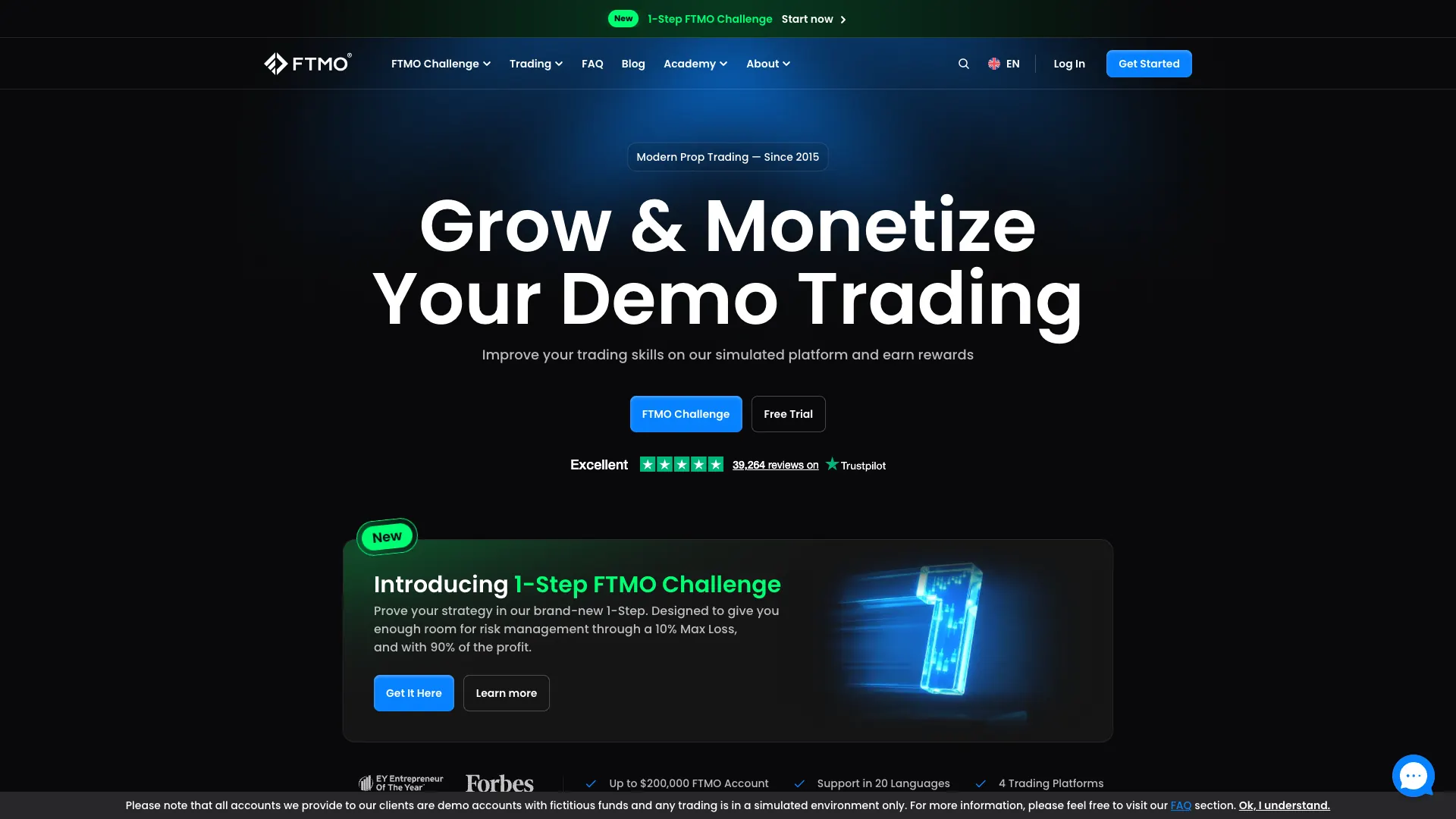
ExploreFTMO is the firm that made retail prop trading mainstream. Founded in 2014 in the Czech Republic, it was the first prop firm to package a challenge-based evaluation into a broadly accessible retail product. Over a decade later, it still carries the strongest brand recognition in the space and one of the longest payout track records among funded trading firms.
This review covers what FTMO offers in 2026, where its rule architecture works well, and where it creates friction for crypto traders specifically. If you are deciding whether FTMO is the right fit for your strategy, this covers the challenge structure, drawdown model, consistency rule, platform, and profit split in full.
FTMO at a glance (verified October 2026)
| Official site | ftmo.com |
| Price from | EUR 79 (1-Step $10K); EUR 89 (2-Step $10K) |
| Profit split | 1-Step 90%; 2-Step 80%, rising to 90% via scaling or Premium |
| Drawdown | 2-Step: static 10% max loss; 1-Step: EOD trailing |
| Payouts | First reward on day 14 after your first trade, then on request |
| Trustpilot | 4.8 from 54,333 reviews (as of Oct 12, 2026) |
| Platforms | MT4, MT5, cTrader, TradingView |
| Markets | Forex, indices, commodities, crypto, stocks (CFDs) |
Highlights of this article
- FTMO's drawdown varies by program: the 2-Step uses a static 10% max loss fixed from the initial balance, the 1-Step uses a daily-recalculated trailing max loss. It is not tick-by-tick
- FTMO's consistency mechanic is the Best Day Rule: your best day must not exceed 50% of your Positive Days' Profit, on the 1-Step programs. Breaching it does not fail the evaluation, it stalls it
- News trading and weekend holding are restricted for some instruments and positions
- Platform support covers MT4, MT5, cTrader, and TradingView; no DXtrade access
- Profit split reaches up to 90% with a scaling plan available
- FTMO is the strongest fit for forex traders, its architecture creates structural friction for dedicated crypto strategies


What FTMO Is
FTMO is a multi-asset prop firm offering funded trading accounts across forex, crypto, indices, commodities, and stocks. The core evaluation model is a 2-step challenge (a 1-Step is also offered): traders must hit a profit target in Phase 1, hit a lower target in Phase 2, and then gain access to a funded FTMO account.
FTMO does not simply license capital. It uses a proprietary fund structure where traders receive a funded account and retain a share of the profits generated on it. Account sizes range from $10,000 to $200,000. Scaling is available for traders who demonstrate consistent performance on funded accounts.
The firm has operated continuously since 2014 and has built one of the most extensive independent payout track records in the prop firm space. For a framework to evaluate any prop firm before committing, see how to evaluate a crypto prop firm.
Challenge Structure
FTMO's main format is a 2-step evaluation (a 1-Step is also offered). You purchase a challenge, pass Phase 1, pass Phase 2, and receive a funded account.
Account sizes: $10,000, $25,000, $50,000, $100,000, $200,000
| Parameter | FTMO | Notes |
|---|---|---|
| Challenge type | 2-Step and 1-Step | 1-Step: 10% target, 3% daily loss, 10% max loss |
| Phase 1 profit target | 10% | No time limit |
| Phase 2 profit target | 5% | No time limit |
| Max drawdown | 10% | Static from initial balance on 2-Step; 1-Step trails daily. Not tick-by-tick (see below) |
| Daily loss limit | 5% | On account equity |
| Min trading days | 4 | Must trade on at least 4 calendar days |
| Consistency rule | Yes, on 1-Step | Best Day Rule: best day ≤50% of Positive Days' Profit. Not a breach |
| News trading | Restricted on funded Standard accounts | Free during the evaluation and on Swing accounts |
| Weekend holding | Restricted on funded Standard accounts | Allowed during the evaluation and on Swing accounts |
| Platforms | MT4, MT5, cTrader, TradingView | No DXtrade |
| Profit split | Up to 90% | 1-Step: 90%. 2-Step: 80%, rising to 90% via the Scaling Plan or Premium |
| Fee refund | 2-Step only | 2-Step fee refunded with the first reward; 1-Step fee not refunded |
| Scaling plan | Yes | Available after consistent funded performance |
Drawdown: Varies by Program
FTMO's drawdown model depends on the program. The 2-Step (Standard) challenge uses a static 10% maximum loss fixed from your initial balance. The 1-Step challenge uses a trailing maximum loss that recalculates once at the start of each day, based on the prior day's closing balance, not on intraday equity peaks. FTMO is not tick-by-tick: the floor never moves in real time on an intraday high.
On the 2-Step, the static floor means an unrealised gain that later retraces has no effect on your loss room. On the 1-Step, the floor can step up after a profitable day, but it is fixed for the duration of that trading day, so an intraday spike does not tighten it mid-session.
The distinction that still matters for crypto traders is coverage. FTMO only offers a static floor on the 2-Step, and its 1-Step still trails day to day. Velotrade uses static drawdown across every plan. The floor is fixed from your starting balance and never moves at all, on any format. It sits at 90% of your starting balance on the Classic 2-Step (10% max drawdown), 93% on the Classic 1-Step (7% max drawdown), and 97% on the Pro 1-Step (3% max drawdown), and it never trails.
For a complete breakdown of how trailing and static models differ and what they mean for challenge pass rates, read EOD trailing vs tick-by-tick drawdown explained. To calculate your exact drawdown floor on any account configuration, use the prop trading drawdown calculator.
The Best Day Rule: Softer Than It Sounds, Still a Constraint
FTMO's consistency mechanic is called the Best Day Rule, and it is widely misreported. Your single best trading day must not exceed 50% of your Positive Days' Profit, which FTMO defines as the sum of closed profits and losses from your profitable trading days only. It applies to the FTMO Challenge 1-Step and the FTMO Account 1-Step.
Two details matter and are usually lost. The denominator is positive days' profit, not total profit and not the profit target, so the figure moves as your losing days are excluded from it. And exceeding the limit does not fail the evaluation. FTMO states plainly that it "is not treated as a rule breach"; you keep trading, and the ratio dilutes as you add profitable days.
That makes it less dangerous than a hard cap and more of a tax on time. For forex strategies that accumulate gradually across many sessions, it is rarely triggered. For crypto strategies built around events, announcements, or concentrated volatility windows, it bites.
In crypto markets, a significant portion of directional moves are concentrated into short windows. ETF decisions, Fed announcements, protocol upgrades, and large liquidation cascades generate outsized single-session returns. A trader who positions correctly into that event and books most of their profit in one session is not overtrading, they are expressing an edge. FTMO will not disqualify them for it, but it will hold them in place until they produce enough further profitable days to bring the ratio down.
One inconsistency is worth knowing before you rely on any of this. FTMO's FAQ states that "provided you maintain sustainable risk management practices, there are no additional consistency requirements for your trading," while clause 7.6.9 of its terms reserves the right to introduce "temporary or permanent consistency measures" at its own discretion. FTMO Futures uses a different rule again, capping the best day at 40% of total profit.
For a full explanation of why the consistency rule is one of the most consequential hidden costs in the funded trading model, see crypto prop firms with no consistency rule. Velotrade has no consistency rule at any stage.
News Trading and Weekend Holding
FTMO's news and weekend restrictions depend on the account type, not the instrument. On a Standard account, trading around selected high-impact news releases is restricted and positions cannot be held overnight or over the weekend, but only once you are on a funded FTMO Account; neither restriction applies during the evaluation. The Swing account type has no news or weekend restrictions at any stage, and the 1-Step allows free news trading during its evaluation.
For crypto traders who hold positions across Saturday and Sunday on a 24/7 market, that means choosing the Swing account type, or accepting a closure requirement on a funded Standard account.
Both restrictions reflect FTMO's forex-first architecture. Crypto markets do not observe economic calendars or trading hours in the same way forex does. A prop firm that imports those restrictions into a crypto product is applying structural assumptions that do not match the underlying market.


Platform: MT4, MT5, cTrader, and TradingView
FTMO supports 4 trading platforms: MT4, MT5, cTrader, and TradingView. If you already run a tested MT5 setup including custom indicators, EAs, and risk management scripts, FTMO lets you bring that environment directly without rebuilding.
For traders coming from the DXtrade ecosystem, FTMO requires a platform transition. MT4 and MT5 are capable execution environments for forex and CFD markets, but they were not purpose-built for crypto. The perpetual swap structure, funding rate mechanics, and crypto-specific order flow dynamics are better served by platforms designed around those asset classes.
Profit Split and Scaling
On the 2-Step, FTMO's profit split starts at 80% and scales to 90% through the FTMO Scaling Plan or Premium. The 1-Step pays 90% from the start. The first reward is available on day 14 after your first trade, then on request.
The scaling plan is a defined path, not an arbitrary ramp-up. Traders who hit a 10% profit across at least 3 months, with no losing month, qualify to have their capital increased under the scaling program. This is a real capital growth mechanism for traders who can demonstrate sustained consistency.
On the 2-Step, the starting 80% split means FTMO keeps 20% of profits until the scaling conditions are met. For a funded account generating $5,000 per month, the difference between 80% and 90% is $500 per month, or $6,000 per year.
Velotrade offers up to 90% from the first payout (80% base, 90% with the add-on) with no ramp-up or scaling period. For traders who want 90% from the first payout on a 2-step format, that is a meaningful structural difference.
FTMO vs Velotrade: Head-to-Head
| FTMO | Velotrade | |
|---|---|---|
| Founded | 2014 | 2026 (crypto prop launch) |
| HQ | Czech Republic | Hong Kong |
| Markets | Forex, indices, commodities, crypto, stocks (CFDs) | Crypto, forex, stocks, indices, commodities |
| Account sizes | $10K to $200K | $5K to $200K |
| Challenge types | 1-Step, 2-Step | 1-Step, 2-Step |
| Drawdown type | Varies (2-Step static, 1-Step daily trailing) | Static on all plans |
| Max drawdown | 10% | 10% (2-Step), 7% (1-Step), 3% (PRO 1-Step) |
| Daily loss limit | 5% | 5% (2-Step), 4% (1-Step), 3% (PRO 1-Step) |
| Consistency rule | Yes, on 1-Step (best day ≤50% of positive days' profit) | None |
| News trading | Restricted on funded Standard accounts | Allowed |
| Weekend holding | Restricted on funded Standard accounts | Allowed |
| Platforms | MT4, MT5, cTrader, TradingView | DXtrade only |
| Profit split | 1-Step 90%; 2-Step 80%, up to 90% (scaling or Premium) | 80% base, 90% with the add-on, from the first payout |
| Fee refund | 2-Step only | No |
| Scaling plan | Yes | No |
| Max funding | $200K | $200K |
| Track record | Since 2014 | Since 2026 |
The core trade-off is clear: FTMO has a decade of verified payout history and a defined scaling path to 90%. Velotrade is newer but is built from the ground up for crypto, and its edge is the full combination: static drawdown on every plan, no consistency rule, news trading and weekend holding allowed, multi-asset coverage, and full REST and WebSocket API access.
Who FTMO Suits
FTMO is a strong choice if:
- You trade forex as your primary market and crypto is secondary
- You already run a tested MT4 or MT5 setup and do not want to change platforms
- You want a firm with 10+ years of verified payout history and an established community
- A scaling plan toward higher capital allocation is part of your long-term strategy
- Your strategy accumulates gradual, consistent returns without large single-session spikes
FTMO is a harder fit if:
- You trade crypto exclusively and your strategy concentrates returns around events or volatility windows
- The Best Day Rule would realistically stall your evaluation, given how concentrated your typical session distribution is
- You need unrestricted weekend holding for positions held across Saturday and Sunday
- You want up to 90% profit split on a 2-step format from the first funded payout without a multi-month ramp-up
For dedicated crypto traders, Velotrade's crypto-native architecture removes the friction points that FTMO's forex-first rule design introduces. For traders who want the longest track record in the space and are running multi-market strategies on MT5, FTMO remains a credible and established choice.
For a broader market view, see best crypto prop firms in 2026, or the best forex prop firms if forex is your main market. For a direct head-to-head on every rule, fee, and structural difference, see FTMO vs Velotrade. For a broader alternatives guide, see FTMO alternative for crypto traders. For the FTMO rule profile alongside all major firms, see the FTMO directory page. For a step-by-step guide from evaluation to first payout, see how to become a funded crypto trader. If you are still comparing, see our ranking of the best prop firms, the best 1-step prop firms, and the best prop firms for UK traders.
Ready to start a Velotrade challenge? View challenge options and pricing
This article is for informational purposes only and does not constitute financial or investment advice. Prop firm rules, fees, and structures change frequently. Always review each firm's official terms and conditions before making any decisions. This review reflects publicly available information as of October 2026.
How FTMO compares
This review is published by Velotrade, so here is where the two differ, including where FTMO is stronger.
| Rule | FTMO | Velotrade |
|---|---|---|
| Drawdown model | Static on 2-Step, end-of-day trailing on 1-Step | Static on every plan, never trails |
| Consistency rule | 1-Step: best day capped at 50% of positive days | None at any stage |
| News and weekends | Restricted on funded Standard accounts | News trading and weekend holding allowed |
| Platforms | MT4, MT5, cTrader, TradingView | DXtrade |
Where FTMO is stronger
- 2-Step fee refunded with the first reward
- Track record since 2014, plus a defined scaling plan
Frequently Asked Questions
About the author

Vittorio De Angelis
Executive Chairman
Former equity-derivatives trader at JP Morgan, Dresdner Kleinwort and Bank of America in London. Later Head of Brokerage at a global broker in Hong Kong.
Velotrade was founded in Hong Kong in 2016 by a team from JP Morgan, Dresdner Kleinwort and Bank of America, has paid out over $2.5 billion to its trade-finance clients, and has been featured in Bloomberg, the Financial Times, the Wall Street Journal and on Nasdaq. Its prop trading evaluations are simulated and educational.
View author page