Trade crypto with funded capital
ExploreThe crypto prop firm industry has grown fast. Not every firm in it deserves your challenge fee. Some firms exist primarily to collect fees from traders who were never going to pass. Others run legitimate operations but have rule structures so skewed toward failure that the outcome is the same.
Knowing what to look for before you pay protects your capital and your time. These are the 5 most reliable red flags in crypto prop trading, what they look like in practice, and what a legitimate firm looks like in comparison.
Highlights of this article
- Rule structures are the single most reliable indicator of a firm's intentions toward traders
- Tick-by-tick trailing drawdown is one of the most dangerous rule designs in the industry
- Firms with no verifiable payout records should be treated as unverified until proven otherwise
- Anonymous ownership and offshore-only registration provide no recourse if something goes wrong
- Terms that change after enrollment are a structural red flag, not an administrative error
- Legitimate firms are transparent about rules, payouts, and ownership before you pay

Red Flag 1: No Verifiable Payout History
The clearest sign of a firm's legitimacy is whether it pays traders. The clearest sign it does not is when you cannot find independent verification of those payouts anywhere.
Many firms publish testimonials on their own website. A photo, a username, and a profit figure is not evidence. It costs nothing to fabricate and requires no verification. What matters is payout proof that exists outside the firm's own marketing channels, such as publicly verifiable on-chain payouts that anyone can confirm.
What to look for:
Look for independent trader forums, Reddit threads (r/PropFirm is the most active), Discord communities, and X posts from real accounts with posting history. Payout screenshots shared by traders with verifiable identities are meaningful. A wall of anonymous testimonials on the firm's homepage is not. The same test applies to paid crypto signals groups, where screenshots of winners are the standard sales tool.
Specifically check:
- How long has the firm been paying out? A firm with 6 months of documented payout history is different from one launched last quarter with no external records.
- Are there any complaints about delayed payouts or rejected requests? Some firms approve withdrawals on paper but create friction in practice.
- Does the firm's payout volume match the size of its marketing operation? A firm running aggressive affiliate campaigns but with minimal independent payout evidence is a mismatch worth investigating.
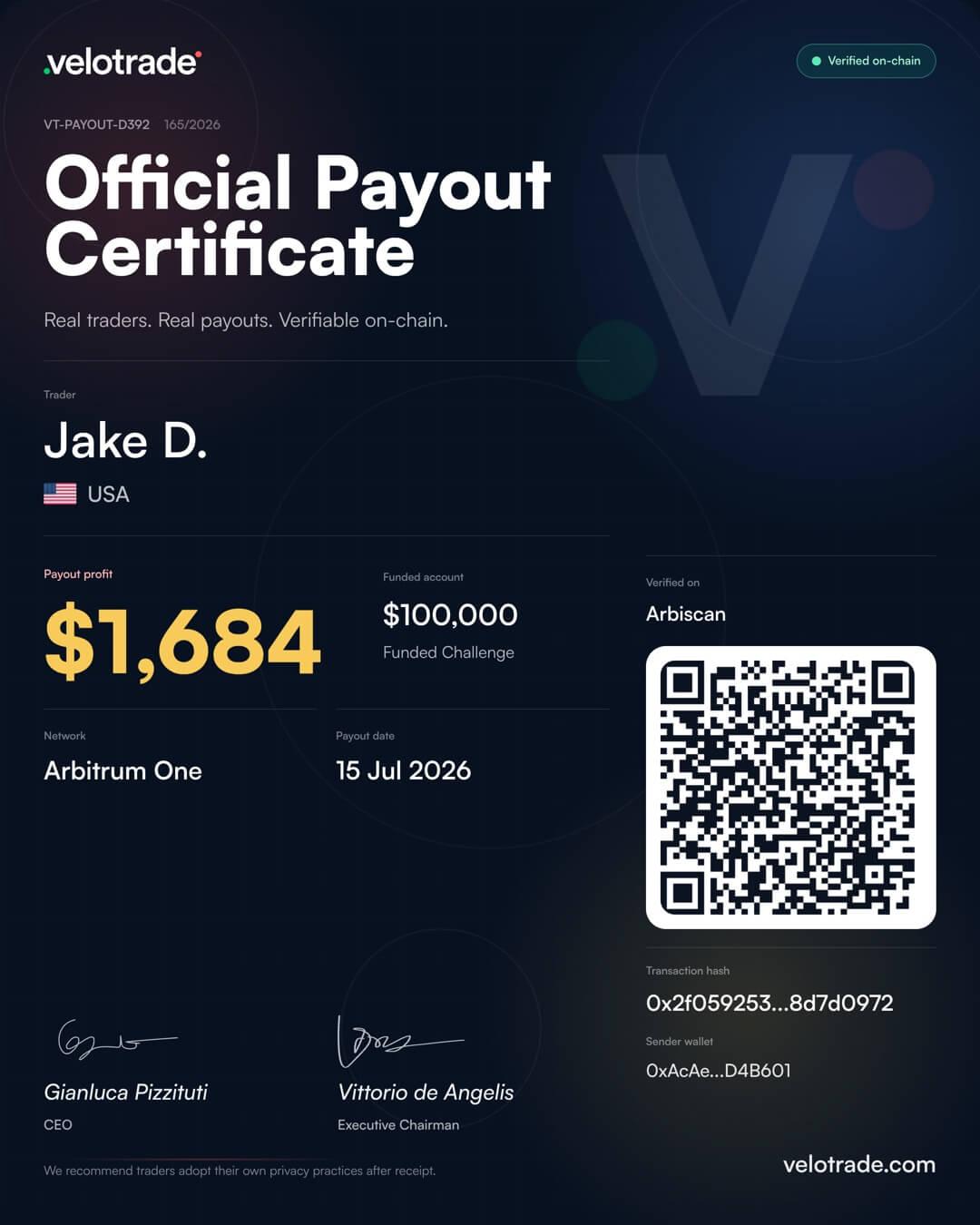
Velotrade launched its crypto prop trading operation in early 2026 and publishes payout records transparently. For a detailed breakdown of how the payout process works, see the Velotrade review. For a full comparison of payout speed, thresholds, and structures across major firms, see crypto prop firm payout speed: what traders need to check.

Red Flag 2: Rule Structures Designed to Fail You
Challenge rules exist for a stated reason: to identify consistent, risk-managed traders. Some rule structures serve that purpose. Others are designed, intentionally or otherwise, to maximize the number of traders who fail and repurchase.
The 2 most dangerous rule designs are tick-by-tick trailing drawdown and strict consistency rules.
Tick-by-tick trailing drawdown means your drawdown floor moves up in real time with every price tick. If your account equity rises intraday by $500 and then falls back to your opening balance, your drawdown floor has already moved up $500. You are now technically in violation even though you ended the day where you started.
In volatile crypto markets, intraday swings of 3-8% are routine. A tick-by-tick system means a single intraday spike, even one you did not trade through, can narrow your viable trading range to near zero. This is not a risk management tool. It is a mechanism that turns normal market conditions into account terminations.
EOD (end-of-day) trailing drawdown addresses this correctly. The floor only moves up at the close of each trading day, based on your highest equity at that point. Intraday spikes do not move the floor. For a full technical comparison, see EOD trailing vs tick-by-tick trailing drawdown explained.
Consistency rules require that no single trading day account for more than a fixed percentage of your total profit (often 30%). This sounds reasonable but creates a structural trap: if you have one strong day early in your challenge, every subsequent trading day must generate enough profit to dilute it. In practice, this forces traders into suboptimal trades to balance the distribution rather than trading their actual edge.
What to look for:
- Does the firm use tick-by-tick or EOD trailing drawdown? Ask before paying. If the answer is unclear or buried in a FAQ, treat it as a warning sign.
- Is there a consistency rule? If yes, understand exactly how it is calculated and what happens if you breach it.
- Are there minimum trading day requirements? Some firms require 5-10 trading days minimum, which forces traders to take marginal setups just to meet the threshold.
For a complete breakdown of how challenge rules are structured and what they actually measure, read crypto prop firm rules and drawdowns explained.
Red Flag 3: No Company Transparency
A legitimate business can tell you who runs it and where it is incorporated. If that information does not exist, you have no recourse if the firm stops paying, changes its rules, or shuts down.
Ownership anonymity is surprisingly common in the prop firm space. Some firms operate behind branded personas with no named founders or leadership team. This is not a regulatory requirement issue. It is a due diligence one. If the people running the firm are not willing to be identified, that asymmetry of accountability works entirely in their favor.
Offshore incorporation with no operational presence is a related concern. Many firms are registered in jurisdictions with minimal financial oversight. This is not inherently fraudulent, but it does mean traders have no regulatory body to complain to and no legal system that will move quickly if something goes wrong.
What to look for:
- Is there a named founding team with verifiable professional backgrounds?
- Is the firm incorporated in a jurisdiction with traceable company registration?
- Does the firm have a physical operational presence anywhere?
None of these factors alone disqualify a firm. But a combination of anonymous ownership, offshore-only registration, and no verifiable team should put you on high alert.
Red Flag 4: Terms That Change After You Enroll
One of the most common complaints in prop trading forums is firms changing their rules mid-challenge or post-challenge without clear notice. This takes several forms:
- Retroactive rule changes: Rules updated during an active challenge that the trader was not notified about and did not agree to
- Interpretation creep: Vague rule language that gets applied selectively when it benefits the firm
- Payout clause additions: New conditions added to payout eligibility that were not present when the trader enrolled (minimum trading days, mandatory evaluation windows, drawdown recalculation methodology changes)
What to look for:
Before paying, download or save a PDF of the firm's full terms of service, challenge rules, and payout policy. Check whether those terms include language that allows unilateral changes without trader consent. If they do, you are accepting terms that can be rewritten after the fact.
Also search forums for complaints specifically about rule changes. Traders who experienced this are usually vocal about it. A firm with a documented pattern of retroactive changes is one to avoid regardless of how attractive the challenge terms look on the landing page.

Red Flag 5: Fee Structures That Do Not Add Up
Challenge fees should reflect the cost of operating the evaluation and funding the trader's account when they pass. When fee structures make no business sense, something else is usually driving the revenue model.
Challenge fees that are too cheap (sub-$50 for a $100k account) are a warning sign, not a deal. If the firm cannot fund itself from challenge fees at a sustainable pass rate, it is either funded by an unrealistically high failure rate built into the rule structure, or it is not funding real accounts at all.
Stacking fees are another pattern to watch for: reset fees, inactivity fees, withdrawal processing fees, account maintenance fees. These structures generate revenue from traders who are already struggling, not from traders who are succeeding.
Profit splits that seem impossible (95-100%) with no explanation of how the firm generates margin deserve scrutiny. A 90% profit split is achievable for a well-run firm because the 10% retained per payout, combined with challenge fees and a realistic pass rate, sustains the model. A 99% split with a $30 challenge fee is not a business model. It is a headline.
What to look for:
- Does the fee structure make economic sense for a firm that is actually paying out funded traders?
- Are there hidden recurring fees in the terms you saved from Red Flag 4?
- What is the firm's documented pass rate? If they do not publish one, ask. A legitimate firm knows its pass rate.
What Legitimate Firms Look Like
A legitimate crypto prop firm does not require you to trust it blindly. It provides evidence before you pay.
| What to look for | Red flag | Green flag |
|---|---|---|
| Payout verification | Anonymous testimonials on their site only | Independent trader posts with verifiable accounts |
| Drawdown model | Tick-by-tick trailing (floor moves intraday) | EOD trailing (floor moves once per day at close) |
| Rule stability | Terms allow unilateral changes | Clear, versioned terms with documented update history |
| Company transparency | Anonymous founders, no company registration | Named team, verifiable incorporation |
| Fee model | Ultra-cheap + stacking fees | Transparent challenge fee, clear payout split math |
| Consistency rule | Required with tight % cap | None, or clearly explained with trader benefit |
| News trading | Banned or restricted with no explanation | Explicitly allowed with defined policy |
| Weekend holding | Not allowed (crypto markets do not close) | Allowed |
Velotrade uses static drawdown on all plans - the floor is fixed from the initial balance and never trails upward - no consistency rule, allows news trading and weekend holding, and lists a named founding team. If you want to understand how it compares directly to other firms, read how to evaluate a crypto prop firm and best crypto prop firms in 2026.
Ready to trade with a firm built around these standards? Start your Velotrade challenge.
To understand how firms that don't trade against you actually operate their risk model, see institutional hedging in crypto prop trading.
Frequently Asked Questions
About the author

Vittorio De Angelis
Executive Chairman
Former equity-derivatives trader at JP Morgan, Dresdner Kleinwort and Bank of America in London. Later Head of Brokerage at a global broker in Hong Kong.
Velotrade was founded in Hong Kong in 2016 by a team from JP Morgan, Dresdner Kleinwort and Bank of America, has paid out over $2.5 billion to its trade-finance clients, and has been featured in Bloomberg, the Financial Times, the Wall Street Journal and on Nasdaq. Its prop trading evaluations are simulated and educational.
View author page