New to funded trading?
ExploreSearching for a free version of a prop firm challenge, or a free funded account, will return a mix of promotional offers, discount codes, fee-refund programs, and outright scams. Very few legitimate prop firms offer a challenge with zero upfront cost and no strings attached. This article covers what each type of "free" offer actually means, which firms run fee-refund programs (the closest real equivalent), what you give up with promotional free challenges, and how to evaluate any offer before you commit.
Last updated: August 2026. Free offers and their terms change frequently, so always verify any "free" claim against the firm's current pricing page.
The genuinely free route: Velotrade Sprint Trading, a free game where you predict Bitcoin's next 5-minute move and the top players win real funded challenge accounts every two weeks, with nothing to pay at any stage. See how the free challenge works.
Highlights of this article
- Genuinely free prop firm challenges are rare from established firms, most require a fee upfront
- Fee-refund programs return your challenge fee on your first funded payout, effectively making the challenge free if you pass
- Promotional free challenges are real but temporary, tied to marketing campaigns, not permanent products
- Free or discounted offers often come with tighter rules, lower profit splits, or limited instruments
- The closest thing to a "free" challenge at a reputable firm is a fee-refund model with good trading conditions
Winners get free challenges
Predict BTC every 5 minutes. Win a free funded challenge.
Velotrade's Sprint Trading is the fast, free way to trade Bitcoin. Top the leaderboard and 12 players win free Velotrade challenge accounts every two weeks.
Try Sprint Trading →What "Free Prop Firm Challenge" Actually Means
There is no single definition. When traders search for free prop firm challenges, they typically mean one of four different things:
1. Zero upfront cost. Pay nothing to start the challenge. Receive funded account credentials if you pass. This format is extremely rare among established firms and almost nonexistent in crypto prop trading specifically.
2. Fee-refund on first payout. Pay the challenge fee upfront, pass the evaluation, and receive the fee back on your first funded withdrawal. You are out of pocket during the challenge phase, but net zero if you pass.
3. Promotional free challenge. A firm runs a limited-time campaign: free access to the evaluation for a set period, or 100% off for the first X signups. These are real but not permanent products. They are marketing tools.
4. Free retry or free re-take. Some firms offer a free second attempt if you fail within specific conditions. This is not a free initial challenge, it is a safety net on a paid one.
Understanding which version you are looking for changes which firms and offers are actually relevant.
"Free Funded Account" and "No Deposit" Offers Explained
Many traders search for a free funded account, or a free funded account with no deposit, rather than a "free challenge." These point to the same offers, with one important distinction.
Free funded account almost always means one of the four routes above: a fee-refund challenge, a promotional free evaluation, or a competition prize. No reputable firm hands out a live funded account, real capital you can withdraw from, with no evaluation at all. The evaluation is how the firm manages its risk, so "free funded account" is shorthand for a free or refunded path to a funded account, not capital with no qualification step.
No deposit is a phrase borrowed from forex broker marketing, where a "no deposit bonus" is common. In prop trading it rarely means a genuine funded account. When you see "free funded account, no deposit," read it as a free or promotional challenge, then apply the same checks: payout history, the full rule set, and the funded-account profit split. The absence of an upfront fee tells you nothing about whether the firm actually pays. For a full breakdown of what "no deposit" means and the three real low-cost routes, see free funded account with no deposit, and for a step-by-step on the cheapest path, how to get a funded account for free.
Fee-Refund Challenges: The Real "Free" Option
The most practical version of a free prop firm challenge is the fee-refund model. You pay to take the challenge, pass, receive a funded account, and get the fee reimbursed on your first payout.
From the funded trader's perspective, this is a zero-net-cost path: you advance capital during the challenge phase, but you recover it on the first withdrawal. If your strategy is solid enough to pass, the challenge costs you nothing.
| Firm | Fee Refund | When Refunded | Crypto Available |
|---|---|---|---|
| HyroTrader | Yes | First funded payout | Yes |
| BrightFunded | Paid add-on | First funded payout (with add-on) | Yes |
| Goat Funded Trader | Yes (100%) | Fourth payout | Yes |
| FundingPips | Varies by model | Verify per model | Yes |
| E8 Markets | Yes | First funded payout | Verify |
| FTMO | 2-Step only | First reward | Limited |
| Topstep | No | N/A | No (futures only) |
| Velotrade | No | N/A | Yes (multi-asset) |
The fee-refund structure only works out to zero cost if you pass. If you fail and retry, you pay again. This makes fee-refund programs most valuable to traders who have a high probability of passing on the first attempt, which requires honest self-assessment before starting.
For a full breakdown of which rules matter most when evaluating a prop firm, see how to evaluate a crypto prop firm.
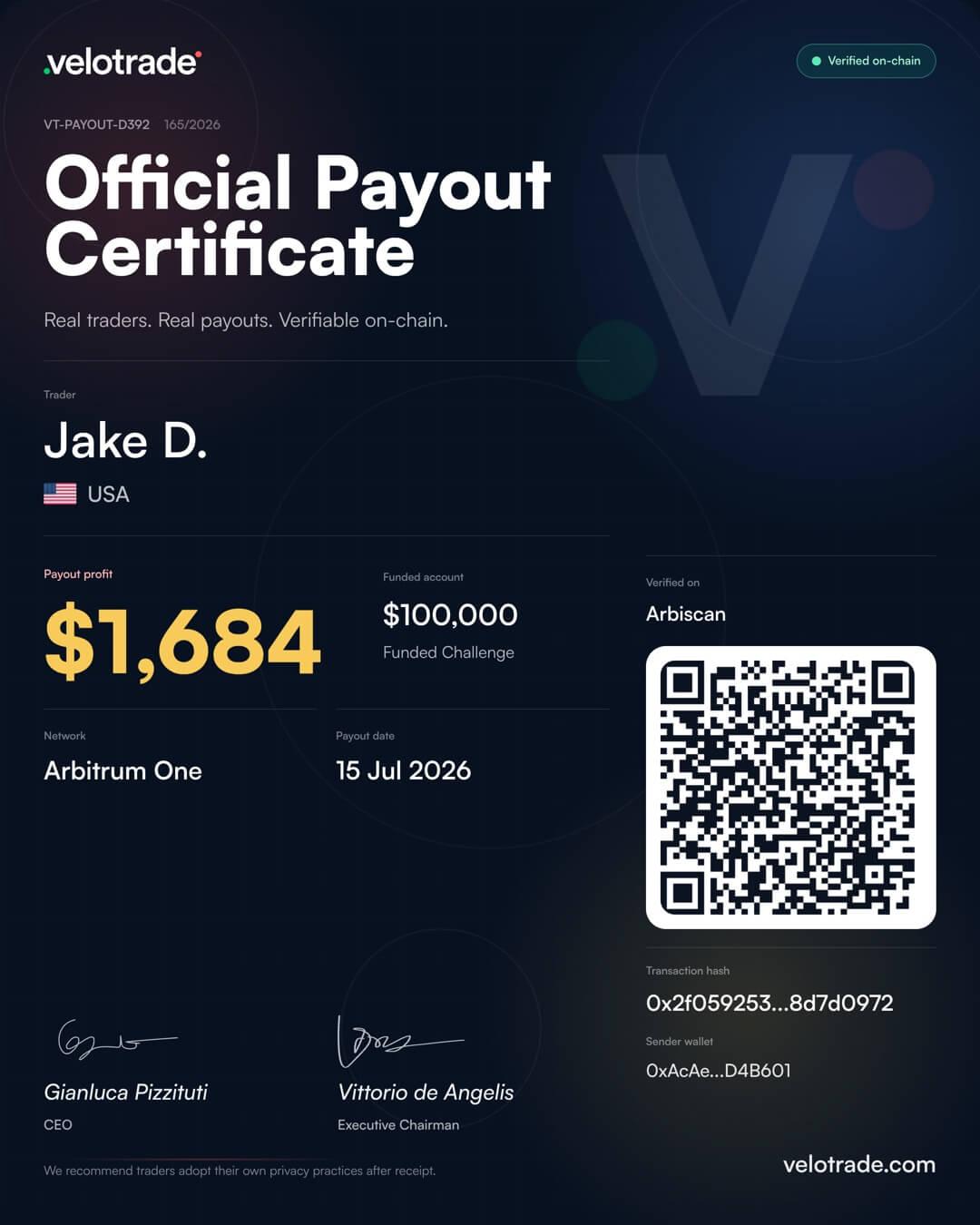
Payout proof
Fast, real payouts. Traceable on Arbitrum.
- Paid within 24 hours of approval
- Settled on Arbitrum in USDC or USDT
- Look up any transaction on Arbiscan

What Promotional Free Challenges Actually Include
Some firms run genuinely free challenges during promotional periods. These are real opportunities, but with important caveats.
What you typically get:
- Access to the standard evaluation format at no cost for the promotional period
- Same profit target and minimum trading days as the paid version
- Same funded account terms if you pass
What you often give up or need to verify:
- Time limits on when you can use the free access (24-72 hours from signup in many cases)
- Geographic restrictions (US traders often excluded)
- Limited account sizes available under the promo (smallest tiers only)
- No guarantee that the same offer will be available for a retry if you fail
Where to find them: Promotional free challenges are announced through the firm's official channels: email lists, Discord servers, and X (Twitter) accounts. Following the firms you are most interested in directly is more reliable than searching third-party sites, which often list outdated offers.
The risk with promotional challenges from smaller firms is that they have lower barriers to entry for both traders and firms running them. The same urgency framing that makes an offer feel like a good deal, "free for 48 hours only", is also used by firms with weaker payout track records to build email lists.
Why Established Firms Rarely Offer Genuinely Free Challenges
The challenge fee is not purely a revenue line for prop firms. It filters applicants. Traders who pay to take an evaluation have more skin in the game than traders who access it free. This matters operationally: serious traders produce cleaner evaluation data, fail less often on rule breaches (vs. strategy failure), and are more likely to succeed as funded traders.
Prop firms that remove the fee entirely tend to see higher evaluation attempt volumes, lower pass rates, and more noise in their funded account portfolio. This is why established firms that do offer fee-refund programs structure the refund as an exit, not an entry: you pay first, you pass, then you recover it. The filtering effect is preserved.
The exception is smaller or newer firms that use free challenges specifically to build brand awareness and trader databases. These firms may be legitimate, but you are trading the financial filter for a weaker track record. Before committing time to a free challenge with a firm you have not heard of, check payout history from independent sources, not just their own site.
For a checklist of red flags that apply to any prop firm offer, see top 5 crypto prop firm red flags.
There is also a genuinely free route that does not involve a discounted fee at all: free crypto trading competitions where the prize is a funded account. Velotrade's Sprint Trading is one of these, a free game where top players win real challenge accounts. See how to win a funded account for free.
Free Retries: What to Look For
Free retry offers, a second attempt at no cost if you fail, are different from free initial challenges. Some firms include them as a standard product feature; others run them as occasional promotions.
What matters in a free retry offer:
Conditions that trigger the free retry. Some firms offer a free re-take only if you failed within a specific drawdown band, for example, if you did not breach the maximum drawdown but did not hit the profit target in time. Others offer it broadly after any failure.
Whether the retry terms match the original. Confirm the retry uses the same profit target, drawdown limits, and time limits as your original attempt. Some retry offers have modified rules that make them easier (helpful) or harder (misleading).
Whether the offer is structural or promotional. A firm that permanently includes one free retry in its standard product is different from one that is running a temporary promotion. The former is a feature to compare against other firms; the latter is not reliably available for future attempts.
The Trade-Offs of "Free" vs Paid With Better Rules
The question traders should actually be asking is not "which prop firm has a free challenge?" but "which prop firm gives me the best chance of passing and the best trading conditions if I do?"
A free challenge at a firm with a consistency rule, restricted news trading, and a tick-by-tick drawdown model costs more in strategy constraints than the fee at a firm with no such restrictions.
| Factor | Free/Promotional Challenge | Fee-Refund Challenge | Paid Challenge (Best Rules) |
|---|---|---|---|
| Upfront cost | Zero | Full fee | Full fee |
| Net cost if you pass | Zero | Zero | Full fee |
| Net cost if you fail | Zero | Full fee paid | Full fee paid |
| Rule quality | Varies (often unverified) | Varies by firm | Verifiable, choose based on conditions |
| Payout track record | Often limited | Established firms only | Verifiable |
| Crypto instrument access | Varies | Varies | Verifiable |
For a trader with a proven strategy, paying a challenge fee at a firm with superior rules, no consistency rule, news trading allowed, static or EOD trailing drawdown, is often the better financial decision than taking a free challenge at a firm whose rules make it harder to trade your edge.
The math is straightforward: if your challenge fee is $100 and your funded account generates $2,500/month at an 85% profit split, recovering the fee takes less than one successful trading day. The fee is not the variable that matters most.
For context on why the drawdown model specifically changes what the challenge actually costs to operate, see EOD trailing vs tick-by-tick drawdown explained.
How to Evaluate Any Free Prop Firm Challenge Offer
Before accepting any free or heavily discounted challenge, run through these checks:
1. Verify the firm's payout history. Look for documented payouts on independent platforms. Trader Reddit communities (r/Forex, r/PropFirms), Discord servers, and independent review sites provide more reliable signals than testimonials on the firm's own site. A firm running a free challenge with no verifiable payout history is a firm that may not pay you.
2. Read the full rule set, not just the headline. Consistency rule, daily loss limit, max drawdown, news trading, weekend holding, minimum trading days. If these are not published clearly before you start, ask. Get the answer in writing.
3. Check the funded account terms, not just the challenge terms. Some firms offer generous free challenge access but reduce the profit split or add restrictions for the funded account. The funded terms are what actually matter for how much you make.
4. Confirm crypto instrument access. Particularly relevant for crypto traders: confirm the specific assets available are the ones you actually trade. "Crypto available" on a firm's marketing page often means BTC and ETH alongside a primarily forex catalogue. If you trade altcoins, verify instrument access explicitly.
5. Understand the retry terms. If you fail a free promotional challenge and want to retry, what are the costs and conditions? Free access on the first attempt does not mean free access on subsequent attempts.
For a more complete framework for comparing prop firms before committing, see best crypto prop firms 2026.

What the Lowest-Cost Path to a Funded Crypto Account Looks Like
Putting the different models together, the lowest-cost path to a funded crypto account depends on how many attempts it takes you to pass.
One attempt (you pass first time):
- Zero-cost promo challenge: $0 total
- Fee-refund challenge: $0 net (fee returned on first payout)
- Standard paid challenge, low fee: $40-$150 depending on account size
Two attempts:
- Free initial promo, paid retry: varies, some firms charge full fee on retry
- Fee-refund challenge (fail first, pass second): two fees paid, one refunded = one fee net
- Standard paid challenge: two fees, no refund
Three or more attempts: This is where the math matters most. Traders who need multiple attempts should look at firms with the lowest challenge fees relative to account size, and rule structures that genuinely fit their strategy rather than optimising for the entry cost.
For a realistic look at what it takes to pass a funded challenge consistently and why most traders fail before the fee becomes a significant variable, see why most retail traders fail prop challenges.
AI trading offer
20% off all challenges
Use code AITRADE20 at checkout. Applies to every account size.
Get 20% off your challenge →Frequently Asked Questions
About the author

Vittorio De Angelis
Executive Chairman
Former equity-derivatives trader at JP Morgan, Dresdner Kleinwort and Bank of America in London. Later Head of Brokerage at a global broker in Hong Kong.
Velotrade was founded in Hong Kong in 2016 by a team from JP Morgan, Dresdner Kleinwort and Bank of America, has paid out over $2.5 billion to its trade-finance clients, and has been featured in Bloomberg, the Financial Times, the Wall Street Journal and on Nasdaq. Its prop trading evaluations are simulated and educational.
View author page