Run your algo on funded capital
ExploreNot every prop firm is built for algorithmic traders. Restricted API access, hosting bans, per-trade risk caps and consistency requirements create compliance overhead that breaks strategies or kills edge. This guide ranks the best crypto prop firms for algo trading in 2026 based on what actually matters: API access, automation policy, where your code is allowed to run, per-trade risk caps, consistency rules and payout structure.
Quick answer: Velotrade is the best overall fit for algo traders: a documented REST and WebSocket API on every account, no per-trade cap and no consistency rule. HyroTrader now permits bots running your own strategy, with direct Bybit and BloFin demo API connections. BrightFunded allows EAs on MT5 and cTrader but not on DXtrade, and bans HFT and grid trading. DNA Funded allows EAs on its 1 Phase, 2 Phase and Rapid accounts but applies a daily profit limit to funded payouts. FundedNext limits EAs to MT4 and MT5 on accounts under $50,000. Rules checked on each firm's own pages on October 15, 2026.
Highlights of this article
- Velotrade is the best overall crypto prop firm for algo traders: full REST and WebSocket API on every account with no fee and no approval step, no cap on risk per trade, no consistency rule, VPS and VPN permitted, and news trading allowed
- HyroTrader now allows bots running your own strategy (terms updated September 29, 2026) and pays within 24 hours, but caps the realised loss on any single position at 3% of the initial balance, so a bot must size to that ceiling rather than manage risk purely through drawdown
- The consistency rule is a structural problem for algo strategies because bots cannot control which session their profit lands in
- BrightFunded permits EAs but not on DXtrade; DNA Funded permits them on 1 Phase, 2 Phase and Rapid but prohibits them on Instant Funding; FundedNext allows EAs only on MT4 and MT5 for accounts under $50,000. Check the account type and platform, not just the firm
- Before paying for any evaluation, verify the firm's automation policy in the rules document, not the marketing copy
What algo traders should look for in a crypto prop firm
Choosing a prop firm as a manual trader is different from choosing one as an algo trader. 5 criteria separate firms that work for automation from firms that create problems.
1. API availability
Some firms permit EAs only through MetaTrader plugins. Others offer documented REST and WebSocket APIs that allow fully custom bot integration. The difference is significant. A documented public API means your system can read account data, monitor equity, manage positions, and respond to market events without relying on platform-specific GUI automation. If you are still choosing what to automate, our guides to crypto trading bots and algorithmic trading strategies cover the main options.
Firms that do not publish API documentation push algo traders toward fragile workarounds. A proper REST API is non-negotiable for serious algorithmic deployment.
2. No cap on risk per trade
Several firms cap how much risk you may carry, separately from the account drawdown. HyroTrader limits the realised loss on any one position to 3% of the initial balance, and limits funded accounts to 25% of the initial balance in total margin and 2x the initial balance in notional exposure. FundedNext requires funded Stellar accounts to limit risk to a maximum of 3% at any given time, based on stop-loss placement. FunderPro applies a 2% per-trade limit on its Instant product. E8 Markets reserves the right to impose a 1% per-trade-idea limit if it flags your account.
A cap like this is not an inconvenience, it is a sizing constraint your bot has to encode. A strategy that occasionally needs one position to carry more of the risk budget cannot express that. Firms with no per-trade cap leave sizing entirely to your algorithm, bounded only by the drawdown.
Worth checking separately: where your code is allowed to run. Topstep prohibits VPS, VPN and remote servers outright and requires all order flow to originate from your own device, which rules out most hosted deployments. Goat Funded Trader banned VPS on several account types for accounts purchased from August 2026, without applying it retroactively.
3. No consistency rule
The consistency rule caps how much of your total evaluation profit can come from any single trading day, typically at 30%. For manual traders with high-conviction event trades, it is restrictive. For bots, it is a different kind of problem.
A bot cannot choose which session its profit lands in. A system running a mean-reversion strategy might generate 60% of its monthly profit in 2 sessions because that is when the setups appeared. It would fail a consistency rule evaluation even with a clean equity curve and controlled drawdown. Firms that remove this rule are the only ones structurally compatible with systematic strategies. For a full breakdown of why this matters, see crypto prop firms with no consistency rule.
4. Payout process
Algo traders often scale faster than discretionary traders. A strategy that passes one challenge will be replicated. Payout speed and reliability determine how quickly capital compounds. Slow or manual payout processes create real friction at scale. Target firms with documented payout timelines and USDC or USDT settlement.
5. Strategy flexibility
News trading, weekend holding, and overnight positions are strategy options that automated systems may use. Firms that restrict these create rule sets that do not map cleanly to systematic strategies. Flexibility in what is permitted reduces the chance of an unintentional breach. For how these systematic strategies are built and tested end to end, see quant trading explained.
Best crypto prop firms for algo traders in 2026
1) Velotrade: best overall for algo traders
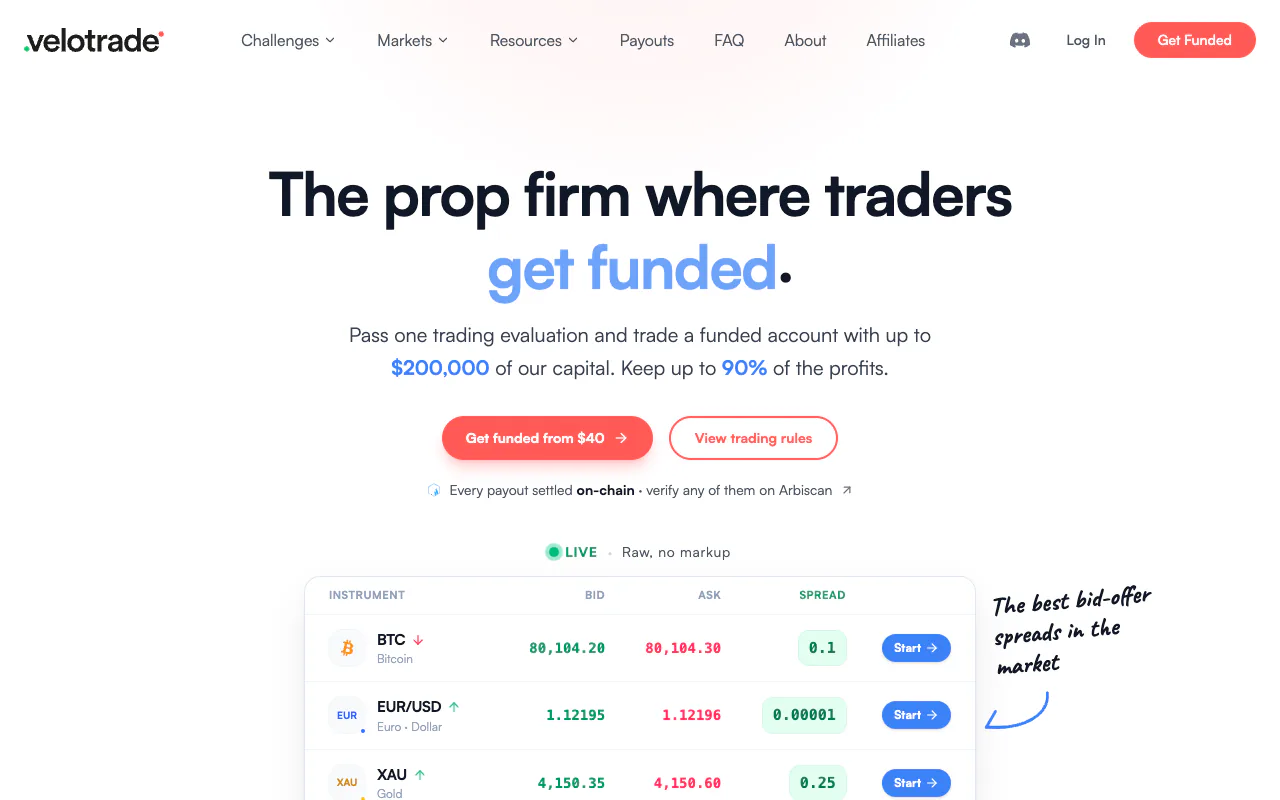
HQ: Hong Kong
Platform: DXtrade, multi-asset (crypto, forex, stocks, indices, commodities)
Bots and API: full REST and WebSocket API on every account, no extra fee, VPS and VPN permitted
Velotrade is built specifically for crypto traders, and its feature set maps directly to what algorithmic strategies need.
API access: Full REST and WebSocket API is available on every account, evaluation and funded. No extra fee. No application or approval process. Connect using the same credentials as your desktop login. The API supports order placement, position management, account data reads, and real-time equity monitoring. Documentation is in the DXtrade API setup guide. For the full integration overview, see the Velotrade API access page, or the step-by-step DXtrade API setup guide.
No cap on risk per trade: Velotrade sets no per-trade risk limit and no maximum lot size. Your bot manages position risk within the static drawdown, and exit logic is yours to define. VPS and VPN use is expressly permitted, so the strategy can run on a hosted server.
No consistency rule: There is no daily profit cap and no requirement that profits be distributed evenly across sessions. A bot that generates outsized returns in 2 sessions out of 20 passes on the numbers, not penalized by a smoothing rule.
News trading allowed: Automated strategies that trade around scheduled macro events face no restrictions. High-volatility windows are fully accessible.
Static drawdown: The drawdown floor is fixed from your starting balance and never trails your equity up. Intraday equity peaks never tighten it, and neither do end-of-day gains, so banked profit widens your buffer instead of moving the failure line closer. For an algo system that trades frequently, a floor that never moves is the most predictable risk boundary to code against.
Weekend holding allowed: Strategies that hold positions through the weekend run without restriction.
Payout: Withdrawals are usually processed within a day, in USDC or USDT. Up to 90% profit split.
If you automate currency pairs, see the forex trading bot guide.
For a complete independent assessment of Velotrade's rules and structure, see the Velotrade review. For the full API integration guide, see the Velotrade API access page.
2) HyroTrader
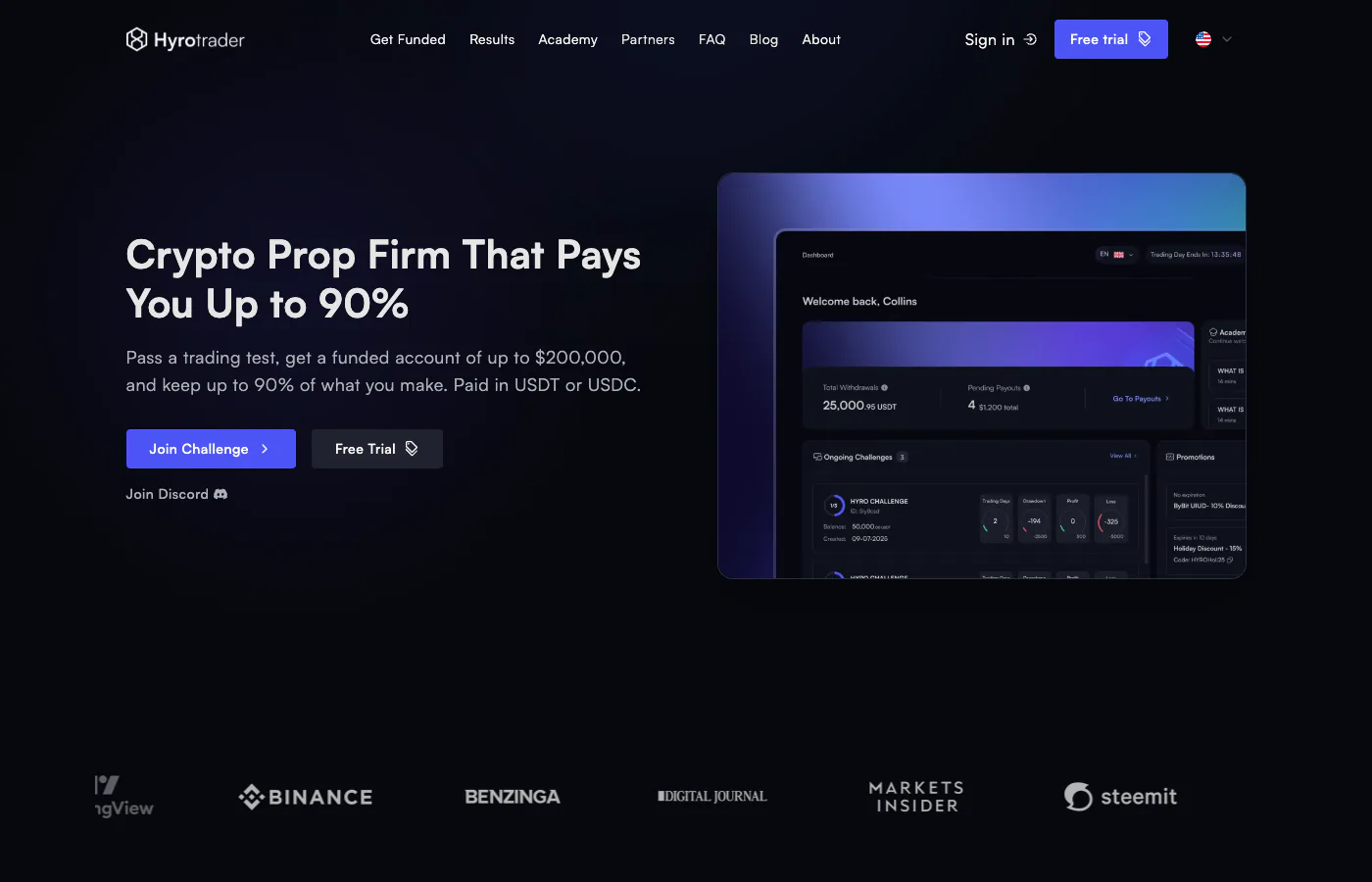
HQ: Slovakia
Platform: Bybit, BloFin and its own Hyro platform
Bots and API: allowed if the strategy is your own, via Bybit and BloFin demo API connections
HyroTrader now permits automated trading. Its terms, last updated September 29, 2026, say that automation of your own strategy is permitted, including through any agent token or Model Context Protocol interface the firm makes available. Its FAQ says bots are allowed as long as the strategy is your own, which rules out copying someone else's trades or signals. An earlier version of the terms pointed to a bot permission that the rules page did not contain, so re-read the current terms if you last checked before late September.
How your bot connects depends on the challenge type. Bybit challenges connect to the Bybit demo API, BloFin challenges to the BloFin demo API, and Hyro platform challenges use the firm's own platform. Whether the Hyro platform has a documented public REST API is not stated in the pages we read, so confirm the connection method before paying if you run custom code.
For a bot, the main rules are these:
- Stop-loss: not required.
- Maximum loss per position: the realised loss on any single position must not exceed 3% of the initial balance. HyroTrader's FAQ says this is not monitored by the automated system and is reviewed manually, so size to it rather than relying on the platform to stop you.
- Profit distribution: on the One-Step and Two-Step evaluation, no single trading day may count for more than 40% of your profit target. On the Zero-Step, no single trade may count for more than 50%. Funded accounts have no profit distribution rule.
- Funded account limits: total margin up to 25% of the initial balance and total notional exposure up to 2x the initial balance. Breaking either gets one warning, then the funded stage fails.
- News trading: allowed, as long as the strategy is not based solely on news.
- Payouts: processed within 24 hours in USDT or USDC, with no withdrawal commission. The profit split starts at 80%.
For a full rules comparison, see HyroTrader vs Velotrade and the HyroTrader review.
3) BrightFunded
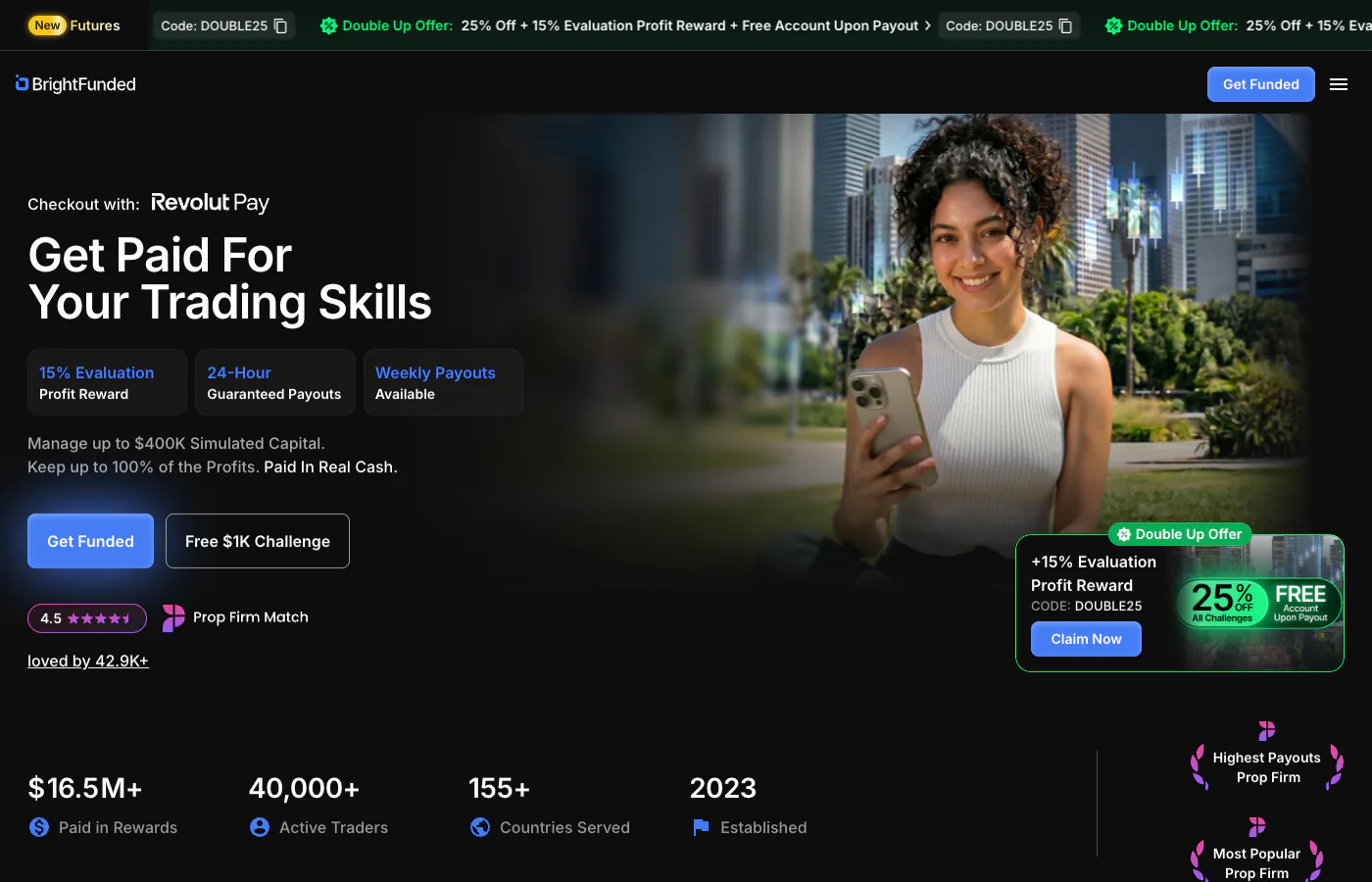
HQ: Dubai, UAE
Platform: MT5, cTrader, DXtrade
Bots and API: EAs on MT5 and cTrader, not on DXtrade; HFT, grid, arbitrage and tick scalping banned
BrightFunded allows EAs, with no per-trade risk cap that we could find. One platform caveat matters more than it sounds: API and automated trading are not supported on DXtrade, so pick MT5 or cTrader if you intend to automate. MT5 is not available to residents of the US and UAE, and cTrader is not available to US residents.
The firm bans several strategy types that bots often use: grid trading, arbitrage, tick scalping and high-frequency trading, along with any system built to execute orders at superhuman speed. It describes itself as built to evaluate human decision-making, not latency arbitrage or server-based tactics. Using a VPN or VPS is permitted.
BrightFunded has no consistency rule. News trading is free in the evaluation phases, but on funded accounts a 10-minute window around news (5 minutes before and after) is prohibited, and trading inside it deducts that trade's profit. Payout requests are processed within a day. The first reward comes 30 days after your first trade on the funded account and then every two weeks, with a weekly cycle as a paid add-on. The split is 80% by default, with 90% available as a paid add-on.
API documentation is less openly published than Velotrade's. For a full side-by-side, see BrightFunded vs Velotrade and the BrightFunded review.
4) DNA Funded
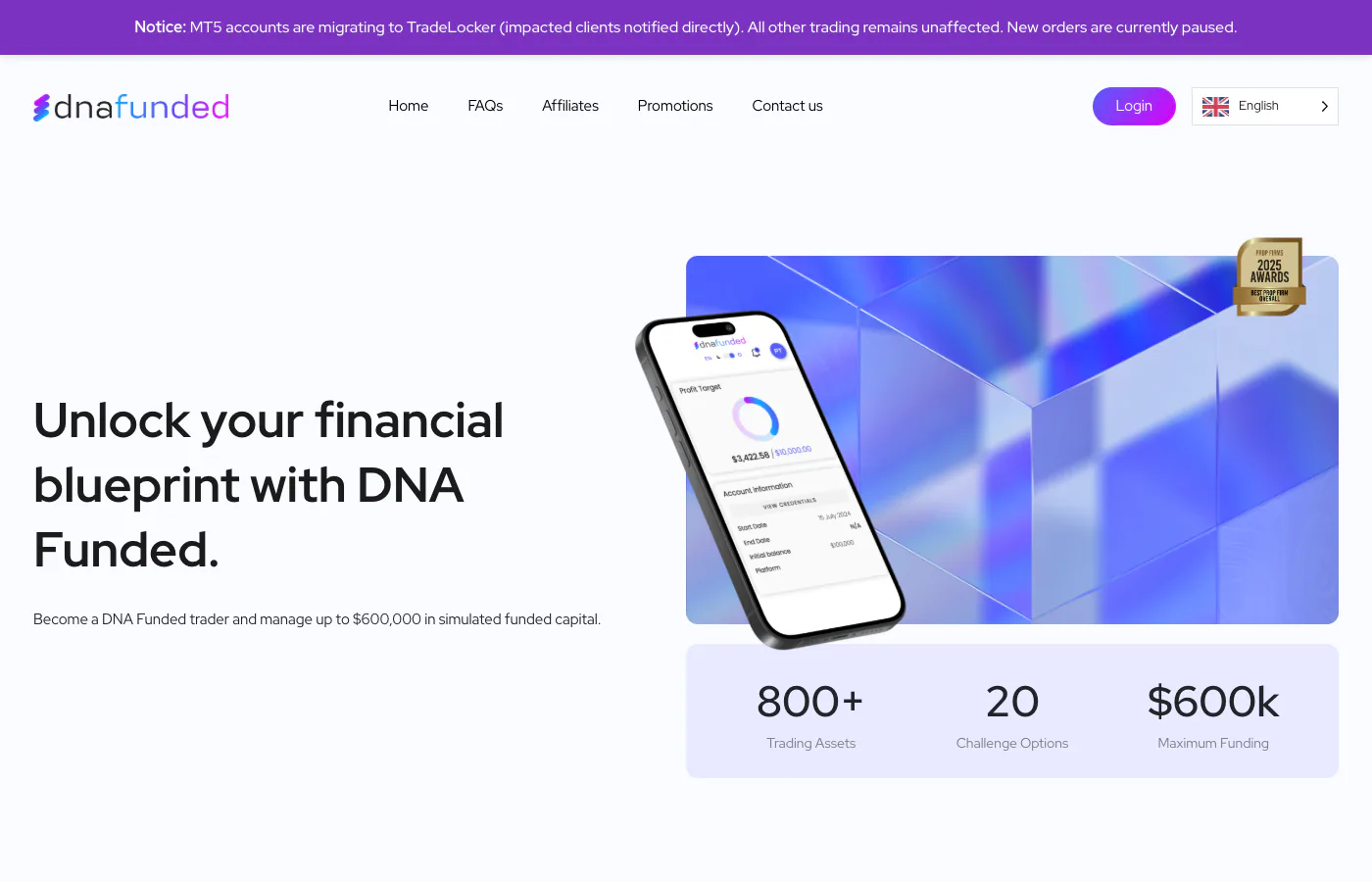
HQ: Saint Lucia
Platform: TradeLocker
Bots and API: EAs allowed on 1 Phase, 2 Phase and Rapid accounts, prohibited on Instant Funding
DNA Funded permits EAs and algorithmic trading on its 1 Phase, 2 Phase and Rapid accounts. On Instant Funding, EAs and algos are prohibited. The platform is TradeLocker, and the firm's FAQ covers connecting an EA to a TradeLocker account, though the depth of any API access is not published.
Two rules matter for systematic strategies:
- Daily profit limit on funded payouts: profit from any single calendar day can only contribute up to a set share of your payout request, and anything above it is deducted from the payout. It is 30% for purchases made after February 3 and 40% for earlier ones. The account is not breached, but a bot that books most of its profit in a few sessions will see part of it cut from payouts.
- News windows: trading is restricted for 5 minutes before and after high-impact news on new purchases.
DNA Funded bans high-frequency trading, reverse arbitrage, hedging and copy trading from non-DNA accounts. On funded accounts it also bans latency arbitrage, news scalping, tick scalping, grid trading and martingale. Payouts average 1 to 4 business days, with a $100 minimum, a 1% fee on crypto withdrawals, and the first three payouts capped at 5% of the starting balance.
For a direct comparison of rules and structure, see DNA Funded vs Velotrade and the DNA Funded review.
5) FundedNext
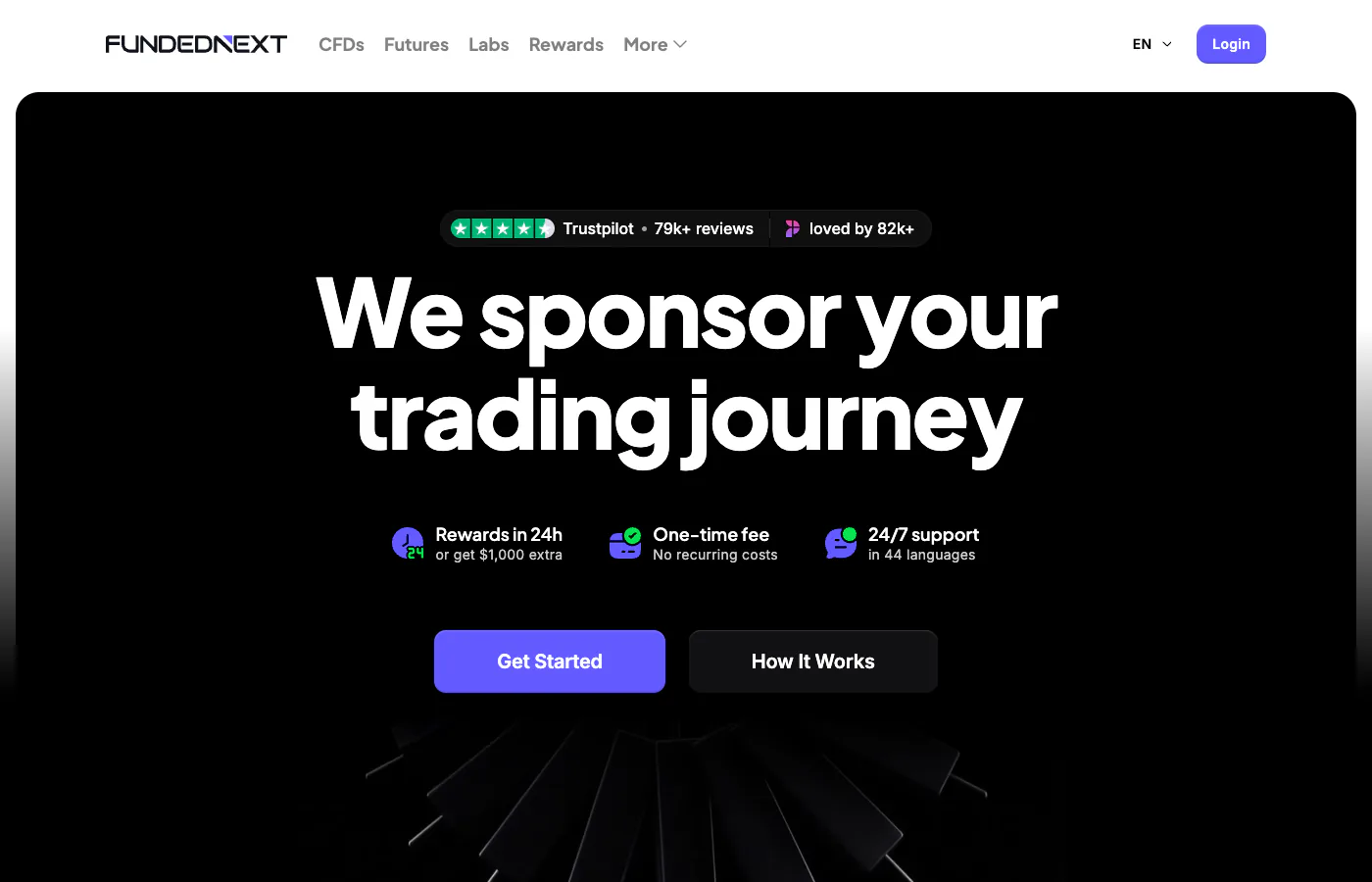
HQ: UAE
Platform: MT4, MT5, cTrader, Match-Trader
Bots and API: EAs on MT4 and MT5 only, on accounts under $50,000; not on cTrader or Match-Trader
FundedNext is the most restrictive of the five for automation. Accounts of $50,000 and above must be traded manually and may not use EAs, bots or other automated tools. On smaller accounts, third-party EAs are allowed on MT4 and MT5 only, with a paid EA add-on. EAs and automated trading are not allowed on cTrader or Match-Trader at any size. Third-party tools that change stop-loss, take-profit or lot size count as EAs.
High-frequency trading, arbitrage and tick scalping are banned, and its Quick Strike rule flags positions closed within 30 seconds. Funded Stellar 1-Step, 2-Step and Lite accounts must limit risk to a maximum of 3% at any given time, based on stop-loss placement. On those funded accounts, news trading falls under a reward share rule: profit from trades within 5 minutes before and after news counts only at 40%.
We found no general consistency rule on the Stellar account pages. A 40% consistency rule appears only in an arrangement offered to traders the firm has flagged for risk. On the 1-Step, rewards are paid every 5 business days and requests are processed within 24 hours of approval.
Check the specific plan, platform and account size before purchasing. For the full comparison, see FundedNext vs Velotrade and the FundedNext review.
Comparison table
| Firm | API access | Per-trade stop-loss | Consistency or daily profit rule | News trading | Payout speed |
|---|---|---|---|---|---|
| Velotrade | Full REST + WebSocket, documented | Not required | None | Allowed | Usually within a day |
| HyroTrader | Bybit and BloFin demo APIs, Hyro platform | Not required, 3% max realised loss per position | 40% per day of the target on One-Step and Two-Step evaluation, none funded | Allowed | Within 24 hours |
| BrightFunded | EAs on MT5 and cTrader, none on DXtrade | Not required | None | Funded accounts: 10-minute window | Processed within a day, first payout after 30 days |
| DNA Funded | TradeLocker EA connection | Not required | 30% daily limit on funded payouts (40% on older purchases) | 5-minute window | 1-4 business days |
| FundedNext | None stated, EAs on MT4 and MT5 under $50K | Not required, funded accounts have a 3% risk cap | None stated on Stellar | Reward share rule in a 5-minute window | Every 5 business days, processed within 24 hours of approval |


Why the consistency rule matters for algo traders
The consistency rule matters more for algorithmic traders than for most manual traders. Here is why.
A discretionary trader who has a big day can consciously dial back the following sessions to smooth their equity curve toward the cap. It is suboptimal, but it is possible. A bot cannot do this. It executes its strategy. If the setups appear, it trades them. If a mean-reversion system catches 5 clean setups in a single session and generates 40% of its monthly expectation in that window, it does so because that is what the market offered.
The consistency rule treats this as a failure condition. The strategy is working correctly. The rule is incompatible with it.
This is not an edge case. Any systematic strategy that concentrates entries around volatility events, breakouts, momentum shifts, or liquidity windows will naturally produce uneven daily P&L distributions. That is not poor risk management. It is how the strategy works. Relative value systems such as statistical arbitrage show the same pattern, because spreads only stretch to an entry level on a few days.
Firms without a consistency rule judge on total outcome: did the account stay within drawdown limits and hit the profit target? That is the correct framework for evaluating an algorithmic strategy. For more on this, see crypto prop firms with no consistency rule.
Why a per-trade risk cap matters to a bot
A 3% cap on the loss any single position may realise sounds minor until you size against it. HyroTrader applies one, and FundedNext applies a similar 3% total-risk limit on funded accounts.
It converts a portfolio-level risk budget into a per-position one. A strategy that concentrates conviction into one trade has to split it across several, or accept a smaller expression of the signal. Systems that scale into a position need to know whether the cap applies per order, per idea or across all open positions, because those give different answers. HyroTrader publishes its 3% figure in its FAQ rather than on its trading rules page, and reviews it manually. Exposure caps work the same way: HyroTrader's funded 2x notional limit and DNA Funded's per-symbol lot caps are sizing constraints your bot has to encode.
There is a subtler issue too. Some strategies are designed to use the overall drawdown limit as the implicit stop, letting the platform's risk system cut the position if it moves against the account. That is a legitimate approach within the overall rules, and a cap on risk per trade overrides it regardless of the strategy's design.
Velotrade imposes no cap on risk per trade and no maximum lot size. Your only sizing limit is the static drawdown, and your bot's exit logic is yours. For more on how the API integration works and what is permitted, see the full guide to algo and bot trading in crypto prop firms.
How to verify a firm's automation policy before paying
Marketing copy at most prop firms says something like "EAs and automated trading permitted." This tells you almost nothing. Here is what to actually check.
Read the full rules document, not the FAQ. Specific automation restrictions are buried in terms. Look for language around stop-loss requirements, position management rules, and strategy restrictions applied specifically to automated accounts.
Ask direct questions before purchasing. Ask support: "Is there a requirement to set a stop-loss on every automated position? If so, what is the time window?" Ask: "Is there a consistency rule on this plan? What is the cap?" Get answers in writing.
Check API documentation before assuming integration is possible. A firm that permits EAs but provides no public API documentation may only support platform-native EA connections. If you are running a custom Python or JavaScript bot, verify that the connection method you need actually exists.
Look for policy enforcement evidence in trader communities. Reddit threads and Discord servers for specific prop firms surface actual rule enforcement cases. Pay attention to accounts closed for automated trading violations. The pattern of what actually triggers enforcement is more informative than the written rules alone.
Red flags to watch for:
- Stop-loss requirements applied specifically to automated trades
- Consistency rules with no clear cap percentage stated
- Automation permitted language followed by "subject to strategy review"
- No public API documentation for a firm claiming API access
- Separate approval process required before running bots
For a broader framework on evaluating any crypto prop firm before paying, see best crypto prop firms in 2026. For a step-by-step guide to connecting a bot, signal system, or EA to a funded account, see how to run a trading bot on a funded crypto account. For how algo trading compares to swing and scalping strategies across prop firm evaluation rules, see best crypto trading strategies for prop firms.
This article reflects prop firm rules and platform specifications as checked on each firm's official pages on October 15, 2026. Rules are subject to change. Always confirm current automation policy in each firm's official rules before purchasing an evaluation. Nothing in this article constitutes financial or investment advice.
Frequently Asked Questions
About the author

Vittorio De Angelis
Executive Chairman
Former equity-derivatives trader at JP Morgan, Dresdner Kleinwort and Bank of America in London. Later Head of Brokerage at a global broker in Hong Kong.
Velotrade was founded in Hong Kong in 2016 by a team from JP Morgan, Dresdner Kleinwort and Bank of America, has paid out over $2.5 billion to its trade-finance clients, and has been featured in Bloomberg, the Financial Times, the Wall Street Journal and on Nasdaq. Its prop trading evaluations are simulated and educational.
View author page