Trade crypto with funded capital
ExplorePlatform breadth versus crypto-native depth. Here is how FundedNext and Velotrade compare across every metric that drives funded account outcomes.
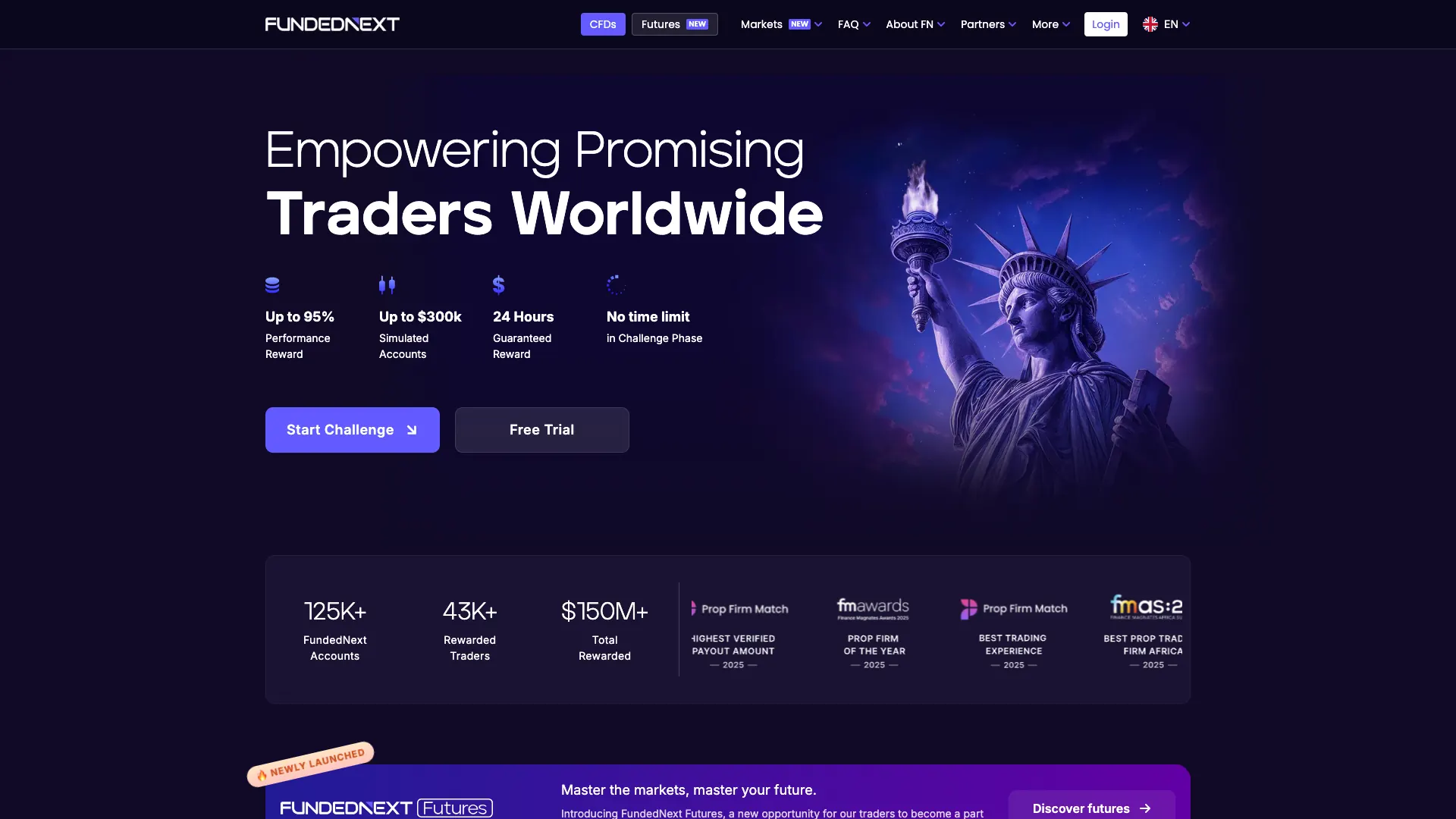
FundedNext is one of the largest-scale prop firms in the market, built around platform flexibility, cross-market access, and a high headline profit split. Velotrade takes the opposite approach: multi-asset, covering crypto, forex, stocks, indices and commodities, with a tightly documented rule set designed for 24/7 volatile markets. If you are deciding between them, this comparison covers profit targets, drawdown mechanics, news trading, profit split, platform choice, and pricing side by side. For a broader view of how both firms fit into the funded trading landscape, see how to become a funded crypto trader.
Highlights of this article
- FundedNext headlines up to 95% profit split; Velotrade offers up to 90% from the first payout
- Both allow weekend holding; on funded accounts FundedNext only credits 40% of the profit from trades within 5 minutes of high-impact news, while Velotrade has no news window
- FundedNext supports MT4, MT5, cTrader, and Match-Trader; Velotrade uses DXtrade exclusively
- Velotrade is crypto-native; FundedNext is a forex-first firm with crypto as a secondary product
- Both firms report no consistency rule
- FundedNext maximum allocation reaches $4,000,000 via scaling; Velotrade caps at $200,000 per account
- FundedNext was founded in 2022 in the UAE; Velotrade is headquartered in Hong Kong
Quick Comparison: FundedNext vs Velotrade
| Velotrade | FundedNext | |
|---|---|---|
| Challenge types | 1-Step, 2-Step | Multiple models |
| Account sizes | $5k to $200k | Various, up to $4M via scaling |
| Phase 1 profit target | 10% | 8% (Stellar 2-Step) |
| Phase 2 profit target | 5% | 5% (Stellar 2-Step) |
| Daily loss limit | 5% (2-Step) | 5% (Stellar 2-Step) |
| Max drawdown | 10% static | 10% static (Stellar 2-Step) |
| Min trading days | 5 qualifying days | 5 trading days |
| Consistency rule | None | None reported |
| News trading | Allowed | Allowed (funded: 40% of profit counts within 5 min of high-impact news) |
| Weekend holding | Allowed | Allowed |
| EAs / automation | Allowed | MT4/MT5 under $50K only, for a fee |
| Platform | DXtrade | MT4, MT5, cTrader, Match-Trader |
| Max funding | $200k | Up to $4M (scaling) |
| Profit split | Up to 90% from the first payout | Up to 95% (headline) |
| HQ | Hong Kong | UAE |
Profit Targets and Drawdown Structure
Velotrade's 2-Step challenge uses a 10% Phase 1 profit target and 5% in Phase 2, with a 10% static maximum drawdown and a 5% daily loss limit. The 1-Step challenge uses a single 10% profit target with a 7% static maximum drawdown and a 4% daily loss limit.
Static drawdown means the floor that sets your breach threshold is fixed from your starting balance and never moves. Intraday equity spikes do not move it, and neither do end-of-day gains. This is the detail that separates Velotrade from firms using tick-by-tick trailing drawdowns, where every unrealised intraday gain can permanently tighten the breach threshold. Static is even more forgiving than end-of-day trailing, because the floor never rises at all as you profit. To see your exact floor, daily budget, and losing trade capacity for any Velotrade account size, use the prop trading drawdown calculator.
FundedNext's Stellar models also use a static maximum loss measured from the initial balance: 10% on the 2-Step, 6% on the 1-Step, and 8% on Lite, with daily limits of 5%, 3%, and 4%. On drawdown type, the two firms now match.
For a detailed breakdown of why the drawdown model type matters more than drawdown percentage alone, read crypto prop firm rules and drawdowns explained.
Weekend Holding: Both Allow It
Both firms allow weekend holding. At Velotrade, positions can stay open from Friday through Monday with no closure requirement. FundedNext allows overnight and weekend holding on every current account type, including all Stellar challenges and funded accounts.
One detail to note at FundedNext: on swap accounts, overnight and weekend swap charges apply and count toward the daily loss calculation, so triple-swap days need to be factored into position sizing.

No Consistency Rule
A consistency rule limits how much of your total evaluation profit can come from any single trading day. When a firm caps one-day profit contribution at, say, 30% of total target profit, a single large winning session can fail the evaluation even if all drawdown and loss limits were respected.
Neither Velotrade nor FundedNext enforces a consistency rule based on available information. At Velotrade, this is explicitly documented: profit distribution across trading days is not evaluated at any stage. A trader who hits the full profit target in a single high-conviction session passes without any additional distribution requirement.
For news traders, volatility traders, and anyone whose strategy naturally concentrates returns into fewer setups, this is the single most important shared characteristic. To understand why the consistency rule remains widespread and how to identify firms that still enforce it, see crypto prop firms with no consistency rule.
Profit Split: 90% vs the 95% Headline
FundedNext advertises up to 95% profit split as a headline figure. Velotrade offers up to 90% from the first funded payout, with no scaling period or performance tier.
The gap between 90% and 95% is real on paper. On $10,000 profit, the difference is $500. Over a year of consistent funded trading, that compounds.
But the conditions attached to the headline matter as much as the number. At FundedNext, the funded split is 80% by default, rises to 90% through its scale-up plan, and reaches 95% only with the paid Lifetime Reward add-on. The payout option chosen at checkout also changes it (a faster 3-day first payout pays 60%).
Velotrade offers up to 90% from the first payout, with no scale-up milestones to unlock it.


News Trading
Both firms allow news trading, but only Velotrade applies no rule to funded-account news trades. Velotrade explicitly documents that traders can hold positions through scheduled and unscheduled macro events, including high-impact data releases, without any pre-event position closure requirement.
FundedNext allows news trading freely in the challenge. On a funded account, its News Reward Share Rule applies: for trades opened or closed from 5 minutes before to 5 minutes after a high-impact release, only 40% of the profit counts toward your balance, while losses count in full.
For crypto traders specifically, news trading freedom matters in both directions: scheduled macro events (Fed decisions, CPI releases) and unscheduled market events both have sharp crypto price impact. A firm that restricts news trading windows imposes artificial risk management on a market that operates 24/7 with no natural liquidity pauses.
Platform: Breadth vs Depth
FundedNext supports MT4, MT5, cTrader, and Match-Trader. This is the widest platform selection among the firms covered in the best crypto prop firms comparison. Traders can bring existing MT4 or MT5 setups, including indicators, EAs, and risk management tools built for those environments, directly into the evaluation without platform migration.
The breadth is a genuine advantage for cross-market traders who already operate across forex and crypto in a single MT5 environment. There is no adjustment period and no tooling rebuild.
Velotrade uses DXtrade exclusively. DXtrade is a purpose-built prop trading platform: challenge monitoring, rules compliance, and account management are all integrated natively. For traders new to DXtrade, there is an adjustment period. For traders already familiar with it, the integration is seamless.
The tradeoff is straightforward: FundedNext gives you more platform choice; Velotrade gives you a more tightly integrated evaluation environment in a single platform built specifically for the funded account model.
Scale of Capital: $200k vs $4,000,000
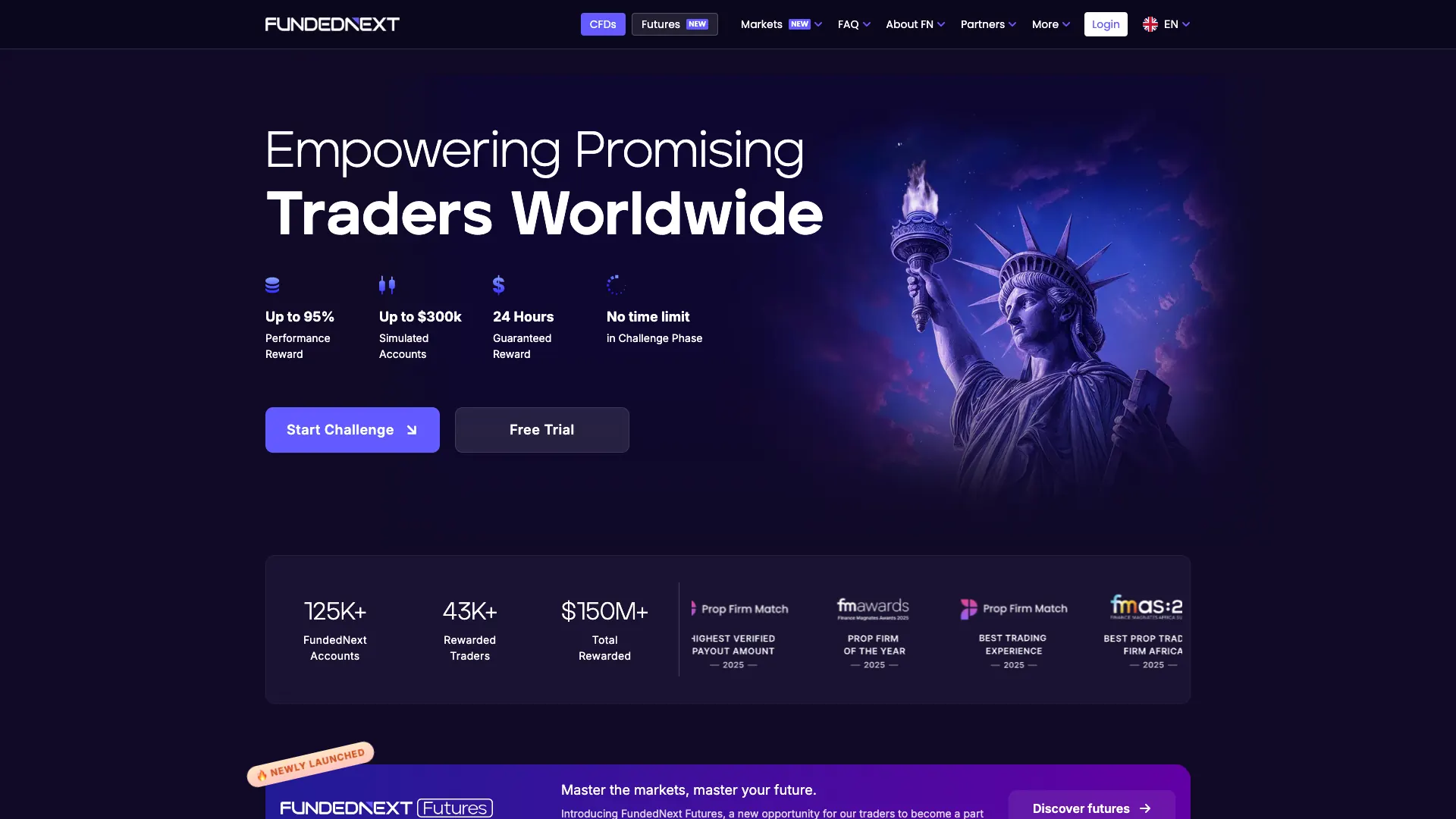
FundedNext's scaling program allows funded traders to reach up to $4,000,000 in total allocated capital. This is a headline differentiator that appeals to traders who have long-term capital scaling as a primary goal. Getting to $4M requires sustained multi-period performance across the scaling program, but the ceiling is among the highest in the market.
Velotrade's maximum allocation is $200,000 per account. This is appropriate for serious funded traders at the strategy validation and early deployment stage, but it is not a path to multi-million dollar allocations.
For traders who are currently at $50,000 to $200,000 and working on strategy consistency, the scaling ceiling is not an immediate constraint. For traders who have already demonstrated that consistency and are looking for the next capital step, FundedNext's structure provides a defined escalation path.
Pricing: Side-by-Side Challenge Fees
| Account Size | Velotrade 2-Step | Velotrade 1-Step | FundedNext (confirm current pricing) |
|---|---|---|---|
| $5,000 | $54 | $67 | Confirm on FundedNext website |
| $10,000 | $100 | $127 | Confirm on FundedNext website |
| $25,000 | $225 | $290 | Confirm on FundedNext website |
| $50,000 | $419 | $543 | Confirm on FundedNext website |
| $100,000 | $769 | $1,075 | Confirm on FundedNext website |
The CLASSIC 2-Step and 1-Step plans cap at $100,000. A $200,000 account is available on the PRO 1-Step plan only, priced at $1,114 base. FundedNext's cheapest entry is $59 for a $6,000 Stellar 2-Step ($65.99 on the 1-Step), and pricing varies by model. Multiple models are available at different price points, and add-ons (such as higher profit split tiers or evaluation model variations) affect the total cost. Confirm exact current pricing directly on FundedNext's website before purchasing.
Velotrade pricing is transparently listed and applies uniformly to both 2-Step and 1-Step challenge types.
Crypto-Native vs Forex-First Architecture
This is the most consequential structural difference for dedicated crypto traders.
Velotrade is built on crypto-native architecture. It now funds multiple asset classes, but every element of its rule set, drawdown calibration, and platform configuration is oriented to 24/7 markets, weekend volatility, and crypto-specific liquidity behavior. There are no forex-inherited constraints in the architecture.
FundedNext's operating core is forex-first. Crypto is available across its products, but the firm's original design, rule structure, and risk controls were developed for a market that operates with structured sessions, fixed trading hours, and lower volatility profiles than crypto.
For traders running multi-market portfolios with both forex and crypto positions, FundedNext's architecture is well matched. For traders whose entire strategy is built around crypto market behavior: the 24/7 session, weekend volatility, and crypto-specific macro catalysts, Velotrade's crypto-native design avoids the structural mismatch that forex-first rules can introduce.
For the full argument on why crypto-native architecture matters for practical outcomes, read why crypto-native infrastructure matters at a multi-asset prop firm.
What Each Firm Suits Best
Choose Velotrade if:
- You are a dedicated crypto trader whose strategy is built around 24/7 markets and weekend volatility
- You trade high-impact news on a funded account and want to keep the full profit
- You want up to 90% profit split from the first payout, with no scaling requirements
- You want a 1-step challenge option for a faster, single-phase evaluation path
- You want to run EAs or bots on any account size (FundedNext requires manual trading from $50,000 up)
Choose FundedNext if:
- You trade across forex and crypto and need a single platform that covers both markets with broad tooling support
- Platform flexibility is a primary requirement: you already work in MT4, MT5, cTrader, or Match-Trader
- Long-term capital scaling toward $4,000,000 or beyond is a defined goal and you have the performance track record to pursue it
- The 95% headline profit split is achievable under the conditions of the specific model you are buying
- You want a firm with a large community, broad market recognition, and a long-established footprint
Which Crypto Prop Firm Is Better?
For dedicated crypto traders, Velotrade is the cleaner structural fit. Both firms use a static drawdown and allow weekend holding, but FundedNext's funded-account news rule and its manual-only requirement above $50,000 are two constraints Velotrade does not have. The split of up to 90% applies from the first payout with no scaling conditions.
For traders who operate across forex and crypto and want the flexibility to use their existing MT5 or cTrader workflow, FundedNext's platform breadth and high capital ceiling are genuine advantages. If your strategy scales well with increasing capital and you are already running a tested multi-market process, FundedNext's $4,000,000 scaling path is a concrete differentiator.
Both are viable funded account paths. The decision comes down to your asset focus and strategy design. Crypto-native traders will find fewer friction points at Velotrade. Multi-market traders who need platform flexibility and higher capital ceiling have a reasonable case for FundedNext.
For a full comparison of all major firms, see best crypto prop firms in 2026. If FundedNext's forex-first architecture is a concern, weigh other options in FundedNext alternatives for crypto traders. For Velotrade's complete rule set and evaluation details, see Velotrade review 2026. For how the funded account model works in practice, see crypto prop firm rules explained. For a full overview of what a crypto funded trading account involves from evaluation to payout, see crypto funded trading accounts: how to get one. For FundedNext's verified challenge profile and rule comparison with other firms, see the FundedNext directory page. For a full standalone review of FundedNext's challenge models, drawdown rules, and payout structure, see FundedNext review 2026.
Ready to start a Velotrade challenge? View challenge options and pricing
This article is for informational purposes only and does not constitute financial or investment advice. Prop firm rules, fees, and structures change frequently. Always review each firm's official terms and conditions before making any decisions. This comparison reflects FundedNext's help centre and Velotrade's terms as of September 2026.
Frequently Asked Questions
About the author
Vittorio De Angelis
Executive Chairman
Former equity-derivatives trader at JP Morgan, Dresdner Kleinwort and Bank of America in London. Later Head of Brokerage at a global broker in Hong Kong.
Velotrade was founded in Hong Kong in 2016 by a team from JP Morgan, Dresdner Kleinwort and Bank of America, has paid out over $2.5 billion to its trade-finance clients, and has been featured in Bloomberg, the Financial Times, the Wall Street Journal and on Nasdaq. Its prop trading evaluations are simulated and educational.
View author page