
Considering FundedNext? See how Velotrade compares
ExploreFundedNext is one of the largest crypto and forex prop firms by trader volume. This review covers the 4 challenge models, the actual profit split structure (not just the headline), drawdown rules, payout mechanics, and who this firm realistically suits. All figures are verified from FundedNext's live website as of October 2026.
FundedNext at a glance (verified October 2026)
| Official site | fundednext.com |
| Price from | $32.99 (Stellar Lite $5K; shown on sale at $29.99) |
| Profit split | 80% base, up to 95% with an add-on |
| Drawdown | Static on the Stellar models |
| Payouts | 2-Step: first reward after 21 days, then every 14 days; 99.99% processed within 24 hours (per FundedNext) |
| Trustpilot | 4.5 from 81,469 reviews (as of Oct 12, 2026) |
| Platforms | MT4, MT5, cTrader, Match-Trader (US traders: Match-Trader only); FundedNext Futures: Tradovate, NinjaTrader, TradingView |
| Markets | Forex, indices, commodities, crypto, stocks (CFDs), plus a separate FundedNext Futures product |
Highlights of this article
- FundedNext offers 4 challenge models: Stellar 2-Step, 1-Step, Lite, and Instant
- Base profit split is 80%; reaching the 95% headline requires a paid upgrade
- Weekend holding is allowed across all Stellar models
- News trading is allowed, but on funded accounts only 40% of the profit from trades within 5 minutes of high-impact news counts
- Maximum loss is static on every Stellar model, measured from the initial balance
- FundedNext says 99.99% of payouts are processed within 24 hours; on the 2-Step the first reward comes after 21 days, then every 14 days
- Challenge fee is refunded with the first payout on the 2-Step, and with the third payout on the 1-Step and Lite


What FundedNext Is
FundedNext is a prop trading firm headquartered in the UAE. It operates across forex, indices, commodities, crypto, and stocks (CFDs), with a separate FundedNext Futures product. Its Stellar challenge models are the primary product for crypto traders. FundedNext's core pitch is platform flexibility, a high headline profit split, and fast payout processing (it says 99.99% of payouts are processed within 24 hours).
The firm supports MT4, MT5, cTrader, and Match-Trader (US traders can use Match-Trader only). For traders already running strategies on those platforms, FundedNext offers a compatible environment without platform migration. For crypto-native traders who want a dedicated setup, the multi-market architecture is a trade-off worth understanding before committing.
The 4 Stellar Challenge Models
FundedNext offers 4 distinct evaluation paths. Account sizes start at $5K and go up to $200K.
| Stellar 2-Step | Stellar 1-Step | Stellar Lite | Stellar Instant | |
|---|---|---|---|---|
| Phase 1 target | 8% | 10% | 8% | No challenge |
| Phase 2 target | 5% | None | 4% | No challenge |
| Daily loss limit | 5% | 3% | 4% | Confirm with firm |
| Max drawdown (static) | 10% | 6% | 8% | Confirm with firm |
| Min trading days | 5 | 2 | 5 | None |
| First withdrawal | 21 days | 5 days | 21 days | Confirm with firm |
| Fee refund | With 1st payout | With 3rd payout | With 3rd payout | Confirm with firm |
Reading this table: the 1-Step model has a lower profit target (10% in one phase) but tighter drawdown limits (6% max vs 10% for 2-Step). The Stellar Lite sits between the two with an 8%/4% structure and a lower max drawdown. Stellar Instant skips the challenge entirely; confirm its specific terms directly with FundedNext before purchasing, as they are not fully documented in public-facing materials.
Pricing starts at $32.99 for a $5,000 Stellar Lite (shown on sale at $29.99 at the time of checking), with larger accounts and other models costing more. Check fundednext.com for current prices.
Profit Split: What 95% Actually Means
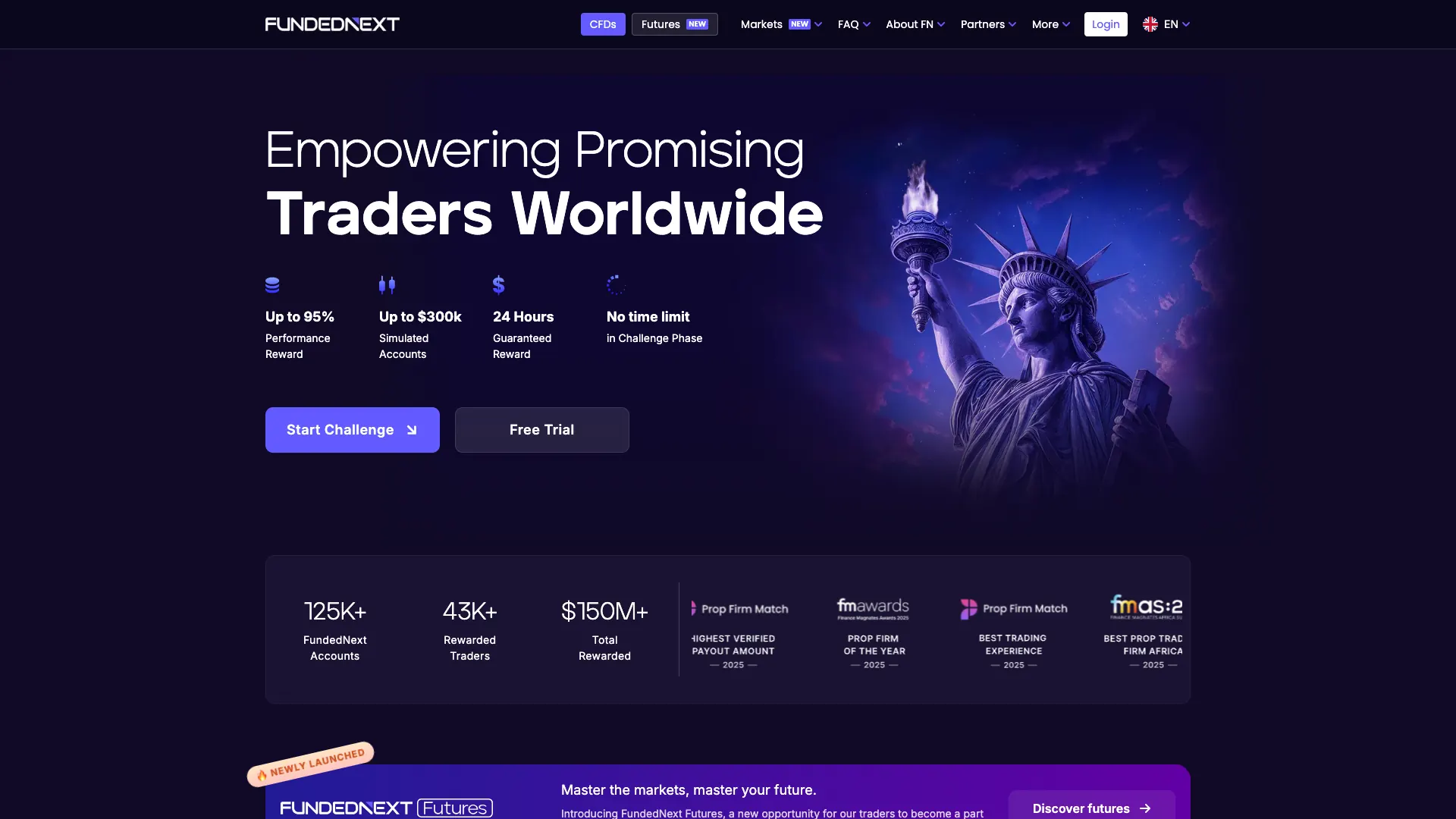
FundedNext's headline is "up to 95% performance reward." The base split is 80%. The 95% figure is accessible through a paid upgrade at checkout. The upgrade cost is not prominently stated in the main pricing pages and should be confirmed before purchase.
FundedNext also pays 15% profit share during the challenge phase itself, on profits generated while still in evaluation. This is a genuine differentiator. Most prop firms only pay out after the funded stage begins.
The practical implication: the 95% headline is achievable, but it requires an additional cost beyond the base challenge fee. Traders who compare FundedNext's 95% to another firm's 90% without accounting for the upgrade fee are making an uneven comparison. The net split after all fees is the correct figure to use.
For how payout timing compares across firms, see fastest payout prop firms compared.
Drawdown: Static From the Initial Balance
FundedNext's drawdown limits are clearly stated: 10% max for 2-Step, 6% for 1-Step, 8% for Lite. The daily loss limits are also stated: 5%, 3%, and 4% respectively.
FundedNext's help centre confirms the calculation method: the maximum loss is measured from the initial balance and does not trail. On a $100,000 Stellar 2-Step, your balance can never fall below $90,000, however much profit you build first. That is the same static model Velotrade uses.
The daily loss limit is also a percentage of the initial balance, resetting at midnight server time, and it widens by any profit made earlier that day (start at $100,000, make $2,000 by noon, and that day's limit becomes $7,000).
For how static compares with trailing models, see EOD trailing vs tick-by-tick drawdown explained.
Weekend Holding and News Trading
FundedNext explicitly allows weekend holding across its Stellar models. Their terms state: "Hold your trades as long as you want, even on weekends." This is confirmed and applies across the standard evaluation models.
News trading is allowed in the challenge without restriction. On a funded account, a News Reward Share Rule applies: for trades opened or closed from 5 minutes before to 5 minutes after a high-impact release, only 40% of the profit counts toward your balance, while any losses count in full.
No consistency rule is stated in FundedNext's public terms. Based on available information, the firm does not enforce a daily profit cap. Verify this directly for the specific model you are purchasing, as FundedNext's multi-model structure means individual terms can vary.
Payout Speed and Process
FundedNext states that 99.99% of payouts are processed within 24 hours. The first withdrawal on the 2-Step model is available after 21 days on the funded account, then every 14 days. On the 1-Step model, the first withdrawal is available after 5 days.
The challenge fee comes back as a "Refundable Fee": with your first payout on the Stellar 2-Step, and with your third payout on the Stellar 1-Step and Lite. The $25 cTrader or Match-Trader platform fee is not refunded.
Payment is available via 20+ methods including credit card, PayPal, Apple Pay, and regional payment systems. Crypto payout options should be confirmed directly with FundedNext, as the payment page focuses on fiat rails.



Scaling
FundedNext operates a scaling program. Funded traders can grow their allocated capital through sustained qualifying performance. The maximum allocation across accounts reaches $4,000,000 via the scaling program. This is a significant ceiling compared to most prop firms, including Velotrade's $200,000 per account maximum.
For traders whose primary objective is maximizing total capital under management over time, FundedNext's scaling ceiling is a concrete differentiator. The qualifying performance criteria for scaling should be confirmed directly with the firm.
FundedNext vs Velotrade: Key Differences
| FundedNext | Velotrade | |
|---|---|---|
| Markets | Forex, indices, commodities, crypto, stocks (CFDs); separate futures product | Crypto, forex, stocks, indices, commodities |
| Account sizes | $5K to $200K | $5K to $200K |
| Max allocation | Up to $4M (scaling) | $200K per account |
| Platform | MT4, MT5, cTrader, Match-Trader (futures: Tradovate, NinjaTrader, TradingView) | DXtrade |
| Drawdown type | Static (from initial balance) | Static on all plans |
| Max drawdown (2-Step) | 10% | Static: CLASSIC 2-Step 10%, CLASSIC 1-Step 7%, PRO 1-Step 3% |
| Daily loss limit | 5% (2-Step) | 5% (2-Step) |
| Min trading days | 5 (2-Step) | 5 qualifying days (each closing with ≥0.8% net profit) |
| Consistency rule | None stated | None |
| Weekend holding | Allowed | Allowed |
| News trading | Allowed (funded: 40% of profit counts within 5 min of high-impact news) | Allowed |
| Profit split | Up to 95% (upgrade required) | Up to 90% (with the 90% add-on) |
| Base profit split | 80% | 80% |
| Challenge phase reward | 15% of challenge profits | None |
| Fee refund | Yes (1st payout on 2-Step, 3rd on 1-Step/Lite) | No |
| First withdrawal | 21 days on the 2-Step, then every 14 days | 14 days, then weekly |
| HQ | UAE | Hong Kong |
The most important differences: both firms reach their top split through an add-on (up to 90% at Velotrade). Both firms use a static maximum loss. FundedNext's scaling ceiling ($4M) is substantially higher than Velotrade's $200K per account.
For the full head-to-head comparison covering drawdown mechanics, platform differences, and rules in detail, see FundedNext vs Velotrade.
Who FundedNext Suits
FundedNext is a reasonable choice if:
- You already trade on MT4, MT5, or cTrader and want to avoid platform migration
- You trade both forex and crypto and want a single evaluation covering multiple markets
- You are focused on scaling capital over time and the $4M ceiling matters
- You want a challenge-phase profit share (15% during evaluation is unusual and valuable)
- You want the broadest possible payment method selection for the challenge fee
FundedNext is a harder fit if:
- You are exclusively a crypto trader and want a drawdown model verified for crypto volatility
- You want the top profit split without paying for an upgrade
- You want on-demand withdrawals from day one of the funded stage
- You trade on DXtrade and want to stay there
If you are a crypto-first trader weighing those tradeoffs, compare FundedNext alternatives for crypto traders. For a broader look at how all major firms rank on these criteria, see best crypto prop firms in 2026. For the full directory view including filterable rules and fees, see the FundedNext directory page and the crypto prop firm directory. If you are still comparing, see our ranking of the best prop firms, the best forex prop firms, and the best 1-step prop firms.
Data sourced from FundedNext's official website as of October 2026. Rules and fees in this category change frequently. Verify all current terms directly with FundedNext before purchasing.
How FundedNext compares
This review is published by Velotrade, so here is where the two differ, including where FundedNext is stronger.
| Rule | FundedNext | Velotrade |
|---|---|---|
| News on funded accounts | Only 40% of profit counts within 5 min of news | No news window |
| EAs and bots | MT4/MT5 only, below $50K, for an add-on fee | Bots, EAs and your own API allowed |
| Payout timing | 2-Step: first after 21 days, then every 14 | First after 14 days, then weekly |
| Platforms | MT4, MT5, cTrader, Match-Trader | DXtrade |
Where FundedNext is stronger
- Challenge fee refunded (1st payout on 2-Step, 3rd on 1-Step)
- Scaling up to $4M and a 15% reward on challenge-phase profits
Frequently Asked Questions
About the author

Vittorio De Angelis
Executive Chairman
Former equity-derivatives trader at JP Morgan, Dresdner Kleinwort and Bank of America in London. Later Head of Brokerage at a global broker in Hong Kong.
Velotrade was founded in Hong Kong in 2016 by a team from JP Morgan, Dresdner Kleinwort and Bank of America, has paid out over $2.5 billion to its trade-finance clients, and has been featured in Bloomberg, the Financial Times, the Wall Street Journal and on Nasdaq. Its prop trading evaluations are simulated and educational.
View author page