
Trade crypto with funded capital
ExploreCrypto prop firms are a real business category. Verified payouts, identifiable operating entities, and genuine funded traders exist across multiple firms at scale.
They are also a category where scams, short-lived operators, and rule structures that extract fees without ever intending to pay traders exist in meaningful numbers. Both things are true simultaneously. Our prop firm transparency report lays out the payout and rule data behind these distinctions: of the 16 firms we track, 8 vary their core rules by plan, so headline terms rarely tell the full story. The category is also unregulated, with no equivalent of the investor protections that bodies like the CFTC and FINRA provide in traditional markets, so verification falls entirely on the trader.
The honest answer to "are crypto prop firms legit?" is: some are, and some are not. The variance in operator quality is wider here than in most financial services categories, and the consequences of choosing poorly are material. This guide explains how the legitimate model works, what evidence to look for, and how to evaluate any firm before paying a challenge fee.
Highlights of this article
- Legitimate crypto prop firms exist and pay funded traders at scale, and the model is real
- The business model is financially sustainable, but creates structural incentives worth understanding
- Operator quality varies enormously, so due diligence is not optional in this category
- Independent payout evidence across time is the most reliable legitimacy signal
- A structured pre-payment evaluation process removes most of the uncertainty
How the legitimate model works
Before evaluating any firm's legitimacy, understanding the business model removes most of the confusion.
A crypto prop firm charges a challenge fee, typically ranging from $50 for small accounts to several hundred dollars for larger tiers. Traders attempt a structured evaluation. Most fail. The firm keeps the fee.
For traders who pass, the firm provides access to a funded account. Profits above certain thresholds are split between the trader and the firm, with the trader typically receiving 80 to 90 percent.
This model is financially sustainable for the firm precisely because the majority of challenge participants do not reach the funded stage. Fee revenue is the primary income source, not a share of trader losses on funded accounts.
That structure does not make it illegitimate. It means the firm's economics do not require traders to succeed, but legitimate firms still pay when they do. That distinction matters.
Why legitimate firms pay traders
A common question is why a firm would pay traders at all if most revenue comes from challenge fees.
The answer is straightforward: payout credibility is the primary acquisition channel for new challenge fee buyers.
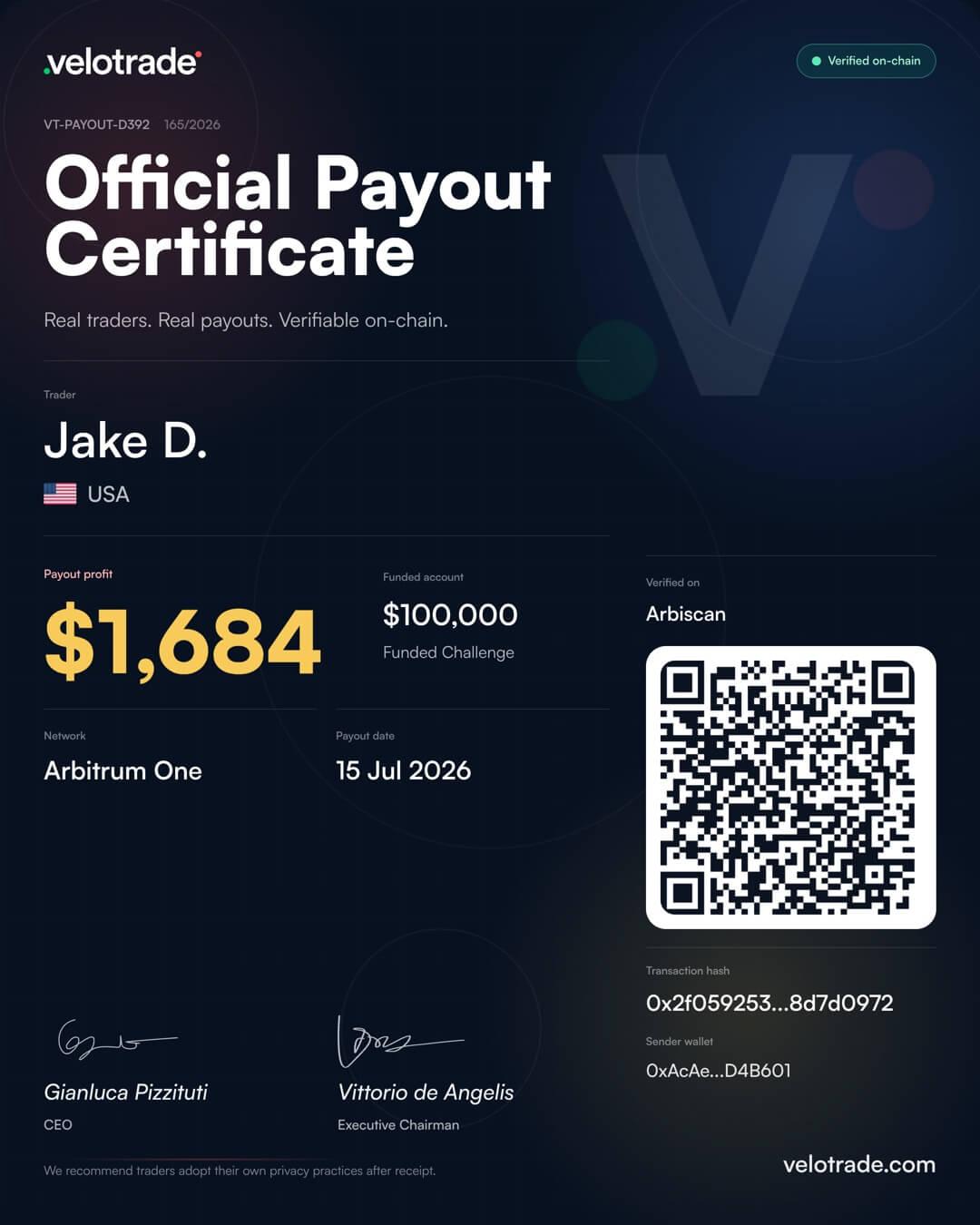
Firms that build a verifiable payout record attract more challenge buyers. Firms that do not pay create a short-lived operation that collapses under payout disputes and reputation damage. The sustainable version of this business requires genuine payouts, and the clearest evidence is real payout proof published on-chain for anyone to verify.
That logic does not guarantee any specific firm will pay. It means legitimate firms have a clear financial incentive to pay consistently, and that incentive is what separates credible long-term operators from fee-extraction schemes.
For a deeper look at how the funding model works in practice, see what a crypto funded trading account actually involves.

What separates legitimate firms from problematic ones
The gap between a legitimate operator and a problematic one is not always visible from marketing. It shows up in verifiable operational details.

| Factor | Legitimate operator | Warning signs |
|---|---|---|
| Payout evidence | Independent, multi-platform, consistent over time | Self-published screenshots only, no volume |
| Rules documentation | Full policy available before purchase | Rules only accessible after payment |
| Operating entity | Named company, identifiable team, traceable footprint | Anonymous, no legal entity, no named team |
| Rule stability | Consistent terms over time | Frequent changes after disputes or payout requests |
| Fee structure | Clear challenge pricing, straightforward costs | Multiple overlapping fees, hidden conditions |
| Dispute handling | Acknowledged publicly, resolved | Deleted complaints, no response to disputes |
| Platform | Established (MT5, DXtrade, cTrader) | Opaque in-house stack, no independent benchmarking |
How to verify a firm before paying
A structured process removes most of the guesswork. Run through all 5 steps before committing to any challenge fee.
Step 1: Search for independent payout confirmations.
Search the firm name plus "payout" across trader communities, Reddit, Discord servers, and independent review platforms. Filter for posts from accounts with established history on the platform, not accounts that exist to post one screenshot. Volume and consistency of confirmations across time is the signal. A handful of screenshots on the firm's own channels is not.
Step 2: Read the full rules before purchase.
The complete policy (drawdown mechanics, consistency rule status, news trading policy, weekend holding policy, and breach definitions) must be available before you pay. Any ambiguity in the written rules will be resolved in the firm's favor when a dispute arises. For a detailed framework covering every rule dimension to check, use how to evaluate a crypto prop firm.
Step 3: Verify the operating entity.
Search the company name, the founding team names, and the registered jurisdiction. A firm with no traceable legal entity and no named leadership is operating anonymously. That is a material risk factor regardless of how competitive the marketing terms appear.
Step 4: Check rule stability over time.
Search for any history of the firm changing payout terms retroactively, adding new breach conditions after traders earned profits, or modifying drawdown definitions mid-challenge. Rule changes after disputes are one of the strongest indicators of bad-faith operation.
Step 5: Assess fee structure logic.
Consider what the firm earns if most traders fail versus what happens if traders consistently pass and receive payouts. If the economics only function when traders fail, the incentive structure does not support a legitimate long-term operation. If you are still deciding between prop trading and trading with your own capital, see funded trading vs leverage trading for a full structural comparison.
For a full checklist of specific warning signals to evaluate before any payment, see the top crypto prop firm red flags.
Which crypto prop firms are considered legitimate in 2026
Several firms have established credible profiles based on operating track record, payout evidence, and rule transparency.
Velotrade operates as a crypto-native multi-asset prop firm backed by a founding team with institutional financial market backgrounds. Its rule structure includes no consistency rule, static maximum drawdown, news trading allowed, weekend holding allowed, and a profit split up to 90 percent. Velotrade covers crypto, forex, stocks, indices, and commodities on a single funded account, including spot gold and silver, WTI oil, and US index ETFs such as SPY and QQQ, and uses institutional hedging to align firm and trader incentives, rather than profiting from trader losses. Because it runs on DXtrade rather than MetaTrader, it is also available to US-based traders, where many MT5-based firms have withdrawn. For a full independent assessment, see the Velotrade review.
HyroTrader offers exchange-connected execution through Bybit with a verifiable payout record, though with a shorter operating history. For a side-by-side comparison, see HyroTrader vs Velotrade.
BrightFunded has built a beginner-accessible track record with broad platform support and clear onboarding structure. For a detailed comparison, see BrightFunded vs Velotrade.
FundedNext, DNA Funded, and FTMO all have verifiable payout histories, though their crypto-specific conditions vary in quality compared to crypto-native operators. See the full ranking and comparison of crypto prop firms for a structured breakdown.
What scam operations look like
Understanding the pattern of a short-lived fee-extraction scheme helps identify one before paying.
The most common structure: a firm launches with competitive marketing, collects challenge fees at volume for several months, then either disappears or begins finding technical reasons to deny funded trader payouts. Common operational patterns:
- Rules are written vaguely enough that any withdrawal request can be technically denied
- Drawdown mechanics are described in marketing language but left undefined in the actual policy
- The firm changes payout processing requirements after traders earn qualifying profits
- Social media shows payout screenshots, but trader community channels show a consistent pattern of disputes and non-payment
- After reputation damage accumulates, the firm rebrands and relaunches under a new name

The category is large enough now that this pattern has repeated multiple times with different firms. Independent research before paying is the only reliable protection mechanism available, because regulatory backstop does not exist.
The regulatory context
Crypto prop firms operate in a relatively unregulated environment compared to traditional financial services. Most jurisdictions do not specifically regulate the funded trading model, meaning there is no licensing requirement or regulatory body providing structured consumer protection.
This is not inherently a disqualifier. Many legitimate financial businesses operate with limited direct regulation. It does mean that the verification responsibility sits entirely with the trader.
In regulated financial environments, licensing status provides a partial quality signal. In crypto prop trading, it does not. The 5-step evaluation process above is not optional. It is the only available tool for assessing counterparty quality before payment.
The absence of regulation also means there is no recourse mechanism if a firm takes your challenge fee and closes. That is the core argument for choosing operators with established presence, named leadership, and a documented payout track record, even when a newer competitor offers more aggressive marketing terms.
For a full framework covering how to pass a crypto prop challenge once you have selected a verified firm, that guide covers challenge mechanics from entry to funded status.
Related reading: Are Prop Firms Worth It in 2026? An Honest Assessment.
Frequently Asked Questions
About the author

Vittorio De Angelis
Executive Chairman
Former equity-derivatives trader at JP Morgan, Dresdner Kleinwort and Bank of America in London. Later Head of Brokerage at a global broker in Hong Kong.
Velotrade was founded in Hong Kong in 2016 by a team from JP Morgan, Dresdner Kleinwort and Bank of America, has paid out over $2.5 billion to its trade-finance clients, and has been featured in Bloomberg, the Financial Times, the Wall Street Journal and on Nasdaq. Its prop trading evaluations are simulated and educational.
View author page