Trade crypto with funded capital
ExplorePrediction markets let you trade contracts on the outcome of a future event, and the price of each contract reads as the market's implied probability of that event happening. If a contract on "will BTC close above $100,000 this month" trades at 64 cents, the market is pricing roughly a 64% chance. This guide covers what a prediction market is, how prediction markets work, the main categories from politics to crypto, the major platforms, and how crypto price direction sits closest to actual trading.
Highlights of this article
- A prediction market is a market where contract prices, from 0 to 100 cents, map directly to the market's implied probability of an outcome
- Most prediction markets use Yes/No shares that resolve to 1 dollar if correct and 0 if not, so price equals probability
- The main categories are politics, economics, sports and crypto, with crypto price direction being the most trading-adjacent
- Major platforms include Polymarket, Kalshi and Robinhood, each with different regulatory and asset profiles
- Crypto direction prediction is a clean on-ramp to real trading, which is where Velotrade's Sprint Trading and funded challenges come in
What is a prediction market?
A prediction market is a market where you buy and sell contracts tied to the outcome of a specific future event. Each contract pays out a fixed amount if the event happens and nothing if it does not. Because the payout is fixed, the price you pay carries information: it is the market's collective estimate of how likely the outcome is.
The standard format is a binary contract. You hold a "Yes" share or a "No" share on a clearly defined question, such as "will the Federal Reserve cut rates at its next meeting" or "will Ethereum trade above $4,000 by Friday." When the event resolves, one side is worth 1 dollar and the other is worth 0.
The defining feature is that price and probability are the same number. A contract trading at 30 cents reflects a 30% implied probability. A contract at 85 cents reflects an 85% implied probability. This is what separates a prediction market from a forecast or a poll: the estimate is backed by real positions, and it updates in real time as new information arrives.
For traders, this is familiar territory. A prediction market is a focused way to express a view on a single, well-defined outcome, with a payoff structure that is easy to read.
How do prediction markets work?
The mechanics are straightforward once you understand the unit. A prediction market question has a defined resolution condition, a resolution date, and two contracts: Yes and No. The prices of the two always add up to about 1 dollar, minus a small spread.
Yes/No shares and the 0 to 100 scale
Prices run from 0 to 100 cents, which you can read directly as 0% to 100%. If Yes trades at 70 cents, No trades at roughly 30 cents. Buy Yes at 70 cents and you risk 70 cents to make 30 cents if the event happens. Buy No at 30 cents and you risk 30 cents to make 70 cents if it does not. The cheaper side pays more because the market thinks it is less likely.
How contracts resolve
Every market has a resolution source agreed in advance, for example an official election result, a published economic data release, or a reference exchange price for a crypto question. On the resolution date, the market settles: the correct side pays 1 dollar per share, the other side pays 0. You can also close a position before resolution by selling your shares at the current market price, which is how active traders take profits or cut losses early.
Where the odds come from and why liquidity matters
No bookmaker sets the line. The price is set by the order flow of everyone trading the market. Buyers of Yes push the price up, buyers of No push it down, and the equilibrium is the crowd's aggregated probability estimate. This is the information-aggregation property that makes prediction markets interesting: they pull together private information, opinion and money into a single, continuously updated number.
Liquidity determines how reliable that number is. A market with deep order books and high volume produces tight spreads and a price that responds quickly to news. A thin market can show a stale or distorted price, and large orders move it sharply. When you read a prediction market price, the volume behind it matters as much as the number itself.
A worked example
Say a market asks "will the next CPI print come in below 3%." Yes is trading at 40 cents, No at 60 cents. You research the recent inflation trend and conclude the chance is closer to 55%. The Yes side is underpriced relative to your estimate, so you buy Yes at 40 cents. If you are right and the data confirms it, your shares resolve to 1 dollar, a 60-cent profit on a 40-cent stake. If you are wrong, you lose the 40 cents.
The key idea is that you are not betting on a number you cannot influence, you are taking the other side of a market price you believe is mispriced, using information and analysis. Over many such calls, an edge in judgement shows up as a positive expected return. That is the same logic a discretionary trader applies to entries, just expressed in a binary contract instead of a position size.


The main categories of prediction markets
Prediction market platforms organise their questions into a few broad categories. Each has a different audience and a different relationship to trading.
Politics and elections
Election outcomes, policy decisions and approval ratings are the category that made prediction markets famous. These markets attract heavy volume around major events and are often cited as a real-time gauge of public expectation, separate from polling.
Economics
Interest rate decisions, inflation prints, jobs numbers and other macro data releases. These markets overlap directly with what rates and macro traders already follow, and they resolve against published official data, which keeps the resolution clean.
Sports
Game outcomes, season-long results and player milestones. This is the largest category by participation in many regions and the one closest in feel to traditional betting, though the contract structure is the same Yes/No format.
Crypto
Crypto is the category most relevant to active traders, because it includes price-direction questions. "Will BTC be above a given level by a given date," "will ETH outperform BTC this week," and similar contracts are, in effect, a clean way to express a directional view on an asset. The skills that win here, reading momentum, sizing a view, managing entries and exits, are the same skills that win in spot and derivatives trading. That overlap is the whole reason this article leans into crypto direction as the bridge to real trading.
If you are new to the wider space, our crypto prop trading glossary defines the terms that come up most often when you move from prediction into live markets.
Prediction market platforms at a glance
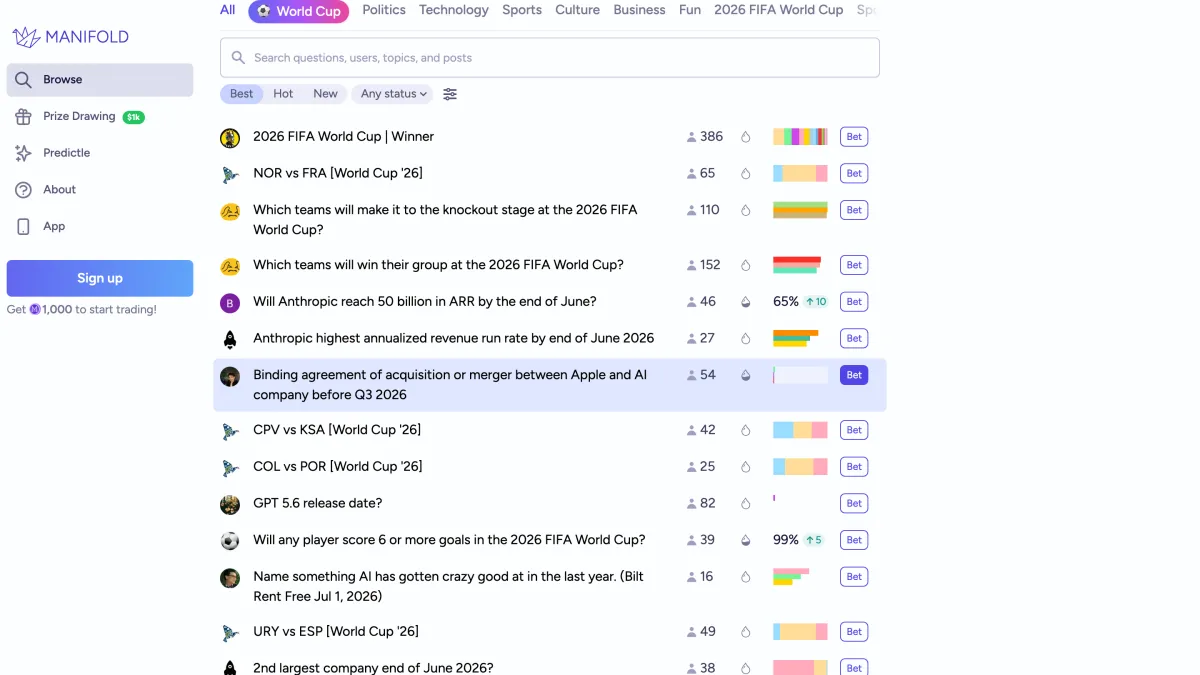
A handful of platforms dominate the space, each with a different regulatory footprint and asset focus. The table below is a neutral, high-level summary. For a deeper, side-by-side breakdown of the two best known, see Polymarket vs Kalshi, or browse the best prediction market apps.
| Platform | Settlement | Primary focus | Notes |
|---|---|---|---|
| Polymarket | Crypto (stablecoin) | Politics, crypto, world events | Large global volume, on-chain settlement |
| Kalshi | US dollars | Economics, politics, events | US regulated event-contract exchange |
| Robinhood | US dollars | Selected event contracts | Prediction contracts inside a mainstream brokerage app |
| Others | Varies | Sports, niche events | Smaller or regional venues, verify resolution rules |
The right venue depends on where you are, what you want to trade, and how you want to settle. Crypto-settled platforms tend to list more crypto and global-event markets, while dollar-settled exchanges lean toward economics and US-regulated event contracts.
A few practical points apply across all of them. Check the exact resolution rule before you trade, because ambiguous wording is the most common reason a market settles in a way participants did not expect. Look at volume and open interest, since a headline price on a thin market is unreliable. And confirm fee structure and withdrawal terms, which vary widely between crypto-settled venues and regulated exchanges. The contract format is similar everywhere; the operational details are where platforms diverge.
Are prediction markets legal and regulated?
The short answer is that it depends on the venue and your location, and the picture is still developing. In the United States, certain event contracts trade on exchanges regulated by the Commodity Futures Trading Commission (CFTC), which treats them as a recognised contract type. That is the framework Kalshi operates under, and it is why some markets are explicitly available to US participants while others are not.
Crypto-settled platforms often operate offshore relative to US rules, which is why access and availability vary by region. Rules around which event categories are permitted, particularly anything resembling sports or election wagering, continue to shift. The practical takeaway is to check the legal status of a specific platform in your jurisdiction before using it, rather than assuming a single global answer. This is general information, not legal advice.
Prediction markets vs gambling
This is the framing that matters most, and it is worth being precise. A pure gambling product, a roulette wheel or a slot machine, has a fixed house edge and an outcome driven entirely by chance. No amount of information or skill changes your expected return.
A prediction market is different in two ways. First, the price aggregates information, so a participant who knows more, or reasons better, about an outcome has a genuine edge. Second, the outcome itself is often a real-world event that can be researched, modelled and anticipated. A trader who correctly reads that an interest rate cut is more likely than the market is pricing can buy the underpriced side and profit on average over many such calls.
That does not mean prediction markets are risk-free. Any single contract can resolve against you, and thin markets, bad resolution rules or emotional sizing will lose money fast. But the core distinction holds: prediction markets reward information and judgement, where gambling does not. That skill component is exactly what makes crypto direction a useful training ground for real trading.
There is also a practical reason traders care about the difference. If outcomes were pure chance, practising would be pointless. Because they are not, repetition compounds: every call you make and review teaches you something about how the market prices information, how it reacts to news, and where your own judgement is sharp or weak. That feedback loop is the whole value of treating prediction as training rather than entertainment.
From prediction to trading: the crypto bridge
Of all the categories, crypto price direction is the one that maps most cleanly onto trading. Calling whether Bitcoin goes up or down over a defined window is a directional decision, the same decision a trader makes when opening a long or short. Get good at reading short-term direction and you are building the exact skill that funded trading rewards.
This is where Sprint Trading comes in. Sprint Trading is a free game at sprint.velotrade.com where you predict whether BTC will be up or down over the next 5-minute sprint. The live BTC/USDT price decides the result. There is no simulation and no house price, the real market is the referee. You get 10 seconds of warning before each sprint locks, so you commit to a call and then watch the live market settle it. See how to win a funded account for free.
You play with 100 free demo tokens per day, which reset at 12:00 UTC. Tokens cannot be purchased, they are demo tokens only, and no real money is deposited or at risk. A winning call pays 1.8x into your Competition Vault. Sprint Trading is skill-based market prediction using demo tokens with prizes. It is not gambling, and it is not real-money binary options.
The competitive layer is what makes it a genuine on-ramp. There are 4 leaderboards: Highest Vault, Most Sprints Won, Best Hit Rate and Longest Winning Streak. A new competition runs every second Monday, every two weeks, with 12 winners per competition and a maximum of one prize per player. The prizes are free Velotrade challenge accounts, starting at $10,000, $5,000 and $2,500 sizes and scaling up as more traders join. In other words, the top directional callers earn a real funded challenge without paying a fee.
Sprint Trading is in closed beta with limited seats at launch. You can join the waitlist at the Sprint Trading waitlist to get in early.
Graduating into funded crypto trading
Sprint Trading trains the directional instinct. The natural next step is a funded account, where that instinct is applied to real positions with real risk management. A crypto funded trading account lets you trade a firm's capital and keep a share of the profit, after passing an evaluation that confirms you can trade within defined risk rules.
If you want the full picture of how this model works, what crypto prop trading is explains the evaluation, the funded phase and the profit split. And if you are weighing where to start, our roundup of the best crypto prop firms compares the rules that actually affect your results.
The path is consistent: read direction in a no-risk environment, prove it on a leaderboard, then carry the same skill into a funded challenge. The table below shows how the three stages compare.
| Stage | What you risk | What you trade | What you can win |
|---|---|---|---|
| Prediction market | Your stake (or demo) | Yes/No on an outcome | The contract payout |
| Sprint Trading | Nothing, demo tokens only | BTC up or down, 5-minute window | A free funded challenge account |
| Funded challenge | A challenge fee, or won free via Sprint Trading | Live multi-asset positions | A funded account and profit split |
For traders who want to start without an upfront fee, our guide to the free prop firm challenge options covers what is genuinely free versus marketing, and Sprint Trading sits naturally alongside that as a way to earn a challenge through skill. You can also see how Sprint Trading compares to other crypto trading competitions in the space.
This is general educational information about prediction markets and trading, not financial advice.
More on prediction markets: Are Prediction Markets Legal? US and Global Status, Crypto Prediction Markets.
Frequently Asked Questions
About the author

Vittorio De Angelis
Executive Chairman
Former equity-derivatives trader at JP Morgan, Dresdner Kleinwort and Bank of America in London. Later Head of Brokerage at a global broker in Hong Kong.
Velotrade was founded in Hong Kong in 2016 by a team from JP Morgan, Dresdner Kleinwort and Bank of America, has paid out over $2.5 billion to its trade-finance clients, and has been featured in Bloomberg, the Financial Times, the Wall Street Journal and on Nasdaq. Its prop trading evaluations are simulated and educational.
View author page