Trade crypto with funded capital
ExploreTo predict Bitcoin price direction, you combine a few sources of evidence and accept that none of them gives certainty. The realistic goal is a probabilistic edge plus strict risk control, not a crystal ball. This guide covers the main methods traders use to read Bitcoin, where each one falls short, and a free way to test your calls on live price.
Highlights of this article
- No method predicts Bitcoin with certainty; the goal is a small edge plus risk control
- Technical analysis reads trend, key levels, and volume to frame probabilities
- On-chain and market-structure data, like funding and liquidations, drive short-term moves
- Macro and sentiment set the bigger backdrop for risk appetite
- The real edge is consistency and risk management, which you can practise for free
Start With Honest Expectations
Nobody predicts Bitcoin reliably. Anyone who claims a method that is always right is selling something.
What good traders actually do is shift the odds. They find setups where the probability leans their way, size the position so a wrong call is survivable, and let the math work over many trades. A 55 percent edge, applied with discipline, compounds. A 90 percent hit rate with reckless sizing still blows up on the first bad streak.
So treat prediction as probability, not prophecy. Every method below improves your read. None removes the risk. This is general education, not financial advice, and it contains no price targets.
Technical Analysis Basics
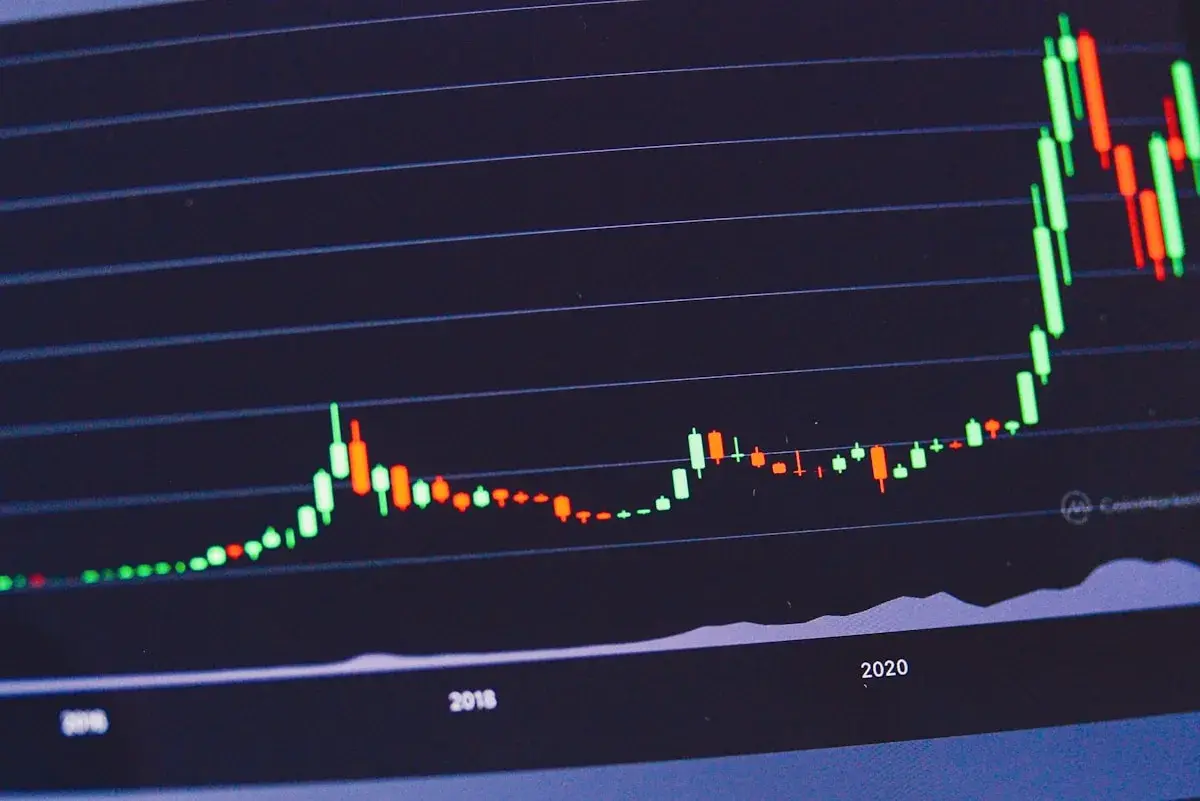
Technical analysis reads the price chart itself to frame what is likely next, from key levels to reversal shapes such as the double top.
The core ideas are trend, levels, and volume. Trend tells you the prevailing direction, and trading with it is usually higher probability than fighting it. Key levels are prices where the market has reacted before, often acting as support below or resistance above. Volume shows conviction, with strong moves on high volume more meaningful than drifts on thin volume. Tools such as the MACD indicator and the Ichimoku cloud turn these trend and momentum ideas into rules you can test.
None of this is predictive on its own. A level holds until it breaks. A trend continues until it reverses. Technical analysis gives you a framework for probabilities and clear invalidation points, which is exactly what you need to manage risk. For the vocabulary, see the crypto prop trading glossary.
On-Chain and Market-Structure Signals
Short-term Bitcoin moves are often driven by market structure rather than headlines. A break of structure, where price takes out the last swing high or low, is often the first sign the short-term trend has changed.
Perpetual funding rates show whether longs or shorts are paying to hold positions. Crowded one-sided positioning can set up a sharp move against the crowd. Open interest shows how much leverage is in the system. Liquidation levels matter because when price hits clusters of leveraged stops, the forced selling or buying can cascade and accelerate the move.
These signals are most useful on short timeframes. They explain why Bitcoin can lurch in minutes with no obvious news. They do not tell you the destination, only that the conditions for a fast move are building.
| Method | What it looks at | Best timeframe | Main limitation |
|---|---|---|---|
| Technical analysis | Trend, levels, volume | Minutes to weeks | Levels and trends only hold until they break |
| Market structure | Funding, open interest, liquidations | Seconds to days | Signals risk, not direction or destination |
| Macro and sentiment | Rates, risk appetite, news | Weeks to months | Slow, and surprises override it |


Macro and Sentiment
The wider backdrop sets the tone for risk assets, and Bitcoin trades as a risk asset much of the time.
Interest rates and liquidity conditions shape how much appetite there is for risk. Major economic releases and policy events can shift the whole market in moments. Sentiment, the general mood of fear or greed, tends to stretch to extremes before it snaps back.
Macro is slow-moving and easy to over-weight. It frames the environment well, but it rarely tells you what happens in the next hour. Treat it as the backdrop, not the trigger.
Short-Term vs Long-Term Prediction
The timeframe changes everything about what is predictable.
A 5-minute call on Bitcoin is mostly noise with a thin layer of momentum and structure on top. You can build a small edge there from positioning and order flow, but variance is high. A multi-week view leans more on trend and the macro backdrop, where the signal is steadier but still uncertain.
Match your method to your horizon. Funding and liquidation reads suit short calls. Trend and macro suit longer ones. Mixing them, using a macro thesis to justify a 5-minute scalp, is a common way to get hurt.

The Part That Actually Pays
Here is the honest centre of it. The edge in trading is not a magic indicator. It is risk management and consistency.
Two traders can use the same signals and get opposite results. The one who sizes positions sensibly, cuts losers at a planned level, and repeats a process over hundreds of trades comes out ahead. The one who doubles down to be right does not. This is the same discipline that funded accounts are built to test. For how that is assessed, see how to pass a crypto prop challenge.
A useful way to internalise this is to separate the call from the outcome. A good call can lose and a bad call can win on any single trade. You judge yourself on the process across many calls, not on one result.
A Simple Framework to Combine the Signals
Methods are more useful stacked than used alone. A practical way to combine them is to work from the top down.
Start with the backdrop. Is the macro environment risk-on or risk-off, and is sentiment stretched. This sets your bias and your size. In a hostile backdrop, you trade smaller and demand better setups.
Then read the structure. Where is leverage sitting, are funding rates lopsided, and where are the liquidation clusters that could fuel a fast move. This tells you the fuel and the likely direction of a squeeze.
Finally, time the entry on the chart. Use trend, a key level, and volume to pick a spot with a clear invalidation point, the price at which your idea is wrong and you exit. When all three layers agree, the call is higher probability. When they conflict, the honest move is to pass. No trade is a position.
Common Mistakes When Predicting Bitcoin
Most prediction errors are not about the signals. They are about behaviour. Paying for someone else's calls does not fix that, so read how to judge a crypto signals provider before you subscribe to one.
The first mistake is confusing a long-term thesis with a short-term trade. Being right that Bitcoin trends up over a year tells you nothing about the next hour, yet traders routinely hold losing scalps because of a macro view.
The second is chasing. Entering after a move has already run, with no level to lean on, means buying high and selling low when the move reverses. The setup is gone once price is extended.
The third is ignoring invalidation. A prediction without a clear point at which it is wrong is just a hope. The level where you exit is what turns a guess into a managed trade.
The fourth is over-sizing a high-confidence call. Confidence is not certainty. The most expensive losses come from putting too much on a call that felt sure and was not. Sizing for the chance of being wrong is what keeps you in the game.
Practise Your Calls for Free
The fastest way to learn whether you can read short-term Bitcoin is to make a lot of calls and keep score, without risking money.
Velotrade's Sprint Trading is a free game built for exactly this. You predict whether Bitcoin will be up or down over the next 5-minute sprint, and the live BTC/USDT price decides the result. You get 10 seconds of warning before each sprint locks. You receive 100 free demo tokens a day, reset at 12:00 UTC, with no option to buy more and no real money at risk. A winning call pays 1.8x into your Competition Vault.
Sprint Trading also keeps score in ways that match real trading skill. Four leaderboards track Highest Vault, Most Sprints Won, Best Hit Rate, and Longest Winning Streak. A new competition runs every second Monday, with 12 winners per competition and one prize each. The top players win real Velotrade challenge accounts, with sizes starting at $10,000, $5,000, and $2,500 and scaling up as more traders join. You can win a funded account for free this way.
That is the bridge from predicting to trading. Once you can call direction with a positive hit rate and manage your tokens like risk, a funded account lets you trade that skill for real. Compare your options in best crypto prop firms, see how a free contest can win you an account in crypto trading competitions, or practise risk-free first with a crypto trading simulator.
This article is general education about reading Bitcoin price direction. It is not financial advice and contains no price predictions. Sprint Trading is a skill game using demo tokens, not gambling.
Related reading: Best Prediction Market Apps and Platforms in 2026, Crypto Prediction Markets.
Frequently Asked Questions
About the author

Vittorio De Angelis
Executive Chairman
Former equity-derivatives trader at JP Morgan, Dresdner Kleinwort and Bank of America in London. Later Head of Brokerage at a global broker in Hong Kong.
Velotrade was founded in Hong Kong in 2016 by a team from JP Morgan, Dresdner Kleinwort and Bank of America, has paid out over $2.5 billion to its trade-finance clients, and has been featured in Bloomberg, the Financial Times, the Wall Street Journal and on Nasdaq. Its prop trading evaluations are simulated and educational.
View author page