Trade crypto with funded capital
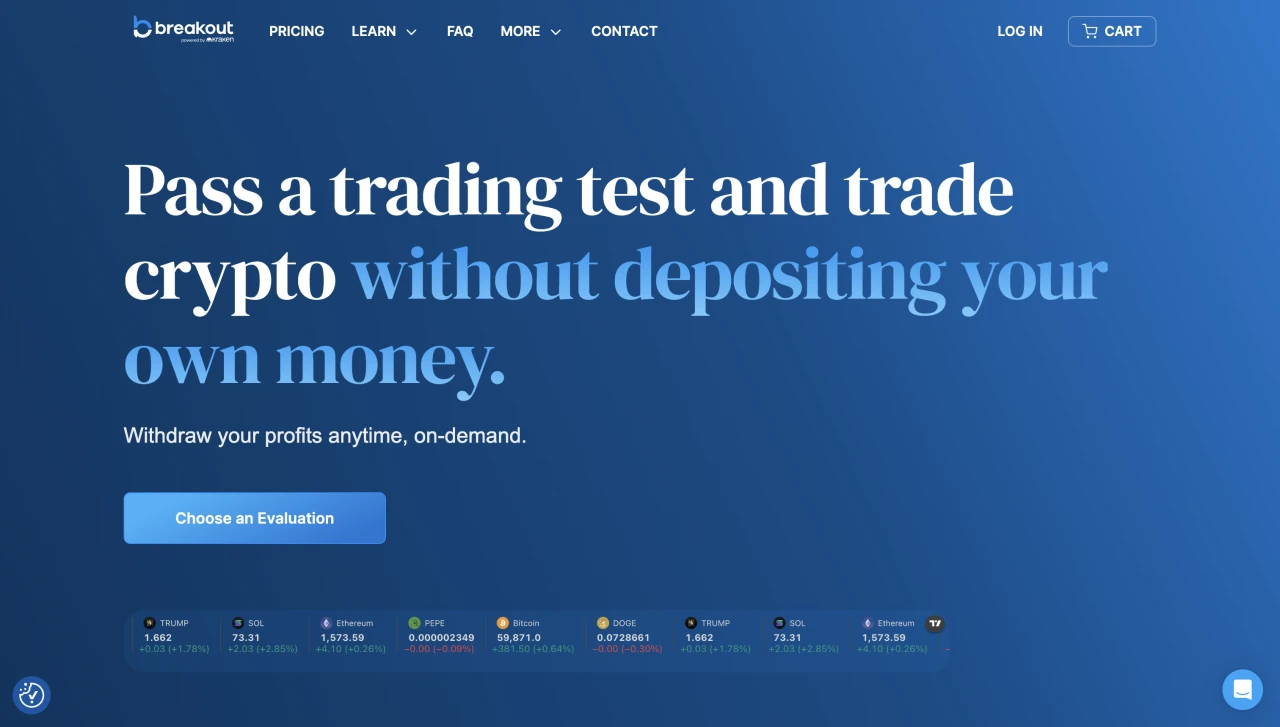
ExploreBreakout Prop and Velotrade are two of the most crypto-native prop firms in the market. Both use a static drawdown on every plan, both apply no consistency rule, both allow news trading and weekend holding, and both are built for the 24/7 crypto market. They are closely matched, so the decision comes down to price, payouts, and market breadth. This comparison puts them side by side, using Breakout's pricing and rules pages as of September 2026.
Highlights of this article
- Both firms are crypto-native with a static drawdown on every plan and no consistency rule, and both allow news trading and weekend holding
- Velotrade is multi-asset (crypto plus forex, stocks, indices, commodities); Breakout Prop is mostly crypto plus index products such as the Nasdaq 100 and S&P 500
- Breakout Prop is cheaper to enter ($20 for a $5,000 Turbo vs Velotrade's $40 PRO 1-Step) but sells 1-step evaluations only; Velotrade also offers a 2-step with a wider 10% floor
- Breakout Prop pays 80%, or 90% with a paid upgrade, on demand in USDC; Velotrade pays up to 90% from day one, first after 14 days and then weekly
- Breakout Prop runs its own platform on Kraken liquidity; Velotrade runs on DXtrade
- Breakout was founded in 2023 and is now owned by Kraken; Velotrade launched its crypto prop product in 2026, so check payout history for each
Quick Comparison: Breakout Prop vs Velotrade
| Breakout Prop | Velotrade | |
|---|---|---|
| Founded | 2023 | 2026 (crypto prop launch) |
| HQ | USA | Hong Kong |
| Markets | 63, mostly crypto plus index products | Crypto, forex, stocks, indices, commodities |
| Account sizes | $5K to $200K | $5K to $200K |
| Challenge types | 1-step only (Classic, Pro, Turbo) | 1-step and 2-step |
| Drawdown type | Static on all plans | Static on all plans |
| Max drawdown | 3% to 6% by plan; 3% daily | CLASSIC 2-Step 10%, CLASSIC 1-Step 7%, PRO 1-Step 3%; 3% to 5% daily |
| Consistency rule | None | None |
| News trading | Allowed | Allowed |
| Weekend holding | Allowed | Allowed |
| EAs / automation | Allowed (no HFT, hedging, copy) | Allowed |
| Platform | Breakout platform (Kraken liquidity) | DXtrade only |
| Profit split | 80%, or 90% with an add-on | Up to 90% from day 1 |
| Payout | On demand 24/7, USDC, $50 minimum | First after 14 days, then weekly, USDC/USDT |
| Cheapest $5K entry | $20 (Turbo) | $40 (PRO 1-Step) |
| Track record | Since 2023 | Since 2026 |
Drawdown: Static at Both Firms
Both firms now use a static drawdown on every plan: the loss floor is fixed from your starting balance and never moves up against you. Breakout discontinued its 2-step, which used a trailing floor, in May 2026, so drawdown type no longer separates them.
The difference is how much room you get. Breakout's plans run from a 3% static floor (Turbo) to 6% (Classic). Velotrade's run from 3% (PRO 1-Step) to 7% (CLASSIC 1-Step) and 10% on its CLASSIC 2-Step, so traders who want the widest buffer have a two-phase option at Velotrade that Breakout no longer sells.
For why the calculation method matters as much as the percentage, see static maximum drawdown explained. To model your floor on either setup, use the prop trading drawdown calculator.
Free calculator
How many losing trades before you breach?
See your drawdown floor, daily loss budget, and losing trade capacity for any account size - before you place a single trade.
Use the free drawdown calculatorRule Freedom: Both Clean
On trading rules, these two firms are about as aligned as any pair in the market. Neither applies a consistency rule, so you can concentrate profit on your best days. Both allow news trading with no blackout windows, and both allow weekend holding, which matches the 24/7 crypto market. For event-driven and concentrated strategies, either firm gives you room that forex-first firms often do not.
This shared rule freedom is exactly why the decision comes down to the structural differences: price, market breadth, platform, and payouts. For more on the consistency rule and which firms still enforce it, see crypto prop firms with no consistency rule.
Payout proof
Fast, real payouts. Traceable on Arbitrum.
- Paid within 24 hours of approval
- Settled on Arbitrum in USDC or USDT
- Look up any transaction on Arbiscan


Multi-Asset vs Crypto-First
This is Velotrade's clearest advantage. Velotrade is multi-asset: you can trade crypto alongside forex, individual stocks, indices, and commodities on the same funded account. Breakout Prop lists 63 markets, but they are mostly crypto plus index products such as the Nasdaq 100 and S&P 500, with no forex, individual stocks, or commodities.
If you trade nothing but crypto, that focus is not a drawback, and Breakout Prop's exchange-native execution may even suit you better. But if you want to diversify across asset classes, hedge crypto exposure with another market, or simply keep your options open on one account, Velotrade covers ground that Breakout Prop does not. For how the multi-asset model works, see best multi-asset prop firm.
Platform and Execution
Breakout Prop runs its own trading platform backed by Kraken liquidity, which gives genuine exchange-native execution on crypto. The trade-off is that there is a proprietary interface to learn rather than a familiar MetaTrader setup. Velotrade runs exclusively on DXtrade, a single platform calibrated for its static, multi-asset rule set.
If exchange-native crypto execution is your priority, Breakout Prop's Kraken-backed platform is the differentiator. If you want one platform that handles crypto and other asset classes under a consistent rule set, Velotrade is built for that. Both firms restrict automation, so confirm your EA or bot is allowed at either.

Profit Split and Payouts
Breakout Prop pays 80% as standard, and you can buy a permanent 90/10 upgrade at checkout. It also pays out on demand, 24/7, in USDC (ERC-20) with a $50 minimum, which is about as crypto-native as payouts get. Its challenge fee is not refunded.
Velotrade pays up to 90% from day one, with the first payout 14 days after you are funded and weekly after that. Breakout wins on payout speed and entry price; the splits are similar once you account for Breakout's upgrade.
What Each Firm Suits Best
Choose Velotrade if:
- You want multi-asset access (crypto plus forex, stocks, indices, commodities) on one account
- You want a two-step evaluation with a wider 10% static floor
- You want up to 90% profit split from your first payout
- You prefer one platform with a consistent rule set across assets
Choose Breakout Prop if:
- You trade crypto only and want exchange-native execution on Kraken liquidity
- You want the cheapest entry ($20 for $5,000) and on-demand USDC payouts
- You are comfortable on a proprietary platform rather than MetaTrader
- You are happy with a 1-step evaluation and a 3% to 6% static floor
Which Prop Firm Is Better?
There is no single winner, because these firms are genuinely close. Breakout Prop wins on price and payouts: a $20 entry, Kraken-backed execution, and on-demand USDC withdrawals. Velotrade wins on breadth and choice: forex, stocks, and commodities on one account, plus a 2-step with a wider floor.
Decide on two questions. Do you trade only crypto and indices, or do you want other markets too? And do you want a two-phase evaluation with more drawdown room? If you trade crypto and want the cheapest entry with on-demand payouts, Breakout Prop is excellent. If you want multi-asset coverage or a wider floor, Velotrade is the better fit. Verify the current terms directly before purchasing either.
For the deeper firm profiles, see the Breakout Prop review and the Velotrade review. For the wider market, see best crypto prop firms in 2026, and for Breakout Prop's full rule profile, the Breakout Prop directory page.
Funded accounts
Ready to compare rule sets directly?
Trade up to $200,000 in firm capital with static drawdown, no consistency rule, and payouts within 24 hours.
View Velotrade's challenge optionsFrequently Asked Questions
About the author

Vittorio De Angelis
Executive Chairman
Former equity-derivatives trader at JP Morgan, Dresdner Kleinwort and Bank of America in London. Later Head of Brokerage at a global broker in Hong Kong.
View author page