New to funded trading?
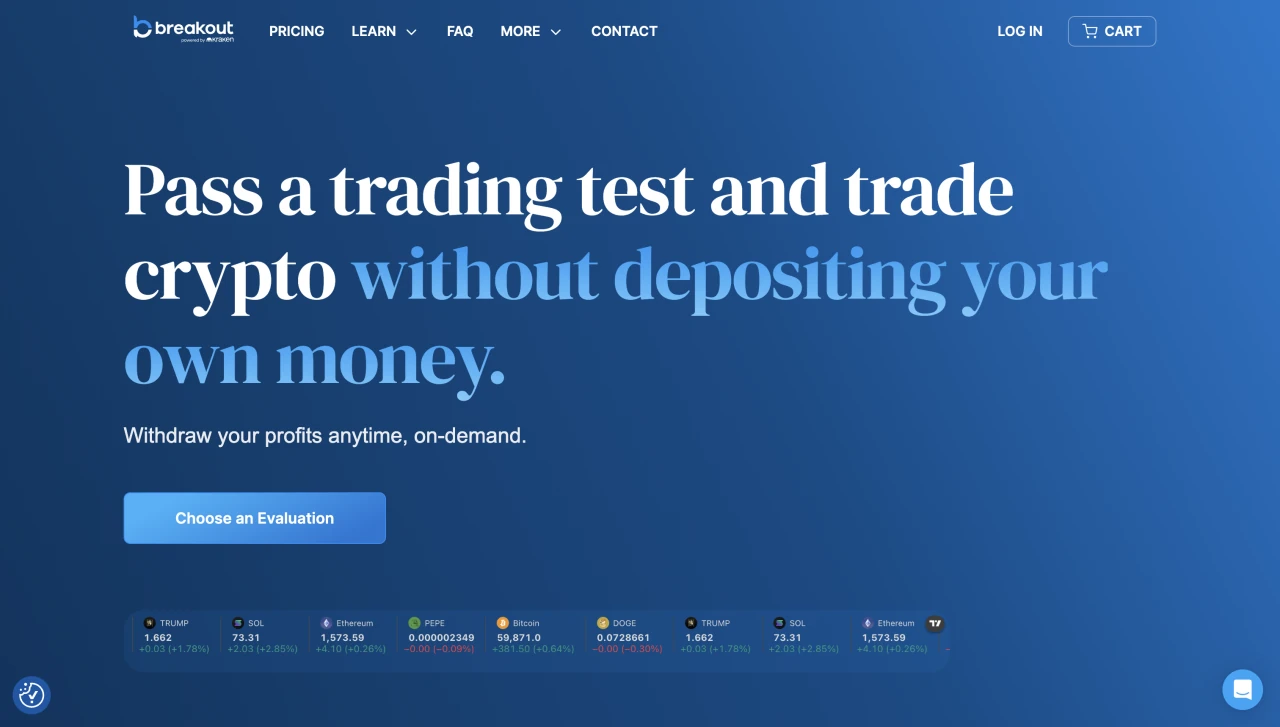
ExploreBreakout Prop is a crypto-first prop firm, founded in 2023 in the USA and now owned by Kraken. It sells three 1-step evaluations from $5,000 to $200,000, all with a static drawdown, on its own platform backed by Kraken liquidity, with on-demand USDC payouts and no consistency rule. This review covers what Breakout offers as of September 2026, based on its pricing and program-rules pages, and where it fits against other crypto-native firms.
Quick answer: Breakout Prop is a Kraken-owned, crypto-first prop firm with three 1-step plans (Classic, Pro, and Turbo), accounts from $5,000 to $200,000, and a static drawdown on every plan. It is one of the cheapest entries in crypto prop: $20 for a $5,000 Turbo evaluation. The split is 80/20, or 90/10 with a paid upgrade, payouts are on demand in USDC, and there is no consistency rule or minimum trading days.
Highlights of this article
- Breakout Prop sells three 1-step plans: Classic (10% target, 6% drawdown), Pro (12%, 5%), and Turbo (9%, 3%); it discontinued its 2-step in May 2026
- Every plan uses a static maximum drawdown and a 3% daily loss limit
- Entry is cheap: $20 (Turbo), $33 (Pro), or $45 (Classic) for a $5,000 account
- No consistency rule, no time limits, and no minimum trading days
- 80/20 split as standard, 90/10 as a paid upgrade; on-demand 24/7 payouts in USDC
- Owned by Kraken; 63 markets including BTC, ETH, SOL, the Nasdaq 100, and the S&P 500
What Breakout Prop Is
Breakout Prop launched in 2023 as a crypto prop firm built around exchange-native execution, and it has since been acquired by Kraken. Rather than reselling a third-party platform, it runs its own trading interface backed by Kraken liquidity, which appeals to traders who want real order-book depth on crypto. Its market list has grown to 63 instruments, mostly crypto plus index products such as the Nasdaq 100 and S&P 500, with up to 10x leverage depending on the asset.
Two things stand out. First, the rule set is clean: no consistency rule, no minimum trading days, no time limits, and a static drawdown on every plan. Second, payouts are crypto-native, processed on demand around the clock in USDC (ERC-20).
For a full evaluation framework to apply before joining any prop firm, see how to evaluate a crypto prop firm.
Payout proof
Fast, real payouts. Traceable on Arbitrum.
- Paid within 24 hours of approval
- Settled on Arbitrum in USDC or USDT
- Look up any transaction on Arbiscan


Challenge Structure and Pricing
Breakout Prop offers three 1-step evaluations. All share a 3% daily loss limit and a static maximum drawdown; they differ in profit target, drawdown room, and price.
| Plan | Profit target | Daily loss | Max drawdown (static) | Account sizes |
|---|---|---|---|---|
| 1-Step Classic | 10% | 3% | 6% | $5K to $100K |
| 1-Step Pro | 12% | 3% | 5% | $5K to $200K |
| 1-Step Turbo | 9% | 3% | 3% | $5K to $200K |
| Account size | Classic | Pro | Turbo |
|---|---|---|---|
| $5,000 | $45 | $33 | $20 |
| $10,000 | $85 | $65 | $40 |
| $25,000 | $215 | $150 | $95 |
| $50,000 | $400 | $280 | $180 |
| $100,000 | $800 | $545 | $330 |
| $200,000 | Not offered | $1,090 | $660 |
Fees are one-time, with no subscription, and are not refunded once trading begins. Upgrading to a 90/10 split costs extra at checkout (for example $48 on a $10,000 Turbo). You can hold up to $200,000 in total funded capital across accounts. Prices are from breakoutprop.com in September 2026.
Drawdown: Static on Every Plan
Since discontinuing its 2-step in May 2026, Breakout Prop uses a static maximum drawdown on every plan: the limit is set when the account is created and never changes, however much profit you make. That is the forgiving model, and it matches Velotrade's approach.
The plans trade drawdown room for price. Turbo is the cheapest but leaves only a 3% buffer, Pro offers 5%, and Classic 6%. On a crypto account with regular intraday swings, a 3% static floor is tight, so size positions accordingly. For why the calculation method matters as much as the percentage, see static maximum drawdown explained. To model your floor, use the prop trading drawdown calculator.
Free calculator
How many losing trades before you breach?
See your drawdown floor, daily loss budget, and losing trade capacity for any account size - before you place a single trade.
Use the free drawdown calculatorTrading Rules: A Clean Set
Breakout Prop's rules are among the most permissive in the crypto prop category.
No consistency rule. Breakout Prop applies no consistency rule, no time limits, and no minimum trading days, so you can pass in a single session if you hit the target. For why this matters and which firms still enforce it, see crypto prop firms with no consistency rule.
News trading allowed. There are no blackout windows around high-impact news.
Weekend holding allowed. Positions can be held over weekends, which fits the 24/7 crypto market.
EAs allowed, with limits. Bots are permitted, but Breakout Prop bans HFT and latency exploitation, cross-account hedging, and copy trading or signal-following. Confirm your specific automation is allowed before purchasing.
Funded accounts
Comparing firms on these specific rules?
Trade up to $200,000 in firm capital with static drawdown, no consistency rule, and payouts within 24 hours.
View Velotrade's confirmed rule setProfit Split and Payout
The split is 80/20 as standard on every plan, and you can upgrade to 90/10 at checkout for an extra fee; the upgrade is permanent for that account. The standout feature is the payout process: on demand, 24/7, with a $50 minimum after the split, paid in USDC (ERC-20).
The challenge fee is not refundable. For what to check before the first payout, see crypto prop firm payout speed: what traders need to check.

Breakout Prop vs Velotrade: Key Differences
| Breakout Prop | Velotrade | |
|---|---|---|
| Founded | 2023 (now owned by Kraken) | 2026 (crypto prop launch) |
| HQ | USA | Hong Kong |
| Markets | 63, mostly crypto plus index products | Crypto, forex, stocks, indices, commodities |
| Account sizes | $5K to $200K | $5K to $200K |
| Challenge types | 1-step only (three plans) | 1-step and 2-step |
| Drawdown type | Static on all plans | Static on all plans |
| Max drawdown | 3% to 6% by plan; 3% daily | CLASSIC 2-Step 10%, CLASSIC 1-Step 7%, PRO 1-Step 3%; 3% to 5% daily |
| Cheapest $5K entry | $20 (Turbo) | $40 (PRO 1-Step) |
| Consistency rule | None | None |
| News trading | Allowed | Allowed |
| Weekend holding | Allowed | Allowed |
| EAs / automation | Allowed (no HFT, hedging, copy) | Allowed |
| Platform | Breakout platform (Kraken liquidity) | DXtrade only |
| Profit split | 80%, or 90% with an add-on | Up to 90% from day 1 |
| Payout | On demand 24/7, USDC, $50 minimum | First after 14 days, then weekly, USDC/USDT |
| Track record | Since 2023 | Since 2026 |
These two firms are closely matched: both are crypto-native, both use a static drawdown on every plan, both apply no consistency rule, and both allow news trading and weekend holding. The differences are in three places. Breakout is cheaper to enter and pays out on demand. Velotrade covers more markets on one account (forex, individual stocks, and commodities as well as crypto and indices), offers a 2-step path with a wider 10% floor, and runs on DXtrade with a full API.
For the full head-to-head, see Breakout Prop vs Velotrade. For Breakout Prop's rule profile alongside other firms, see the Breakout Prop directory page, and for the broader market, best crypto prop firms in 2026.
What to Verify Before Purchasing
- Which plan fits your risk: Turbo's 3% static floor is tight; Classic's 6% gives more room at a higher price.
- Split upgrade cost if you want 90/10 from the start.
- Payout minimums and verification, beyond the advertised on-demand USDC speed.
- EA policy for your strategy, confirming your automation is not classed as HFT, hedging, or copy trading.
- Platform specifics, since Breakout runs its own interface rather than MT5 or cTrader.
For the full due diligence framework, see how to evaluate a crypto prop firm and top crypto prop firm red flags.
Who Breakout Prop Suits
Breakout Prop is a reasonable choice if:
- You trade mainly crypto and want exchange-native execution with Kraken liquidity
- You want the cheapest possible entry ($20 for $5,000 on Turbo)
- You want on-demand 24/7 payouts in USDC
- You want a clean rule set: static drawdown, no consistency rule, news and weekend trading allowed
Breakout Prop is a harder fit if:
- You want forex, individual stocks, or commodities on the same account
- You want a two-phase evaluation with a wider drawdown
- You prefer a familiar platform like MT5, cTrader, or DXtrade over a proprietary interface
- You want the challenge fee refunded on your first payout
For a broader view of the market, see best crypto prop firms in 2026 or browse the crypto prop firm directory.
Data sourced from breakoutprop.com (pricing and program rules) as of September 2026. Confirm all current terms directly with Breakout Prop before purchasing.
Frequently Asked Questions
About the author

Vittorio De Angelis
Executive Chairman
Former equity-derivatives trader at JP Morgan, Dresdner Kleinwort and Bank of America in London. Later Head of Brokerage at a global broker in Hong Kong.
View author page