New to funded trading?
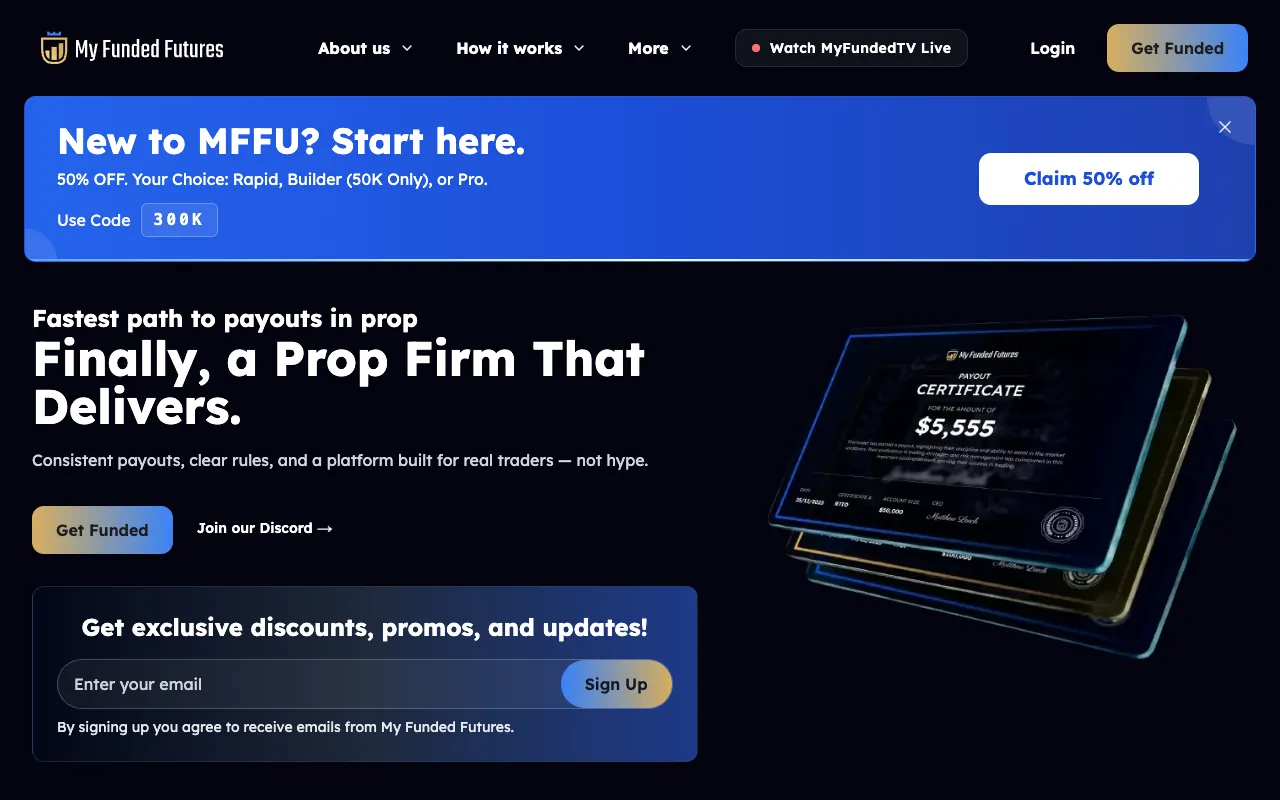
ExploreMyFundedFutures and Velotrade are both well-regarded prop firms, but they fund different traders in different markets. MyFundedFutures, often shortened to MFFU, is a US futures firm that funds CME contracts on session hours, with four plans and a genuine strength that most rivals lack: three of them have no daily loss limit at all. Velotrade is crypto-native and multi-asset, trading 24/7 with a static drawdown fixed from your starting balance on every plan.
The choice between them is really a choice of markets and structure. If you trade CME futures on US session hours and like the freedom of a plan with no daily loss cap, MFFU is built for you. If you trade crypto or want 24/7 multi-asset access under one predictable rule set, Velotrade is the closer fit. This comparison puts them side by side so you can decide.
Quick answer: MyFundedFutures is a US CME futures firm with four plans (Rapid, Rapid EOD, Builder, Pro), one-time evaluation fees with no activation fee, a $3,000 target on a $50,000 account, no daily loss limit on three of the four plans, and a drawdown model that changes by plan (Rapid trails intraday once funded; the others stay end-of-day). Velotrade is a crypto-first multi-asset firm that trades 24/7 under a static drawdown fixed from your starting balance, with no consistency rule and no maximum risk per trade. Neither is strictly better; MFFU wins for futures traders who want fast payouts and plan choice, Velotrade wins for 24/7 crypto traders who want one simple drawdown model.
Highlights of this article
- MyFundedFutures trades CME futures on session hours; Velotrade trades crypto 24/7 including weekends, plus forex, stocks, index ETFs and commodities
- MFFU has no daily loss limit on three of its four plans, a real strength, but its drawdown model changes by plan (Rapid trails intraday once funded; the others trail at the end of the day)
- Velotrade uses one uniform static drawdown fixed from your starting balance that never trails, with no consistency rule and no maximum risk per trade
- MFFU offers four plans to match different styles; Velotrade offers three challenge types with one static drawdown model
- MFFU runs 80/20 to 90/10 splits with frequent payouts; Velotrade pays up to 90% from your first payout
- MFFU launched in September 2023 with an Excellent Trustpilot rating and more than $120M paid; Velotrade launched its crypto prop product in 2026
Quick Comparison: MyFundedFutures vs Velotrade
| MyFundedFutures | Velotrade | |
|---|---|---|
| Markets | CME futures (plus a separate new 24/7 perps product) | Crypto-first; forex, stocks, indices, commodities |
| Trading hours | CME session hours | 24/7 including weekends |
| Drawdown model | End-of-day trailing; Rapid switches to intraday trailing once funded | Static, fixed from starting balance, on every plan |
| Daily loss limit | None on Rapid, Rapid EOD, Pro; $1,000 soft pause on Builder | 4% to 5% (CLASSIC), 3% (PRO 1-Step) |
| Consistency rule | Evaluation: 50% (Rapid), 30% (Rapid EOD); Builder 50% at payout | None |
| Max risk per trade | Not applicable | None |
| Plans | Four (Rapid, Rapid EOD, Builder, Pro) | Three challenge types, one static drawdown model |
| Profit split | 80/20 (Builder), 85/15 (Pro), 90/10 (Rapid) | Up to 90% from day 1 |
| Payouts | Daily (Rapid), 48 hours (Builder), bi-weekly (Pro) | First after 14 days, then weekly |
| Platforms | Futures platforms (NinjaTrader, Tradovate, etc.) | DXtrade |
| Track record | Since Sept 2023, $120M+ paid, Trustpilot Excellent (~4.9) | Since 2026 (crypto prop launch) |
Markets and Hours: CME Futures vs 24/7 Crypto
This is the first fork in the road. MyFundedFutures funds CME futures contracts only, with no crypto, forex, indices, or stock markets. Trading is bound to CME session hours, so there is no true 24/7 or weekend trading. For a dedicated futures trader, that focus is a feature, not a limitation: MFFU is built end to end for the instruments and hours you already trade.
Velotrade takes the opposite approach. It is crypto-native and multi-asset, funding crypto, forex, stocks, indices, and commodities under one rule set, and the market runs 24/7 including weekends. News trading and weekend holding are allowed. If your edge lives in crypto or you want the flexibility to hold through the weekend when the market never closes, Velotrade matches how you trade in a way a session-bound futures firm cannot.
Neither approach is better in the abstract. It comes down to which markets you actually trade. For the wider futures field, see the best prop firm for futures.
Drawdown and Daily Loss: Plan-Dependent vs One Static Rule
Both firms handle risk well, but in very different ways, and MFFU deserves real credit here. Three of MyFundedFutures' four plans (Rapid, Rapid EOD, and Pro) have no daily loss limit, and Builder's is only a $1,000 soft pause, so a single rough session rarely ends an account that stays above the overall drawdown. The catch is that the drawdown model changes by plan: every plan uses an end-of-day trailing drawdown in the evaluation, but once funded Rapid switches to an intraday trailing drawdown that locks at $100, while Rapid EOD, Builder, and Pro stay end-of-day. The plan you pick matters more than the account size, and a trailing model can still move against a profitable account.
Velotrade keeps it uniform. It uses one static maximum drawdown fixed from your starting balance that never trails, in the evaluation or when funded. There is no plan-by-plan variation to decode, no consistency rule, and no maximum risk per trade. You get a single predictable floor and full discretion over position sizing. To understand why the calculation method matters as much as the percentage, see static maximum drawdown explained.
So the honest read is this: MFFU gives you the freedom of no daily loss limit on most plans but asks you to learn which drawdown model your plan uses, while Velotrade pairs a daily loss limit with one static floor that behaves the same everywhere. Both are fair; they suit different preferences.

Payout proof
Fast, real payouts. Traceable on Arbitrum.
- Paid within 24 hours of approval
- Settled on Arbitrum in USDC or USDT
- Look up any transaction on Arbiscan


Plans: Five Options vs One Rule Set
MyFundedFutures offers four plans, Rapid, Rapid EOD, Builder, and Pro, each with its own drawdown, split, and payout schedule. That range is powerful once you know what you want: daily payouts on Rapid, an end-of-day drawdown on Rapid EOD or Pro, the cheapest entry on Builder, and the largest payouts on Pro. The trade-off is that you have to understand the plans to choose well, and older plans such as Core, Flex, Starter, and Expert have been retired, so older reviews can mislead.
Velotrade runs one rule set with 1-step and 2-step challenges. There is no menu to decode: the static drawdown, the absence of a consistency rule, and the profit split apply the same way across the board. If plan-picking feels like homework, that simplicity is the appeal. If you value being able to tune your rules to a specific style, MFFU's menu is the advantage.
For the full MFFU plan breakdown, see the MyFundedFutures review. Before you commit to either firm, model your odds with the challenge pass calculator.
Profit Split and Payouts
Both firms are strong on payouts. MyFundedFutures runs a 90/10 split on Rapid and Rapid EOD, 85/15 on Pro, and 80/20 on Builder, with fast payouts: Rapid and Rapid EOD pay daily, Builder every 48 hours, and Pro bi-weekly with up to $100,000 per payout. That makes MFFU one of the more trader-friendly futures firms on payout mechanics.
Velotrade pays up to 90% from your first payout with no tier to climb, and its payouts are frequent as well. On headline split, both firms reach the 90% mark, MFFU on its Rapid plan and Velotrade with its checkout add-on. The practical difference is structure: at MFFU your split and cadence depend on which plan you bought, while at Velotrade the split you choose applies from the start.
Fees and Resets
MyFundedFutures charges a one-time evaluation fee with no renewals and no activation fee. List prices for a $50,000 account are about $157 (Rapid), $153 (Builder), and $227 (Pro), and frequent promotions cut 30% to 50% off, so headline pricing moves often. It lets you reset a failed evaluation for a fee rather than rebuying the plan. Confirm current pricing on myfundedfutures.com before buying.
Velotrade also charges a one-time challenge fee per account, and the fee is not refunded on passing. At $50,000, MFFU's promoted prices can undercut Velotrade's $305 PRO 1-Step, while Velotrade's smallest entry ($40 for $5,000) is far below MFFU's smallest $25,000 plan. Both firms revise pricing and promotions frequently, so verify the current terms directly.
Platforms
MyFundedFutures runs on established futures platforms such as NinjaTrader and Tradovate, the standard tooling for CME futures traders, so you can keep a familiar setup. Velotrade runs on DXtrade. Neither is inherently better; the right choice is the platform that fits the markets you trade. A futures trader will feel at home on MFFU's platform lineup, while a crypto and multi-asset trader gets a single consistent interface on DXtrade.
Track Record and Background
MyFundedFutures is the more established name in this comparison. Launched in September 2023, it holds an Excellent rating on Trustpilot, around 4.9 out of 5 across roughly 18,000 or more reviews, and publishes a running payout total of more than $120 million across 55,000-plus payouts by mid-2026. It has not been hit by the kind of mass payout controversy that has damaged some competitors. In a category where trust is scarce, that record is a real point in its favour, even though the firm is still relatively young.
Velotrade launched its crypto prop product in 2026, so it has less accumulated payout history than MFFU. Its counterpoint is a documented institutional team background and a rule set built specifically for 24/7 crypto and multi-asset trading. Where MFFU leads on operating history and public payout proof, Velotrade leads on crypto-native rules and a simpler structure. Both are legitimate; they are just at different stages.
What Each Firm Suits Best
Choose Velotrade if:
- You trade crypto or want 24/7 multi-asset access including weekends
- You want one uniform static drawdown fixed from your starting balance that never trails
- You want no consistency rule and no maximum risk per trade
- You prefer one simple rule set over a menu of plans, and you are comfortable on DXtrade
Choose MyFundedFutures if:
- You trade CME futures on US session hours
- You value having no daily loss limit on your account (Rapid, Rapid EOD, or Pro)
- You want to pick a plan that matches your style (fast payouts, forgiving drawdown, or fixed max loss)
- You want a longer public payout record and an Excellent Trustpilot reputation
Which Prop Firm Is Better?
Neither is strictly better; they serve different traders. MyFundedFutures is the stronger choice for CME futures traders who want session-hours trading, fast payouts, and the flexibility to pick a plan whose drawdown and payout cadence match how they trade, backed by a strong public payout record. Velotrade is the stronger choice for crypto and multi-asset traders who want 24/7 markets under one static drawdown, with no consistency rule and no maximum risk per trade.
Decide on markets first. If you trade futures, MFFU is built for you and its no-daily-limit plans are a genuine advantage. If you trade crypto or want always-on multi-asset access under one predictable rule set, a Velotrade challenge fits the way you trade. Verify the current terms directly before purchasing either. For the wider market, see top prop firms in 2026.
Free calculator
What does passing actually pay you?
Plug in your account size and see your profit target, max drawdown, and first payout - before you commit to a challenge.
Use the free prop challenge calculatorFrequently Asked Questions
About the author

Vittorio De Angelis
Executive Chairman
Former equity-derivatives trader at JP Morgan, Dresdner Kleinwort and Bank of America in London. Later Head of Brokerage at a global broker in Hong Kong.
View author page