
Trade indices with funded capital
ExploreFutures prop firms give traders access to CME-listed contracts, including S&P 500 futures, Nasdaq 100 futures, crude oil, and gold, using the firm's capital rather than their own. The evaluation model is the same as any prop challenge: pay a fee, pass a simulated test, receive a funded account, and earn a profit split.
The differences between futures prop firms matter. Fee model, drawdown type, consistency rules, maximum contract sizes, and what happens to the funded account if you breach drawdown all vary significantly. This guide ranks the best futures prop firms of 2026 by what actually decides whether you get paid, and covers the best alternative for traders who want 24/7 leveraged exposure without futures-specific constraints.
Quick answer: The best futures prop firms in 2026 are the established CME specialists. Topstep leads on track record (about 15 years, by its own count), Apex Trader Funding on profit split and account scaling, Take Profit Trader on day-one payouts, MyFundedFutures on fast payouts and plan choice, and Lucid Trading on cheap one-time pricing with an end-of-day drawdown. Traders who want 24/7 leveraged exposure without futures session hours often choose a multi-asset funded account like Velotrade instead. Match the firm to the contracts, hours, and drawdown model you actually trade.
For head-to-head breakdowns against a 24/7 multi-asset alternative, see Apex Trader Funding vs Velotrade, Take Profit Trader vs Velotrade, MyFundedFutures vs Velotrade, Lucid Trading vs Velotrade, and Topstep vs Velotrade.
Highlights of this article
- Topstep is the most established futures prop firm, with about 15 years of history and a futures-only CME product list
- Apex, Take Profit Trader, MyFundedFutures, and Lucid are the main US alternatives, and they differ most on fee model, drawdown type, and consistency rules
- The drawdown model is the rule that ends most futures accounts: end-of-day trailing, intraday trailing, and fixed floors behave very differently
- FundedNext runs a separate futures line (Flex and Rapid) from its forex brand, from $74.99 for a 50K account, for traders who already use the FundedNext ecosystem
- Most futures prop firms fund a simulated account. Only Topstep's Live Funded Account, Take Profit Trader's PRO+ and a few later-stage accounts trade live capital
- For traders who want 24/7 leveraged exposure without session restrictions or expiry dates, Velotrade's funded account with static drawdown is the closest structural alternative
Futures prop firms at a glance (verified October 15, 2026)
Prices and rules below were read from each firm's own pages on October 15, 2026. Many firms run large coupon discounts, so the number at checkout can differ.
| Firm | Price from | Drawdown | Consistency | Payouts | Split |
|---|---|---|---|---|---|
| Topstep | $49 a month (50K Combine), plus $149 activation per funded account. A no-activation path is $95 a month | EOD on the Express Funded Account | 55% in the Combine, optional 40% path when funded | $125 minimum | 90% |
| Apex Trader Funding | One-time fee plus an activation fee of $89 to $159 depending on plan and size | Intraday or EOD trailing | None in the evaluation, 50% on funded accounts | Weekly, $500 minimum, 6 payouts per account | 100% |
| Take Profit Trader | Test from $150 a month (25K), up to $360 (150K) | EOD in the test, intraday on PRO | 50% in the test only | From day one on PRO, daily | 80% PRO, 90% PRO+ |
| MyFundedFutures | Builder from $92 on promotion ($153 regular) | Varies by plan | 50% or 30% in the evaluation, 50% at payout on Builder | Daily on Rapid, $500 minimum | 80% to 90% |
| Lucid Trading | $70.60 with the current coupon for 25K ($123 list) | EOD, locks at the start balance plus $100 | 40% on funded accounts | Paid within 2 business days of a request, $500 minimum | 90% |
| FundedNext Futures | Flex from $74.99 (50K) | EOD trailing | 40% in the challenge | Every 5 days on Flex | 90% to 95% |
All of these funded stages are simulated. Topstep's Live Funded Account, Take Profit Trader PRO+ and later live accounts at some firms are the exceptions, and they come after extra criteria.


What futures prop trading actually gives you
Futures prop trading gives access to exchange-listed instruments: CME Group contracts, typically routed through Rithmic, Tradovate, or NinjaTrader. These are not CFDs or synthetic instruments. The liquidity, price discovery, and execution behavior match what institutional traders use. That centralised volume is why futures traders lean on tools like volume profile to see where the market accepted price.
The primary contracts available at most futures prop firms:
| Contract | Underlying | Exchange |
|---|---|---|
| ES | S&P 500 index | CME |
| NQ | Nasdaq 100 index | CME |
| MES | Micro S&P 500 (1/10 ES) | CME |
| MNQ | Micro Nasdaq (1/10 NQ) | CME |
| CL | Crude oil | NYMEX |
| GC | Gold | COMEX |
| ZB | US Treasury bonds | CBOT |
Micro contracts (MES, MNQ) allow position sizing at a fraction of the full contract size, making them more accessible for smaller funded accounts. New to intraday futures? Our guide to day trading for beginners covers the basics and five starter strategies.
Futures markets trade during defined sessions: CME Globex opens Sunday evening and runs through Friday afternoon US Eastern time, with brief daily maintenance breaks. This is a structural difference from crypto, which trades continuously 24/7 with no session breaks.
Best prop firms for futures traders in 2026
1) Topstep, most established futures prop firm

Platform: TopstepX plus supported third-party platforms (check the current list)
Markets: CME Group futures only (ES, NQ, MES, MNQ, CL, GC, ZB, micro Bitcoin and Ether futures, and more)
Fee model: Monthly subscription: $49, $99 or $199 a month for 50K, 100K or 150K on the Standard path (plus a $149 activation fee per funded account), or $95, $149 or $229 a month on the no-activation-fee path
Topstep is the most established futures prop firm in the retail space, with about 15 years of history by its own count and the most extensive payout track record in the category.
Its Trading Combine tests traders on simulated CME contracts before funding them. The permitted product list is strictly CME Group futures: no forex, no stocks, no spot crypto, and no options.
Strengths:
- longest operating track record in futures prop trading
- the full CME product list, including micro contracts for precise position sizing
- extensive payout history documented across third-party trader communities
- 90/10 split on funded accounts
- an optional consistency path when funded: 3 days, a 40% rule and a $6,000 payout cap
Trade-offs:
- futures only: no spot crypto, forex, equities, or options (crypto only via CME micro Bitcoin and Ether futures)
- positions must be closed before the daily session cut-off (3:10 PM Central), so no overnight holds
- the Express Funded Account is simulated. Only the Live Funded Account trades live capital, after a call-up and starting at 20% of the balance
- payouts have a $125 minimum and per-size caps
- the Trading Combine subscription is an ongoing monthly cost while you are being evaluated
For a full review and comparison with a 24/7 alternative, see Topstep review 2026 and Topstep vs Velotrade.
2) Apex Trader Funding, best profit split and account scaling
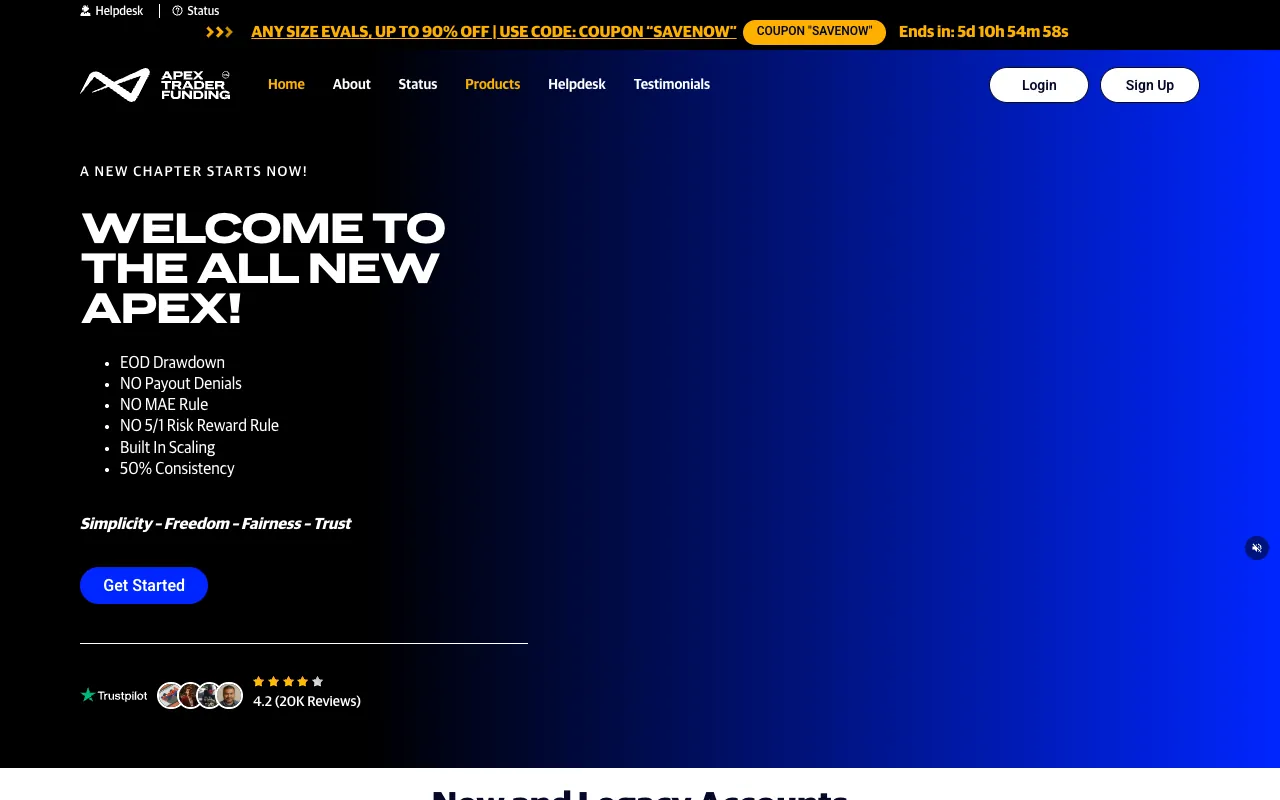
Markets: CME futures
Account sizes: $25,000 to $150,000 (up to 20 accounts)
Fee model: One-time evaluation fee (expires after 30 days, no resets) plus an activation fee on the standard path
Apex is the biggest name in US futures funding by search interest, built around a one-step evaluation and multi-account scaling. Its overhaul, with new products from March 1, 2026, replaced the old monthly subscription with a one-time evaluation fee, added an end-of-day drawdown option, and dropped the MAE and risk-reward rules.
Strengths:
- 100% of requested payouts in the simulated funded stage, up to weekly
- one-step evaluation with no consistency rule and an end-of-day drawdown option
- run several accounts at once to scale position size
Trade-offs:
- a 50% consistency rule applies on funded accounts, and end-of-day plans add a daily loss limit
- evaluations expire 30 days after purchase with no reset
- the activation fee is charged separately ($109 to $159 on EOD plans, $89 to $149 on intraday plans), so the real entry cost is higher than the headline eval price, and Apex advertises prices with a large coupon discount, so check the live price
- payouts have a $500 minimum, a cap of 6 payouts per funded account and per-payout caps by size
- costs stack quickly if you run multiple accounts
Full breakdown: Apex Trader Funding review and Apex Trader Funding vs Velotrade.
3) Take Profit Trader, best for day-one payouts

Markets: CME futures
Account sizes: $25,000 to $150,000
Fee model: Monthly test subscription, listed at $150, $170, $245, $330 and $360 a month for 25K to 150K, with promo codes that cut it
Take Profit Trader runs a one-step test with a 6% profit target, an end-of-day trailing drawdown, a 3-day minimum, a 50% consistency rule, and no daily loss limit. Its headline feature is that funded PRO accounts can request payouts from day one.
Strengths:
- day-one payouts on the funded PRO account, with daily withdrawals and no maximum
- no daily loss limit during the test
- 80% split on PRO, up to 90% on PRO+
Trade-offs:
- the drawdown is end-of-day during the test but switches to intraday trailing on the funded PRO account, which is stricter than it looks
- monthly test pricing adds up if the evaluation takes several months
- PRO is a simulated account, while PRO+ is live and reached by review, so check which one a plan leads to
Full breakdown: Take Profit Trader review and Take Profit Trader vs Velotrade.
4) MyFundedFutures, best for fast payouts and plan choice
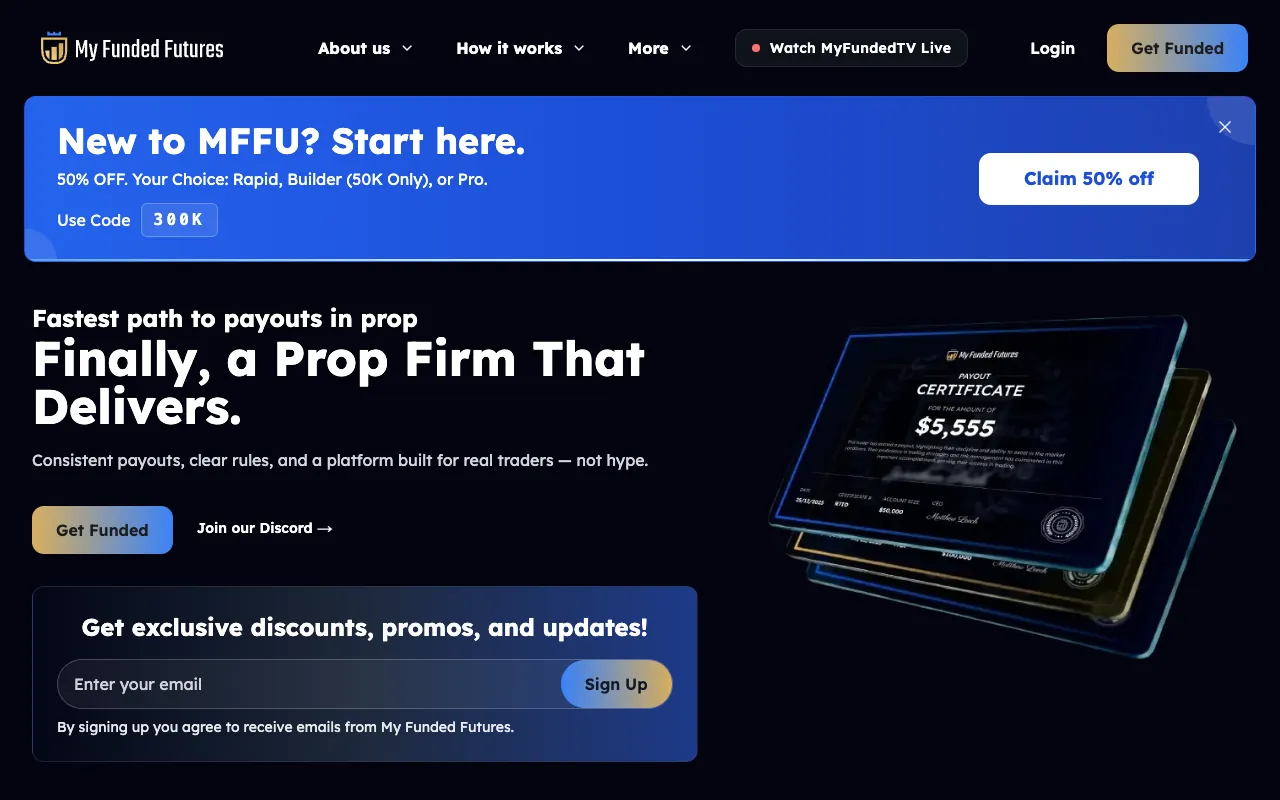
Markets: CME futures
Account sizes: $25,000 to $150,000
Plans: Rapid, Rapid EOD, Builder, Pro
Fee model: One-time evaluation fee, no activation fee. Builder is $92 on promotion ($153 regular) and Rapid is $125 ($209 regular)
MyFundedFutures sells single-phase evaluations ($3,000 target on a $50,000 account) across four plans, all one-time purchases with no activation fee. The plans differ mainly on drawdown model, split, and payout speed, which lets you pick the structure that matches how you trade.
Strengths:
- no daily loss limit on Rapid, Rapid EOD, or Pro
- splits from 80/20 (Builder) to 90/10 (Rapid), with daily payouts on Rapid
- Pro pays up to $100,000 per payout and moves you to live capital after three payouts
- all accounts start simulated, and there is no overnight holding
Trade-offs:
- drawdown differs by plan: Rapid switches to intraday trailing once funded; Rapid EOD, Builder, and Pro stay end-of-day
- evaluation consistency rules on Rapid (50%) and Rapid EOD (30%), and a $1,000 soft daily pause on Builder
Full breakdown: MyFundedFutures review and MyFundedFutures vs Velotrade.
5) Lucid Trading, best cheap entry with an end-of-day drawdown
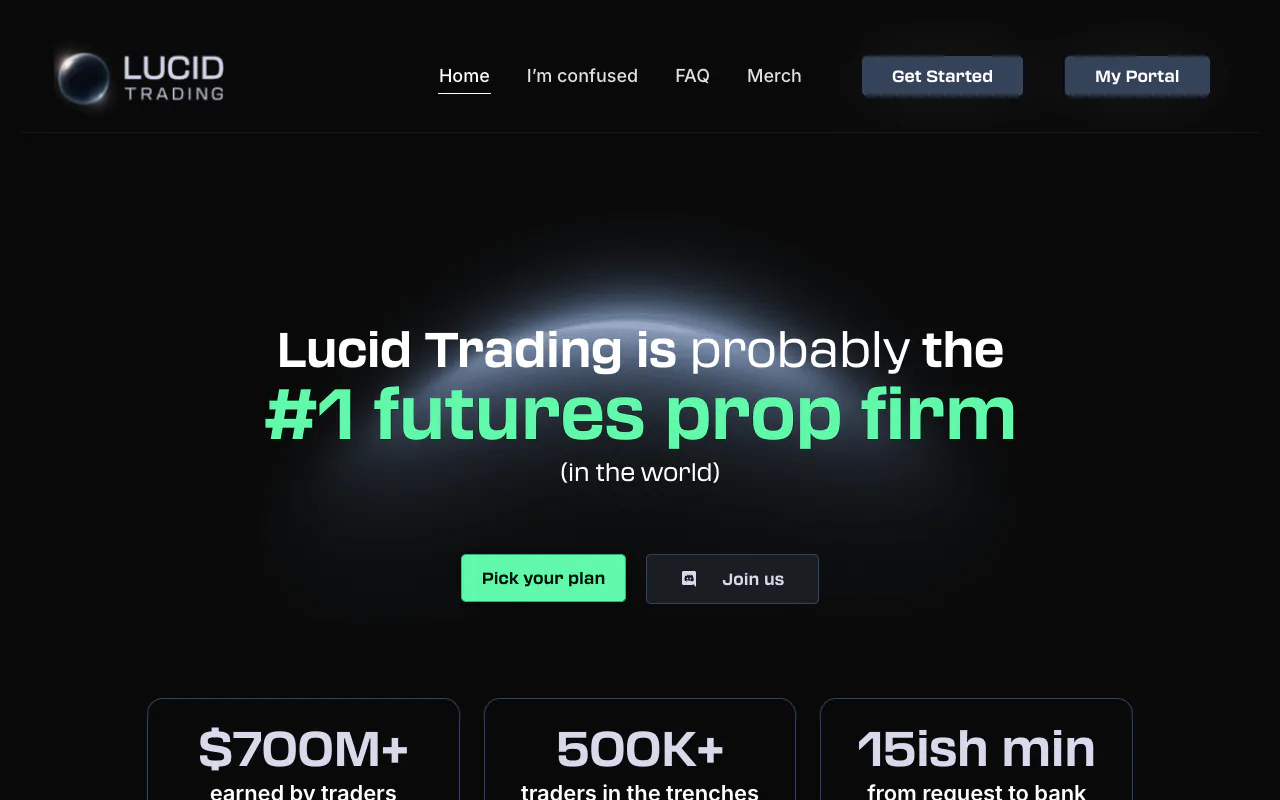
Markets: CME futures only
Platform: NinjaTrader, Tradovate, Rithmic
Account sizes: $25,000 to $150,000
Fee model: One-time evaluation fee
Lucid is a newer US futures firm that has grown fast on one-time pricing, fast payouts, and an end-of-day trailing drawdown that avoids intraday spike-outs. Its LucidPro path is a one-step evaluation with no minimum trading days.
Strengths:
- one-time fee: $123, $192, $307 and $410 list across $25K to $150K, or about $70 to $245 with the current limited-time coupon
- end-of-day trailing drawdown, so an intraday spike does not breach you
- 90% profit split and US traders accepted
Trade-offs:
- a 40% consistency rule on funded LucidPro accounts can delay a payout after one big day (it was 35% on accounts bought before November 28, 2025)
- payouts have a $500 minimum and caps of $1,000 to $3,500, and funded accounts are simulated
- futures only, with no forex, stocks, or crypto
Full breakdown: Lucid Trading review and Lucid Trading vs Velotrade.
6) FundedNext Futures, best if you already use FundedNext
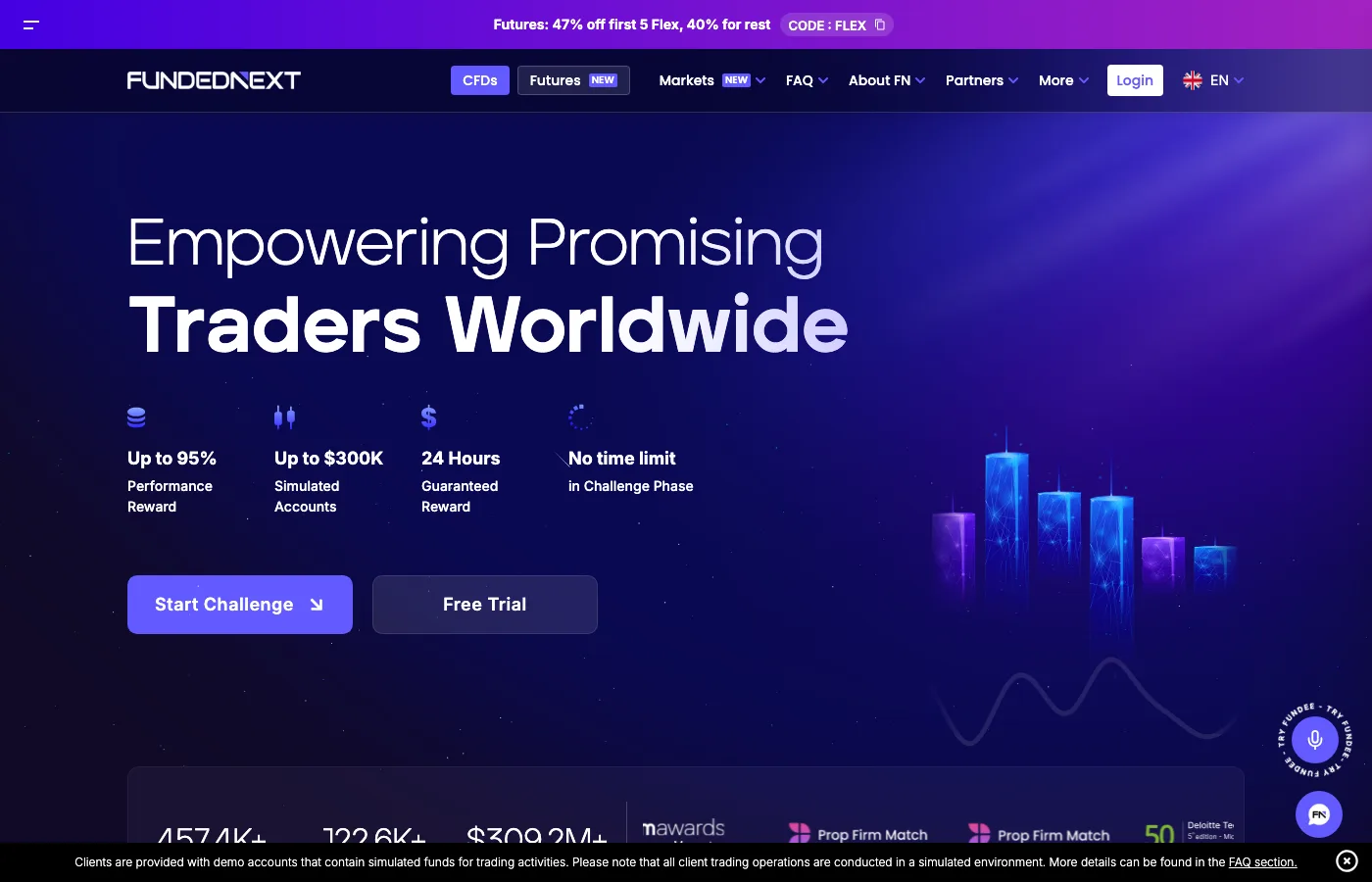
FundedNext sells futures as a separate line from its forex and CFD challenges, with its own Flex and Rapid products. Its CFD brand uses a different platform list and rules, so check the futures pages and not the forex ones.
Fee model: Flex from $74.99 for a 50K account
Split: 95% on Flex, 90% on Rapid
Environment: simulated
Flex uses an end-of-day trailing drawdown, a 40% consistency rule in the challenge, and payouts every 5 days with caps of $1,500 to $4,000 per cycle. FundedNext states that all futures trading takes place in a simulated environment.
Strengths:
- one of the highest headline splits in this comparison
- low entry price on the Flex product
- a familiar brand if you already trade FundedNext's forex challenges
Trade-offs:
- a newer futures offering without Topstep's or Apex's track record
- the futures platform list, overnight rules and contract limits are not confirmed here, so check them directly before purchasing
For a full breakdown, see FundedNext vs Velotrade and FundedNext review 2026.
Also worth checking: Tradeify, Alpha Futures and Bulenox
Three other US futures firms are credible additions to a shortlist. The details below are each firm's own claims from its official site, and we have not reviewed their payout records in depth.
- Tradeify: end-of-day drawdown, no consistency rule once funded, an instant-funding plan, and a 25K evaluation listed at $109.
- Alpha Futures: end-of-day drawdown, a 20% consistency rule on its Direct accounts, and payouts of up to $15,000 per cycle. Direct 25K is listed at $349.
- Bulenox: trailing or end-of-day drawdown options, news trading allowed, daily payouts, and splits of up to 90%.
7) Velotrade, best for 24/7 leveraged trading without futures constraints
HQ: Hong Kong
Platform: DXtrade
Max funding: Up to $200,000
Markets: Crypto, forex, stocks, indices, commodities
Velotrade does not offer CME futures. It belongs in this comparison because many futures traders are really after leveraged directional trading on indices and commodities, and Velotrade covers those markets through a single funded account: index ETFs like SPY and QQQ, gold, silver, and oil, and 24/7 crypto perpetuals.
Where Velotrade compares favorably to CME futures for prop trading:
- 24/7 crypto market access with no session breaks or daily maintenance windows
- No expiry dates, position rollovers, or contract switches on crypto perpetuals, so no roll cost from contango and backwardation
- Static drawdown: the floor is fixed from the initial balance and never tightens regardless of profits made, unlike the trailing models used by every futures firm above
- No consistency rule; no cap on single-day profit contribution
- Entry from $40 for a $5,000 account (PRO 1-Step)
Where CME futures are preferable:
- genuine exchange liquidity and price discovery on major indices
- regulated instrument structure for traders who require it
- the full CME contract list, including rates and agricultural products
For traders whose interest in futures is primarily about leveraged directional trading on price, Velotrade offers a comparable structure with 24/7 crypto availability and a more trader-friendly rule set. For a ranked view of that field, see our best crypto prop firms guide.
See Velotrade challenge options →

Comparison table
| Firm | Primary markets | Account sizes | Fee model | Profit split | Drawdown model | Consistency rule | Best for |
|---|---|---|---|---|---|---|---|
| Topstep | CME futures | $50K to $150K | Monthly Combine ($49 to $199), + $149 activation (Standard path) | 90% | EOD trailing (Express Funded) | 55% target in Combine; optional 40% payout path | Dedicated CME futures traders |
| Apex Trader Funding | CME futures | $25K to $150K | One-time (30-day expiry) + activation fee | 100% of requested payouts | Intraday or EOD trailing | 50% | Split and multi-account scaling |
| Take Profit Trader | CME futures | $25K to $150K | Monthly test | 80% (PRO) to 90% (PRO+) | EOD in test, intraday on PRO | 50% in test only | Day-one payouts |
| MyFundedFutures | CME futures | $25K to $150K | One-time | 80% to 90% | EOD (Rapid intraday once funded) | 50%/30% in eval (Rapid/Rapid EOD) | Fast payouts, plan choice |
| Lucid Trading | CME futures | $25K to $150K | One-time | 90% | EOD trailing | 40% (funded LucidPro) | Cheap entry, EOD drawdown |
| FundedNext Futures | CME futures | From 50K | One-time (Flex from $74.99) | 90% to 95% | EOD trailing | 40% in the challenge | Existing FundedNext users |
| Velotrade | Crypto, forex, stocks, indices, commodities | $5K to $200K | One-time | 80% to 90% | Static | None | 24/7 multi-asset directional trading |
How the drawdown model decides who gets paid
Profit targets across futures prop firms cluster around 6%, so the target rarely separates one firm from another. The drawdown rule does.
- Intraday trailing: the floor follows your highest unrealized equity tick by tick. A trade that runs up and then reverses can move the floor permanently, even if you close flat.
- End-of-day trailing: the floor only moves on your closing balance, so intraday swings do not breach you, but a profitable day still lifts the floor for tomorrow.
- Fixed or static: the floor stays at a set level from your starting balance and never moves up.
Check which model applies in the evaluation and which applies on the funded account, because several firms switch models after you pass. Our EOD trailing vs tick-by-tick drawdown guide walks through worked examples, and static maximum drawdown explained covers the fixed model.
What to check before buying a futures prop firm challenge
1. Confirm max contract size on the funded account. Futures prop firms cap the number of contracts you can hold simultaneously on a funded account. This cap differs by account tier. A $50,000 funded account may allow 3 ES contracts. Confirm this against your normal position sizing before purchasing.
2. Add up the full fee model. Topstep's Combine and Take Profit Trader bill monthly during evaluation. Apex, MyFundedFutures, Lucid and FundedNext Futures charge one-time fees, and Apex adds a separate activation fee after you pass. Coupon prices at Apex, Lucid, MyFundedFutures and Take Profit Trader are large, so compare list prices as well. Price the total cost at the number of months or resets you realistically need.
3. Verify platform compatibility with your existing tools. Futures traders typically have established setups on Rithmic, Tradovate, NinjaTrader, or Sierra Chart. Confirm the firm supports your platform and that any automation or indicators you use are compatible.
4. Read the consistency rule before the funded stage. Apex (50%) and Lucid (40% on funded LucidPro) cap how much of your profit can come from a single day. One outsized winning day can delay a payout until the rest of your record catches up.

Last updated: October 15, 2026. Challenge conditions, contract availability, and evaluation structures change regularly. Verify directly with each firm before purchasing.
Frequently Asked Questions
About the author

Vittorio De Angelis
Executive Chairman
Former equity-derivatives trader at JP Morgan, Dresdner Kleinwort and Bank of America in London. Later Head of Brokerage at a global broker in Hong Kong.
Velotrade was founded in Hong Kong in 2016 by a team from JP Morgan, Dresdner Kleinwort and Bank of America, has paid out over $2.5 billion to its trade-finance clients, and has been featured in Bloomberg, the Financial Times, the Wall Street Journal and on Nasdaq. Its prop trading evaluations are simulated and educational.
View author page