One account, every market we offer
ExploreApex Trader Funding is one of the largest and most searched futures prop firms in the world, known for automated payouts, generous scaling, and a big 2026 rule and pricing overhaul. Its "4.0" update in March 2026 replaced the old monthly subscription with a one-time evaluation fee, which changes how you should think about the real cost. This review covers what Apex actually offers in 2026, how its evaluation and payouts work, the stacked one-time fees most reviews gloss over, and who it suits.
Quick answer: Apex Trader Funding is a legitimate US futures prop firm. You buy a one-time evaluation ($25,000 to $150,000), hit a 6% profit target without touching the trailing drawdown, and can pass in one day, with no consistency rule, but the evaluation expires after 30 days with no reset. Funded accounts then pay 100% of requested payouts every 5 trading days, subject to a 50% consistency rule. Compared with Topstep, Apex trades a monthly subscription and capped payouts for a deadline and per-account fees that stack if you run several accounts.
Highlights of this article
- Apex Trader Funding is a US futures firm (Austin, Texas, founded 2021) and one of the highest-volume prop firms in 2026
- Current accounts run from $25,000 to $150,000 with profit targets of $1,500 to $9,000, on an intraday-trailing or end-of-day drawdown, and you can hold up to 20 accounts
- The evaluation has no consistency rule and can be passed in one day, but it is a one-time fee that expires after 30 days with no resets
- Funded (PA) accounts add a 50% consistency rule, built-in scaling and payouts every 5 trading days, and Apex pays 100% of requested payouts in the simulated funded stage
- The 2026 overhaul (accounts bought since March 1, 2026) replaced monthly billing with one-time fees and removed the MAE and 5:1 risk-reward rules
What Is Apex Trader Funding
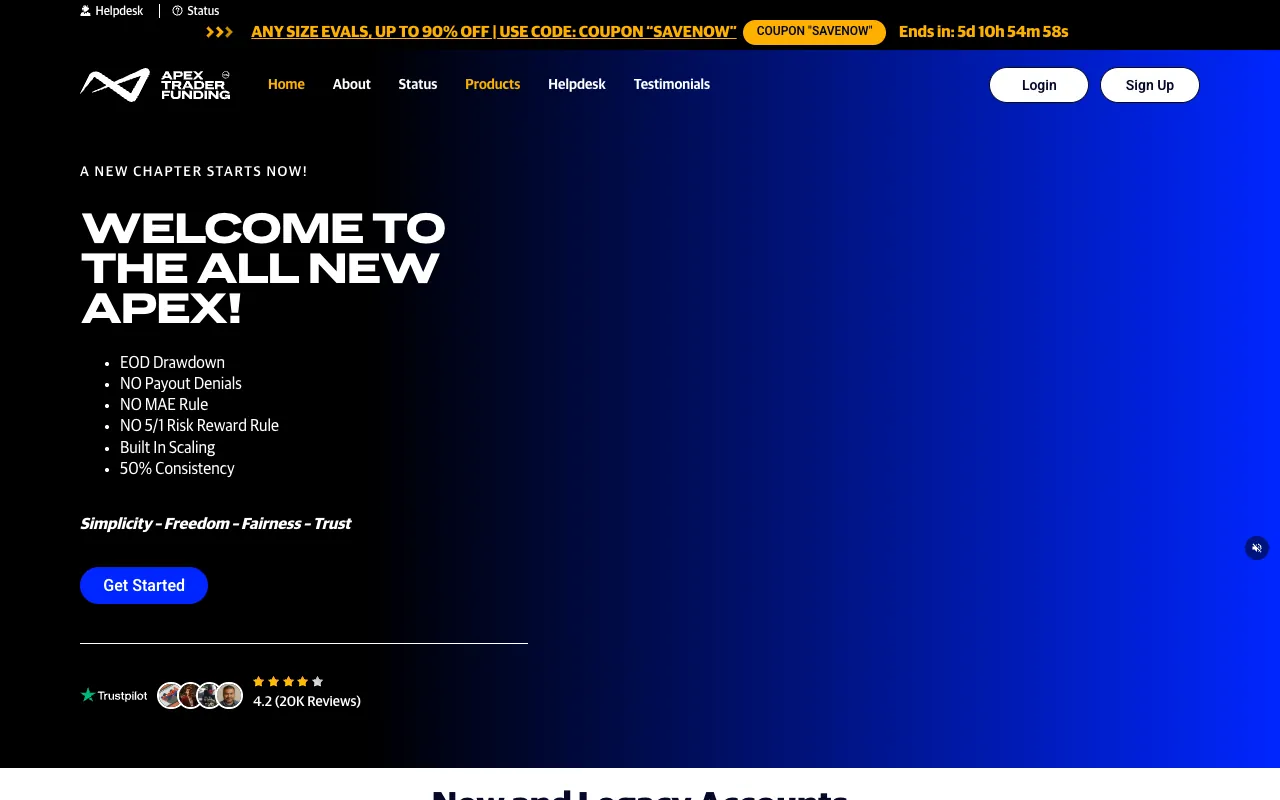
Apex Trader Funding is a US-based proprietary trading firm founded in 2021 by Darrell Martin and headquartered in Austin, Texas. It funds futures traders on CME contracts (index, energy, and micros such as MES, MNQ, ES, NQ, RTY, and CL) through platforms like Tradovate and NinjaTrader. Apex self-reports over $700 million in cumulative trader payouts and carries a strong Trustpilot rating (4.2 from about 21,000 reviews shown on its site in October 2026). It is futures-only (equity index, currency, agricultural, energy and metal futures), with no spot crypto, spot forex or stock offering. Its main futures-firm rivals are Take Profit Trader and MyFundedFutures. For how those rivals compare against a 24/7 crypto alternative, see Take Profit Trader vs Velotrade and MyFundedFutures vs Velotrade.
How the Evaluation Works
Apex runs a one-step evaluation: hit the profit target (6% of the account) without touching the maximum drawdown, in as little as one trading day. There is no consistency rule in the evaluation, but the evaluation is a one-time purchase that stays active for 30 days, then expires, and cannot be reset. You choose an intraday-trailing or end-of-day (EOD) drawdown when you buy, and EOD plans add a daily loss limit. The 2026 overhaul also removed the MAE (maximum adverse excursion) rule, the 5:1 risk-reward rule and the old 7-day minimum.
Once you pass and activate a Performance Account (PA), the rules change: a 50% consistency rule applies (no single day may exceed half your profit in the payout window), scaling is built in, and you can request a payout every 5 trading days.
The headline improvement is the end-of-day drawdown option. On an EOD-trail plan, your loss limit is recalculated only at market close, so floating profit and closed intraday gains do not move the floor during the session. That is far more forgiving than a pure intraday trailing model, and it is the plan most experienced Apex traders choose.
Account Sizes, Scaling, and Drawdown
Apex's current accounts come in $25,000, $50,000, $100,000 and $150,000 sizes, with built-in scaling on the funded account and up to 20 accounts at once (up to $3 million at the $150K size). Drawdown is either intraday trailing or end-of-day trailing; the older static and $300K plans belong to Apex's legacy lineup, which it reopens only for limited-time promotions.
Apex Account Sizes and Pricing at a Glance
The table below shows Apex's current accounts and list prices on its standard path (October 2026). Apex runs near-constant coupons of up to 90% off, so the price you actually pay is usually a fraction of the list price. The standard path adds a separate Performance Account activation fee when you pass; a No Activation Fee path costs more upfront instead. Platform and market-data feeds can carry their own charges, so confirm the live numbers on apextraderfunding.com before you buy.
| Account size | Intraday trail (list) | EOD trail (list) | Profit target | Max drawdown | EOD daily loss limit | Max contracts |
|---|---|---|---|---|---|---|
| $25,000 | $167 | $490 | $1,500 | $1,000 | $500 | 4 minis / 40 micros |
| $50,000 | $249 | $590 | $3,000 | $2,000 | $1,000 | 6 minis / 60 micros |
| $100,000 | $790 | $1,190 | $6,000 | $3,000 | $1,500 | 8 minis / 80 micros |
| $150,000 | $1,190 | $2,190 | $9,000 | $4,000 | $2,000 | 12 minis / 120 micros |
The end-of-day plans cost more because the floor only moves at the close, and they add the daily loss limit. Every evaluation expires 30 days after purchase with no reset, so a slow trader may need to buy again. Treat these numbers as a starting point and verify the live terms, since Apex changes plans and prices often.
Payout proof
Fast, real payouts. Traceable on Arbitrum.
- Paid within 24 hours of approval
- Settled on Arbitrum in USDC or USDT
- Look up any transaction on Arbiscan


The Real Cost After the 4.0 Overhaul
This is the area Apex's 2026 "4.0" overhaul changed most. For years Apex billed the evaluation as a monthly subscription, and many older reviews still describe it that way. Since the March 2026 update, the evaluation is a one-time fee per account instead, listed from $167 to $2,190 depending on size and drawdown type but routinely discounted up to 90% with coupons. On the standard path, passing then triggers a separate Performance Account activation fee that promo codes do not reduce. Because each evaluation expires after 30 days with no reset, a failed or unfinished attempt means buying a new one. Platform and market-data feeds can still carry small charges depending on the software you use. The practical cost lever now is scale: because Apex lets you run many accounts at once, the one-time fees multiply across every account you take, so a trader grinding several accounts still pays far more than a single challenge fee. Model the full stack, not just the discounted first payment.
Profit Split and Payouts
On current accounts, Apex pays 100% of the payouts you request in the simulated funded (PA) stage, with no profit split taken. You can request a payout every 5 trading days, subject to the 50% consistency rule, and Apex states there are no payout denials, payout reviews, video reviews or chart screenshots. Traders who show long-term consistency can be invited to an Apex Live account. Combined with the removed rules and the EOD drawdown option, the 2026 model is genuinely more trader-friendly than Apex's older rule set. The offsetting cost is the stacked one-time fees described above.
Apex Trader Funding pros and cons
No prop firm fits every trader. Here is a balanced view of where Apex is strong and where it is not.
Pros
- One-step evaluation with no consistency rule, passable in a single day
- 100% of requested payouts in the simulated funded stage, with no split
- Payouts every 5 trading days, with no denials, reviews or screenshots required
- End-of-day drawdown option that only recalculates at market close, far more forgiving than a pure intraday trailing model
- Generous scaling, with up to 20 accounts at once and built-in scaling on funded accounts
- Near-constant coupons of up to 90% off that make the upfront entry cost among the lowest in futures prop trading
Cons
- Futures only on CME contracts, with no crypto, forex, or stock offering
- A 50% consistency rule applies on funded accounts, so no single day may exceed half your profit in the payout window
- Evaluations expire 30 days after purchase and cannot be reset
- End-of-day plans add a daily loss limit
- Costs stack beyond the discounted eval fee, including a non-discounted activation fee and any platform or data charges, and they multiply across every account you run, so model the full cost
- Trading is limited to CME session hours, with no 24/7 or weekend markets
- Recurring Trustpilot complaints about slow or held payouts and accounts closed after becoming profitable
Is Apex Trader Funding legit or a scam?
Apex Trader Funding is a legitimate, established firm, not a scam. It has operated since 2021, self-reports more than $700 million in cumulative trader payouts, and showed a Trustpilot score of 4.2 out of 5 from about 21,000 reviews on its site in October 2026. Most of that feedback is positive, with traders repeatedly praising the cheap evaluations, lenient pass conditions, and fast automated withdrawals.
The criticism is worth reading too. Recurring one-star reviews cluster around slow or held payouts, accounts closed after becoming profitable, denials that reference rules Apex says it removed, and support going quiet during disputes. None of this makes Apex a scam, and the payout record is real, but it does mean you should follow the rules of your specific plan closely, keep your own records, and confirm the current terms on apextraderfunding.com before funding.
Apex vs Topstep
Apex and Topstep are the two most searched US futures prop firms, and they solve the same problem in opposite ways.
| Apex Trader Funding | Topstep | |
|---|---|---|
| Evaluation fee | One-time, expires after 30 days, no resets | Monthly subscription until you pass |
| $50K profit target | $3,000 | $3,000 |
| $50K max loss | $2,000 (intraday or end-of-day trail) | $2,000 (end-of-day trail) |
| Consistency in evaluation | None | Best day must stay below 55% of target |
| Consistency on funded account | 50% rule | 40% on the Consistency payout path only |
| Funded payout split | 100% of requested payouts | 90/10 |
| Payout frequency | Every 5 trading days | After 5 winning days of $150+ (or 3 days on the Consistency path) |
| Payout caps | Not stated on its site | 50% of balance, $2,000 to $6,000 per request until Live |
| Max accounts | 20 | 5 funded at a time |
| Platform | Several (Tradovate, NinjaTrader, Rithmic tools) | TopstepX |
Choose Apex if you want a one-time fee, many accounts at once and no split on funded payouts, and you can pass within 30 days. Choose Topstep if you prefer a longer track record (since 2012), its own TopstepX platform and no evaluation deadline, and you accept a monthly fee and capped payouts until you reach a Live account. For the full Topstep rules and payout caps, see the Topstep review. For the wider field, including Take Profit Trader, MyFundedFutures and Lucid, see the best futures prop firms.
Who Apex Trader Funding Suits
Apex is a strong fit for active CME futures day traders who want automated payouts, generous scaling across multiple accounts, and the EOD drawdown option, and who are comfortable managing per-account fees when they run several accounts. It is a weaker fit for traders who want crypto or forex, need to hold overnight or over weekends, or want a single simple rule set without a consistency rule.
The Alternative: 24/7 Multi-Asset With a Static Drawdown
If the futures-only scope, the trailing drawdown, or the 50% consistency rule are the sticking points, a crypto-native firm is a structurally different option. Velotrade funds crypto, forex, stocks, index ETFs such as SPY and QQQ, and commodities on a static maximum drawdown that is fixed from your starting balance and never trails. There is no consistency rule, news trading and weekend holding are allowed, and crypto trades 24/7 rather than on CME session hours. Both firms now charge a one-time evaluation fee rather than a subscription, so the real decision is markets and rules, not billing model.
It is not a like-for-like swap: Apex is for CME futures, while Velotrade is for 24/7 crypto and multi-asset trading. But if you want a predictable static drawdown and no consistency rule, it is worth comparing. See the head-to-head Apex Trader Funding vs Velotrade comparison, the best futures prop firms, and top prop firms in 2026, and check your realistic odds first with the challenge pass calculator.
Free calculator
How many losing trades before you breach?
See your drawdown floor, daily loss budget, and losing trade capacity for any account size - before you place a single trade.
Use the free drawdown calculatorFrequently Asked Questions
About the author

Vittorio De Angelis
Executive Chairman
Former equity-derivatives trader at JP Morgan, Dresdner Kleinwort and Bank of America in London. Later Head of Brokerage at a global broker in Hong Kong.
View author page