New to funded trading?
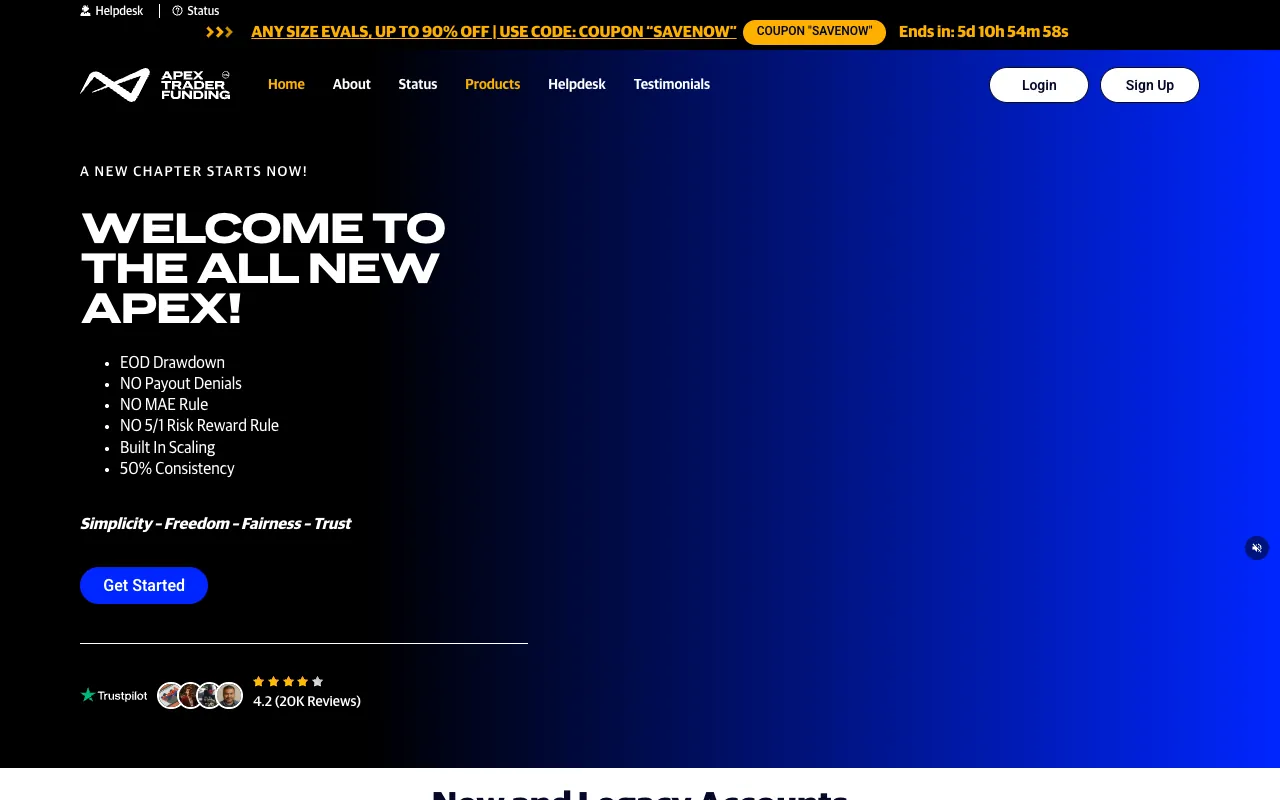
ExploreApex Trader Funding and Velotrade are both established prop firms, but they fund completely different traders. Apex is one of the largest futures firms in the world, funding CME contracts on session hours with a trailing drawdown and a 50% consistency rule. Velotrade is crypto-native, funding 24/7 crypto plus forex, stocks, index ETFs and commodities on a static drawdown with no consistency rule. On paper they compete for the same "get funded" search, but they solve different problems.
Because their markets and rules diverge so sharply, this is not a case of one firm beating the other on a spec sheet. The right answer depends entirely on what and when you trade. This comparison puts the two side by side so you can see exactly where each one fits.
Quick answer: Apex Trader Funding is a US futures firm: CME contracts, session hours, a one-step evaluation, a trailing drawdown (with an optional end-of-day drawdown), and a 50% consistency rule. Velotrade is a crypto-native multi-asset firm: crypto, forex, stocks, indices, and commodities on one account (crypto trades 24/7), a static drawdown fixed from your starting balance that never trails, no consistency rule, and no maximum risk per trade. A futures day trader who wants CME contracts leans Apex; a trader who wants always-on crypto and multi-asset markets with a predictable static floor leans Velotrade.
Highlights of this article
- Apex funds CME futures on session hours; Velotrade funds crypto 24/7, including weekends, plus forex, stocks, index ETFs and commodities
- Apex uses a trailing drawdown (with an optional end-of-day drawdown); Velotrade uses a static drawdown fixed from your starting balance that never trails
- Apex keeps a 50% consistency rule on funded accounts; Velotrade has no consistency rule and no maximum risk per trade
- Both firms now charge a one-time evaluation fee, so billing model is no longer the differentiator; markets, drawdown, and the consistency rule are
- Apex pays 100% of requested payouts in its simulated funded stage, every 5 trading days; Velotrade pays up to 90% from your first payout
- Apex runs on Tradovate and NinjaTrader; Velotrade runs on DXtrade
Quick Comparison: Apex Trader Funding vs Velotrade
| Apex Trader Funding | Velotrade | |
|---|---|---|
| Markets | CME futures only (index, energy, micros) | Crypto-first; forex, stocks, indices, commodities |
| Trading hours | CME session hours, no weekends | 24/7, including weekends |
| Drawdown model | Trailing, with optional end-of-day | Static, fixed from starting balance |
| Consistency rule | None in the evaluation; 50% on funded accounts | None |
| Profit split | 100% of requested payouts (simulated funded stage) | Up to 90% from day 1 |
| Fees | One-time eval fee + separate activation fee | One-time eval fee, from $40 (PRO 1-Step) |
| Payouts | Every 5 trading days, no denials | Processed in under 24 hours once requested; first after 14 days, then weekly |
| Platforms | Tradovate, NinjaTrader | DXtrade |
| Track record | Founded 2021, $700M+ self-reported paid, Trustpilot ~4.3 | Crypto prop launch 2026, institutional team background |
Markets and Hours: CME Futures vs 24/7 Crypto
This is the first fork in the road. Apex funds CME futures only: index, energy, and micro contracts such as MES, MNQ, ES, NQ, RTY, and CL. There is no crypto, forex, or stock offering, and trading follows CME session hours, so there are no weekend markets. For a dedicated futures day trader, that focus is a feature, not a limitation.
Velotrade is built the other way around. It is crypto-native, funding crypto alongside forex, stocks, indices, and commodities, and its markets run 24/7. Weekend holding and news trading are allowed by default because the crypto market never closes. If your edge lives in overnight moves, weekend volatility, or assets outside the CME, Velotrade covers ground Apex structurally cannot.
Neither is strictly better here. Apex is the specialist for CME contracts; Velotrade is the generalist for always-on crypto and multi-asset trading. Match the firm to the market you actually trade. For the wider futures field, see the best prop firm for futures traders.
Drawdown: Trailing vs Static
The drawdown model is the second decisive difference, and it changes how a losing session feels. Apex uses a trailing drawdown by default, where the loss floor follows your account higher as you make profit. Its 2026 lineup added an optional end-of-day drawdown that only recalculates the floor at market close, which is far more forgiving than a pure intraday trail and is the plan most experienced Apex traders choose.
Velotrade uses a static drawdown. The loss floor is fixed from your starting balance and never moves up against you, so a green run early in the account cannot shrink your buffer later. For volatile 24/7 markets, that predictability is the point. There is also no maximum risk per trade, so position sizing is left to you.
Both models are defensible, but they suit different temperaments. If you want a floor that only updates at close, Apex's EOD option gets you part of the way; if you want a floor that never trails at all, Velotrade's static model is the cleaner fit. For the mechanics, see static maximum drawdown explained and EOD trailing vs tick-by-tick drawdown.

Payout proof
Fast, real payouts. Traceable on Arbitrum.
- Paid within 24 hours of approval
- Settled on Arbitrum in USDC or USDT
- Look up any transaction on Arbiscan


Consistency Rule: 50% vs None
Apex applies a 50% consistency rule: no single trading day may exceed half of your total profit. That pushes you toward spreading returns across multiple sessions rather than banking most of your target in one strong day. It is a common futures-firm rule and manageable, but it does shape how you trade.
Velotrade has no consistency rule at any stage. If your edge concentrates returns on a few high-conviction sessions, you can bank them without a daily cap working against you. For traders whose profit naturally clusters, that freedom is meaningful.
This one tilts toward Velotrade for concentrated styles and toward Apex only if you were going to spread returns evenly anyway. It is a genuine structural difference, not a marketing point.
Fees: One-Time Eval Both Ways
For years the fee model was the obvious contrast, because Apex billed its evaluation as a monthly subscription. That changed with Apex's 2026 "4.0" overhaul, which replaced the subscription with a one-time evaluation fee. Passing then triggers a separate activation fee that promo codes do not reduce, and because Apex lets you run up to 20 accounts, those one-time fees multiply across every account you take. The eval fee itself is frequently discounted heavily during Apex's regular sales.
Velotrade also charges a one-time evaluation fee, starting from $40 on the PRO 1-Step, with no subscription. So billing model is no longer the thing that separates these two firms. Both are one-time fees. The real differentiators are the ones above: markets, the trailing versus static drawdown, and the consistency rule. Read the fee stack on each firm's site before buying, but do not let the headline price decide a choice that markets and rules should drive.
Profit Split and Payouts
On current accounts, Apex pays 100% of the payouts you request in its simulated funded stage, with no split, and you can request one every 5 trading days, subject to its 50% consistency rule. It states there are no payout denials or reviews. Combined with up to 20 accounts at once, that is a strong payout package for active traders running multiple accounts.
Velotrade pays up to 90% from your first payout with no tier to climb. Apex's headline number is higher, since it takes no split on requested payouts, and its no-denial payout process is a real strength. Velotrade's counterpoint is a simple split with no scaling ladder. On payouts, Apex leads on the top-end number and automation.
Platforms
Apex runs on futures-native platforms like Tradovate and NinjaTrader, which is exactly what a CME futures trader expects. Velotrade runs exclusively on DXtrade. If you already have a NinjaTrader or Tradovate setup for futures, Apex fits your existing workflow; if you are trading crypto and multi-asset markets, DXtrade keeps Velotrade's rule set consistent across every asset. This is a preference and workflow question more than a winner-takes-all one.
Track Record and Background
Apex's operating history is a genuine strength. Founded in 2021 in Austin, Texas, it self-reports over $700 million in cumulative trader payouts and holds a Trustpilot rating of around 4.3 from tens of thousands of reviews. It is one of the highest-volume futures firms in the market, and that accumulated payout proof is worth weighing. As with any firm, negative reviews exist, mostly around slow or held payouts, so follow your plan's rules closely and keep records.
Velotrade launched its crypto prop product in 2026, so it does not have Apex's years of payout history. Its counterpoint is a documented institutional team background (JP Morgan, Dresdner Kleinwort, Bank of America) and a rule set built specifically for 24/7 crypto and multi-asset trading. Apex leads on operating history and public payout volume; Velotrade leads on crypto-native rules and team transparency. For the full firm profile, see the Apex Trader Funding review.
What Each Firm Suits Best
Choose Apex Trader Funding if:
- You trade CME futures and want index, energy, or micro contracts
- You are comfortable trading on session hours without weekend markets
- You want a trailing drawdown with an optional end-of-day recalculation
- You want automated fast payouts and scaling across many accounts
Choose Velotrade if:
- You trade crypto or multi-asset markets and want 24/7 access, including weekends
- You want a static drawdown fixed from your starting balance that never trails
- You want no consistency rule and no maximum risk per trade on funded accounts
- You want up to 90% profit split from your first payout
Which Prop Firm Is Better?
Neither is strictly better, because they are built for different traders. Apex wins for CME futures: a respected, high-volume firm with automated payouts, generous multi-account scaling, and an end-of-day drawdown option that softens its trailing model. Velotrade wins for 24/7 crypto and multi-asset trading: a static drawdown that never trails, no consistency rule, and no maximum risk per trade.
Decide on what and when you trade. If you want CME contracts on session hours and value a long public payout record, Apex is the stronger package. If you want always-on crypto and multi-asset markets with a predictable static floor and no consistency rule, a Velotrade challenge is the better fit. Both now charge a one-time evaluation fee, so the choice is markets and rules, not billing. Verify the current terms on each firm's site before purchasing. For the wider market, see top 10 prop firms.
Free calculator
What does passing actually pay you?
Plug in your account size and see your profit target, max drawdown, and first payout - before you commit to a challenge.
Use the free prop challenge calculatorFrequently Asked Questions
About the author

Vittorio De Angelis
Executive Chairman
Former equity-derivatives trader at JP Morgan, Dresdner Kleinwort and Bank of America in London. Later Head of Brokerage at a global broker in Hong Kong.
Velotrade was founded in Hong Kong in 2016 by a team from JP Morgan, Dresdner Kleinwort and Bank of America, has paid out over $2.5 billion to its trade-finance clients, and has been featured in Bloomberg, the Financial Times, the Wall Street Journal and on Nasdaq. Its prop trading evaluations are simulated and educational.
View author page