One account, every market we offer
ExploreMost prop firms started as forex firms. A handful started as crypto firms. In 2026, a growing number claim to cover everything, but the quality of multi-asset coverage varies enormously between firms.
This guide focuses specifically on multi-asset prop trading: funded accounts that let you trade forex, stocks, indices, commodities and crypto on one account, under one evaluation, with consistent rules across all asset classes.
For traders who want real flexibility, not a firm that technically allows EURUSD and then restricts everything else, the differences below matter.
Quick answer: The best multi-asset prop firm in 2026 is the one whose rules stay consistent across every asset class. Velotrade leads for traders who want static drawdown and no session restrictions across crypto, forex, stocks, indices, and commodities on one account. FTMO is strongest for forex-first traders, and FundedNext offers the widest instrument count.
Highlights of this article
- True multi-asset prop trading means one evaluation, one funded account, and consistent rules across all asset classes, not selective access with heavy restrictions
- Static drawdown is significantly more compatible with multi-asset strategies than trailing drawdown, which creates asymmetric risk across different asset volatility profiles
- Firms built on 24/7 infrastructure (crypto-native) extend that uptime advantage to all assets including stocks and indices at weekends
- DXtrade is currently the strongest platform for multi-asset prop trading in the retail funded account space
- Velotrade is the only major prop firm that started as crypto-native and has extended its infrastructure to cover forex, stocks, indices and commodities on the same account
What Makes a Prop Firm Genuinely Multi-Asset
The phrase "multi-asset" is used loosely in prop trading marketing. What it actually means varies considerably.
At minimum, a multi-asset prop firm should let you trade instruments across at least three distinct asset classes, currency pairs, equity instruments (stocks or indices), and commodities such as gold, from a single funded account. Gold traders can compare firms in the best prop firm for gold guide, and index traders in the best prop firm for indices guide. For individual markets, see how to trade indices, how to trade oil, and how to trade silver. But access alone is not the full picture.
Consistent rules across asset classes
Some firms allow access to multiple asset classes but apply different rules to different instruments. For example:
- Different drawdown limits per instrument
- News trading allowed on indices but not on forex
- Crypto permitted only on specific account tiers
- Weekend holding banned on stocks but not on commodities
For a multi-asset strategy to work, the rules need to be consistent or at least clearly defined per instrument. Unexpected restrictions mid-evaluation are one of the most common sources of failed challenges for multi-asset traders.
Drawdown model compatibility
This is the most underappreciated factor in multi-asset prop trading.
Trailing drawdown, where the floor rises as your equity peaks, creates fundamentally different risk profiles across different asset volatility levels. A position in a high-volatility asset like BTC or a volatile stock can tighten your trailing floor significantly, even if the position recovers. A static drawdown floor, fixed from the initial starting balance, is the same regardless of what instruments you trade or how volatile they are.
For multi-asset traders running simultaneous positions across BTC, EURUSD, and US500, a trailing drawdown model can create compounding floor risk that would not affect a single-asset trader in the same way. Static drawdown removes this dynamic entirely.
Platform quality
MT4 and MT5 were built for forex. They handle crypto through synthetic instruments and most do not natively support equity market session restrictions or stock instrument handling.
DXtrade is the current platform of choice for genuine multi-asset prop trading. It handles currency pairs, spot crypto, indices, commodities and stocks through a unified interface with proper instrument metadata (session hours, leverage limits, tick sizes) per asset class.
Best Multi-Asset Prop Firms in 2026
1) Velotrade: crypto-native, now multi-asset
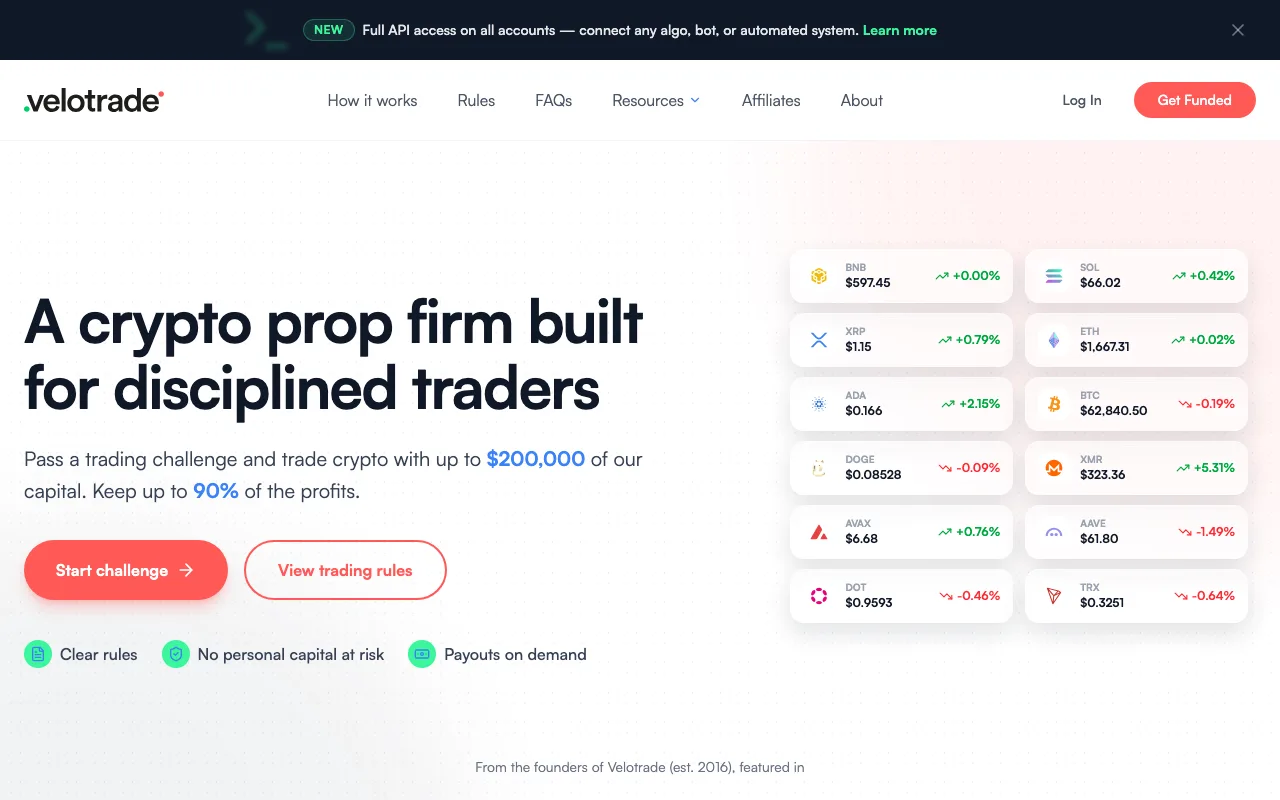
HQ: Hong Kong Platform: DXtrade Max funding: Up to $200,000 Markets: Crypto (BTC/ETH/SOL), forex (EURUSD/GBPUSD/USDJPY), stocks (TSLA/NVDA/AAPL), indices (US500/US100/GER40), commodities (XAUUSD/XAGUSD/USOIL)
Velotrade started as a crypto prop firm in 2025, built on infrastructure designed for 24/7 markets. That architecture, static drawdown, no overnight restrictions, no trailing floor mechanics, turns out to be a better foundation for multi-asset trading than the forex-native model most competitors use.
When you add stocks, indices and commodities to a firm originally designed for round-the-clock crypto trading, the result is an account with no session restrictions: you can trade US stocks such as TSLA, or an index like US500, at 2am Saturday and hold to Monday open without penalty. That is not the case at most forex-origin multi-asset firms, which treat out-of-hours holding on equity instruments as a rule violation.
Velotrade uses static drawdown across all asset classes. Your drawdown floor is set from your starting balance and never moves. This makes risk calculation straightforward regardless of what you're trading.
The DXtrade platform handles all instrument classes consistently. Leverage varies by asset (check the instruments page for current figures), but the execution environment is the same across all markets.
Key details for multi-asset traders:
- Static (fixed) drawdown, floor never trails your equity peak
- No overnight restrictions on any instrument
- News trading allowed
- No consistency rule
- Withdrawals on demand
Velotrade's multi-asset range is newer than its crypto offering. Instrument count is currently lower than longer-established forex firms. But for traders who want the same rules to apply across everything they trade, with infrastructure that does not penalise positions held across session boundaries, it is the clearest option in the market in 2026.
See Velotrade's challenge options →
2) FTMO: strongest legacy multi-asset track record

HQ: Prague Platform: MT4, MT5, cTrader Max funding: Up to $200,000 Markets: Forex, indices, commodities, crypto (limited), stocks (limited)
FTMO has the longest operating track record of any prop firm and the most verified payout history. For traders who prioritize counterparty trust above all other factors, FTMO remains the benchmark.
Multi-asset coverage is broad on paper. In practice, crypto availability is limited and conditions on equity instruments are more restrictive than on forex. The platform stack (MT4/MT5) is well-suited to forex and commodity trading but less clean for crypto or stocks.
FTMO applies a Best Day Rule on its 1-Step programs, requiring that the best day not exceed 50% of positive days' profit. Exceeding it does not fail the account, but it holds the evaluation open until further profitable days dilute the ratio, which can affect multi-asset traders whose results skew toward specific macro events or instrument-specific moves.
For traders primarily interested in forex and commodities with multi-asset as a secondary need, FTMO is a strong choice. For traders who want crypto or equities as a primary focus, the coverage has gaps.
3) FundedNext: widest instrument count
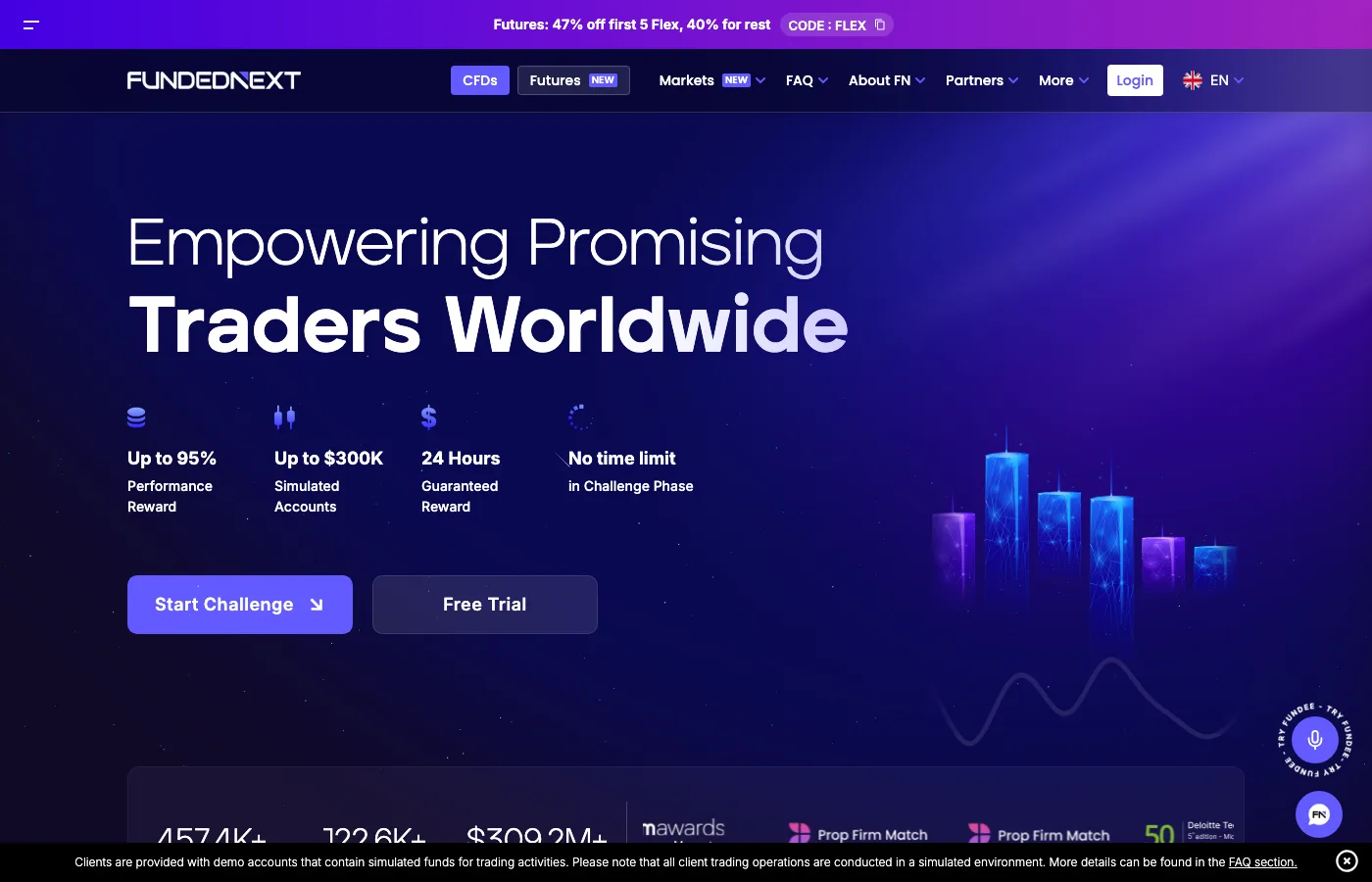
HQ: Dubai / UAE Platform: MT4, MT5, DXtrade Max funding: Up to $200,000 Markets: Forex, crypto, indices, commodities, stocks
FundedNext offers one of the widest instrument lists in the retail prop space. DXtrade availability makes it a reasonable choice for multi-asset traders who want platform quality alongside coverage breadth.
Split potential is high (up to 95% in some account tiers). However, FundedNext applies a consistency rule on most accounts and has had mixed reviews on payout reliability compared to older-established firms. Verify current payout reports before purchasing.
4) BrightFunded: solid mid-tier multi-asset option

HQ: Belize Platform: DXtrade Max funding: Up to $200,000 Markets: Forex, crypto, indices, commodities
BrightFunded uses DXtrade and covers multiple asset classes with a clean rule set. It is a reasonable entry point for traders who want multi-asset without the premium cost of top-tier firms.
Coverage is slightly narrower than Velotrade or FundedNext, stocks are limited. Static drawdown model. No consistency rule on most account types.
A solid option for forex and commodity traders who want crypto access without changing platforms.
5) The5ers, strong forex base, expanding multi-asset
HQ: Israel Platform: MT4, MT5 Max funding: Up to $4,000,000 (across scaling program) Markets: Forex, indices, commodities (crypto limited)
The5ers is forex-native with the highest maximum funding ceiling in the industry through its scaling program. Multi-asset coverage is solid for forex and indices. Crypto is limited.
For traders who want extreme capital access primarily in forex and indices, The5ers is worth considering. For traders whose strategy spans crypto and equities, the platform limitations and crypto restrictions are material.
Payout proof
Fast, real payouts. Traceable on Arbitrum.
- Paid within 24 hours of approval
- Settled on Arbitrum in USDC or USDT
- Look up any transaction on Arbiscan


Key Comparison: Multi-Asset Rule Quality
| Firm | Static drawdown | No overnight restriction | No consistency rule | Crypto + stocks |
|---|---|---|---|---|
| Velotrade | Yes | Yes | Yes | Both |
| FTMO | No (trailing/EOD) | No | No (most accounts) | Limited |
| FundedNext | Varies by account | Varies | No | Both |
| BrightFunded | Yes | No | Yes (most) | Limited stocks |
| The5ers | No | No | No | Limited crypto |
Which Multi-Asset Prop Firm Should You Choose?
Choose Velotrade if: You trade multiple asset classes, want identical rule quality across all instruments, and value no overnight restrictions or trailing drawdown mechanics. Especially strong for traders coming from crypto who want to expand into forex, XAUUSD, or equity indices without changing their approach.
Choose FTMO if: Trust and payout history are your primary criteria, and your multi-asset focus is mostly forex and commodities rather than crypto or individual stocks.
Choose FundedNext if: You want the widest instrument count and are comfortable with a consistency rule and slightly less established payout track record.
Choose BrightFunded if: You want a clean DXtrade experience at lower cost, and your multi-asset needs are mostly forex and commodities with some crypto.
Choose The5ers if: Forex is your primary focus and you want the highest possible funded account ceiling through a scaling program.
Trading one asset class in particular?
If your strategy centres on a single market, these guides rank the best prop firms for each:
- Best prop firm for futures
- Best prop firm for forex
- Best prop firm for options trading
- Best prop firm for stocks
How trading multiple assets on one funded account works
Running several asset classes through one account is not the same as trading them on separate accounts. A few mechanics matter in practice.
Session hours differ by asset. Crypto trades 24/7. Forex runs Sunday evening to Friday evening. Equity indices and individual stocks follow exchange hours with defined breaks. On a firm with static drawdown and no overnight restrictions, you can hold any of these across session boundaries without penalty. On firms that enforce session rules, an equity position held past the close can breach the rules even when crypto positions are fine.
Leverage is set per instrument, not per account. A multi-asset account applies different maximum leverage to forex, crypto, indices and commodities because the underlying volatility differs. Position sizing has to account for this: the same dollar risk produces a very different notional size in EURUSD than in BTC. Check the instruments page for current per-asset leverage before sizing trades.
Margin and drawdown are shared across the account. Every open position draws from the same balance and the same drawdown floor, which is where the drawdown model becomes decisive. Under static drawdown, the floor is fixed from your starting balance, so simultaneous positions in BTC, US500 and XAUUSD all measure against one stable number. Under trailing drawdown, a spike in any single volatile position can ratchet the floor up and shrink the headroom for every other trade you hold.
Correlation is a hidden risk. Trading five asset classes feels diversified, but many instruments move together during macro events. A risk-off move can pull equities, crypto and commodities the same direction at once. Treat correlated positions as one larger exposure against your daily loss limit, not five independent trades.
What to check before buying a multi-asset prop firm challenge
Before paying any challenge fee, confirm these for the specific account you are buying, not the firm's marketing page:
- Drawdown model. Static or trailing, and whether it is the same across every instrument. This is the single biggest factor for multi-asset risk.
- Which assets are actually included on your account tier. Some firms gate crypto or stocks to higher tiers.
- Per-instrument rules. Confirm news trading, weekend holding and overnight policy apply consistently, not just to forex.
- Consistency rule. A consistency rule penalises results skewed to one instrument or one macro day, which is common for multi-asset traders.
- Platform. DXtrade handles all asset classes in one interface. MT4 and MT5 were built for forex and handle crypto and stocks through synthetic instruments.
- Payout track record. Verify recent, dated payout proof rather than headline split percentages.
If you are moving from a single market, the transition guide on going from crypto to multi-asset prop trading covers what changes and what carries over.
Frequently Asked Questions
About the author

Vittorio De Angelis
Executive Chairman
Former equity-derivatives trader at JP Morgan, Dresdner Kleinwort and Bank of America in London. Later Head of Brokerage at a global broker in Hong Kong.
View author page