
Trade stocks with funded capital
ExploreThe best prop firms for stock trading in 2026 are Trade The Pool for pure US stock traders (12,000+ US stocks and ETFs), Velotrade for stocks alongside crypto and commodities, and FTMO or FundedNext for stock CFDs next to forex. Topstep is the pick if you only trade the index through futures.
No retail stock prop firm gives you share ownership. Every firm in this guide gives you exposure to stock prices through simulated accounts, CFDs, price references or index futures, and each one handles earnings, dividends and overnight holding differently. Rules and prices below were checked on each firm's own pages in October 2026. For the wider field beyond stock-specific picks, see our roundup of the best prop firms.
Highlights of this article
- Trade The Pool lists 12,000+ US stocks and ETFs, the widest stock list of any prop firm in this comparison
- Velotrade covers 77 single stocks and 7 index ETFs on the same account as crypto, forex and commodities, at 5x leverage in the challenge
- FundedNext lists 20 stock CFDs at 1:2 leverage; FTMO added 35 stock CFDs in March 2026
- Topstep offers index futures (ES, NQ, RTY, YM) only, with no individual stocks
- Almost every stock prop firm restricts holding through earnings, so check the rule before you buy


How stock trading works at a prop firm
At a prop firm, you trade stock prices, not shares. Depending on the firm, that exposure comes in one of four forms:
- Simulated stock accounts: Trade The Pool gives you buying power on a simulated account that mirrors US stocks and ETFs.
- Stock CFDs: FundedNext, FTMO and The5ers list contracts that track a company's share price on MetaTrader or cTrader.
- Price references: Velotrade's single stock instruments reference a listed company's price on DXtrade. You hold no shares and no shareholder rights.
- Index futures: Topstep's ES and NQ contracts track the S&P 500 and Nasdaq-100. If you trade the index itself, see the best prop firm for indices and what is NAS100.

The practical differences that matter to a stock trader are the size of the stock list, the leverage on single names, whether you can hold overnight and through earnings, and how dividends and corporate actions are handled.
Stock prop firms key facts
| Item | Detail |
|---|---|
| Firms compared | Trade The Pool, Velotrade, FTMO, FundedNext, The5ers, Topstep |
| Widest stock list | Trade The Pool, 12,000+ US stocks and ETFs |
| Stocks plus crypto on one account | Velotrade (77 stocks, 7 index ETFs, crypto, forex, commodities) |
| Single-stock leverage | Velotrade 5x challenge and 3x funded; FundedNext 1:2 |
| Index futures only | Topstep (ES, NQ, RTY, YM and micros) |
| Firms left out | DNA Funded (new orders paused), BrightFunded (no individual stock CFDs listed) |
Best prop firms for stock trading in 2026
1) Trade The Pool, best for pure US stock traders
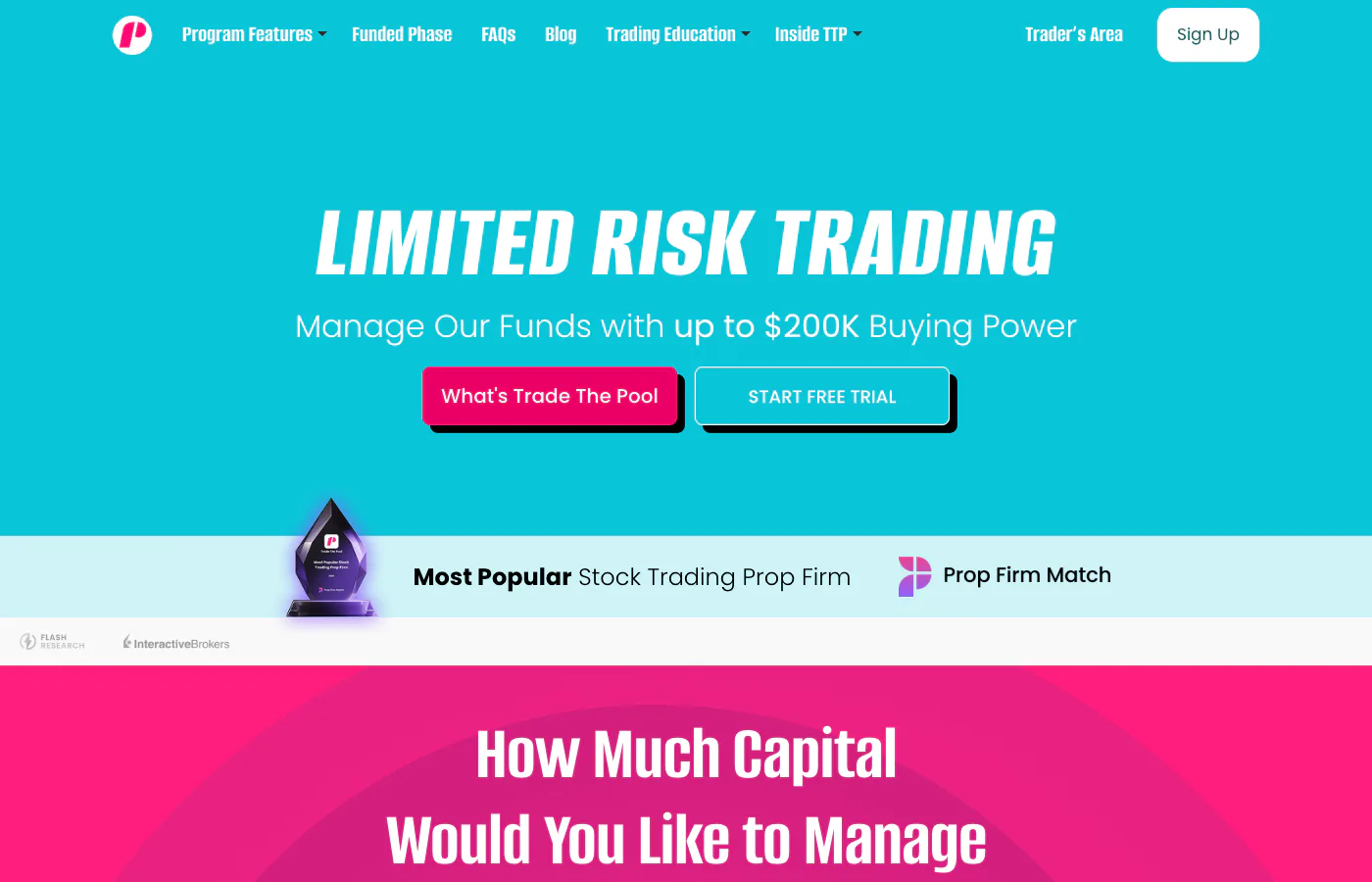
Platform: TraderEvolution
Stock access: 12,000+ US stocks and ETFs
Profit split: 70% on Flex and MAX, 80% on The Edge
Price from: $47 or $59 for a $5K Flex account, depending on the variant
Trade The Pool is the most stock-focused firm in this list, and it is run by the same company as The5ers. You trade US stocks and ETFs with simulated buying power, and Flex accounts run from $5K ($47 or $59) to $100K ($435 or $545) as of October 2026.
The rules are written for equities. Day accounts must be flat by 15:50 ET, you cannot hold through earnings, and you must close before splits and ex-dividend dates. If you scan small and mid caps for intraday setups, nothing else here comes close on breadth.
Strengths:
- by far the largest stock and ETF list
- rules designed around US equity sessions, earnings and corporate actions
- several program types, including day and swing variants
Trade-offs:
- stocks only, so no forex, crypto or commodities
- 70% split on the main programs, lower than most CFD firms
- day accounts close every position before the US close
2) Velotrade, best for stocks alongside crypto and commodities
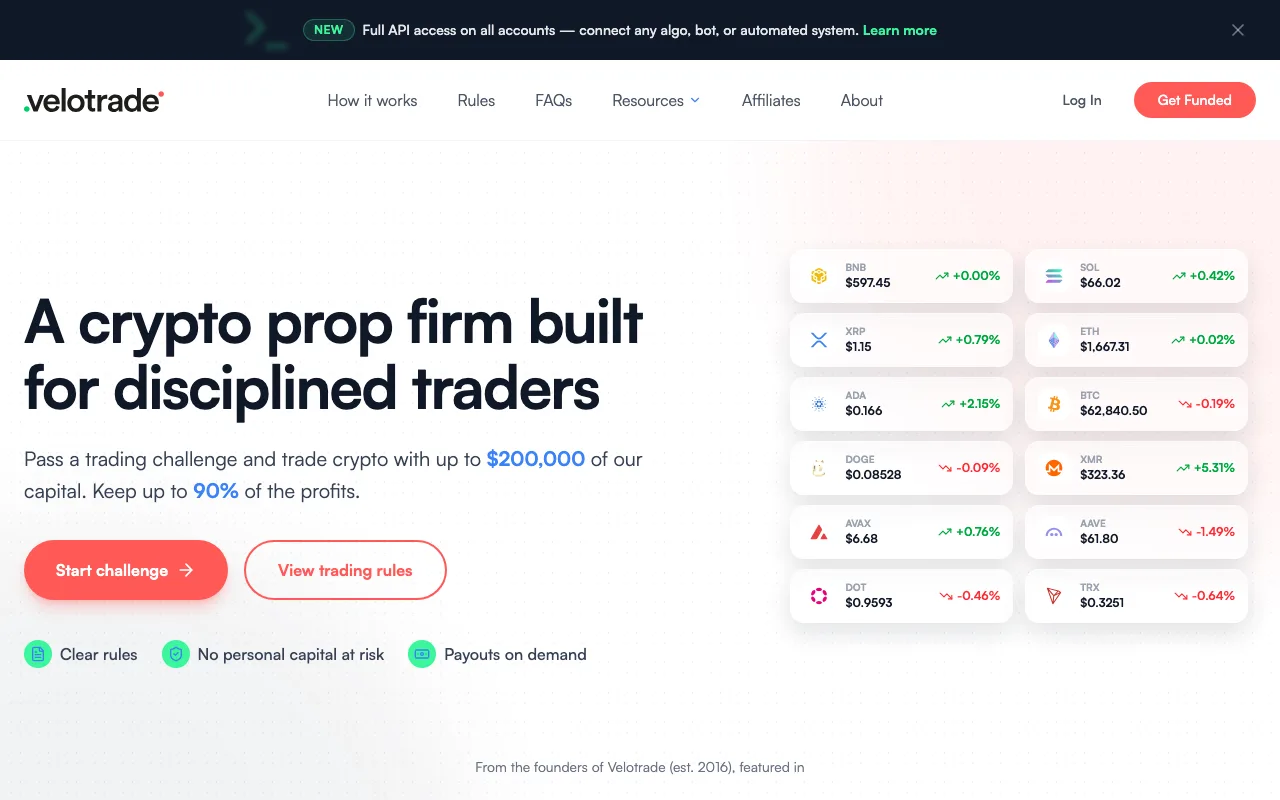
HQ: Hong Kong
Platform: DXtrade (plus REST and WebSocket API)
Max funding: Up to $200,000
Markets: Crypto, forex, stocks, index ETFs, commodities
Stock access: 77 single stocks at 5x leverage in the challenge and 3x funded
Velotrade is a multi-asset prop firm whose stock list includes names such as TSLA, NVDA, AAPL, MSFT, META, AMD, PLTR, COIN and MSTR, plus 7 index ETFs including SPY, QQQ and IWM at 6x challenge leverage. They sit on the same simulated DXtrade account as crypto, forex and commodities such as gold, silver and WTI crude.
The account rules are the same across all of them: a static maximum drawdown fixed from your starting balance, no consistency rule, news trading allowed, a minimum of 5 trading days and no time limit. Entry starts at $40 for a $5K 1-Step PRO challenge.
Single stocks carry their own rules. You must close a position 24 hours before an earnings release or ex-dividend date, and before a corporate action. Positions open at 00:30 UTC pay overnight funding of 0.05% of notional per day. Read the single stock rules before trading single names.
Strengths:
- one account for stocks, index ETFs, crypto, forex and commodities
- higher single-stock leverage than FundedNext's 1:2
- static drawdown and no consistency rule on every plan
Trade-offs:
- 77 stocks, far fewer than Trade The Pool
- no CME index futures; indices are ETFs only
- payouts in USDC or USDT stablecoins, not bank transfer
For a full breakdown, see the Velotrade review.
3) FTMO, best track record for stock CFDs
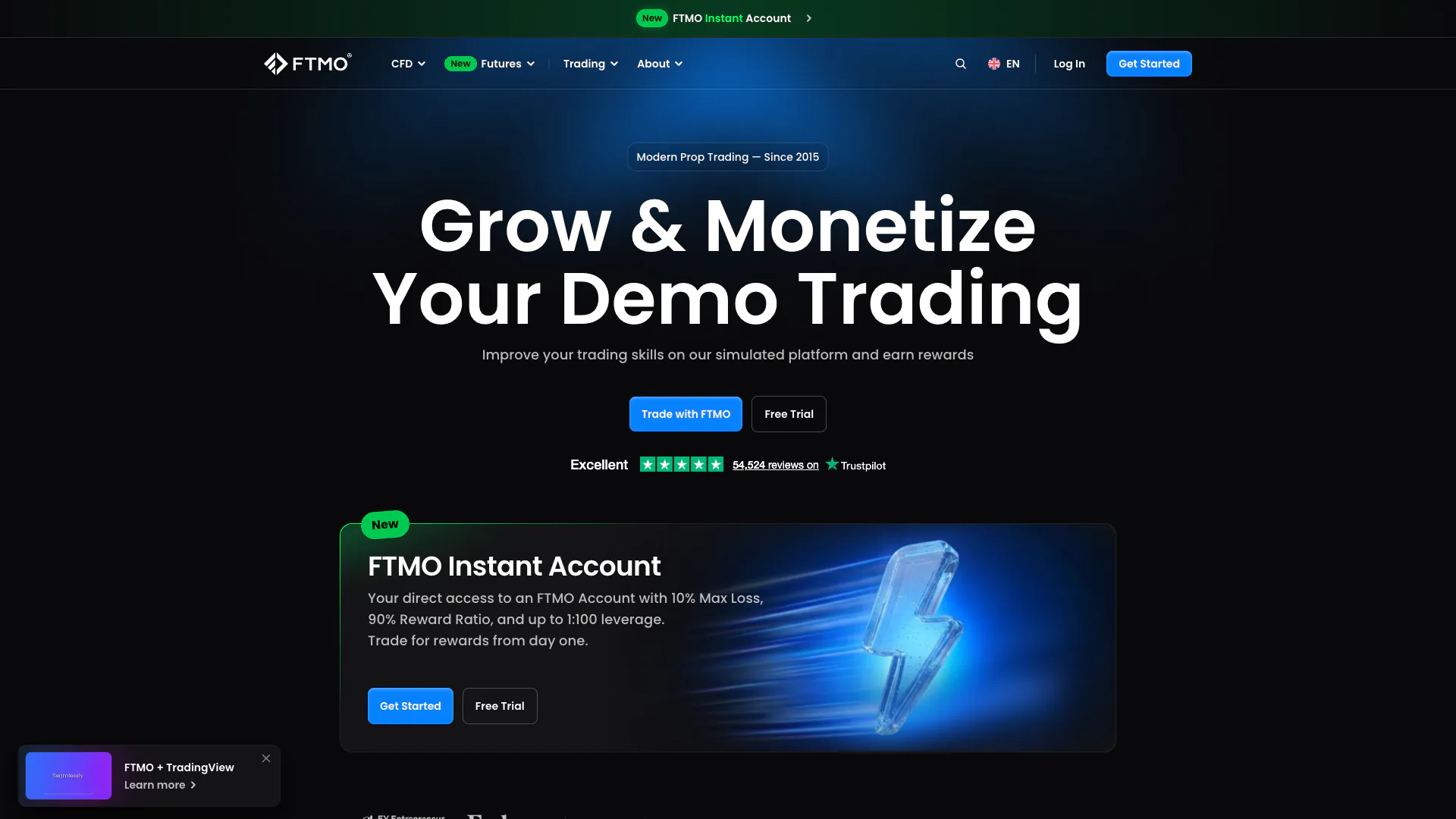
HQ: Prague
Platform: MT4, MT5, cTrader, DXtrade
Max funding: $200,000 per account
Stock access: stock CFDs, including 35 added on March 19, 2026
FTMO is the best-known prop firm in this list, and on March 19, 2026 it added 35 stock CFDs, including AMD, ASML, JPM, PLTR and MSTR. Accounts run from $10K to $200K with a split of up to 90%.
It suits a forex or index trader who wants to add a few large-cap stocks under a long-established brand. It is not built around stocks, so check the stock list and the session hours for each CFD before you buy.
Strengths:
- longest track record in this comparison
- four platforms, including DXtrade
- split of up to 90%
Trade-offs:
- stock CFDs are a side offering to forex and indices
- check each stock's trading hours and swap before holding overnight
For a full breakdown, see FTMO review and FTMO vs Velotrade.
4) FundedNext, best for stock CFDs next to forex
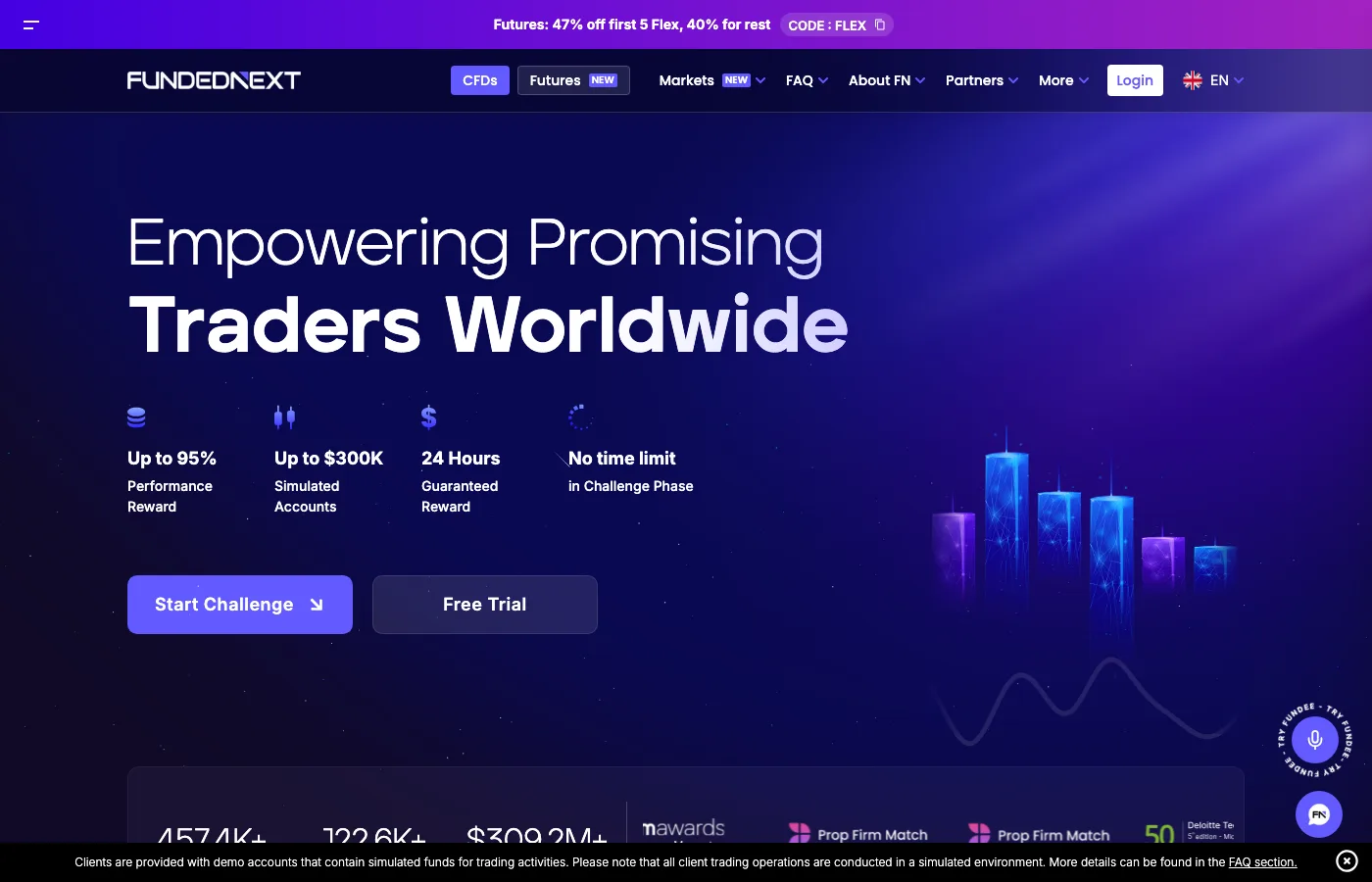
HQ: UAE
Platform: MT4, MT5, cTrader, Match-Trader
Max funding: $200,000 per account, scaling to $4,000,000
Stock access: 20 stock CFDs (14 US, 6 EU) at 1:2 leverage
FundedNext lists 20 stock CFDs, including AAPL, AMZN, GOOG, MSFT, NVDA, TSLA and META, plus 6 European names. Leverage on stocks is 1:2. Weekend holding is allowed, with a triple swap charge.
The split is 80%, or 95% with an add-on, and its Stellar Lite challenge starts at $32.99 for $5K, the lowest entry price here. It fits a forex trader who wants a handful of mega-cap stocks on the same MetaTrader account.
Strengths:
- low entry price
- weekend holding allowed on stock CFDs
- four platforms
Trade-offs:
- only 20 stocks, at 1:2 leverage
- triple swap on weekend holds adds cost to swing trades
For a full breakdown, see FundedNext review and FundedNext vs Velotrade.
5) The5ers, best for growth-plan traders who add stocks

HQ: London (UK-registered, Israel-founded)
Platform: MT5
Max funding: growth up to $4,000,000
Stock access: Hyper Growth program only
The5ers offers stocks on its Hyper Growth program only, which starts at $52 for $5K. Its main appeal is the growth path, which can scale an account up to $4 million. If stocks are your main market, its sister company Trade The Pool is the better fit.
Strengths:
- long scaling path
- low Hyper Growth entry price
Trade-offs:
- stocks on one program only
- MT5 only
For a full breakdown, see The5ers review and The5ers vs Velotrade.
6) Topstep, best for index futures instead of single stocks

HQ: Chicago
Platform: TopstepX
Stock access: none; equity index futures (ES, NQ, RTY, YM and micros)
Topstep is a futures firm, not a stock firm. It belongs here for one reason: if you trade the S&P 500 or Nasdaq-100 as an index, ES and NQ futures are a liquid way to do it. There are no individual stocks, positions must be closed by 3:10pm CT, and TopstepX is the only platform.
Pricing is a monthly subscription from $49 per month plus a $149 activation fee, or a no-activation option from $95 per month. The split is 90%. For more futures options, see our best futures prop firms.
Strengths:
- real CME index futures
- 90% split
- long track record in futures
Trade-offs:
- no individual stocks
- intraday only, flat by 3:10pm CT
- monthly fees until you pass
For a full breakdown, see Topstep review and Topstep vs Velotrade.
Not ranked this time: DNA Funded paused new orders in October 2026 while it migrates accounts from MT5 to TradeLocker. BrightFunded was dropped because it does not list individual stock CFDs.
Prop firm comparison for stock traders
| Firm | Stock access | Stock leverage | Earnings and holding | Split | Entry price | Best for |
|---|---|---|---|---|---|---|
| Trade The Pool | 12,000+ US stocks and ETFs | Buying power model | No holding through earnings; day accounts flat by 15:50 ET | 70% to 80% | $47 ($5K Flex) | Pure US stock traders |
| Velotrade | 77 stocks + 7 index ETFs | 5x challenge, 3x funded | Close 24h before earnings and ex-dividend | 80%, up to 90% with add-on | $40 ($5K PRO) | Stocks plus crypto and commodities |
| FTMO | Stock CFDs (35 added March 2026) | Check per instrument | Check per instrument | Up to 90% | Not verified | Forex traders adding large caps |
| FundedNext | 20 stock CFDs | 1:2 | Weekend holds allowed, triple swap | 80%, 95% with add-on | $32.99 ($5K) | Forex traders adding mega caps |
| The5ers | Stocks on Hyper Growth only | Check per instrument | Check per instrument | Varies by program | $52 ($5K) | Growth-path traders |
| Topstep | None (ES, NQ, RTY, YM futures) | Futures margin | Flat by 3:10pm CT | 90% | $49/month + $149 activation | Index futures traders |
What to look for as a stock trader at a prop firm

Check the exact ticker list. "Stocks available" can mean 20 mega caps or 12,000 symbols. Search the firm's instrument list for the tickers you trade before you pay.
Read the earnings and corporate-action rules. Trade The Pool and Velotrade both require you to close before earnings, ex-dividend dates and corporate actions. If your edge is the earnings gap, few prop firms will suit you.
Know your holding costs. Overnight swaps and funding charges add up on swing trades. Whether you hold intraday, as in day trading for beginners, or for days, as in swing trading, changes how much these costs matter.
Compare leverage on single names. Stock leverage ranges from 1:2 at FundedNext to 5x in a Velotrade challenge. Lower leverage means you need a bigger move to hit the same profit target.
Plan the short side. If you trade the downside, short selling explains how a short works, and the short squeeze guide covers the risk of being in a crowded short. New to reading price? Start with how to read stock charts and chart patterns.
Sources
All pages checked October 20, 2026.
- Trade The Pool, the program and program terms
- FundedNext, stock CFD instruments and leverage
- FundedNext, Stellar Lite
- FTMO
- The5ers
- Topstep and Topstep Help Center, permitted products
- DNA Funded, homepage notice
- Velotrade stocks, challenges and rules
Last updated: October 2026. Instrument lists and challenge conditions change often, so verify directly with each firm before buying.
Frequently Asked Questions
About the author

Vittorio De Angelis
Executive Chairman
Former equity-derivatives trader at JP Morgan, Dresdner Kleinwort and Bank of America in London. Later Head of Brokerage at a global broker in Hong Kong.
Velotrade was founded in Hong Kong in 2016 by a team from JP Morgan, Dresdner Kleinwort and Bank of America, has paid out over $2.5 billion to its trade-finance clients, and has been featured in Bloomberg, the Financial Times, the Wall Street Journal and on Nasdaq. Its prop trading evaluations are simulated and educational.
View author page