Trade stocks with funded capital
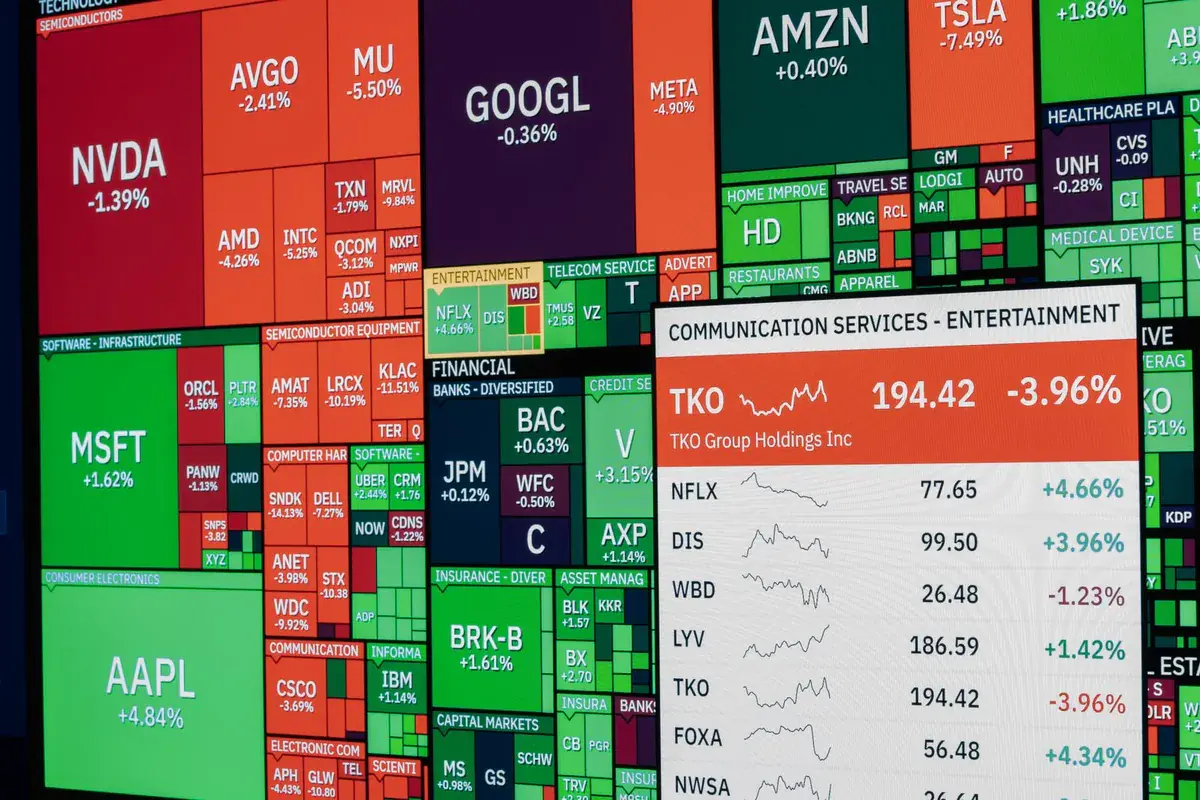
Explore stocksThe best stocks to day trade share a few measurable traits: heavy daily volume, tight spreads, enough intraday range to cover costs, and a reason to move today. A stock can be a great company and a poor day trade. What matters for an intraday trader is whether you can get in and out quickly at a fair price, and whether the stock moves enough between your entry and the close.
This guide covers the selection criteria that matter most when choosing the best stocks for day trading, a step-by-step screening process, and a set of liquid US names and index ETFs that day traders commonly watch. It is an education piece, not a list of recommendations.
Quick answer: The best stocks to day trade are highly liquid large caps with high average daily volume, high relative volume on the day, a wide average true range (ATR) and tight bid-ask spreads. Names commonly day traded include TSLA, NVDA, AMD, AAPL, META, AMZN and PLTR, plus the index ETFs SPY, QQQ and IWM. The right list changes daily, so screen for relative volume and a catalyst each morning.
Highlights of this article
- Liquidity comes first: high average daily volume and tight spreads keep entry and exit costs low
- Relative volume shows which stocks are unusually active today, often because of a catalyst
- ATR tells you how far a stock typically moves, which sets your stop distance and position size
- Low-float and high-beta stocks move fast but carry more slippage and gap risk
- Mega caps such as TSLA, NVDA and AAPL and the ETFs SPY, QQQ and IWM are the usual starting watchlist
What makes a stock good for day trading?
A day trade opens and closes within the same session. You do not hold through the overnight gap, so the stock has to deliver its move during market hours. That shifts the question from "is this a good business?" to "does this stock trade cleanly and move enough today?"
Most experienced day traders look for 3 things: liquidity, so orders fill at the expected price; volatility, so there is a range worth trading; and a catalyst, so there is a reason for that range today. If you are new to intraday trading in general, start with our guide to day trading for beginners, which covers the basics of the session, costs and risk.
Want to practise on stocks without risking your own capital? See the US stocks and index ETFs available on a Velotrade simulated evaluation, and read how the top prop firms compare.
Selection criteria for day trading stocks
Each criterion below answers a practical question. Together they filter thousands of listed stocks down to a short watchlist.
| Criterion | What it measures | What day traders usually look for |
|---|---|---|
| Average daily volume | Shares traded per day over a lookback, often 30 or 90 days | High, so large orders fill without moving the price |
| Relative volume (RVOL) | Today's volume vs the average for this time of day | Above 1.5x to 2x signals unusual interest |
| ATR and average range | Typical distance between the day's high and low | Large enough to cover spread, commission and a reasonable stop |
| Bid-ask spread | Gap between the best buy and sell quotes | A cent or two on liquid large caps; wide spreads are a hidden cost |
| Float | Shares available to trade publicly | Large floats trade smoothly; small floats move fast and erratically |
| Catalyst | News, earnings, guidance, sector moves, macro data | A clear reason for today's volume and range |
| Beta | Sensitivity to moves in the overall market | Higher beta means bigger swings when the index moves |
Liquidity and average daily volume
Average daily volume is the starting filter. A stock that trades tens of millions of shares a day lets you enter and exit at, or very close to, the quoted price. A thinly traded stock can look like a clean setup on the chart and still cost you on every fill. Many traders also look at dollar volume (shares traded times price), because 1 million shares of a $10 stock is far less liquidity than 1 million shares of a $400 stock.
Relative volume
Relative volume compares today's activity with normal activity. A stock trading 3 times its usual volume by 10:00 New York time is in play: more participants, more order flow and usually a larger range. Relative volume is the single most useful filter for finding today's best stocks for day trading, because the names that are active change every day.
ATR and average range
The ATR indicator measures how far a stock typically travels in a period. On a daily chart, the 14-day ATR gives you the average daily range. A stock with a small ATR relative to its price may not move enough to pay for costs. A stock with a very large ATR forces wider stops, which means a smaller position for the same dollar risk.
Spread
The bid-ask spread is paid on every round trip. For a trader taking several trades a day, a wide spread adds up quickly. Liquid large caps and the major index ETFs usually quote very tight spreads during regular hours. Spreads widen in the first minutes after the open, in the pre-market and after hours, and during sharp news moves.
Float
Float is the number of shares available for public trading. Low-float stocks can make huge percentage moves on modest volume, which attracts momentum traders, but they also halt, gap and reverse violently. Large-float names move in a more orderly way. A short squeeze is an extreme example of what happens when a small float meets heavy short interest.
Catalysts
A catalyst is the reason a stock is moving: earnings, guidance changes, analyst actions, product news, sector moves or macro data such as inflation releases. Without a catalyst, even a liquid stock can drift in a narrow range all day. With one, the first hour often sets up clean breakout or reversal opportunities.
Beta
Beta measures how much a stock tends to move relative to the market. A beta above 1 means the stock usually moves more than the index; below 1, less. High-beta names such as many semiconductor and growth stocks give bigger intraday swings on market-wide moves. Lower-beta names such as large consumer staples tend to be quieter.
A daily screening process
The list of stocks worth trading changes every morning. A short, repeatable routine keeps you focused on the names that are actually in play.
- Start with a liquidity floor. Filter for high average daily volume and a share price high enough to avoid penny-stock behaviour. This removes most of the market.
- Scan the pre-market for gaps and relative volume. Look for stocks gapping on volume well above their normal pre-market activity. Note the reason for each move.
- Check the catalyst. Read the headline. Earnings, guidance and sector news tend to produce sustained moves; rumours and low-quality press releases often fade.
- Measure the range. Check the ATR and the pre-market high and low. Decide whether the expected range is large enough for your stop and target.
- Mark the levels. Draw the prior day's high, low and close, the pre-market high and low, and key support and resistance. Add VWAP once the session opens.
- Cut the list to 3 to 5 names. Most day traders cannot follow more than a handful of stocks well. Keep one index ETF on the list to read the overall market.
- Wait for the open to settle. Many traders let the first 5 to 15 minutes form a range, then trade the break with an opening range breakout plan.
Write the watchlist down before the bell.
Examples of stocks commonly day traded
The names below are widely followed by US day traders because they combine very high liquidity with regular news flow. They are examples of the type of stock that tends to pass the criteria above, not recommendations. Characteristics are described qualitatively, because volume, range and volatility change with market conditions. Check current average volume and ATR on your own platform or screener before trading.
| Ticker | Company or fund | Liquidity | Typical intraday range | Common catalysts | Tradable on Velotrade |
|---|---|---|---|---|---|
| TSLA | Tesla | Very high | Wide; one of the most volatile mega caps | Deliveries, earnings, CEO headlines, EV and AI news | Yes |
| NVDA | Nvidia | Very high | Wide for a mega cap | AI demand, earnings, chip export news, sector moves | Yes |
| AMD | Advanced Micro Devices | Very high | Wide; high beta to the semiconductor sector | Earnings, product launches, Nvidia and sector moves | Yes |
| AAPL | Apple | Very high | Moderate; steadier than most tech names | Product events, earnings, index flows | Yes |
| META | Meta Platforms | Very high | Moderate to wide | Earnings, advertising data, AI spending news | Yes |
| AMZN | Amazon | Very high | Moderate | Earnings, cloud and retail data | Yes |
| PLTR | Palantir | Very high | Wide; popular with retail momentum traders | Earnings, government contracts, AI sentiment | Yes |
| SPY | SPDR S&P 500 ETF | Extremely high | Narrow in percentage terms | Macro data, Fed decisions, broad market flows | Yes (index ETF) |
| QQQ | Invesco QQQ (Nasdaq-100) | Extremely high | Narrow to moderate | Mega-cap tech earnings, rates, macro data | Yes (index ETF) |
| IWM | iShares Russell 2000 ETF | Very high | Moderate; small-cap sensitivity | Rates, small-cap sentiment, macro data | Yes (index ETF) |
Single stocks vs index ETFs
Single stocks give larger moves and stock-specific catalysts, but also stock-specific risk: one headline can gap a position through your stop. Index ETFs such as SPY, QQQ and IWM move less in percentage terms, are not exposed to any one company's earnings, and track the market that drives most single stocks anyway. Many day traders use QQQ or SPY as a market filter even when they trade single names. Our guide on how to trade indices covers the ETFs in more detail.
Risk and position sizing for day trading stocks
Picking the right stock is only half the job. The other half is sizing each trade so that the loss at your stop is a fixed, small share of your account. Use the stock's ATR and your chart levels to set the stop, then work backwards to size.
For example, on a $50,000 account risking 0.5% per trade, risk is $250. Suppose NVDA trades at $180 and your stop-loss is $2.50 below entry, position size is $250 / $2.50 = 100 shares, a notional of $18,000. If an AAPL setup needs only a $1.25 stop, the same $250 risk buys 200 shares. Different stocks, same dollar risk.
Two practical rules help. Avoid trading through scheduled news unless the plan is built for it, and stop after a fixed number of losses or a fixed daily loss. Our guide to risk management in trading covers daily limits and losing streaks in more detail.
What changed with the pattern day trader rule
In the US, FINRA's pattern day trader rule required a $25,000 minimum equity balance for margin accounts that made 4 or more day trades in 5 business days. In April 2026 the SEC approved FINRA's amendments to Rule 4210 that remove the pattern day trader designation and the $25,000 minimum, replacing them with intraday margin standards, effective June 4, 2026. Brokers are implementing the change on their own timelines and may keep their own minimums, so check your broker's current policy.
Day trading stocks on Velotrade
Velotrade, a multi-asset prop trading firm, runs simulated evaluations on DXtrade that include more than 70 US single stocks and 7 index ETFs on the same account as crypto, forex and commodities. You trade price references in a simulated environment; you do not own shares. Every example in the table above is tradable on Velotrade: TSLA, NVDA, AMD, AAPL, META, AMZN and PLTR as single stocks, and SPY, QQQ and IWM as index ETFs. Other liquid names on the list include MSFT, GOOGL, AVGO, NFLX, COIN, MSTR, MU and HOOD. The full list is on the stocks page.
| Instrument type | Challenge leverage | Funded leverage | Commission per side |
|---|---|---|---|
| Single stocks (e.g. TSLA, NVDA, AAPL) | 5x | 3x | 0.03% of notional |
| Index ETFs (SPY, QQQ, IWM, EWJ, EWY, EWZ, STXX) | 6x | 5x | 0.03% of notional |
A few rules matter for stock day traders. Single stock positions must be closed 24 hours before a scheduled earnings release and may not be reopened until 24 hours after it, so earnings-day gap trades on single stocks are not allowed; index ETFs are not tied to one company's earnings. Outside regular US market hours, single stock prices are indicative and can gap at the open. Positions open at 00:30 UTC pay an overnight charge of 0.05% of notional, which a day trader avoids by closing before then.
The risk limits are measured on live equity. The daily loss limit resets at 00:30 UTC from the higher of balance or equity. The maximum drawdown is static, a fixed floor from your starting balance that never moves. On the CLASSIC 2-Step plan the limits are 10% maximum drawdown and 5% daily loss, from $54 for a $5K account. There is no consistency rule and no time limit, and news trading is allowed outside the single-stock earnings restriction. For a comparison of stock-focused firms, see best prop firm for stocks, and for intraday rule sets, best prop firms for day trading.
This article is educational only. It is not investment advice or a recommendation to buy or sell any security. Past volatility does not predict future moves.
Sources
- Federal Register, Vol. 91 No. 74, April 17 2026: the SEC order approving FINRA's Rule 4210 day-trading amendments. FINRA Regulatory Notice 26-10 (April 20 2026) confirms the June 4 2026 effective date.
- Charles Schwab, "SEC Approves Scrapping $25,000 Day Trader Minimum": the April 2026 approval of FINRA's Rule 4210 amendments.
- E*TRADE, "Pattern day trading rule change": how the new intraday margin standard is being implemented by a broker.
- J. Welles Wilder, New Concepts in Technical Trading Systems, 1978: the original definition of Average True Range.
- Velotrade single stock instrument rules, effective 12 June 2026: earnings, ex-dividend and corporate action restrictions, and the overnight charge.
Frequently Asked Questions
About the author

Gianluca Pizzituti
Chief Executive Officer
Formerly on the derivatives desk at Dresdner Kleinwort in London, then founded and ran a proprietary HFT firm in FX and equity indices out of Singapore.
Velotrade was founded in Hong Kong in 2016 by a team from JP Morgan, Dresdner Kleinwort and Bank of America, has paid out over $2.5 billion to its trade-finance clients, and has been featured in Bloomberg, the Financial Times, the Wall Street Journal and on Nasdaq. Its prop trading evaluations are simulated and educational.
View author page