One account, every market we offer
ExploreThe opening range breakout, or ORB, is one of the simplest intraday strategies to define. You mark the high and low of the first few minutes after a market opens, then trade in the direction price breaks out of that range. The hard parts are choosing the range length, placing the stop and accepting that many breakouts fail.
Quick answer: An opening range breakout (ORB) strategy marks the high and low of the first 5, 15 or 30 minutes after a session opens, then buys a break above the high or sells a break below the low. The stop sits at the opposite side or middle of the range, and the trade closes at a target or the session end.
Highlights of this article
- The opening range is the high and low of the first 5, 15 or 30 minutes of a session
- A close beyond the range triggers the trade; the stop sits at the far side or the midpoint of the range
- Shorter ranges trigger more often and fail more often; longer ranges are slower but cleaner
- On Velotrade you can apply ORB to SPY and QQQ at the US open, and to forex and gold at the London open
- Crypto has no official open, so ORB traders anchor to a session time such as 00:00 UTC or the London or New York start
Funded accounts
Ready to get funded?
Trade up to $200,000 in firm capital with static drawdown, no consistency rule, and payouts within 24 hours. Pass the challenge and keep up to 90% of your profits.
Get funded from $40Opening range breakout: key facts
| Item | Detail |
|---|---|
| Definition | Trade the break of the high or low set in the first minutes of a session |
| Common range lengths | 5, 15 or 30 minutes |
| Entry trigger | A candle closes above the range high (long) or below the range low (short) |
| Stop placement | Opposite side of the range, the range midpoint, or a multiple of ATR |
| Exit | Fixed R multiple, trailing stop, or the end of the session |
| Best instruments | Liquid markets with a clear daily open, such as US index ETFs at 9:30 ET |
| Main risk | False breakouts that reverse back through the range |
| Related strategies | Breakout trading, momentum trading, VWAP |
What is an opening range breakout?
The opening range is the price range set during the first part of a trading session. At the start of the session, overnight news, queued orders and fresh positioning all hit the market at once. The high and low of that burst act as a short-term battle line. If price can break and hold beyond one side, ORB traders read it as a sign that one side of the market has taken control for the day.
The approach was popularised by trader Toby Crabel in his 1990 book on short-term price patterns and the opening range breakout, and it has been part of the day trader's toolkit ever since. It sits under the wider breakout trading family in the trading strategies library. The difference is the anchor: a general breakout trader uses any consolidation, while the ORB trader uses a range defined by the clock.
How do you trade the opening range breakout?
A basic, rules-based ORB looks like this:
- Define the session open. For US stocks and ETFs, the NYSE core session opens at 9:30 a.m. Eastern Time. For forex and gold, many traders use the London open at 08:00 London time.
- Mark the range. Record the highest high and lowest low of the first 5, 15 or 30 minutes.
- Wait for a close outside the range. A wick through the high is not enough. Many traders require a full candle close beyond the level to reduce false signals.
- Enter in the direction of the break. Long above the high, short below the low.
- Place the stop. Use the opposite side of the range for a wide stop, or the midpoint for a tighter one.
- Plan the exit. Take profit at a fixed multiple of risk such as 2R, trail a stop behind recent swings, or close at the end of the session.
- Limit attempts. Take one long and one short at most per session. If both fail, the market is choppy and you are done for the day.
The chart below shows a 15-minute range built from three 5-minute candles, a close above the range high, and the stop placed under the range low.
Should you use a 5, 15 or 30-minute opening range?
The range length is the main setting in an ORB system, and each choice has a trade-off.
| Range | Pros | Cons | Suits |
|---|---|---|---|
| 5-minute | Early entry, tight stop, more trades | Most exposed to opening noise and false breaks | Fast, experienced intraday traders |
| 15-minute | Balances noise and speed; a common default | Some moves are already underway by the break | Most traders starting with ORB |
| 30-minute | Range reflects more of the opening order flow, fewer false breaks | Wider stop, later entry, fewer signals | Traders who prefer fewer, slower decisions |
A wider range means a wider stop, so position size must shrink to keep risk in dollars the same.
There is no universally best length. Backtest each one on the instrument you plan to trade, including costs, before you choose.
Payout proof
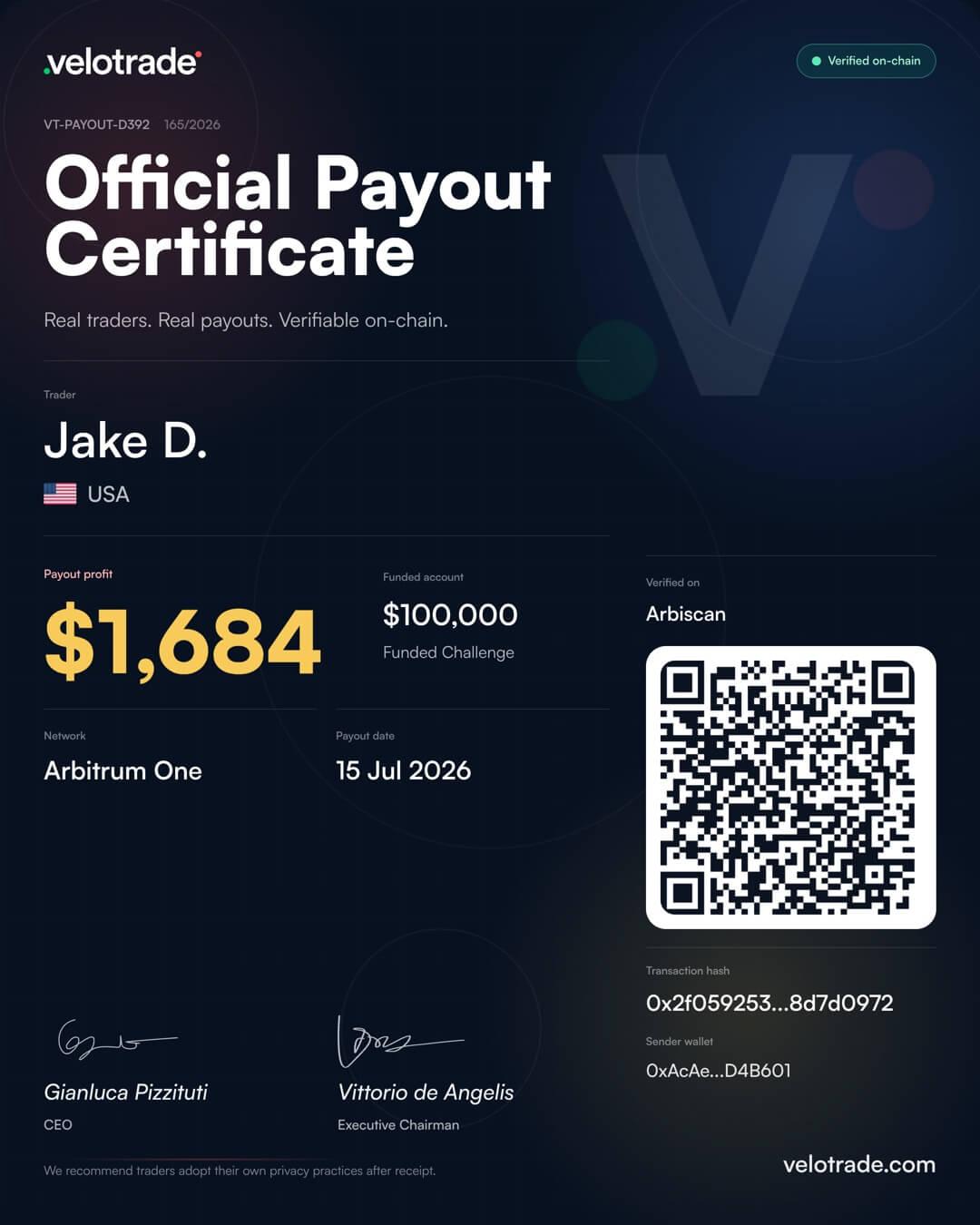
Fast, real payouts. Traceable on Arbitrum.
- Paid within 24 hours of approval
- Settled on Arbitrum in USDC or USDT
- Look up any transaction on Arbiscan

Where should the stop go on an ORB trade?
Stop placement decides both the win rate and the cost of each loss.
- Opposite side of the range. The widest and most forgiving stop. A long is only wrong if price falls through the whole range. Fewer stop-outs, smaller size.
- Range midpoint. Half the distance, so twice the size for the same dollar risk. More stop-outs on normal pullbacks.
- ATR-based. A fixed multiple of the average true range, such as 0.5 or 1 ATR from entry. This adjusts to quiet and volatile days.
- Time stop. If the breakout has not moved in your favour within a set time, such as 30 to 60 minutes, exit at market.
Whichever you choose, write it into your trading plan and never move a stop-loss further away once the trade is live.
How do you filter out false breakouts?
False breakouts are the main cost of the strategy. Price pokes through the range, triggers entries, then reverses back inside. Common filters:
- Require a candle close beyond the range, not just a touch.
- Check volume. A breakout on rising volume is more convincing than one on fading volume.
- Use VWAP as a bias. Some traders only take longs when price is above VWAP and shorts when it is below.
- Respect the higher timeframe. A long breakout into a major daily resistance level has less room to run.
- Skip scheduled news inside the range window. A data release at the open can create a range that reflects one headline rather than real positioning.
How do you apply ORB to SPY, QQQ, forex, gold and crypto?
ORB needs an open. Velotrade's instruments have different kinds of open, so the anchor changes by market.
SPY and QQQ at the US open
Velotrade lists the index ETFs SPY (S&P 500), QQQ (Nasdaq-100) and IWM (Russell 2000), with up to 6x leverage on challenges. These ETFs are where ORB is most natural, because the underlying US equity session has a clear 9:30 a.m. ET open, which is 13:30 UTC in US summer time and 14:30 UTC in winter. Note that Velotrade offers the ETFs, not index CFDs or futures. On Velotrade, SPY, QQQ and IWM are quoted 24/7, so the 9:30 a.m. ET cash open is a reference session you choose to trade, not the moment the market opens on the platform.
Forex and gold at the London open
Forex trades around the clock on weekdays, but liquidity jumps when London opens. The United Kingdom is the largest FX trading centre: in the BIS 2022 Triennial Survey it handled 38% of global foreign exchange turnover. Traders apply ORB to EUR/USD, GBP/USD and gold (XAU) using the first 15 or 30 minutes after 08:00 London time. That is 07:00 UTC during British Summer Time and 08:00 UTC in winter. See forex market hours for the full session map.
Crypto: use a session-based open
Crypto perpetuals trade 24/7, so there is no official open. ORB traders choose an anchor and stay consistent:
- 00:00 UTC, where most exchanges start the daily candle
- The London open, when European traders come online
- The US equity open, when crypto often reacts to moves in US stocks
Pick one, backtest it and stay with it.
Worked example: sizing an ORB trade on SPY
Here is an illustrative example on a 25K PRO 1-Step account. Product rules come from the Velotrade challenge page and FAQ; the prices are illustrative.
Account rules
- Account size: 25,000 USD
- Daily loss limit: 3%, so 750 USD, reset at 00:30 UTC from the higher of balance or equity
- Maximum drawdown: 3% static, a fixed floor at 24,250 USD
Trade plan
- 15-minute opening range on SPY: high 571.50, low 570.00
- Entry: a 5-minute candle closes at 571.60, above the range high
- Stop: 569.95, just under the range low, so 1.65 USD of risk per share
- Target: 2R, so 571.60 + 3.30 = 574.90
- Risk per trade: 0.4% of the account, so 100 USD
Position size
Size = 100 / 1.65 = 60 shares (rounded down). Notional = 60 x 571.60 = 34,296 USD, about 1.4x the account, inside the 6x challenge leverage for index ETFs.
Costs matter more than you think
Velotrade charges commission of 0.03% per side on notional for index ETFs. On 34,296 USD that is about 10.29 USD per side, or about 20.58 USD round trip, roughly 21% of the 100 USD risk. If you switch to a midpoint stop at 570.75, the risk per share drops to 0.85 USD, size rises to 117 shares (about 66,877 USD notional) and the round-trip commission rises to about 40 USD, or 40% of the risk. Tighter stops do not make a trade cheaper; they make costs a bigger share of every result.
What the numbers mean for the account
On this plan the static drawdown and the daily limit are the same 750 USD. Seven full losses of about 120 USD including costs would end the account, not just the day. That is why PRO 1-Step suits traders with very small, strict risk per trade. A trader who wants more room for a strategy with frequent small losses might compare CLASSIC 1-Step (4% daily, 7% static) or CLASSIC 2-Step (5% daily, 10% static) on the challenges page.
A London open example on gold
Suppose gold's first 30 minutes after 08:00 London time set a range 12 USD wide, and you place the stop 1 USD beyond the far side of the range, so 13 USD of risk per ounce. With 100 USD of risk, you can trade 7 ounces (100 / 13 = 7.7, rounded down). Commission on commodities is 0.01% per side on notional, lower than on index ETFs.
How does ORB fit prop firm rules?
ORB is a day trading strategy, so it lines up well with daily risk rules. A few points to plan for:
- Most ORB trades close the same day. That keeps you clear of overnight holding costs and of the single stock holding restrictions in the Velotrade rules.
- The daily loss limit resets at 00:30 UTC, not at the US open. For a US session trader, the whole US day sits inside one daily window.
- The static drawdown floor never moves. Winning days build a real cushion above the floor because the floor does not trail your gains.
- No max risk per trade. Velotrade does not cap position size per trade, so set your own cap in your plan and stick to it.
- Two failed breakouts is a signal. Stopping after one failed long and one failed short protects the daily limit on choppy days.
Funded accounts earn an 80% profit split, with a paid add-on for 90%. For a comparison of intraday-friendly rules across firms, see best prop firm for day trading, and for the basics of intraday work see day trading for beginners.
Common opening range breakout mistakes
- Entering on a wick instead of a candle close beyond the range
- Trading every day regardless of news, gaps or a range that is unusually wide
- Sizing by shares instead of risk, so a wide range day carries far more risk than a narrow one
- Ignoring costs, especially with tight stops on high-notional positions
- Re-entering repeatedly after failed breakouts in a choppy session
Day trading is risky, and regulators such as FINRA warn that frequent intraday trading can lead to large losses in a short time. Treat ORB as an educational framework, test it on historical data, and size it so a bad week cannot end your account.
Sources
- NYSE, "Holidays & Trading Hours": core trading session from 9:30 a.m. to 4:00 p.m. ET.
- BIS, "OTC foreign exchange turnover in April 2022": the United Kingdom handled 38% of global FX turnover.
- Investopedia, "Guide to Using the Opening Range in Trading": definition of the opening range and how traders use it.
- Investopedia, "Breakout": what a breakout is and why volume matters.
- FINRA, "Frequent Intraday Trading: Understanding the Basics": risks of day trading.
Frequently Asked Questions
About the author

Gianluca Pizzituti
Chief Executive Officer
Formerly on the derivatives desk at Dresdner Kleinwort in London, then founded and ran a proprietary HFT firm in FX and equity indices out of Singapore.
Velotrade was founded in Hong Kong in 2016 by a team from JP Morgan, Dresdner Kleinwort and Bank of America, has paid out over $2.5 billion to its trade-finance clients, and has been featured in Bloomberg, the Financial Times, the Wall Street Journal and on Nasdaq. Its prop trading evaluations are simulated and educational.
View author page