Run your win rate against the rules before you start
ExploreA funded trader is someone who trades an account provided by a proprietary trading firm instead of their own savings, and keeps a share of the profits. Today, almost every route into funded trading runs through an evaluation: you pay a fee, trade under fixed rules, and if you meet the profit target without breaking a loss limit, you receive a funded account.
This guide covers each step in order, whatever market you trade: what a funded trader is, how evaluations work, how to choose a firm, how to pass, how payouts work, what it costs, and what the published data says about pass rates.
Quick answer: To become a funded trader, choose a prop firm, pay for an evaluation (a "challenge"), and reach its profit target without breaching the daily loss limit or maximum drawdown. Pass, and you trade a funded account and keep a share of the profits, often 80% or more. Fees start at around 40 USD, and published industry data puts the challenge pass rate near 14%.
Highlights of this article
- A funded trader trades a prop firm's account under fixed risk rules and keeps a share of the profits
- The standard route is a paid evaluation with a profit target, a daily loss limit, and a maximum drawdown
- Rules matter more than the headline account size: drawdown type, minimum days, and payout terms decide whether you can actually get paid
- Published industry data covering 300,000 accounts found about 14% of traders passed a challenge and about 7% ever received a payout
- Most failures come from breaking risk rules, not from a lack of strategy, so a written plan and fixed position sizing are the core skills
Funded accounts
Ready to get funded?
Trade up to $200,000 in firm capital with static drawdown, no consistency rule, and payouts within 24 hours. Pass the challenge and keep up to 90% of your profits.
Get funded from $40How to become a funded trader: key facts
| Item | Detail |
|---|---|
| Definition | A trader who trades a prop firm's account under fixed rules and keeps a share of the profits |
| Main route | Pass a paid evaluation (1-step or 2-step) and receive a funded account |
| Typical rules | A profit target (often 8% to 10%), a daily loss limit, and a maximum drawdown |
| Typical cost | From about 40 USD for a small account to over 1,000 USD for a large one, usually a one-time fee per attempt |
| Typical profit split | 80% to 90% to the trader at many firms |
| Published pass rate | About 14% of traders passed a challenge in FPFX Tech data covering 300,000 accounts across 10 firms |
| Main risk | Losing the fee, then paying again, by breaching a loss limit on a bad day |
| Related reading | Risk management in trading, trading plan, why traders fail prop challenges |
What is a funded trader?
A funded trader is a trader who operates an account supplied by a proprietary trading firm, often called a prop firm. The firm sets the rules: how much you may lose in a day, how far the account may fall in total, which markets you can trade, and how profits are shared. You make the trading decisions. When you are profitable, you request a payout and receive your share, while the firm keeps the rest.
The model used by most modern online prop firms is evaluation-based. Instead of interviewing you, the firm asks you to prove your process on a test account first. That test is the evaluation, and the account you trade after passing is the funded account. At many firms, Velotrade included, both the evaluation and the funded account are simulated: trades are priced against real-time markets, and payouts are calculated from your simulated results.
Being a funded trader is not the same as being employed by a trading desk. You are usually an independent contractor, you pay for your own evaluations, and nobody pays you a salary. For a wider look at every route into trading, including bank desks and trading your own money, see how to become a trader.
How do prop firm evaluations work?
An evaluation is a fixed set of rules applied to a test account. Three numbers define almost every evaluation:
- Profit target. The gain you must reach to pass, usually a percentage of the starting balance, such as 10%.
- Daily loss limit. The most the account may lose in a single trading day. Breach it once and the evaluation usually ends.
- Maximum drawdown. The lowest the account may fall in total. This can be static (a fixed floor from the starting balance) or trailing (a floor that rises as the account makes new highs). A static maximum drawdown is easier to plan around because the floor never moves against you.
Evaluations come in two main formats. A 1-step evaluation has one phase: hit the target once and you are funded. A 2-step evaluation has two phases, usually with a lower target in the second phase and slightly looser loss limits overall. Many firms also set a minimum number of trading days, and some set a time limit.
As an example of real numbers, these are the rules on Velotrade's three plans. All three use static maximum drawdown and have no maximum time limit.
| Plan | Profit target | Daily loss limit | Max drawdown | Account sizes |
|---|---|---|---|---|
| PRO 1-Step | 10% | 3% | 3% (static) | 5K to 200K USD |
| CLASSIC 1-Step | 10% | 4% | 7% (static) | 5K to 100K USD |
| CLASSIC 2-Step | 10%, then 5% | 5% | 10% (static) | 5K to 100K USD |
For a full walkthrough of how rules like these are enforced, see prop firm rules explained.
How do you choose a prop firm?
The account size in the advert is the least important number. Before you pay for any prop firm challenge, check the details that decide whether you can pass and get paid:
- Drawdown type. Static or trailing, and whether the daily limit is measured from balance or equity. The same 10% drawdown behaves very differently under each.
- Payout terms. When you can request your first payout, how often after that, the minimum amount, and how it is paid.
- Profit split. The share you keep, and whether a higher split costs extra.
- Markets and instruments. Whether the firm offers what you actually trade, such as forex, crypto, indices, commodities, or stocks, and at what leverage and commission.
- Restrictions. Rules on news trading, weekend holding, consistency, and maximum risk per trade. A consistency rule, for example, can block a payout even when every loss limit was respected.
- Track record. Evidence that the firm pays traders, such as published payout records, and clear terms you can read before buying.
Match the firm to your style, not the other way round. A swing trader who holds through weekends needs a firm that allows it. A news trader needs a firm that permits trading around releases. If you trade one market in particular, compare firms for that market first.

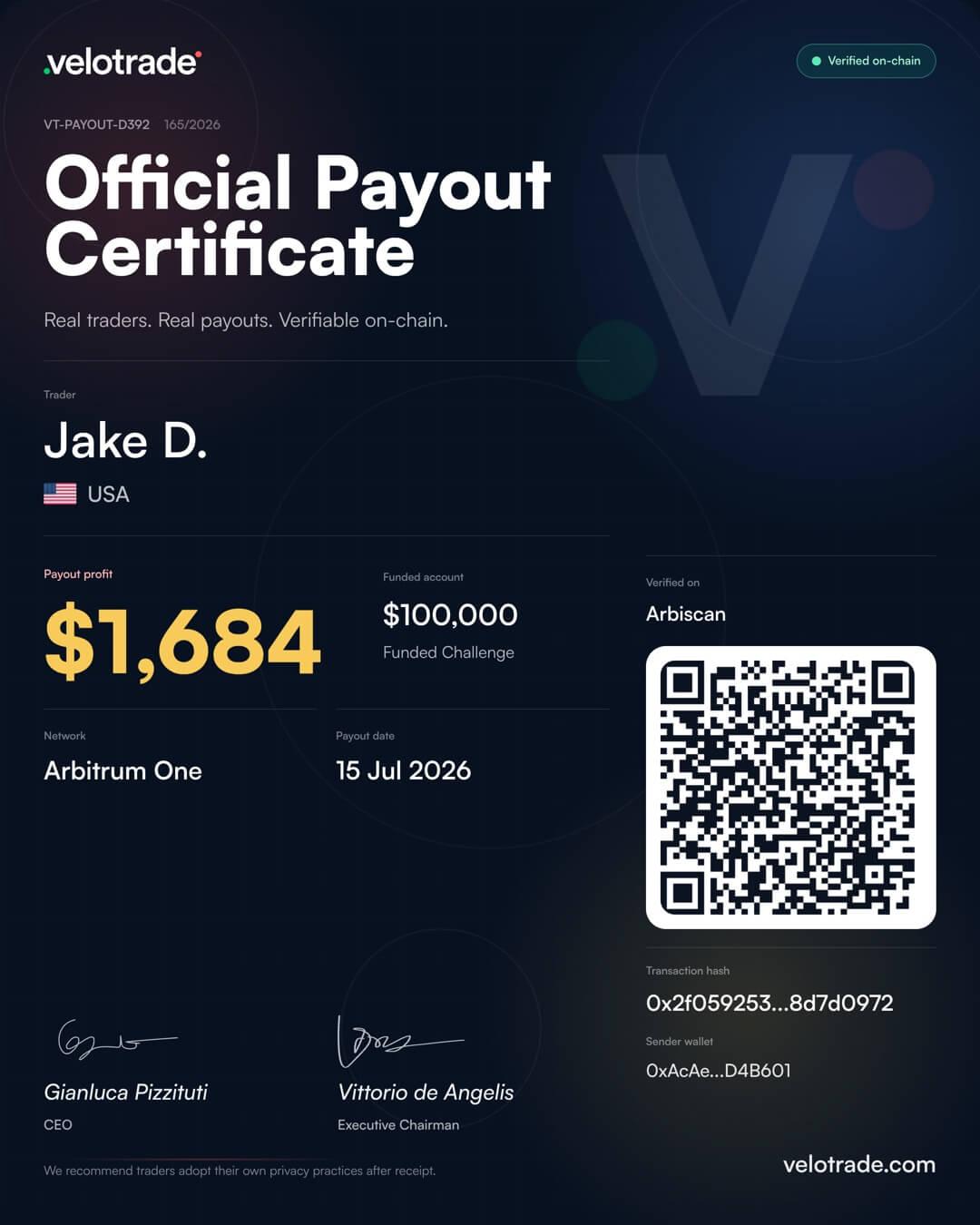
Payout proof
Fast, real payouts. Traceable on Arbitrum.
- Paid within 24 hours of approval
- Settled on Arbitrum in USDC or USDT
- Look up any transaction on Arbiscan

How do you pass a funded trader evaluation?
Passing is mainly a risk management exercise. The profit target is rarely what ends an evaluation; a loss limit is. These habits make the biggest difference:
- Write a plan first. Decide your markets, setups, entry and exit rules, and daily stop before you trade. Our guide to building a trading plan includes a template with a prop evaluation version.
- Size every trade from the loss limit. Work backwards from the daily loss limit, not forwards from the profit target. Risking 0.5% to 1% per trade on an account with a 3% to 5% daily limit leaves room for a normal losing streak. The risk management in trading guide shows how to set those numbers.
- Set a personal daily stop inside the firm's limit. If the firm allows 4% a day, stop yourself at 2% to 3%. The gap protects you from slippage and from one emotional trade.
- Ignore the clock. If your evaluation has no time limit, there is no reason to force trades. Rushing to hit a target is one of the most common causes of failure.
- Trade the same way you would on a funded account. A strategy that only passes by taking outsized risk will not survive the funded stage.
- Journal and review. Record every trade and the reason for it, and review the losers weekly.
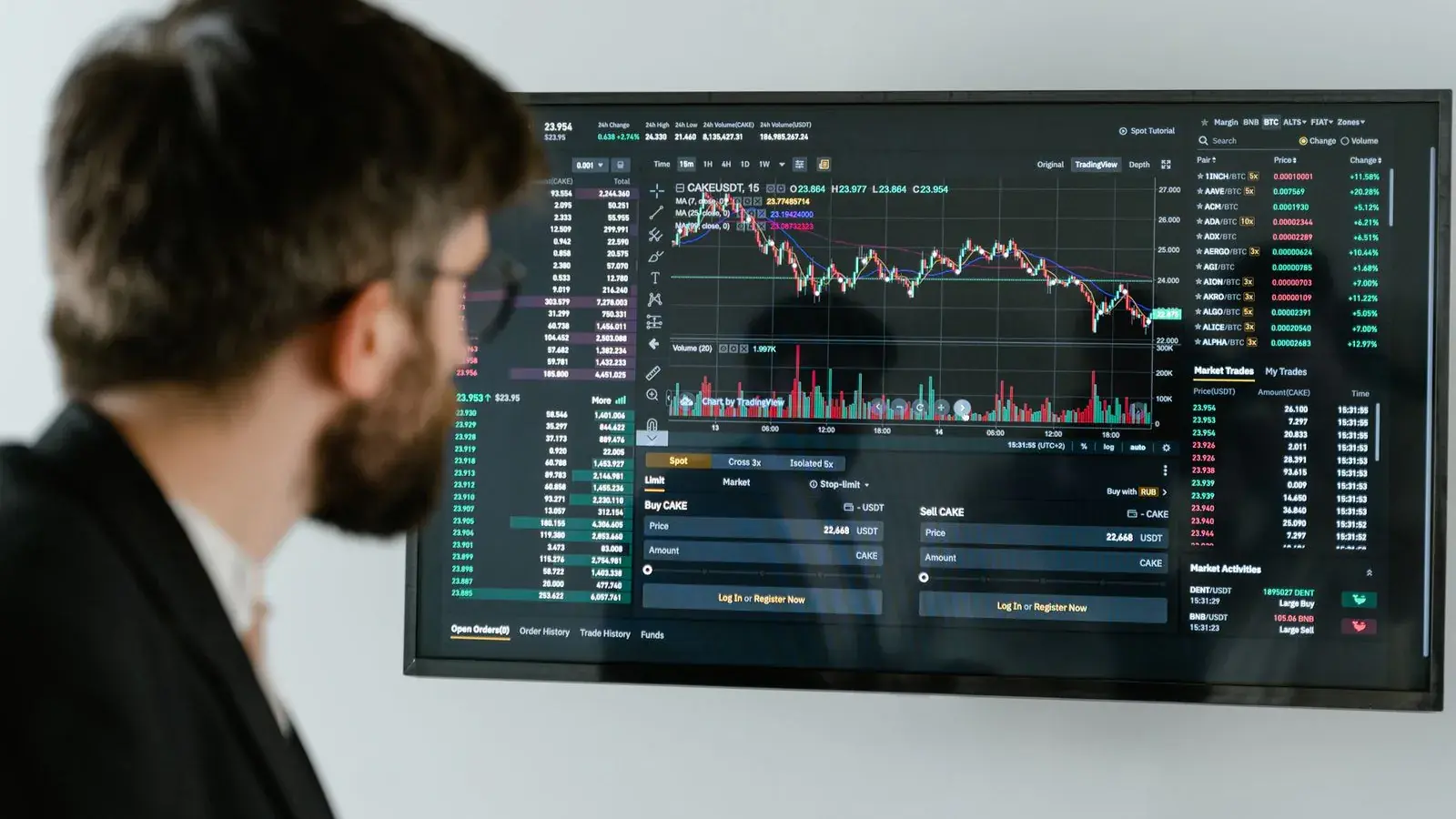
You can test your numbers before you pay with the challenge pass calculator, which runs your win rate and risk per trade against a plan's rules. For a phase-by-phase walkthrough, see how to pass a 2-step prop challenge and how to pass a 1-step prop challenge. The tactics apply to any market, not only crypto.
How do funded traders get paid?
Once funded, you trade under the same type of rules as the evaluation, usually without a profit target. You request a payout when you have profit above the starting balance and meet the firm's conditions, and you receive your share of that profit.
The details vary by firm, so read them before you buy:
- First payout timing. Many firms require a minimum period or number of trading days before the first payout.
- Payout frequency. Monthly, every two weeks, or weekly after the first payout.
- Minimum amount and method. For example bank transfer, card, or stablecoins.
- Profit split. Commonly 80% to 90% to the trader.
On Velotrade, the standard profit split is 80%, with a paid add-on that raises it to 90%. The first payout can be requested 14 calendar days after your first funded trade, once the required qualifying trading days are complete, and payouts can then be requested weekly. The minimum payout is 100 USD, and payouts are processed in USDC or USDT within 24 hours of approval. The payouts page shows how this works in practice.
How much does it cost to become a funded trader?
The main cost is the evaluation fee. Fees scale with account size, and most firms charge a one-time fee per attempt rather than a subscription. On Velotrade, fees start at 40 USD for a 5K USD PRO 1-Step account and rise to 1,114 USD for a 200K USD account; you can compare every size on the challenges page. Evaluation fees are generally non-refundable, although some firms refund the fee with your first payout.
The real cost is the fee multiplied by the number of attempts. If you fail twice and pass on the third try, your cost is three fees, so a cheaper small account is often the better starting point while you learn how you behave under the rules. Paid add-ons, such as a higher profit split, add to the cost. Before you buy, compare the fee against a realistic payout, not the account size: are prop firms worth it walks through that maths.

What are realistic pass rates?
Most firms do not publish their pass rates, so treat any single figure with care. The largest public dataset comes from FPFX Tech, a technology provider to prop firms, which shared data with Finance Magnates covering more than 300,000 accounts from about 100,000 traders across 10 firms. In that data:
| Stage | Share of traders |
|---|---|
| Passed a challenge and reached a funded account | About 14% |
| Funded traders who received at least one payout | About 45% |
| All traders who ever received a payout | About 7% |
The same report found the average payout was about 4% of the funded account size. In other words, getting funded is the first hurdle, and staying within the rules on the funded account is the second.
Two points help put these numbers in context. First, they include many traders who bought a challenge without a tested plan, so a prepared trader is not bound by the average. Second, the numbers are a warning against treating an evaluation as a lottery ticket. Research on retail trading points the same way: Barber and Odean (2000) found that the households that traded most earned the lowest net returns. The traders who pass tend to trade less, risk less per trade, and follow written rules. For the most common failure patterns, see why traders fail prop challenges.
How long does it take to become a funded trader?
It depends on the evaluation format and your style. A 1-step evaluation can be passed in a few weeks if your strategy produces the target without breaching a limit; a 2-step evaluation takes longer because there are two targets. Minimum trading day rules set a floor. Where there is no maximum time limit, the honest answer is that it takes as long as your process needs. Learning to trade consistently before you buy an evaluation usually takes much longer than the evaluation itself.
Which markets can a funded trader trade?
Funded accounts now cover most liquid markets: forex, crypto, stock indices, commodities such as gold and oil, and individual stocks. The process of becoming funded is the same in each; what changes is the instrument list, leverage, commission, and trading hours. Velotrade, for example, offers forex, crypto, index ETFs, commodities, and stocks on one simulated evaluation account. If you trade crypto specifically, our guide on how to become a funded crypto trader covers the crypto-specific details, such as 24/7 markets and volatility.
Velotrade is an educational, simulated evaluation provider. It is unregulated and is not a broker or investment service. This article is educational and is not investment advice.
Sources
- Finance Magnates via TradingView, "Only 7% of 300,000 prop trading accounts achieved payouts": FPFX Tech data on challenge pass rates, payout rates, and average payout size across 10 prop firms.
- Barber and Odean, "Trading Is Hazardous to Your Wealth" (2000): households that trade most earn the lowest net returns.
- FINRA, "Frequent Intraday Trading: Understanding the Basics": the risks of frequent intraday trading.
Frequently Asked Questions
About the author

Vittorio De Angelis
Executive Chairman
Former equity-derivatives trader at JP Morgan, Dresdner Kleinwort and Bank of America in London. Later Head of Brokerage at a global broker in Hong Kong.
Velotrade was founded in Hong Kong in 2016 by a team from JP Morgan, Dresdner Kleinwort and Bank of America, has paid out over $2.5 billion to its trade-finance clients, and has been featured in Bloomberg, the Financial Times, the Wall Street Journal and on Nasdaq. Its prop trading evaluations are simulated and educational.
View author page