See exactly how much room your account gives you
ExploreProp firm rules determine whether your trading strategy can pass an evaluation and stay funded. Most traders who fail a challenge do not fail because of poor trading. They fail because a rule they did not fully understand ended their account before they reached the profit target.
This guide covers every major prop firm rule category, explains how each one works in practice, and identifies where different rules create the most friction for different trading styles. For a firm-by-firm breakdown of where each rule lands, see the prop firm rules database.
Highlights of this article
- Daily loss limit and trailing drawdown model are the 2 rules that cause the most account breaches
- EOD trailing drawdown is more trader-friendly than tick-by-tick trailing because intraday peaks do not permanently tighten the floor
- Consistency rules disqualify evaluations where a single strong session generates too large a share of total profits
- News trading restrictions eliminate high-volatility setup windows for event-driven traders
- Velotrade has no consistency rule, uses static drawdown on all plans, and allows news trading on all accounts
- Read the written terms document, not the marketing page, before paying any challenge fee
Funded accounts
Prefer a firm where every rule is published before you pay?
Trade up to $200,000 in firm capital with static drawdown, no consistency rule, and payouts within 24 hours.
See Velotrade's challenge optionsDaily loss limit
The daily loss limit is the maximum amount you can lose in a single trading day. At some firms a breach suspends the account for the rest of the day; at others, including Velotrade, a breach fails the challenge or closes the funded account. Velotrade resets the limit at 00:30 UTC.
Most prop firms set the daily loss limit at 4-5% of the account balance. On a $100,000 account, that is $4,000 to $5,000 per day.
How it is calculated varies significantly between firms. Some firms calculate the daily loss limit against your closing balance from the previous day. Others calculate it against your current balance at the start of each session. Some include unrealized P&L from open positions in the daily loss calculation. Others only count closed trades.
The most important question to ask: does an open position that is temporarily in loss count toward your daily limit even before you close the trade?
If yes, a position that goes against you by 3% intraday can trigger the daily limit even if you close it later at breakeven. If no, only realized losses count.
Practical implications for position sizing:
If your daily loss limit is 5% of $50,000 ($2,500) and your normal stop loss per trade is 1% ($500), you have 5 losing trades at full size before the session suspension. Size your positions so that your normal worst-case daily outcome stays within that window.
Maximum drawdown (trailing vs fixed)
Maximum drawdown is the total distance your account can fall from its peak before the account is permanently closed.
There are 3 main models:
Fixed drawdown: the floor is set at a fixed percentage below your initial account balance and never moves. If you start with $100,000 and the maximum drawdown is 10%, the floor is always $90,000 regardless of how much profit you generate. Predictable, but does not reward profitable trading.
EOD trailing drawdown: the floor follows your account equity upward, but only updates once per day at close. If you end a day at $105,000, your floor moves up to $95,000 (10% below the new high). Intraday peaks have no effect. A session where you run up 3% and close flat leaves the floor exactly where it started that morning.
Tick-by-tick trailing drawdown: the floor updates in real time with every equity peak, including unrealized gains from open positions. If a position runs +2% intraday and you close flat, your floor has permanently risen 2%. You paid for that peak with drawdown room even though you never locked in the profit.
For most trading styles, EOD trailing drawdown is the most practical model. It does not penalize intraday volatility. For a full comparison with worked examples, see EOD trailing vs tick-by-tick drawdown explained.
Velotrade uses static (fixed) drawdown on all plans. The floor is set from the initial balance and never trails upward regardless of profits made. For a full breakdown of how the static model works, see static maximum drawdown explained.
Consistency rule
A consistency rule limits the percentage of your total evaluation profit that can come from any single trading day.
A typical consistency rule caps single-day profit contribution at 30-50% of the total. On a challenge with a $1,000 profit target, if you make $450 on one day and need only $550 more to pass, that one day represents more than 30% of your final total. Depending on how the rule is applied, this can invalidate the evaluation even if the profit target is hit.
Who this hurts most: traders with concentrated, event-driven strategies who generate large portions of their weekly or monthly profits during a small number of high-conviction sessions.
Who it does not affect: traders who spread consistent, even gains across many sessions over time.
Of 15 firms whose published rules we reviewed in September 2026, four carry no consistency rule at any stage: Velotrade, BrightFunded, Breakout Prop and Bitfunded. Three apply one unconditionally, and eight apply one that depends on the plan, the phase or the payout route chosen.
Be careful with the headline percentage, because it is measured against four different things across the industry. FTMO caps the best day at 50% of positive days' profit. Topstep's funded path caps it at 40% of total net profit, while its evaluation separately targets 50% of the profit target. DNA Funded limits any one day to 30% of a requested payout. HyroTrader caps a day at 40% of total net result, during evaluation only.
One thing is consistent across all of them: a consistency breach does not fail your account. The profit target is raised, the payout is blocked, or the excess is deducted. You stay in the evaluation, you just take longer to finish it. For a side-by-side comparison, see prop firm comparison 2026.
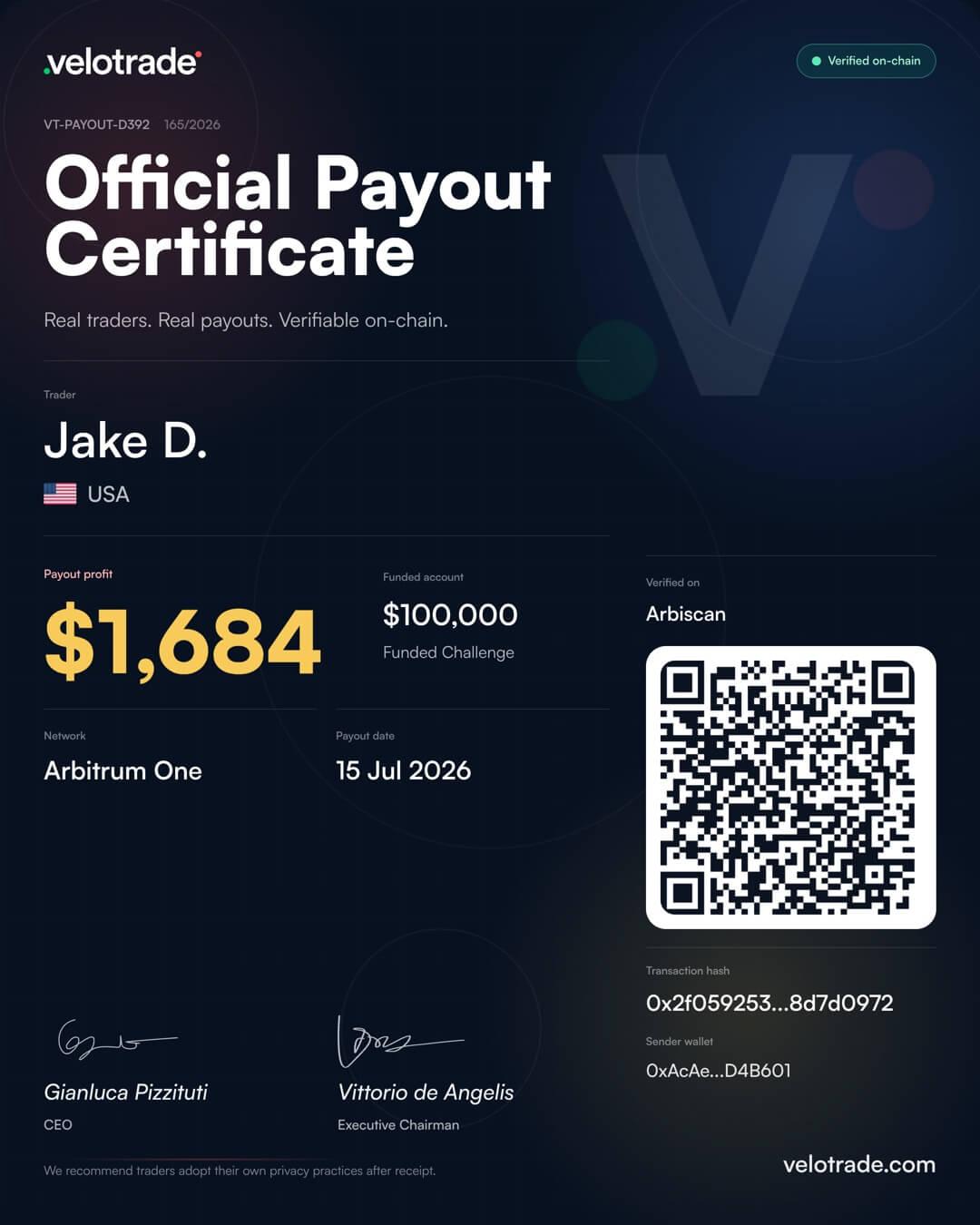
Payout proof
Fast, real payouts. Traceable on Arbitrum.
- Paid within 24 hours of approval
- Settled on Arbitrum in USDC or USDT
- Look up any transaction on Arbiscan

News trading restrictions
News trading restrictions prohibit entering or holding positions during defined windows around high-impact macro events. Common restricted events include FOMC announcements, NFP releases, and CPI reports.
The restriction typically works in one of two ways:
- No new positions can be opened in a defined window before and after the event (e.g., 2 minutes before and 2 minutes after)
- Any open positions must be closed before the event window begins
For traders whose best setups come from volatility around macro releases, news restrictions eliminate a meaningful portion of viable opportunities.
Read the exact policy language before purchasing. Marketing pages say "news trading allowed" or "news restrictions apply" without specifying which events, how wide the window is, or whether the restriction applies to crypto instruments specifically (or only to forex pairs). The exact definition is in the terms document, not the sales page.
Velotrade allows news trading on all accounts with no event restrictions and no forced position-close windows.
Minimum trading days
Many evaluations require a minimum number of trading days before you can hit the profit target and pass. Common minimums are 3, 5, or 10 trading days.
This rule prevents traders from taking a single oversized position, hitting the profit target on one day, and immediately requesting a funded account. It forces distribution of results across multiple sessions.
For traders who are patient and trade a normal schedule, minimum day requirements rarely create friction. For traders who want to pass quickly or who trade infrequently, this rule extends the evaluation timeline.
Check whether the minimum day requirement counts calendar days or trading days, and whether a day counts only if you place at least one trade on it.
Maximum position size and lot limits
Many prop firms cap the number of simultaneous open positions or the maximum contract size on an account. Funded account limits often differ from evaluation account limits.
For futures traders, this typically appears as a maximum contract limit per account tier (e.g., a $50,000 funded account allows up to 5 ES contracts simultaneously). For crypto traders, it may appear as a maximum position size as a percentage of account balance.
Confirm the funded account limits specifically, not just the evaluation account limits. They can differ.
Profit target
The profit target is the percentage gain required to pass the evaluation and receive a funded account. Most challenges require 8-10% in a single phase or 10% followed by 5% across two phases.
The profit target interacts directly with the daily loss limit. If your daily loss limit is 5% and your profit target is 10%, you need a minimum 2:1 reward-to-risk ratio across your evaluation period just to break even on the math. Factor this into your position sizing and expected evaluation duration.
Prohibited strategies
Most firms prohibit specific strategies that exploit structural weaknesses rather than market skill. Common prohibited strategies:
- Hedging between accounts at the same firm: opening opposing positions on two accounts to lock a spread
- High-frequency trading: some firms restrict order frequency per session or per day
- Latency arbitrage: exploiting price feed delays between the firm's platform and reference markets
- Copy trading from a live funded account: using a funded account as a signal source to mirror on challenge accounts
Velotrade explicitly allows algorithmic trading, API access, and automated strategies. Confirm explicitly which strategy types are permitted if you use any systematic approach.

Rule summary table
| Rule | What it limits | Key question to ask |
|---|---|---|
| Daily loss limit | Max loss per trading day (4-5% typical) | Is it calculated on realized P&L only, or does it include floating unrealized losses? |
| Maximum drawdown | Max total distance from equity peak to current balance | Is it fixed, EOD trailing, or tick-by-tick trailing? |
| Consistency rule | Max % of total profit from any single day | Does it apply to my plan type? What is the cap? |
| News trading | Entry/hold during macro event windows | Which events? How wide is the window? Does it cover crypto? |
| Minimum trading days | Min sessions before profit target counts | Calendar days or trading days? Does a day count with 0 trades? |
| Max position size | Max simultaneous contracts or position size | What are the funded account limits specifically (not just evaluation)? |
| Profit target | % gain required to pass | What is the target per phase? Is there a time limit? |
Free calculator
What does passing actually pay you?
Plug in your account size and see your profit target, max drawdown, and first payout - before you commit to a challenge.
Use the free prop challenge calculatorLast updated: June 2026. Challenge conditions and rule sets change regularly. Verify directly with each firm before purchasing.
Frequently Asked Questions
About the author

Vittorio De Angelis
Executive Chairman
Former equity-derivatives trader at JP Morgan, Dresdner Kleinwort and Bank of America in London. Later Head of Brokerage at a global broker in Hong Kong.
View author page