See when a challenge pays for itself
Explore calculatorsHow much do day traders make? Most make nothing, and the majority lose money. The largest academic studies of real trading accounts find that only a very small share of day traders earn a steady profit after costs. In a study of Brazilian day traders who traded for at least 300 days, 97% lost money, and only 0.4% earned more than a bank teller.
That is the honest starting point. There is no salary for day trading, no average wage and no floor. Income is the result of 3 things: how much capital you trade, the edge you have after costs, and how long you can keep it. This guide covers what the research found, what drives a trader's income, how retail, funded and institutional traders are paid, and a simple model you can run with your own numbers.
Quick answer: There is no reliable average income for day traders, because most lose money. A study of Taiwanese day traders from 1992 to 2006 found that less than 1% were predictably profitable after fees. European regulator ESMA found that 74% to 89% of retail CFD accounts lose money. The small group that does profit earns in proportion to its capital, so a 2% net monthly return is $200 on $10,000 and $2,000 on $100,000.
Highlights of this article
- Day traders have no salary: income is account size multiplied by net return, and for most traders the net return is negative
- In Brazil, 97% of people who day traded for at least 300 days lost money, and 0.4% earned more than a bank teller (US$54 per day)
- In Taiwan, less than 1% of day traders were predictably profitable after fees over 1992 to 2006
- ESMA found that 74% to 89% of retail CFD accounts lose money, with average losses of 1,600 to 29,000 euros per client
- A 5 percentage point change in win rate can turn a monthly loss into a profit, which is why costs and discipline decide the outcome
How much do day traders make on average?
There is no trustworthy average, and any single figure you see quoted should be treated with caution. Three problems make the number hard to pin down.
Day trading is not a job category. The US Bureau of Labor Statistics does not track self-employed day traders. Salary websites that show an "average day trader salary" are mostly reporting people employed by trading firms, which is a different occupation.
Survivors are overcounted. People who lose money stop trading and stop answering surveys, so self-reported income data is biased upwards.
The distribution is extremely uneven. A few traders earn a great deal and most lose. An average of that group says little about what a typical trader takes home. The median, the trader in the middle, is losing money.
The useful evidence comes from studies that use complete account records from an exchange or regulator, where every trader is counted, including those who quit.
What do the studies say?
Four sources stand out because they are based on full datasets, not surveys.
| Source | Market and period | Sample | Key finding |
|---|---|---|---|
| Chague, De-Losso and Giovannetti (2020) | Brazil, equity index futures, people who started in 2013 to 2015 | All individuals who day traded for at least 300 days | 97% lost money. 0.4% earned more than a bank teller (US$54 per day) |
| Barber, Lee, Liu and Odean (2014) | Taiwan Stock Exchange, 1992 to 2006 | All day traders | Less than 1% predictably earned positive returns after fees |
| Barber, Lee, Liu, Odean and Zhang (2017) | Taiwan Stock Exchange, 1992 to 2006 | All day traders | More than 75% quit within 2 years. Aggregate performance after fees was negative in each of the 15 years |
| ESMA (March 27, 2018) | European Union, retail CFD accounts | National regulator analyses | 74% to 89% of retail accounts lose money. Average losses of 1,600 to 29,000 euros per client |
Brazil: "Day Trading for a Living?"
Fernando Chague, Rodrigo De-Losso and Bruno Giovannetti studied the people who took day trading seriously: everyone who started between 2013 and 2015 and kept going for at least 300 days. The single best trader in the sample earned US$310 per day, with a standard deviation of US$2,560, meaning the daily result swung enormously. The authors found no evidence that traders improved with experience.
Taiwan: the largest day trading dataset
Brad Barber, Yi-Tsung Lee, Yu-Jane Liu and Terrance Odean used the complete records of the Taiwan Stock Exchange. Skill did exist, but it was rare. The 500 top-ranked day traders from one year went on to earn 61.3 basis points per day before fees and 37.9 basis points per day after fees in the next year. A basis point is 0.01%, so that is about 0.38% per day after fees. The bottom-ranked traders lost 28.9 basis points per day after fees. The 2017 follow-up found that many traders kept going despite a long record of losses.
Europe: regulator disclosures
In March 2018 the European Securities and Markets Authority (ESMA) restricted the sale of contracts for difference (CFDs) to retail clients. It cited analyses by national regulators showing that 74% to 89% of retail accounts typically lose money, with average losses per client ranging from 1,600 to 29,000 euros. CFD brokers in Europe must now publish the share of their retail accounts that lose money.
These studies cover different countries, products and decades, and they agree.


What decides how much a day trader makes?
A day trader's income is the product of 4 factors: capital, edge, costs and consistency. A weakness in any one can take the result to zero.
Capital
Income scales with account size. The same skill produces very different dollar amounts on different accounts.
| Account size | Net monthly return of 1% | Net monthly return of 2% | Net monthly return of 4% |
|---|---|---|---|
| $5,000 | $50 | $100 | $200 |
| $25,000 | $250 | $500 | $1,000 |
| $100,000 | $1,000 | $2,000 | $4,000 |
| $500,000 | $5,000 | $10,000 | $20,000 |
These are illustrations of arithmetic, not expected results. Very few traders in the studies above sustained anything close to a net 2% a month. The table shows why small accounts cannot produce a living wage even for a skilled trader, and why undercapitalised traders are tempted to take oversized risks.
Edge: win rate and reward to risk
Edge is the average profit per trade before costs. It comes from 2 numbers: how often you win and how much you win relative to what you lose. The formula is called expectancy.
Expectancy = (win rate x average win) - (loss rate x average loss)
A trader who wins 45% of the time, makes $150 on winners and loses $100 on losers has an expectancy of:
(0.45 x $150) - (0.55 x $100) = $67.50 - $55.00 = $12.50 per trade
Win rate alone means little. A 70% win rate loses money if the average loss is 3 times the average win. The risk-reward ratio guide covers how the 2 numbers combine.
Costs
Day traders trade often, so costs take a larger share of their results than of any other style. The main ones are:
- Spread. The gap between the buying and selling price, paid on every round trip. See the bid-ask spread guide.
- Commission. A fee per trade or per share, where charged.
- Slippage. The difference between the price you wanted and the price you got.
- Data, platform and software fees. Fixed monthly costs that must be covered before any profit.
- Taxes. Short-term trading profits are often taxed at higher rates than long-term gains, depending on the country.
A small edge can be fully consumed by costs.
Consistency
A trader needs the edge to hold across hundreds of trades and through losing streaks. Most blown accounts are not the result of a bad strategy. They come from breaking the plan: larger size after losses, revenge trades and overtrading. A trading journal is the standard tool for finding out whether the problem is the strategy or the trader.
A worked income model
The model below shows how sensitive monthly income is to a small change in win rate. The assumptions are fixed across all 3 rows:
- 100 trades per month, about 5 per trading day
- $100 risked per trade, so the average loss is $100
- Average win of $150, a reward to risk of 1.5 to 1
- Total costs of $6 per trade, or $600 per month
| Win rate | Expectancy per trade | Gross per month | Costs per month | Net per month |
|---|---|---|---|---|
| 40% | $0.00 | $0 | $600 | -$600 |
| 45% | $12.50 | $1,250 | $600 | $650 |
| 50% | $25.00 | $2,500 | $600 | $1,900 |
The calculation for the 50% row: (0.50 x $150) - (0.50 x $100) = $25.00 per trade. Over 100 trades that is $2,500 gross, minus $600 in costs, for $1,900 net.
Three things stand out.
- A 5 point change in win rate decides everything. At 40% the trader breaks even before costs and loses $600 after them. At 45% the same trader makes $650.
- Costs are a fixed hurdle. At 45%, costs take 48% of the gross profit ($600 / $1,250).
- The numbers are small relative to the effort. $650 a month for about 100 trades assumes the edge is real and stable.
This is a model, not a forecast. Real results are lumpier. Run it with your own journal data, not with numbers you hope for.
Retail vs funded vs institutional: how traders get paid
"Day trader" covers 3 very different arrangements. They differ in whose capital is at risk and how the trader is paid.
| Retail trader | Funded (prop evaluation) trader | Institutional trader | |
|---|---|---|---|
| Whose capital | Their own | A firm-provided account, after passing an evaluation | The employer's |
| How they are paid | 100% of profits | A share of profits, often 80% | Salary plus a bonus |
| Downside | 100% of losses, up to the whole account | The evaluation fee | Loss of bonus or job |
| Fixed income | None | None | Yes |
| Main limit on income | Size of own savings | The firm's risk rules and passing rate | Seat, mandate and firm performance |
Retail traders
A retail trader trades personal savings through a broker. They keep every dollar of profit and absorb every dollar of loss. The limit is capital: most people cannot put enough money at risk for a realistic return to cover living costs. Our day trading basics guide explains how the style works.
Funded traders
A funded trader pays a fee to take an evaluation at a prop firm. If they hit a profit target without breaking the loss limits, they trade a larger account and receive a share of the profits. The appeal is leverage on skill: a trader with a small bankroll can be paid on a larger account while risking only the fee.
The trade-off is that many people do not pass. The fee is lost when the rules are broken, and repeated attempts add up. The reasons are covered in why traders fail prop challenges, and the cost side in are prop firms worth it.
Institutional traders
Institutional traders work for banks, hedge funds, market makers and proprietary trading companies. They are employees, with a salary, a bonus tied to performance, and the firm's capital, technology and risk controls behind them. Few of them day trade in the retail sense.
The closest US government figure is for a broader occupation. The Bureau of Labor Statistics reports that the median annual wage for securities, commodities and financial services sales agents was $78,660 in May 2025. The lowest 10% earned less than $48,040 and the highest 10% earned more than $212,880. This group includes brokers and sales staff as well as traders, and it says nothing about self-employed day traders.
What are the realistic odds?
The realistic odds of earning a living from day trading are low. Based on the studies above, a fair summary is:
- Most lose. Between about 3 in 4 and more than 9 in 10 retail short-term traders lose money, depending on the market and the product.
- Most quit. In Taiwan, more than 75% of day traders stopped within 2 years.
- A small group is consistently profitable. In the largest dataset, that group was less than 1% of all day traders.
- Time alone does not fix it. The Brazilian study found no evidence of learning among traders who persisted.
This does not mean nobody succeeds. It means the default outcome is a loss, and anyone starting out should plan for it: trade only money you can afford to lose, keep your job, and record at least 100 trades to measure your expectancy after costs before you scale.
How this applies to a Velotrade evaluation
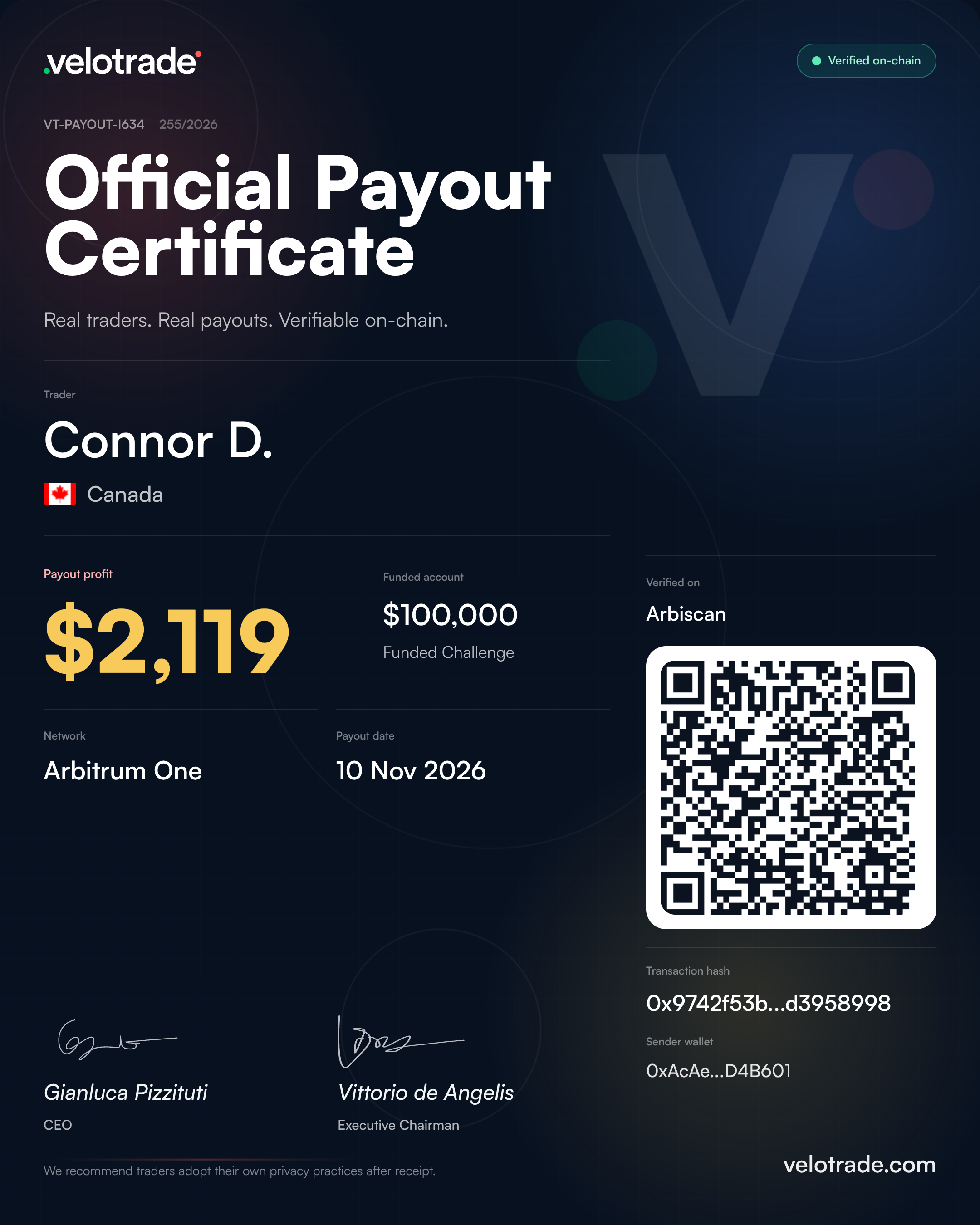
Velotrade offers simulated, educational trading evaluations on crypto, forex, stocks, index ETFs and commodities. A trader who passes and trades a funded account receives an 80% profit split, with 90% available as a paid add-on. Each plan has a daily loss limit and a static maximum drawdown, a fixed floor that does not trail profits.
Nothing about that changes the odds described above. Evaluation fees are non-refundable, passing is not guaranteed, and no income is guaranteed. The model in this article still applies: the result depends on expectancy after costs and on staying inside the limits. If you want the process in detail, read how to become a funded trader.
Sources
- Chague, F., De-Losso, R. and Giovannetti, B., "Day Trading for a Living?" (FGV EESP working paper 525, 2020): 97% of persistent Brazilian day traders lost money, 0.4% earned more than a bank teller.
- Barber, B., Lee, Y., Liu, Y. and Odean, T., "The cross-section of speculator skill: Evidence from day trading", Journal of Financial Markets, vol. 18 (2014): less than 1% of Taiwanese day traders predictably profitable after fees, and the returns of the top 500.
- Barber, B., Lee, Y., Liu, Y., Odean, T. and Zhang, K., "Do Day Traders Rationally Learn About Their Ability?" (October 2017): more than 75% of day traders quit within 2 years, and aggregate performance after fees was negative in all 15 years.
- ESMA, "ESMA agrees to prohibit binary options and restrict CFDs to protect retail investors" (March 27, 2018): 74% to 89% of retail CFD accounts lose money, average losses of 1,600 to 29,000 euros.
- US Bureau of Labor Statistics, Occupational Outlook Handbook, "Securities, Commodities, and Financial Services Sales Agents" (May 2025 wage data): median annual wage and the 10th and 90th percentile wages.
Frequently Asked Questions
About the author

Gianluca Pizzituti
Chief Executive Officer
Formerly on the derivatives desk at Dresdner Kleinwort in London, then founded and ran a proprietary HFT firm in FX and equity indices out of Singapore.
Velotrade was founded in Hong Kong in 2016 by a team from JP Morgan, Dresdner Kleinwort and Bank of America, has facilitated over $2.5 billion in trade-finance payments, and has been featured in Bloomberg, the Financial Times, the Wall Street Journal and on Nasdaq. Its prop trading evaluations are simulated and educational.
View author page