New to funded trading?
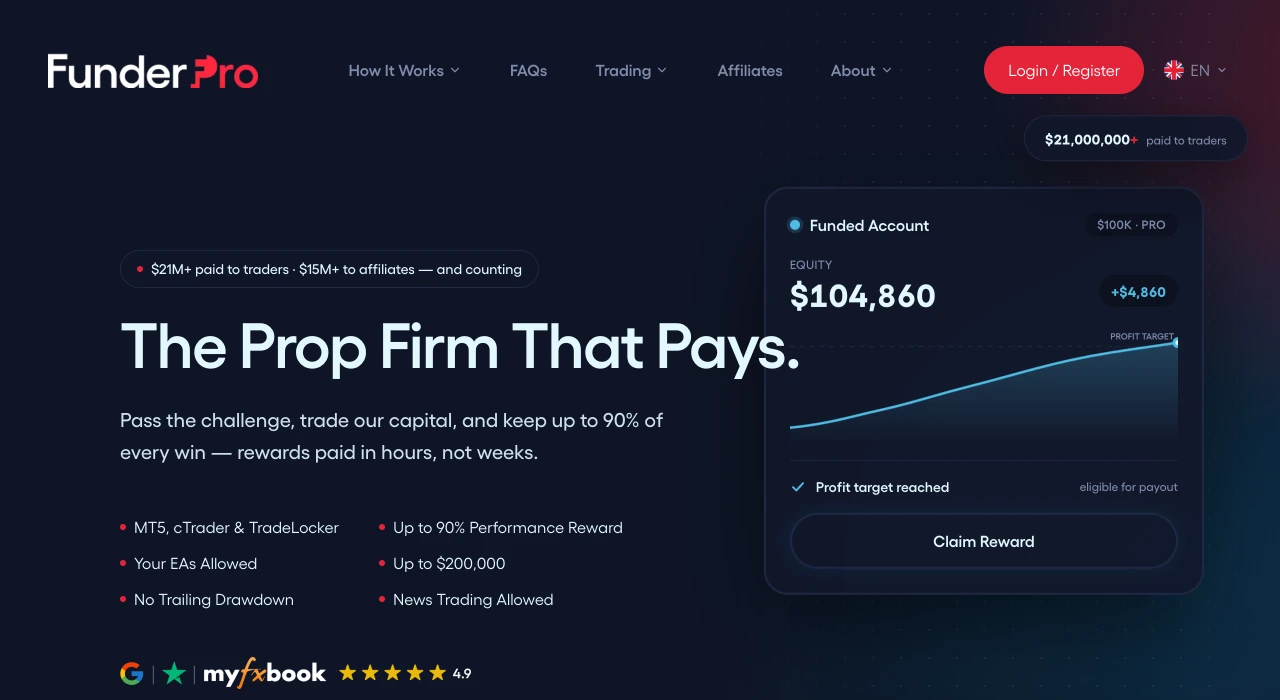
ExploreFunderPro is a multi-asset prop firm founded in 2023 and headquartered in Malta. It offers 1-step and 2-step evaluations from $5,000 to $200,000, a static drawdown, low entry fees, and a public payout record of over $21M. This review covers what is confirmed about FunderPro's rules, the paid add-on that crypto traders need to know about, and what to verify before purchasing.
Quick answer: FunderPro is a forex-first multi-asset prop firm (Malta, founded 2023) with 1-step and 2-step challenges from $5,000 to $200,000, a static drawdown, low fees, and over $21M in verified payouts. It is a strong pick for transparency, but crypto traders should note the paid add-on required for crypto access.
Highlights of this article
- FunderPro runs 1-step and 2-step challenges across 6 account sizes from $5,000 to $200,000, with low entry fees (from $69)
- Drawdown is static (balance-based): 3 to 5% daily and 6 to 10% overall, depending on plan
- Weekend holding and news trading on funded accounts require the paid Swing add-on, otherwise positions close Friday 16:30 EST
- The Classic plan has no consistency rule; One Phase and Pro cap the best day at 40 to 45% of total profit
- Profit split is 80% standard (90% with an add-on), and Pro pays 60% daily or 90% weekly, with fees refunded on Classic and One-Phase (not Pro)
- Founded 2023, forex-first, with over $21M reported paid to traders and a strong public Myfxbook record
What FunderPro Is
FunderPro launched in 2023 as a forex-first multi-asset prop firm and has built a reputation on transparency and fast payouts. It covers forex, crypto, indices, metals, stocks, and commodities, and supports MT5, cTrader, and TradeLocker. Its public track record is a genuine strength: over $21M reported paid to traders and a strong Myfxbook rating, which is more verifiable proof than most firms offer.
FunderPro's pricing is among the most competitive in the market, starting at $69 for a $5,000 account. The challenge structure is clear and the fees are published, which makes it easy to compare on cost.
The detail that matters most, especially for crypto traders, is how weekend holding and news trading are handled. FunderPro is built around forex market hours, and that shows up in its funded-account rules, covered below.
For a full evaluation framework to apply before joining any prop firm, see how to evaluate a crypto prop firm.
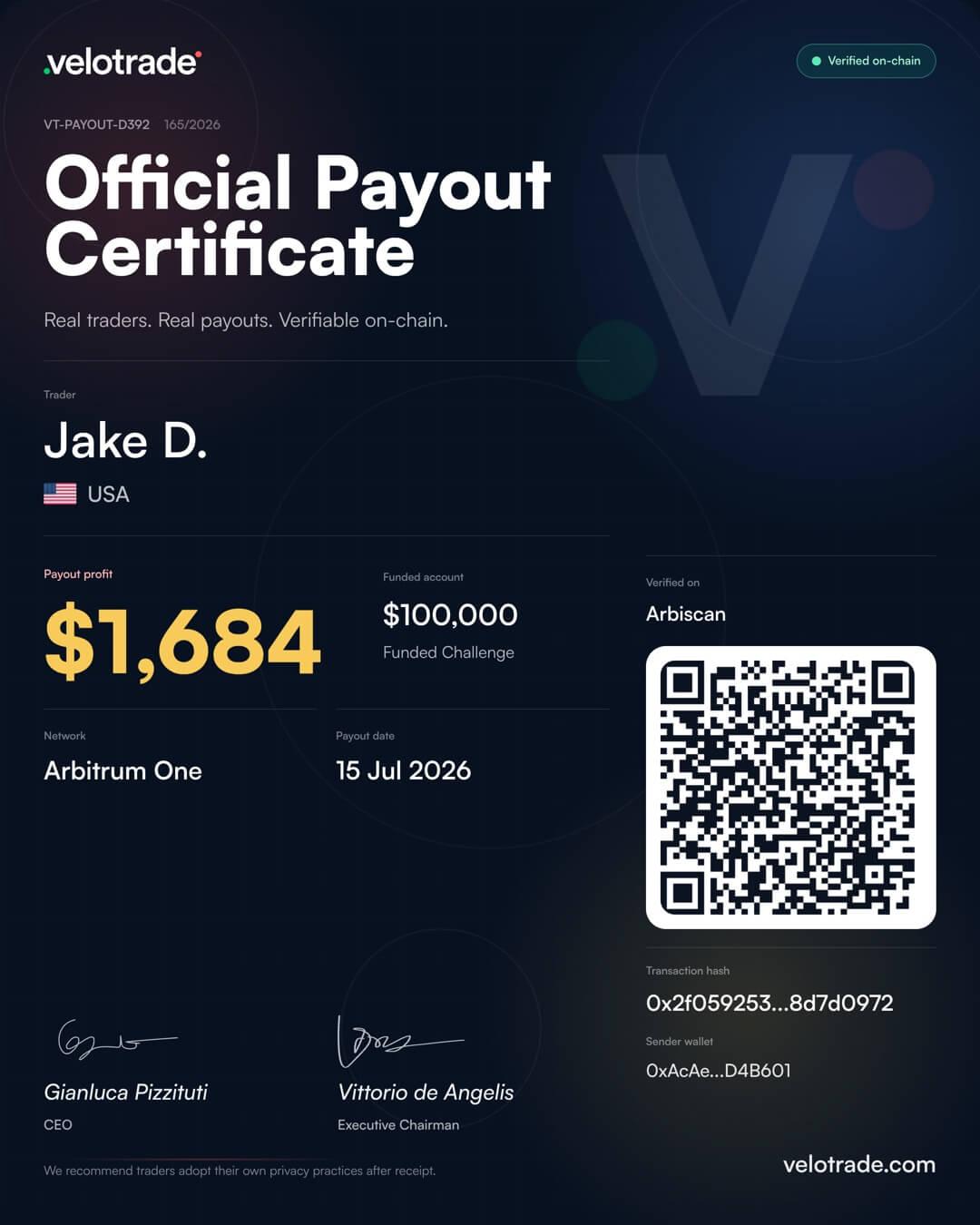
Payout proof
Fast, real payouts. Traceable on Arbitrum.
- Paid within 24 hours of approval
- Settled on Arbitrum in USDC or USDT
- Look up any transaction on Arbiscan

Challenge Structure
FunderPro offers both 1-step and 2-step evaluations, so you can pick a single-phase or two-phase path.
Account sizes: $5,000, $10,000, $25,000, $50,000, $100,000, $200,000
Reported parameters (Classic plan):
| Parameter | FunderPro | Notes |
|---|---|---|
| Challenge types | 1-Step and 2-Step | Choose by phase preference |
| Max daily loss | 3 to 5% | Varies by plan |
| Max overall loss | 6 to 10% | Static, balance-based |
| Drawdown type | Static | No trailing |
| Consistency rule | Classic: none | One Phase / Pro: best day capped at 40 to 45% |
| News trading | Challenges: allowed | Funded: needs paid Swing add-on |
| Weekend holding | Needs paid Swing add-on | Otherwise closes Friday 16:30 EST |
| Platforms | MT5, cTrader, TradeLocker | Confirmed |
| Profit split | 60 to 90% | 80% standard, 90% add-on; Pro 60% daily or 90% weekly |
| Fee refund | Classic / One-Phase: yes | Pro: not refunded |
Reference fees on the Classic plan: $69 for $5,000, $219 for $25,000, $539 for $100,000, $989 for $200,000. Confirm the current fee and the exact parameters for the specific plan and account size you are buying, as terms in this space update regularly.
Drawdown: Static and Balance-Based
FunderPro uses a static drawdown. The loss floor is fixed from your starting balance and does not trail up as your equity grows, which the firm markets as "no trailing drawdown." The limits are a 3 to 5% maximum daily loss and a 6 to 10% maximum overall loss, depending on the plan.
A static model is the more forgiving structure for volatile markets, because the floor does not chase your intraday peaks. The buffer itself is moderate, so position sizing still matters, but you keep your full room throughout the day.
For why the calculation method matters as much as the percentage, see static maximum drawdown explained. To model your floor and trade capacity on a confirmed setup, use the prop trading drawdown calculator.
Free calculator
How many losing trades before you breach?
See your drawdown floor, daily loss budget, and losing trade capacity for any account size - before you place a single trade.
Use the free drawdown calculatorTrading Rules: The Swing Add-On Catch
FunderPro's headline rules look generous, but the detail crypto traders need to understand is the Swing add-on.
Weekend holding and news trading need a paid add-on. On funded accounts, holding positions over the weekend and trading through high-impact news both require FunderPro's paid Swing add-on. Without it, all positions must close by Friday 16:30 EST, and you cannot trade within 2 minutes of a high-impact news release. For a crypto trader, where the market runs 24/7 and weekends are active, a forced Friday close is a structural limitation, not a minor rule. Factor the add-on cost into your comparison.
Consistency rule varies by plan. The Classic plan has no consistency rule. The One Phase and Pro plans cap your best day at 40 to 45% of total profit. If your edge concentrates returns on a few days, choose the plan accordingly. For why this rule matters and which firms skip it entirely, see crypto prop firms with no consistency rule.
EAs allowed, with limits. Automated strategies are permitted, but FunderPro bans HFT, latency and hedge and scalping arbitrage, gap exploitation, cross-account copy trading, and third-party EAs you do not own. Confirm your specific strategy is allowed before purchasing.
Funded accounts
Comparing firms on these specific rules?
Trade up to $200,000 in firm capital with static drawdown, no consistency rule, and payouts within 24 hours.
View Velotrade's confirmed rule setProfit Split and Payout
FunderPro's profit split is 80% on Classic and One Phase accounts, or 90% with a checkout add-on. The Pro plan lets you choose daily rewards at a 60% split or weekly rewards at 90%. The challenge fee is fully credited on your first reward for the Classic and One-Phase plans, so a passed challenge effectively costs nothing on those plans. Pro challenge fees are not refunded.
Payouts are a genuine FunderPro strength. The firm advertises rewards paid in hours rather than weeks and backs it with a public Myfxbook record and over $21M reported paid. Still, confirm the current payout methods and any minimum thresholds directly. For what to verify before the first payout, see crypto prop firm payout speed: what traders need to check.

FunderPro vs Velotrade: Key Differences
| FunderPro | Velotrade | |
|---|---|---|
| Founded | 2023 | 2026 (crypto prop launch) |
| HQ | Malta | Hong Kong |
| Markets | Forex-first; crypto, indices, metals, stocks, commodities | Crypto-first; forex, stocks, indices, commodities |
| Account sizes | $5K to $200K | $5K to $200K |
| Challenge types | 1-step and 2-step | 1-step and 2-step |
| Drawdown type | Static | Static |
| Max drawdown | 6 to 10% overall, 3 to 5% daily | CLASSIC 2-Step 10%, CLASSIC 1-Step 7%, PRO 1-Step 3%; daily 5% / 4% / 3% |
| Consistency rule | Classic none; One Phase / Pro 40 to 45% | None |
| News trading | Funded needs paid Swing add-on | Allowed (no add-on) |
| Weekend holding | Needs paid Swing add-on (else Friday 16:30 close) | Allowed (no add-on) |
| EAs / automation | Allowed (no HFT, arbitrage, copy, third-party) | Allowed |
| Platforms | MT5, cTrader, TradeLocker | DXtrade only |
| Profit split | 80% standard (90% add-on); Pro 60% daily or 90% weekly | Up to 90% from day 1 |
| Fee refund | Classic / One-Phase yes; Pro no | No |
| Track record | Since 2023, $21M+ paid | Since 2026 |
Both firms use a static drawdown and similar account sizes, so the floor mechanics are comparable. The decisive difference is how each handles 24/7 trading. FunderPro is forex-first: weekend holding and news trading on funded accounts both sit behind the paid Swing add-on, and without it positions close Friday 16:30 EST. Velotrade is crypto-native, so weekend holding and news trading are included with no add-on, which matches how the crypto market actually trades.
FunderPro's advantages are real: lower entry fees, a longer track record, three platform choices, and strong public payout proof. Velotrade's advantage is always-on rules built for crypto plus no consistency rule on any plan. If you trade crypto or hold over weekends, the add-on requirement is the number to weigh.
For the full head-to-head on rules, drawdown, and pricing, see FunderPro vs Velotrade. For FunderPro's rule profile alongside all major firms in one view, see the FunderPro directory page, and for the broader market, best crypto prop firms in 2026.
What to Verify Before Purchasing
Before paying any FunderPro challenge fee, confirm these points directly with the firm:
- Swing add-on cost and terms if you intend to hold over weekends or trade news on a funded account.
- Which consistency rule applies to your plan (Classic none, One Phase / Pro 40 to 45%).
- Exact daily and overall drawdown for the specific plan and account size you are buying.
- Fee-refund conditions, which apply to Classic and One-Phase but not Pro.
- EA policy for your strategy, confirming your automation is not classed as HFT, arbitrage, copy, or third-party.
- Payout methods and minimum thresholds, beyond the advertised speed.
These answers are available through FunderPro's support quickly and eliminate the most common sources of post-purchase problems. For the full due diligence framework, see how to evaluate a crypto prop firm and top crypto prop firm red flags.
Who FunderPro Suits
FunderPro is a reasonable choice if:
- You want low entry fees and a clear, published price list
- You value a public payout record (Myfxbook) and fast reward processing
- You trade primarily forex or other non-24/7 markets, or you are willing to pay for the Swing add-on
- You want platform choice across MT5, cTrader, and TradeLocker
FunderPro is a harder fit if:
- You trade crypto and want weekend holding and news trading included by default
- You do not want to pay an add-on to hold positions past Friday 16:30 EST
- You want the same rule set across every plan rather than consistency rules that vary by plan
For a broader view of the market, see best crypto prop firms in 2026 or browse the crypto prop firm directory to filter by drawdown model, trading rules, and platform.
Data sourced from publicly available FunderPro materials and community reporting as of May 2026. Confirm all current terms directly with FunderPro before purchasing.
Frequently Asked Questions
About the author

Vittorio De Angelis
Executive Chairman
Former equity-derivatives trader at JP Morgan, Dresdner Kleinwort and Bank of America in London. Later Head of Brokerage at a global broker in Hong Kong.
View author page