New to funded trading?
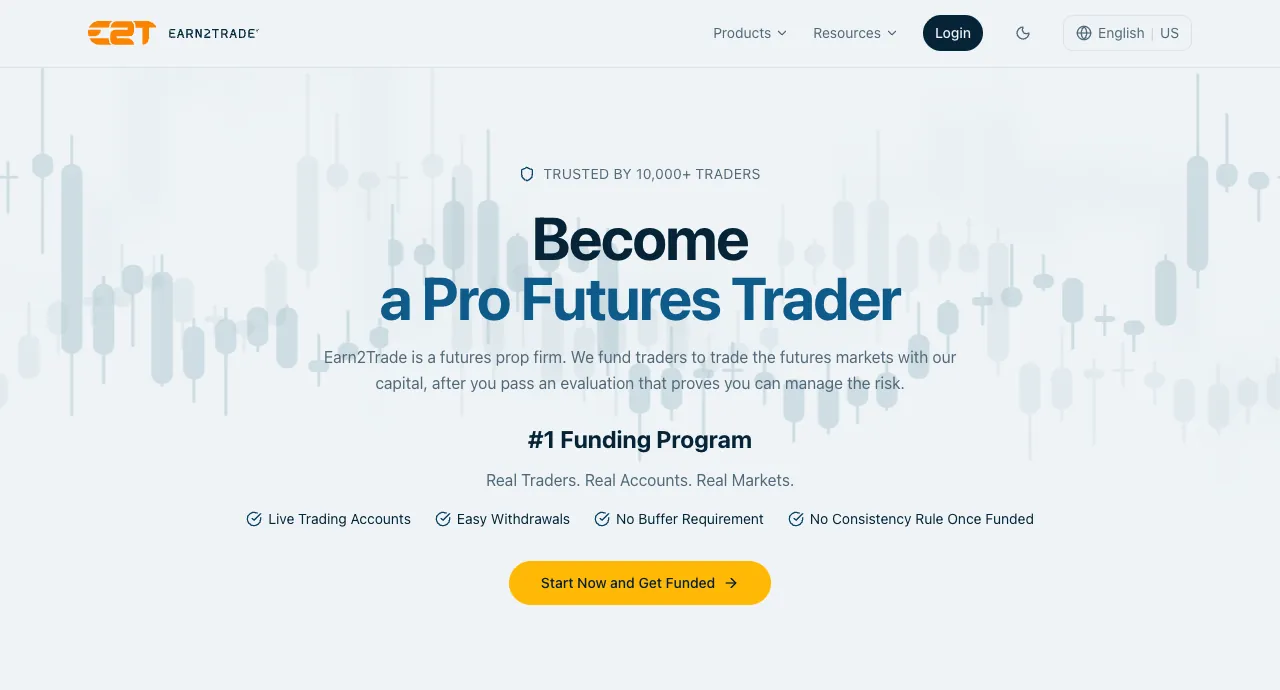
Explore all marketsThis Earn2Trade review looks at one of the oldest names in futures evaluations. Earn2Trade is a Wyoming company that sells monthly subscription tests, the Trader Career Path and the Gauntlet Mini, and passes traders who succeed to partner prop firms for a LiveSim or Live account. It claims more than 10 years in business and is one of the few firms that publishes its own pass rate.
That transparency is useful, because the numbers tell you a lot. The headline "up to 80%" split is not what most traders receive on smaller withdrawals, the drawdown trails rather than staying fixed, and funded accounts carry fees that the evaluation price does not show. Every figure below was read on Earn2Trade's own site and help centre in November 2026.
Highlights of this article
- Earn2Trade is futures-only: CME, CBOT, NYMEX and COMEX contracts, with no forex, stocks, crypto or CFDs, and Bitcoin and Ether futures are disallowed
- Both programs are monthly subscriptions: the Trader Career Path runs $150 to $350 a month and the Gauntlet Mini $170 to $550 a month at list price (prices change with promotions, so check the official site)
- The evaluation drawdown is end-of-day trailing but still counts open equity, a 30% consistency rule applies during the test, and there is no minimum number of trading days
- The profit split is set per withdrawal: 50% on withdrawals under a threshold ($1,500 on TCP25) and 80% above it, with a $139 LiveSim activation fee taken from the first payout
- In 2025, 8.89% of candidates passed, and about 18% of funded accounts made at least one withdrawal, according to Earn2Trade's own disclaimer
What Is Earn2Trade
Earn2Trade LLC is registered in Sheridan, Wyoming, and describes itself as an educational company. It does not hold your funded account. When you pass, it forwards you to a proprietary trading partner (Helios Trading Partners, Appius Trading Limited or Kronos Proprietary Trading), which offers a LiveSim account (simulated, with real withdrawals) or a Live brokerage account.
The product range is narrow: futures on CME, COMEX, NYMEX and CBOT only, including micros. Stocks, options, forex, crypto and CFDs are not available, and Bitcoin and Ether futures are excluded.
The homepage claims 10,000+ traders and 6,400+ traders funded in 2025, which are company figures. The more useful numbers sit in the footer: in 2025, 8.89% of candidates passed, and 18.04% of Live accounts and 18.20% of LiveSim accounts had at least one withdrawal. Few firms publish that.
The Two Programs: Trader Career Path and Gauntlet Mini
The Trader Career Path (TCP) is the flagship. You start with a $25K, $50K or $100K evaluation, then trade a funded account of the same size. Each time you hit the profit goal and withdraw, you move up a level, through $50K, $100K and $200K to a $400K account. TCP includes a free reset at every monthly rebill.
The Gauntlet Mini is the fast track: a single-phase evaluation from $50K to $200K, with a funded account of the same fixed size and no growth plan.
Both renew every 30 days until you pass or cancel, with no time limit and no refunds.
| Plan | List price | Profit goal | EOD drawdown | Daily loss limit | Contracts |
|---|---|---|---|---|---|
| TCP25 | $150/month | $1,750 | $1,500 | $550 | 2 |
| TCP50 | $190/month | $3,000 | $2,000 | $1,100 | 4 |
| TCP100 | $350/month | $6,000 | $3,500 | $2,200 | 8 |
| GAU50 | $170/month | $3,000 | $2,000 | $1,100 | 4 |
| GAU100 | $315/month | $6,000 | $3,500 | $2,200 | 8 |
| GAU150 | $375/month | $9,000 | $4,500 | $3,300 | 12 |
| GAU200 | $550/month | $11,000 | $6,000 | $4,400 | 15 |
These are list prices from the purchase page in November 2026, with evaluation data fees included for non-professional traders. A 50% discount code was running, so prices change with promotions; check the official site. Resets cost $100 on most sizes and $130 and $155 on GAU150 and GAU200.
Evaluation Rules in Detail
The rules are the same across both programs, scaled to account size.
- Profit goal: roughly 5.5% to 7% of the starting balance ($1,750 on $25K, $3,000 on $50K, $6,000 on $100K).
- Daily loss limit: measured on open and closed PnL plus commissions, from 5:00 pm to 5:00 pm Central Time. Touch it, even with a position still open, and the evaluation fails and needs a reset.
- Maintain Consistency (30%): no single day can account for 30% or more of your total profit. Breaking it does not fail you. You simply have to keep trading until your best day falls under 30% of the total.
- No minimum trading days: you pass as soon as you hit the profit goal while meeting the 30% consistency rate.
- Trading hours: positions and orders must be closed by 3:50 pm CT. No overnight holding.
- News trading: allowed, with no restrictions around economic releases.
- Contract limit: for evaluations bought on or after November 2, 2026, Earn2Trade dropped the Progression Ladder rule. Exceeding the contract limit no longer fails you, because the maximum is enforced by the system.
On TCP50, a single $1,200 day means you need more than $4,000 in total profit to pass, not $3,000. One strong session can add subscription months to your test.
How the Drawdown Works
Earn2Trade calls its evaluation drawdown "EOD", and the label is partly true. The minimum allowed balance is adjusted once a day, after market close, based on your highest end-of-day balance. On a $100K account with a $3,500 drawdown, the floor starts at $96,500. Close day 1 at $102,000 and the floor moves to $98,500. It keeps trailing up until it reaches the starting balance, then stops.
The catch is in Earn2Trade's own wording: open equity losses count. If an open position drags your account below the minimum balance during the day, the evaluation fails, even if the trade would have recovered by the close. So the floor moves only at end of day, but you can still breach it intraday. That is stricter than firms whose EOD drawdown checks only the closing balance.
After you pass, LiveSim keeps the EOD drawdown, Live accounts use a real-time trailing drawdown, and the $200K and $400K TCP levels use a fixed drawdown (the $200K floor is $194,000). To compare the models, see our guide to EOD trailing vs tick-by-tick drawdown and the explainer on a static maximum drawdown.
Funded Accounts: LiveSim or Live
When you pass, you choose LiveSim or Live with the same capital. Funded accounts have no subscription, no consistency rule and no profit buffer, and you can hold up to 3 at once, only 1 of them Live. The fees differ:
- LiveSim: non-professional traders pay a one-time $139 activation fee per account, deducted from the first withdrawal only. If you never withdraw, you never pay it.
- Live: no activation fee, but you pay CME market data yourself, $140 per month per exchange on Rithmic or $156 per month per exchange on NinjaTrader. CME charges are not prorated.
- Both: you pay FCM commissions, NFA fees and exchange fees per trade. Micro contracts cost $0.82 to $1.20 per contract per side, per the help centre.
LiveSim has a withdrawal cap per size ($1,750 on TCP25, $3,000 on TCP50, $6,000 on TCP100, $5,000 on Gauntlet Mini). Once you reach it, you move to a Live account and the data fees start.

Profit Split and Payouts
This is the section most reviews skip. Earn2Trade's split depends on the size of each individual withdrawal, not on your accumulated profit:
| Account | 50% split | 80% split |
|---|---|---|
| TCP25 | Under $1,500 | $1,500+ |
| TCP50 | Under $2,250 | $2,250+ |
| TCP100 | Under $3,000 | $3,000+ |
| GAU50 | Under $2,250 | $2,250+ |
| GAU100 | Under $3,000 | $3,000+ |
| GAU150 | Under $4,000 | $4,000+ |
| GAU200 | Under $5,000 | $5,000+ |
The $400K TCP level is a fixed 60/40 split. In practice, a trader taking small, frequent withdrawals keeps half. To reach 80%, you need to let profit build and withdraw in larger amounts.
The payout mechanics:
- 5 profitable days per withdrawal: before every request you need 5 new days with a minimum profit ($100 on TCP25, $150 on TCP50 and GM50, $200 on TCP100 and GM100, $250 on GM150, $350 on GM200). The days need not be consecutive, and days used for one withdrawal cannot be reused.
- Weekly schedule: withdrawals are processed on Wednesdays, with requests due by 2:00 pm CT the previous Friday.
- Minimum: $100 net.
- Withdrawal fees: Rise charges $50 per withdrawal for non-US traders and 1.5% for US traders. Deel is $50, Bayzat $5 to $40, and direct crypto (select cases only) 0.735%.
A $1,000 first withdrawal on TCP25 is split 50%, leaving $500 before the $139 activation fee and the payment fee come off.

Restricted Countries
Earn2Trade accepts US traders and most international traders. Non-US traders complete a W-8BEN form with a foreign tax number. Citizens of the following countries cannot get funded: Afghanistan, Albania, Azerbaijan, Burma (Myanmar), Central African Republic, Cuba, Gibraltar, Iran, Iraq, Kenya, Libya, Mali, Nauru, Nigeria, North Korea, Pakistan, Russia, Somalia, South Sudan, Sudan, Syria, Turkmenistan, Ukraine, Venezuela and Yemen.
There is a second, less obvious gap. Earn2Trade's withdrawal policy says Rise does not support payouts for traders in Iowa, Minnesota, South Carolina, Guam, Puerto Rico, the US Virgin Islands or Haiti. If you live in one of those, confirm how you would be paid before you subscribe. You must also be 18 or older, and the account must be in your legal name, not an LLC.
Platforms and Prohibited Conduct
Platforms include NinjaTrader, Tradovate, TradingView, Finamark, R Trader Pro, Black Arrow and DeepCharts, plus anything that connects through Rithmic, Black Arrow or dxFeed data. Market depth (DOM) data costs extra each month.
Trade copiers are banned on every program, and accounts passed with one can be denied with no refund. The prohibited list also covers exploiting platform errors, spoofing, hedging or pooling risk across accounts, and software or AI that could manipulate the environment. The help centre gives no clear answer on fully automated strategies, so ask support in writing before running a bot.
Is Earn2Trade legit?
Yes. Earn2Trade is a long-running, real company with a registered US address, named prop firm partners and a published fee schedule. Its Trustpilot profile shows 4.5 out of 5 across 5,073 reviews (November 2026), with most recent reviews praising support response times. It is also more open than most about outcomes, publishing its 2025 pass rate and withdrawal rate.
The fair caveats: Earn2Trade states it is an educational institution without a financial licence, LiveSim accounts are simulated, refunds are not offered, and the published success rates show that most subscribers never pass. That is true across the industry, but here you can see the numbers.
Earn2Trade pros and cons
Pros
- Long track record and published pass and withdrawal rates
- No minimum trading days, and news trading allowed
- No consistency rule, subscription or buffer once funded
- TCP scales up to a $400K account, with a real path to a Live account
- Wide platform choice, and US traders accepted
Cons
- Futures-only, with Bitcoin and Ether futures excluded
- Monthly subscription with no refunds
- Drawdown trails, and open equity can breach it intraday
- 50% split on smaller withdrawals, 80% only on larger ones
- $139 LiveSim activation fee, Live data fees and withdrawal fees
- No overnight holding
Who Earn2Trade Suits
Earn2Trade fits a patient CME futures day trader who wants a structured path to a real Live account and can withdraw in larger chunks to reach the 80% tier. It is a weaker fit if you want small, frequent withdrawals, overnight holds, markets beyond US futures, or a one-time fee. If you are comparing futures firms, see our Apex Trader Funding review, Topstep review, MyFundedFutures review and Tradeify review, or our ranking of the best prop firms.
The Alternative: Multi-Asset With Static Drawdown
If the subscription, trailing floor and per-withdrawal split put you off, Velotrade makes different trade-offs. It has no CME futures, but it is multi-asset (crypto, forex, stocks, commodities and index ETFs like SPY, QQQ and IWM) on DXtrade, for a one-time, non-refundable fee.
The drawdown is static on every plan, so the floor never trails. There is no consistency rule or time limit, and news trading, weekend holding, EAs and your own API are allowed. The split is up to 90% (from the first payout), with 80% default and 90% as a paid add-on. The PRO 1-Step starts at $40 ($5K to $200K), one of the lowest entry prices, and US traders are accepted. Velotrade funded accounts are simulated.
For more options, see the best prop firm for futures, the best prop firm for US traders, and our guide to futures market hours, or compare all prop firms in one directory.
Sources
- Earn2Trade, Trader Career Path page and purchase page (earn2trade.com/trader-career-path, earn2trade.com/purchase), read November 2026
- Earn2Trade, Gauntlet Mini page (earn2trade.com/gauntlet-mini), read November 2026
- Earn2Trade Help Center: How Does "End of Day Drawdown" Work?, What is a Trailing Drawdown?, What is the "Maintain Consistency" Rule?, How is my Daily Loss Calculated?
- Earn2Trade Help Center: What is the Withdrawal Policy?, What is the Fee Structure on the Live or LiveSim Accounts?, What is the LiveSim?, What Happens When I Complete My Evaluation?
- Earn2Trade Help Center: I'm Not an American/US Citizen, Can I Still Get Funded?, Prohibited Conduct, Am I Allowed to Copy Trades Across Multiple Accounts?, What is Your Refund Policy?, Are You Regulated/Licensed?
- Trustpilot, Earn2Trade profile (trustpilot.com/review/www.earn2trade.com), read November 2026
Last updated: November 2026. Earn2Trade's prices, promotions, profit split thresholds and country eligibility change regularly. Confirm current terms on Earn2Trade's own site before purchasing.
Frequently Asked Questions
About the author

Vittorio De Angelis
Executive Chairman
Former equity-derivatives trader at JP Morgan, Dresdner Kleinwort and Bank of America in London. Later Head of Brokerage at a global broker in Hong Kong.
Velotrade was founded in Hong Kong in 2016 by a team from JP Morgan, Dresdner Kleinwort and Bank of America, has paid out over $2.5 billion to its trade-finance clients, and has been featured in Bloomberg, the Financial Times, the Wall Street Journal and on Nasdaq. Its prop trading evaluations are simulated and educational.
View author page